From Surf Wiki (app.surf) — the open knowledge base
Taepodong-1
North Korean space launch vehicle
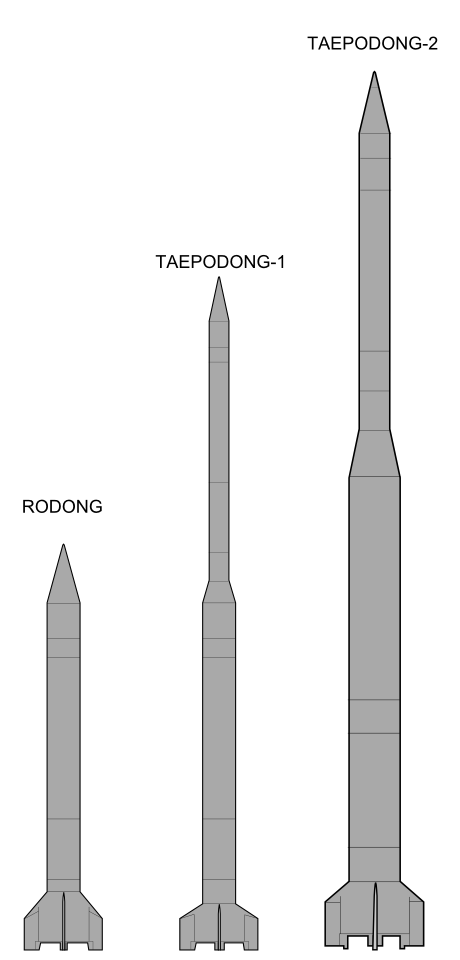
North Korean space launch vehicle
| Field | Value |
|---|---|
| is_missile | yes |
| name | Taepodong-1 |
| image | Taepodong-1.png |
| type | technology demonstrator |
| engine | liquid-fueled |
| guidance | inertial |
| length | 25.8 m |
| diameter | 1.8 m |
| weight | 33.4 tons |
| manufacturer | North Korea |
| used_by | North Korea |
Taepodong-1 () was the external designation given to a three-stage technology demonstrator developed by North Korea, a development step toward an intermediate-range ballistic missile. The missile was derived originally from the Scud rocket and was tested once in 1998 as a space launch vehicle. As a space launch vehicle, it was sometimes called the Paektusan 1.
History

On August 31, 1998, North Korea announced that they had used this rocket to launch their first satellite Kwangmyŏngsŏng-1 from a pad on the Musudan-ri peninsula. However, the satellite failed to achieve orbit; outside observers conjecture that the additional third stage either failed to fire or malfunctioned. This is contrary to official statements of the North Korean state media, which stated that the satellite achieved orbit about 5 minutes after launch. On this single launch, the main two-stage booster flew for 1,646 km without any significant problems.
The rocket was launched eastward, passing over Japan at an altitude of over 200 km. The second stage came down into the Pacific Ocean about 60 km past Japan, and the third stage about 600 km beyond Japan. According to post-launch analysis of the launch vehicle, debris from the third stage fell as far as 4,000 kilometers from the launch pad. Some analysts believe that a three-stage space booster variant of the Taepodong-1 could be capable of travelling as far as 5,900 kilometers with a very small payload.
In 2003, the US Defense Intelligence Agency reported to the Congress: "We have no information to suggest Pyongyang intends to deploy the Taepo Dong 1 (TD-1) as a surface-to-surface missile in North Korea. We believe instead that the vehicle was a test bed for multi-stage missile technologies." In 2009, the US National Air and Space Intelligence Center assessed that the Taepodong-1 was a technology demonstrator, a development step toward longer-range missile development.
The Taepodong-2, or Unha-2, was the successor to the Taepodong-1 technology demonstrator, with a first (unsuccessful) test launch in 2006.
Description
- Liftoff thrust: 525.25 kN
- Total mass: 33,406 kg
- Diameter: 1.8 m
- Length: 25.8 m
- Range with 1,500 kg of payload: 2000 km
- Range with 1,000 kg of payload: 2500 km
- Range with 50 kg of payload and third stage: 6,000 km
The rocket's first stage is a Hwasong-7 (Rodong-1) MRBM, and the second stage uses a single engine from the Hwasong-7.
In a nominal space launch, the first stage burns for 95 seconds, before separating, and landing about 250 km downrange. The payload fairing separates 144 seconds after launch. This is followed by the depletion and separation of the second stage, 266 seconds into the flight, resulting in an impact about 1650 km downrange. The third stage, which is spin-stabilised, then burns for 27 seconds to insert the payload into low Earth orbit. The payload is estimated at 6 kg mass.
References
References
- Wade, Mark. "Paektusan 1". Encyclopedia Astronautica.
- "A History of Ballistic Missile Development in the DPRK". Center for Nonproliferation Studies Occasional Papers.
- "Kwangmyongsong".
- [http://www.rian.ru/world/20060707/51040626.html Все названия испытываемых в КНДР ракет в иностранной печати придуманы], [[RIA Novosti]], 07–07–2006.
- "Response of the Defense Agency to the Missile Launch by North Korea". Federation of Atomic Scientists.
- [https://fpc.state.gov/documents/organization/101748.pdf CRS report for Congress].
- U.S. Senate Select Committee on Intelligence, [http://www.fas.org/irp/congress/2003_hr/021103qfr-dia.pdf World Wide Threat Hearing, 11 February 2003].
- (April 2009). "Ballistic and Cruise Missile Threat". Air Force Intelligence, Surveillance and Reconnaissance Agency.
- (July 5, 2006). "CNN.com - U.S. officials: North Korea tests long-range missile - Jul 4, 2006". CNN.
- [http://space.skyrocket.de/doc_lau/pekdosan-1.htm Pekdosan-1 ("Taepodong-1")], skyrocket.de.
This article was imported from Wikipedia and is available under the Creative Commons Attribution-ShareAlike 4.0 License. Content has been adapted to SurfDoc format. Original contributors can be found on the article history page.
Ask Mako anything about Taepodong-1 — get instant answers, deeper analysis, and related topics.
Research with MakoFree with your Surf account
Create a free account to save articles, ask Mako questions, and organize your research.
Sign up freeThis content may have been generated or modified by AI. CloudSurf Software LLC is not responsible for the accuracy, completeness, or reliability of AI-generated content. Always verify important information from primary sources.
Report