From Surf Wiki (app.surf) — the open knowledge base
Tabarka
| Field | Value | |
|---|---|---|
| official_name | Tabarka | |
| native_name | طبرقة | |
| native_name_lang | ar | |
| settlement_type | ||
| <!-- images, nickname, motto ---> | image_skyline | {{Photomontage |
| photo1a | Ile de tabarka 1.jpg | |
| position | center | |
| color_border | white | |
| color | white | |
| size | 280 | |
| foot_montage | From top to bottom, left to right: The Genoese Fort of Tabarka,Tabarka Golf Course, Tabarka Forest | |
| imagesize | 300px | |
| dot_x | dot_y = | |
| pushpin_map | Tunisia | |
| pushpin_label_position | bottom | |
| pushpin_map_caption | Location in Tunisia | |
| subdivision_type | Country | |
| subdivision_name | [[File:Flag of Tunisia.svg | 25px]] Tunisia |
| subdivision_type1 | Governorate | |
| subdivision_name1 | Jendouba Governorate | |
| leader_title1 | ||
| established_title | ||
| established_title2 | ||
| established_title3 | ||
| unit_pref | Imperial | |
| area_total_km2 | ||
| area_land_km2 | ||
| population_as_of | 2022 | |
| population_total | 22,119 | |
| population_density_km2 | 3894 | |
| timezone | CET | |
| utc_offset | 1 | |
| coordinates | ||
| elevation_footnotes | ||
| elevation_m | 4.7 | |
| postal_code_type | Postal Code | |
| postal_code | 8110 |
Tabarka ( **) is a coastal town located in north-western Tunisia, close to the border with Algeria. Tabarka was occupied at various times by Punics, Greeks, Romans, Arabs, Genoese and Ottomans. The town is dominated by an offshore rock on which there remains a Genoese castle. Nationalist leader Habib Bourguiba, later president of post-independence Tunisia, was exiled on Tabarka by the French colonial authorities in 1952. Tourist attractions include coral fishing, the Coralis Festival of underwater photography, and its annual jazz festival.
Etymology
Name
Tabarka was known to the Carthaginians as (). This was transcribed into Greek as Thaúbraka (Θαύβρακα) and into Latin as Thabraca. In modern day Berber it is known as Tabarka or Tbarga, while its Arabic name is Ṭbarqa (طبرقة).
History
Although older sources placed Thabraca within the Roman province of Numidia, recent ones agree on placing it in the Roman province of Africa, known also as Africa Proconsularis. It was a Roman colony. It was connected by a road with Simitthu, which it served as a port for the export of its famous marble. The rebellious Roman official Gildo, the brother of Firmus, committed suicide in Thabraca. Under the Vandal king Gaiseric, the town had a monastery for men and a convent for women.
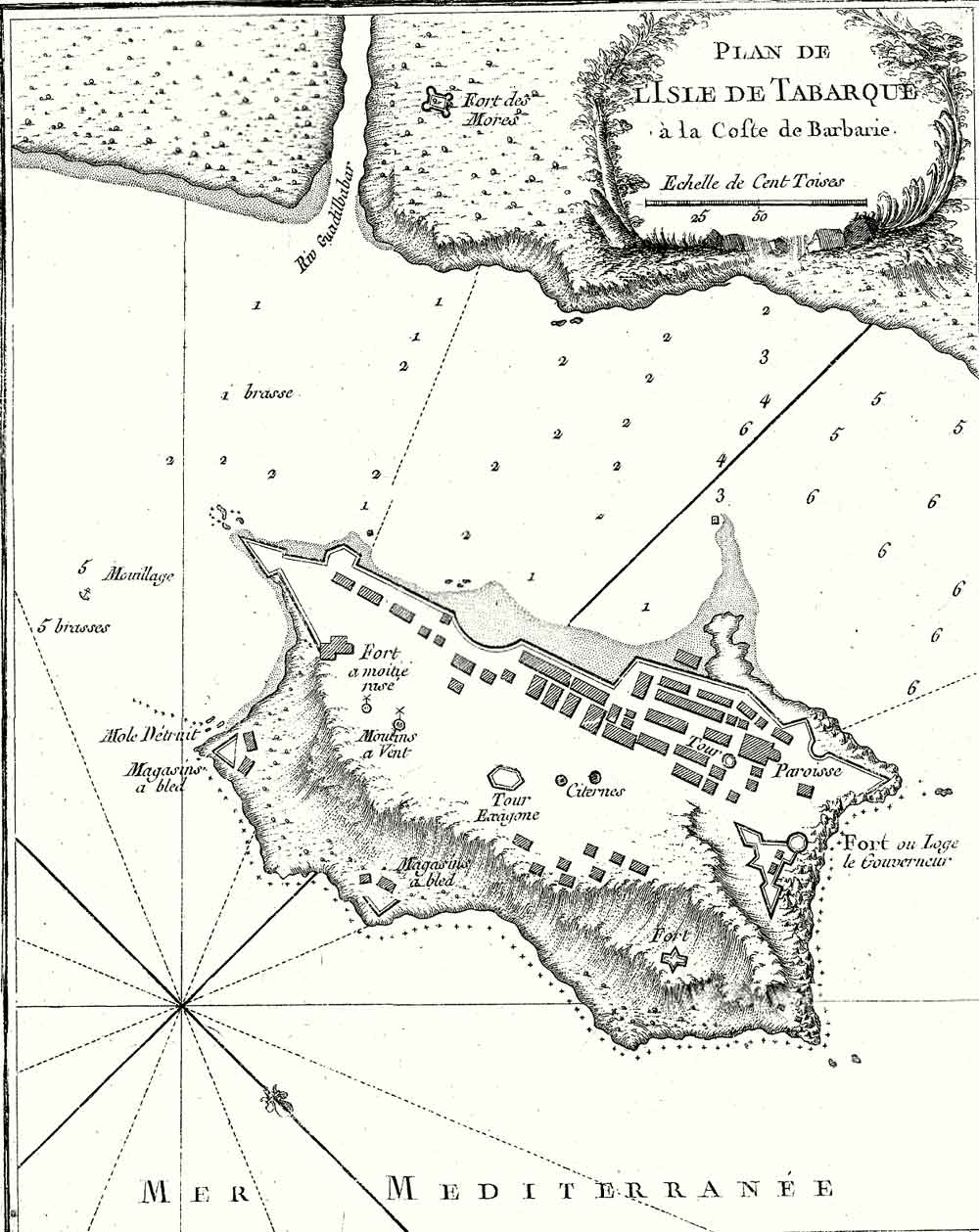

From 1540 to 1742, the Genoese maintained a garrison on the adjacent island, also called Tabarka, which lies about 365 yd off the town. In 1540 the island was given by the Ottoman Bey of Tunis as a concession to the Genoese Lomellini family. The Genoese were in the service of Spain during 1553 at the request of Emperor Charles V who was interested in coral fishing. The Lomellini were part of the circle of Andrea Doria, Doge of Genoa, and were related to the Grimaldi family. The grant was possibly due to a secret ransom for the release of the pirate Turkish Dragut, captured in Girolata in 1540 by Giannettino Doria, nephew of Andrea Doria. The Lomellini colonized Tabarca with a group of inhabitants of Pegli, near Genoa, where they had various properties and a huge palace. The community of Pegliesi lived in Tabarka for several centuries.
In 1738 due to the exhaustion of the coral reefs and the deterioration of relations with the Arab population a large group of "Tabarkini" moved to San Pietro Island off Sardinia, then uninhabited, where they founded a new town of Carloforte. The transfer was made possible thanks to the King of Sardinia, Charles Emmanuel III of Sardinia who wanted to colonize those of his lands which were not yet inhabited. The name of Carloforte was chosen in honor of the sovereign. Another group of Tabarkini was resettled in the town of Calasetta on the adjacent Island of Sant'Antioco, whose population still speaks a variant of Genoese dialect originating from Tabarka. Others were moved to the Spanish island of New Tabarca. In 1741 or 1742, the Genoese fortress surrendered to the (nominally Ottoman but essentially autonomous) Bey of Tunis. At Tabarka, the ruins consists of a pit once used as a church and some fragments of walls which belonged to Christian buildings. There were also two Ottoman Turkish fortresses, one of which has been repaired. A French expedition was dispatched to capture Tabarka but failed.
.jpg)
Under French colonial rule it was annexed to the civil district of Souk el-Arba, now in the Tunisian governorate of Jendouba, and a rather important fishing centre. Tabarka Jazz Festival was established in 1973.
Ecclesiastical history

Thabraca became a Christian bishopric that is no longer a residential see but is included in the Catholic Church's list of titular sees.[[File:Tabarka, décembre 2014 (28).jpg|right|thumb|View of Tabarka's fort]]

Bishops
The bishops of Thabraca, who met with the other bishops of Proconsular Africa, included:
- Victoricus, at the Council of Carthage (256)
- Rusticianus, at the conference of Carthage in 411, where his competitor was the Donatist Charentius; he also signed in 416 the letter from the council of Proconsular Africa to Pope Innocent I;
- Clarissimus, who in 646 signed the letter from the same Council to Patriarch Paul II of Constantinople against the Monothelites. The Bishopric was founded during the Roman Empire and survived through the arian Vandal and Orthodox Byzantine empires, only ceasing to function with the Muslim conquest of the Maghreb. The diocese was re-founded in name at least in the 20th century as a titular see of the Roman Catholic church.
Titular bishops
- Pierre Brigot, (22 Jan 1755 Appointed – 8 Nov 1791)
- St. Louis Gabriel Taurin Dufresse, (24 Jul 1798 Appointed – 14 Sep 1815)
- Edward Kernan (6 Feb 1818 Appointed – 19 Nov 1824)
- Rémi Gaulin † (10 May 1833 Appointed – 14 Jan 1840 Succeeded, Bishop of Kingston, Ontario)
- Bernardino di Milia, (27 Mar 1884 Appointed – 4 Jun 1891)
- Antonin Guillermain, (12 Jan 1895 Appointed – 14 Jul 1896)
- Henri Streicher, (1 Feb 1897 Appointed – 2 Jun 1933)
- Auguste-Joseph-Marie Cogneau (23 Jun 1933 Appointed – 12 Apr 1952)
- Georges Kettel, (24 Mar 1953 Appointed – 10 Nov 1959)
- Charles Quentin Bertram Olwell, (19 Jan 1961 Appointed – 30 Jan 1972)
- Antônio Agostinho Marochi (27 Sep 1973 Appointed – 2 Feb 1976)
- Sebastian Acol Dalis (18 Nov 1987 Appointed – 27 Oct 2004 Died)
- Pedro Joaquin Hernández Cantarero, (12 Feb 2005 Appointed – )
Weather
Climate
The weather in Tabarka is usually variable from year to year. Summers are mostly hot and dry, but milder than the Saharan hinterland. It barely rains in July and August. The average temperatures for this season is 28.2 C. Winters are mostly rainy and mild. The average temperature for this season is 12.0 C.
|Jan record high C = 26.1 |Feb record high C = 29.2 |Mar record high C = 36.5 |Apr record high C = 37.0 |May record high C = 41.4 |Jun record high C = 47.1 |Jul record high C = 47.4 |Aug record high C = 48.4 |Sep record high C = 43.3 |Oct record high C = 39.7 |Nov record high C = 33.2 |Dec record high C = 28.1 |year record high C = 48.4 |Jan record low C = -0.5 |Feb record low C = -2.4 |Mar record low C = 0.2 |Apr record low C = -1.4 |May record low C = 3.0 |Jun record low C = 7.5 |Jul record low C = 8.5 |Aug record low C = 9.0 |Sep record low C = 8.5 |Oct record low C = 4.0 |Nov record low C = 0.5 |Dec record low C = 0.0 |year record low C = -2.4 | archive-url = https://web.archive.org/web/20191219211209/http://data.transport.tn/dataset/9e1ed3a1-69f5-4ef9-a05e-daa8126fdb7c/resource/acf0d32e-92b3-4247-9281-1b3a1587d23f/download/normales_1981_2010.txt | archive-date = 19 December 2019 | access-date = 3 January 2020}}{{cite web | archive-url = https://web.archive.org/web/20191221032155/http://data.transport.tn/dataset/c8d4b465-056c-41e2-a666-05160d19784e/resource/3d38ac83-8a3c-4207-b327-9684131292b3/download/normales_1961_1990.txt | archive-date = 21 December 2019 | access-date = 3 January 2020}}{{cite web | archive-url = https://web.archive.org/web/20191221032448/http://data.transport.tn/dataset/b19bf5d3-5f47-43a3-befc-80a4f4f1d267/resource/0f4ff280-9f86-4e4f-bc18-29df886c2a30/download/extremes.txt | archive-date = 21 December 2019 | access-date = 3 January 2020}}
| **Jan** | **Feb** | **Mar** | **Apr** | **May** | **Jun** | **Jul** | **Aug** | **Sep** | **Oct** | **Nov** | **Dec** |
|---|---|---|---|---|---|---|---|---|---|---|---|
| 16 °C | 15 °C | 15 °C | 16 °C | 18 °C | 21 °C | 24 °C | 26 °C | 25 °C | 23 °C | 20 °C | 17 °C |
Transport
The airport in Tabarka was named Airport 7 Novembre until the Tunisian revolution; it was then renamed Tabarka-Ain Draham International Airport.
Gallery
File:Modifier (211301149).jpeg File:Port de Tabarka.jpg File:Tabarka - Golf Beach - panoramio.jpg File:Vue de la mer du Port de Tabarka.jpg File:ViewTabarkaBorj.JPG File:Tabarka le soir.jpg File:Tabarka Jendouba.png File:Aiop.jpg File:Tabarka port 02.jpg File:Tabarka green.jpg|alt= File:Tabarka tunisia.jpg|alt= File:Tabarka ❤️.jpg|alt=
References
Citations
Notes
Bibliography
- .
- .
References
- Derek Hopwood & Sue Mi Terry, Habib Bourguiba of Tunisia:The Tragedy of Longevity, Springer 2016 p.72
- Elżbieta Lisowscy, DK Eyewitness Travel Guide: Tunisia, Dorling Kindersley 2011 p.41
- Donna Wheeler, Paul Clammer & Emilie Filou, Tunisia: Lonely Planet, 2010 p.284
- "Charlton T. Lewis, Charles Short, ''A Latin Dictionary''".
- Chapot, V.. (1928). "The Roman World". Knopf.
- (2012). "The Oxford Classical Dictionary". OUP Oxford.
- Conant, J.. (2012). "Staying Roman: Conquest and Identity in Africa and the Mediterranean, 439-700". Cambridge University Press.
- (2001). "Letters 1-99". New City Press.
- Thomas Allison Kirk, Genoa and the Sea, JHU Press, 2013
- (May 2012). "L'Isola di Tabarka e le tracce dei genovesi".
- "Calasetta".
- Varela, Santiago. (1983). "Alicante / Alacant, Tabarca: Rutas de aproximación al patrimonio cultural valenciano / Rutes d'aproximació al patrimoni cultural valencià". Servicio de patrimonio arquitectónico: Conselleria de Cultura, Educación y Ciencia: Generalidad Valenciana.
- ''Annuario Pontificio 2013'' (Libreria Editrice Vaticana, 2013, {{ISBN. 978-88-209-9070-1), p. 979
- [https://www.catholic.org/encyclopedia/view.php?id=11405 Thabraca] at Catholic Encyclopedia.org
- [http://www.newadvent.org/cathen/14552a.htm Thabraca] at New Advent Catholic Encyclopedia.
- A Library of Fathers of the Holy Catholic Church, Anterior to the Division of the East and West, Volume 17 (J.H. Parker, 1844) [https://books.google.com/books?id=LRs2AQAAMAAJ&dq=Thabraca++gcatholic&pg=PA294 p294].
- [http://www.gcatholic.org/dioceses/former/t1684.htm Titular Episcopal See of Thabraca] at GCatholic.org.
- [http://www.catholic-hierarchy.org/diocese/d2t10.html Thabraca] at catholic-hierarchy.org.
- "Période ensoleillée 1981-2010 climatiques en Tunisie". Ministère du Transport.
- "Réseau des stations météorologiques synoptiques de la Tunisie". Ministère du Transport.
- [https://www.weather2travel.com/tunisia/tabarka/climate/?r=home Weather2Travel - Tabarka]. Retrieved 2 July 2020.
This article was imported from Wikipedia and is available under the Creative Commons Attribution-ShareAlike 4.0 License. Content has been adapted to SurfDoc format. Original contributors can be found on the article history page.
Ask Mako anything about Tabarka — get instant answers, deeper analysis, and related topics.
Research with MakoFree with your Surf account
Create a free account to save articles, ask Mako questions, and organize your research.
Sign up freeThis content may have been generated or modified by AI. CloudSurf Software LLC is not responsible for the accuracy, completeness, or reliability of AI-generated content. Always verify important information from primary sources.
Report