From Surf Wiki (app.surf) — the open knowledge base
Syzygy (astronomy)
Alignment of celestial bodies
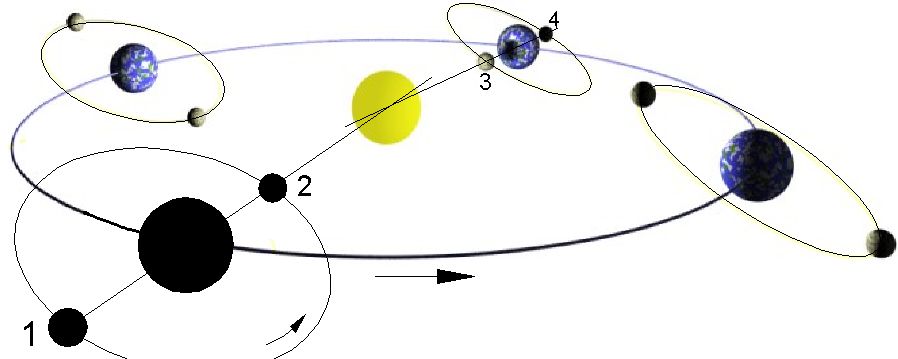
Alignment of celestial bodies
the alignment of celestial bodies
In astronomy, a syzygy ( ; , expressing the sense of σύν (syn- "together") and ζυγ- (zug- "a yoke") ) is a roughly straight-line configuration of three or more celestial bodies in a gravitational system.
The word is often used in reference to the Sun, Earth, and either the Moon or a planet, where the latter is in conjunction or opposition. Solar and lunar eclipses occur at times of syzygy, as do transits and occultations.

Main types
A syzygy sometimes results in an occultation, transit, or an eclipse.
- An occultation occurs when an apparently larger body passes in front of an apparently smaller one.
- A transit occurs when a smaller body passes in front of a larger one.
- In the combined case where the smaller body regularly transits the larger, an occultation is also termed a secondary eclipse.
- An eclipse occurs when a body totally or partially disappears from view, either by an occultation, as with a solar eclipse, or by passing into the shadow of another body, as with a lunar eclipse (thus, both are listed on NASA's eclipse page).
Consequences
Einstein ring
Main article: Einstein ring
As electromagnetic rays are affected by gravitation, when they pass by a heavy mass they are bent. As a result, the heavy mass acts as a form of gravitational lens. If the light source, the gravitating mass and the observer stand in a line, one sees what is termed an Einstein ring.
Tidal variation
A syzygy causes the fortnightly phenomena of spring tides. At the new and full moon, the Sun and Moon are in syzygy. Their tidal forces act to reinforce each other, and the ocean both rises higher and falls lower than the average. Tidal variations can also be measured in the Earth's crust, and these Earth tide influences may affect the frequency of earthquakes.
Extraterrestrial cases
The word syzygy is often used to describe interesting configurations of astronomical objects in general. For example, one such case occurred on March 21, 1894, around 23:00 GMT, when Mercury transited the Sun as would have been seen from Venus, and Mercury and Venus both simultaneously transited the Sun as seen from Saturn.
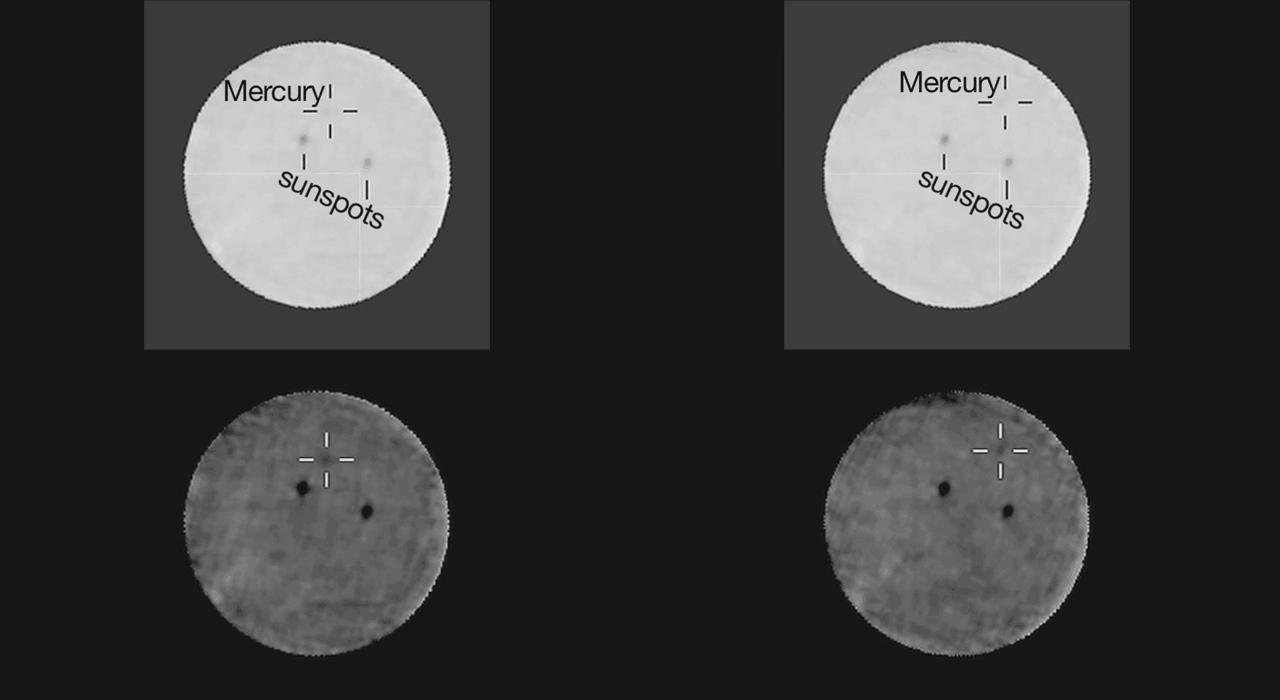
On June 3, 2014, the Curiosity rover on Mars observed the planet Mercury transiting the Sun, marking the first time a planetary transit has been observed from a celestial body besides Earth.
Other uses
The term is also used to describe situations when all the planets are on the same side of the Sun although they are not necessarily in a straight line, such as on March 10, 1982.

Because the orbits of all the planets in the Solar System (as well as the Moon) are inclined by only a few degrees, they always appear very near the ecliptic in our sky. Therefore, although an apparent planetary alignment known as a planetary parade may appear as a line (actually, a great arc), the planets are not necessarily aligned in space.
References
References
- {{cite Collins Dictionary. syzygy
- (2012). "Syzygy". [[HM Nautical Almanac Office]] and [[United States Naval Observatory]].
- Coyle, Harold P.. (2008). "Syzygy". McGraw-Hill Companies.
- "Three Planets Dance Over La Silla". ESO Picture of the Week.
- http://eclipse.gsfc.nasa.gov/eclipse.html
- Rosenberg, Matt. "Tides: The Sun and Moon Affect the Oceans".
- Webster, Guy. (June 10, 2014). "Mercury Passes in Front of the Sun, as Seen From Mars". [[NASA]].
- (March 14, 1982). "Ideas & Trends in Summary; It's All Right To Come Out Now". [[The New York Times]].
This article was imported from Wikipedia and is available under the Creative Commons Attribution-ShareAlike 4.0 License. Content has been adapted to SurfDoc format. Original contributors can be found on the article history page.
Ask Mako anything about Syzygy (astronomy) — get instant answers, deeper analysis, and related topics.
Research with MakoFree with your Surf account
Create a free account to save articles, ask Mako questions, and organize your research.
Sign up freeThis content may have been generated or modified by AI. CloudSurf Software LLC is not responsible for the accuracy, completeness, or reliability of AI-generated content. Always verify important information from primary sources.
Report