From Surf Wiki (app.surf) — the open knowledge base
Syrians
Majority inhabitants of Syria
Majority inhabitants of Syria
| Field | Value | |||
|---|---|---|---|---|
| group | *Syrians* | |||
| population | [[File:Map of the Syrian Diaspora in the World.svg | center | frameless | 260x260px]] |
| total | **41,974,216** | |||
| popplace | Syria | |||
| 25,603,166 (2025 estimate) | ||||
| region2 | Brazil | |||
| pop2 | 4,000,000 | |||
| region3 | Turkey | |||
| pop3 | 3,600,000 | |||
| region4 | Argentina | |||
| pop4 | 2,000,000 | |||
| region5 | Egypt | |||
| pop5 | 1,500,000 | |||
| region6 | Jordan | |||
| pop6 | 1,200,000 | |||
| region7 | Lebanon | |||
| pop7 | 1,129,624 | |||
| region8 | Saudi Arabia | |||
| pop8 | 500,000 – 2,500,000 | |||
| region9 | Germany | |||
| pop9 | 712,000 – 973,000 – 1,281,000 | |||
| region10 | Venezuela | |||
| pop10 | 400,000 – 1,000,000 | |||
| region11 | Iraq | |||
| pop11 | 295,000 | |||
| region12 | United States | |||
| pop12 | 281,331 | |||
| region13 | Sweden | |||
| pop13 | 263,899 | |||
| region14 | UAE | |||
| pop14 | 250,000 | |||
| region15 | Chile | |||
| pop15 | 200,000 | |||
| region16 | Kuwait | |||
| pop16 | 150,000 | |||
| region17 | Netherlands | |||
| pop17 | 150,000 | |||
| region18 | Sudan | |||
| pop18 | 60,000 – 250,000 | |||
| region19 | France | |||
| pop19 | 80,000 | |||
| region20 | Canada | |||
| pop20 | 77,050 | |||
| region21 | Algeria | |||
| pop21 | 50,000 – 84,700 | |||
| region22 | Australia | |||
| pop22 | 55,321 | |||
| region23 | Qatar | |||
| pop23 | 54,000 | |||
| region24 | Austria | |||
| pop24 | 49,779 | |||
| region25 | Denmark | |||
| pop25 | 46,334 | |||
| region26 | Norway | |||
| pop26 | 36,026 | |||
| region27 | Nigeria | |||
| pop27 | 23,000 | |||
| region28 | Ivory Coast | |||
| pop28 | 15,000 | |||
| region29 | Spain | |||
| pop29 | 11,188 | |||
| region30 | Guadeloupe *(Overseas France)* | |||
| pop30 | 10,000 | |||
| region31 | Finland | |||
| pop31 | 9,333 | |||
| region32 | United Kingdom | |||
| pop32 | 8,848 England & Wales unknown in Scotland and 2,000 in Northern Ireland. | |||
| region33 | Italy | |||
| pop33 | 8,227 (Syrian born) | |||
| region34 | Morocco | |||
| pop34 | 5,250 | |||
| region35 | Tunisia | |||
| pop35 | 5,000 | |||
| region36 | Ireland | |||
| pop36 | 3,922 | |||
| region37 | French Guiana *(Overseas France)* | |||
| pop37 | 3,120 | |||
| region38 | Mali | |||
| pop38 | 3,000 | |||
| region39 | Yemen | |||
| pop39 | 3,000 | |||
| region40 | Japan | |||
| pop40 | 1,091 | |||
| ref40 | ||||
| region41 | Martinique *(Overseas France)* | |||
| pop41 | 1,000 | |||
| langs | ||||
| religions | ||||
| related | Iraqi Sunni Arabs, Lebanese, Palestinians, Jordanians and other Arabs | |||
| native_name | ||||
| native_name_lang | ar | |||
| flag | Flag of the Syrian revolution.svg | |||
| flag_caption | Flag of Syria |
Syrians as the majority inhabitants of the country of Syria
25,603,166 (2025 estimate)
Syrians () are the majority inhabitants of Syria, indigenous to the Levant, most of whom have Arabic, especially its Levantine and Mesopotamian dialects, as a mother tongue. The cultural and linguistic heritage of the Syrian people is a blend of both indigenous elements and the foreign cultures that have come to rule the land and its people over the course of thousands of years. By the seventh century, most of the inhabitants of the Levant spoke Aramaic. In the centuries after the Muslim conquest of the Levant in 634, Arabic gradually became the dominant language, but a minority of Syrians (particularly the Assyrians and Syriac-Arameans) retained Aramaic (Syriac), which is still spoken in its Eastern and Western dialects.
The national name "Syrian" was originally an Indo-European corruption of Assyrian and applied to Assyria in northern Mesopotamia, however by antiquity it was used to denote the inhabitants of the Levant. Following the Muslim conquest of the Levant, Arab identity gradually became dominant among many Syrians, and the ethnonym "Syrian" was used mainly by Christians in Levant, Mesopotamia and Anatolia who spoke Syriac. In the 19th century, the name "Syrian" was revived amongst the Arabic speakers of the Levant. Following the establishment of the Arab Kingdom of Syria in 1920, the name "Syrian" began to spread amongst its Arabic speaking inhabitants. The term gained more importance during the Mandate for Syria and the Lebanon, becoming the accepted national name for the Arabic speakers of the Syrian Republic.
Most Arabic-speaking Syrians identify as Arabs and are described as such by virtue of their modern-day language and bonds to Arab culture and history. But they are, in fact, genetically a blend of the various Semitic-speaking groups indigenous to the region. There is no contradiction between being an Arab and a Syrian since the Syrian Arab identity is multi-layered and being Syrian complements being Arab. In addition to denoting Syrian Arabs, the term "Syrian" also refer to all Syrian citizens, regardless of their ethnic background. In 2018, Syria had an estimated population of 19.5 million, which includes, aside from the aforementioned majority, Kurds, Assyrians, Turkmen, Armenians and others.
Even before the Syrian Civil War, there was a large Syrian diaspora that had emigrated to North America (United States and Canada), European Union member states (including Sweden, France, and Germany), South America (mainly in Brazil, Argentina, Venezuela, and Chile), the West Indies, Africa, Australia, and New Zealand. Six million refugees of the Syrian Civil War also live outside Syria now, mostly in Turkey, Egypt, Jordan, Lebanon, Germany as well as Sweden.
Etymology
Various sources indicate that the name Syria itself is derived from Luwian term "Sura/i", and the derivative ancient Greek name: Σύριοι, grc, or Σύροι, grc, both of which originally derived from the Akkadian word Aššūrāyu (Assyria) in northern Mesopotamia, modern-day Iraq. However, during the Seleucid Empire, this term was also applied to The Levant, and henceforth the Greeks applied the term without distinction between the Assyrians of north Mesopotamia and Arameans of the Levant.
Applications of the name in antiquity
The Greeks used the terms "Syrian" and "Assyrian" interchangeably to indicate the indigenous Arameans, Assyrians and other inhabitants of the Levant and Mesopotamia, Herodotus considered "Syria" west of the Euphrates. Starting from the 2nd century BC onwards, ancient writers referred to the ruler of the Seleucid Empire as the King of Syria or King of the Syrians. The Seleucids designated the districts of Seleucis and Coele-Syria explicitly as Syria and ruled the Syrians as indigenous populations residing west of the Euphrates (Aramea) in contrast to Assyrians who had their native homeland in Mesopotamia east of the Euphrates. However, the interchangeability between Assyrians and Syrians persisted during the Hellenistic period.
In one instance, the Ptolemaic dynasty of the Hellenistic kingdom of Egypt applied the term "Syrian Village" as the name of a settlement in Fayoum. The Ptolemies referred to all peoples originating from Modern Syria and Palestine as Syrian.
The term Syrian was imposed upon Arameans of modern Levant by the Romans. Pompey created the province of Syria, which included modern-day Lebanon and Syria west of the Euphrates, framing the province as a regional social category with civic implications. In Roman usage, the term could refer narrowly to people of Aramean descent, but it was also applied more broadly to all inhabitants of the province, among them descendants of Greek and Italian settlers. Authors varied in their descriptions: Plutarch described the indigenous people of this newly created Roman province as "Syrians", so did Strabo, who observed that Syrians resided west of the Euphrates in Roman Syria, and he explicitly mentions that those Syrians are the Arameans, whom he calls Aramaei, indicating an extant ethnicity. Posidonius noted that the people called Syrians by the Greeks refer to themselves as Arameans. Tacitus also portrayed Syrians as a distinct ethnic group or race.
In The Jewish War, Josephus, a Hebrew historian native to the Levant, mentioned the Syrians as the non-Hebrew, non-Greek indigenous inhabitants of Syria.
History
Main article: Arameans, , Arabs
Syrians are mainly descended from the various ancient Semitic-speaking peoples of the ancient Near East. The Seleucids ruled the indigenous peoples of the Levant, whom they named "Syrians", as a conquered nation; Syrians were not assimilated into Greek communities, and many local peasants were exploited financially as they had to pay rent for Greek landlords. Outside Greek colonies, the Syrians lived in districts governed by local temples that did not use the Greek civic system of poleis and colonies. The situation changed after the Roman conquest in 64 BC; Semitic-speaking Syrians obtained the citizenship of Greek poleis, and the line separating the Greeks and the natives blurred. The idioms Syrian and Greek were used by Rome to denote civic societies instead of separate ethnic groups.
Ancient Syria of the first millennium BC was dominated by the Aramaeans; they originated in the Northern Levant as a continuum of the Bronze Age populations of Syria. The Aramaeans assimilated most of the earlier Levantine populations through their language. With the adoption of a common religion, Christianity, most of the inhabitants turned into Syrians (Aramaeans). Islam and the Arabic language had a similar effect where the Aramaeans themselves became Arabs regardless of their ethnic origin following the Muslim conquest of the Levant. The presence of Arabs in Syria is recorded since the 9th century BC, and Roman period historians, such as Strabo, Pliny the Elder, and Ptolemy, reported that Arabs inhabited many parts of Syria, which according to modern historians indicate either an ethnic group or a nomadic way of life. The urheimat of the Arab ethnos is unclear; the traditional 19th century theory locates this in the Arabian Peninsula, while some modern scholars, such as David Frank Graf, note that the epigraphic and archaeological evidence render the traditional theory inadequate to explain the Arabs' appearance in Syria. The Arabs mentioned in Syria by Greco-Roman writers were assimilated into the newly formed "Greco–Aramaean culture" that dominated the region, and the texts they produced were written in Greek and Aramaic. Old Arabic, the precursor of Classical Arabic, was not a literary language; its speakers used Aramaic for writing purposes.
Linguistic Arabization
On the eve of the Rashidun Caliphate conquest of the Levant, 634 AD, Syria's population mainly spoke Aramaic as the Lingua franca, while Greek was the language of administration. Arabization and Islamization of Syria began in the 7th century, and it took several centuries for Islam, the Arab identity, and language to spread; the Arabs of the caliphate did not attempt to spread their language or religion in the early periods of the conquest, and formed an isolated aristocracy. The Arabs of the caliphate accommodated many new tribes in isolated areas to avoid conflict with the locals; caliph Uthman ordered his governor, Muawiyah I, to settle the new tribes away from the original population. Syrians who belonged to Monophysitic denominations welcomed the Muslim Arabs as liberators.
The Abbasids in the eighth and ninth centuries sought to integrate the peoples under their authority, and the Arabization of the administration was one of their methods. Arabization gained momentum with the increasing numbers of Muslim converts from Christianity; the ascendancy of Arabic as the formal language of the state prompted the cultural and linguistic assimilation of Syrian converts. Some of those who remained Christian also became Arabized, while others stayed Aramean, it was probably during the Abbasid period in the ninth century that Christians adopted Arabic as their first language; the first translation of the gospels into Arabic took place in this century. Many historians, such as Claude Cahen and Bernard Hamilton, proposed that the Arabization of Christians was completed before the First Crusade. By the thirteenth century, the Arabic language achieved complete dominance in the region, with many of its speakers having become Arabs.[[File:Garshuni example in Western Syriac alphabet (ܓܪܫܘܢܝ, ܣܪܛܐ ܡܥܪܒܝܐ).gif|350 px|thumb|Garshuni sample]]Those who retained the Aramaic language are divided among two groups:
- The Eastern Aramaic Syriac-speaking group, followers of the West Syriac Rite of the Syriac Orthodox Church and the Syrian Catholic Church; kept the pre-Islamic Syrian (Syriac) identity throughout the ages, asserting their culture in face of the Arab dominance. Linguists, such as Carl Brockelmann and François Lenormant, suggested that the rise of the Garshuni writing (using the Syriac alphabet to write Arabic) was an attempt by the Syriac Orthodox to assert their identity. Syriac is still the liturgical language for most of the different Syriac churches in Syria. The Syriac Orthodox Church was known as the Syrian Orthodox Church until 2000, when the holy synod decided to rename it to avoid any nationalistic connotations; the Catholic Church still has "Syrian" in its official name.
- The Western Neo-Aramaic-speaking group, that is, the inhabitants of Bakh'a, Jubb'adin and Ma'loula. The residents of Bakh'a and Jubb'adin converted to Islam in the eighteenth century (retaining their Aramean identity), while in Ma'loula, the majority are Christians, mainly belonging to the Melkite Greek Catholic Church, but also to the Greek Orthodox Church of Antioch, in addition to a Muslim minority, who speaks the same Aramaic dialect of the Christian residents. The people of those villages use Arabic intensively to communicate with each other and the rest of the country; this led to a noticeable Arabic influence on their Aramaic dialect where around 20% of its vocabulary is of Arabic roots. Bakh'a is steadily losing its dialect; by 1971, people aged younger than 40 could no longer use the Aramaic language properly, although they could understand it. The situation of Bakh'a might eventually lead to the extinction of its Aramaic dialect.
Revival of the designation "Syrian"
The Arabs in Arabia called the region of Syria region al-Sham () which became the dominant name of the Levant under the Rashidun Caliphate and its successors. The geographic designation "Syria" returned in 1864 when Ottoman Syria was reorganized and the name was used for a vilayet encompassing generally the southern Levant. The use of the national designation "Syrian" however has its origin in the tense relationship between the Arabic-speaking Muslims and Christians of the Levant, where Christians wanted to distance themselves from the Muslims. Already in the 1830s, the Lebanese traveler As'ad Khayyat identified with the term Syria, but it took till the 1880s for the name to begin to be widely used by the inhabitants to refer to themselves. Both Muslims and Christians agreed that the Muslims were not Syrians because they belonged to the Arabs while the Christians retained the Syrianism of antiquity. The spread of the Syrian "idea" amongst the Muslims can be traced to the efforts of Rashid Rida who contributed to the formulation of the Syrian Union Party's manifesto in 1918, demanding that Syria, in the aftermath of World War I and the Ottoman withdrawal from the region, become an independent state and not part of larger Arab one ruled by the Hashemites of the Kingdom of Hejaz. Rida did not reject the Arab identity but recognized a Syrian uniqueness and advocated the idea of a Syrian state. In the end, Syria did become a separate state but under the Hashemite king Faisal. He entered Damascus in 1918 in the aftermath of the Ottomans' evacuation of the Levant at the end of World War I. His entry ignited the Syrian national consciousness after he declared an Arab government in the Levant centred in Damascus with him as prince. In June 1919, the Syrian National Congress, which included representatives from Palestine and Lebanon, demanded the full independence of Syria, within borders that encompass more or less the Levant; this helped to further strengthen the development of the Syrian national consciousness. Initially, most inhabitants were against the establishment of Syria as they considered this a step against Arab unity, but gradually, Faisal's Syria, which was declared an independent kingdom in 1920, prompted the Syrians to begin exploring the notion of Syrianism instead of pan-Arabism. Faisal was deposed by the French who established a mandate in 1920, but the formation of a Syrian consciousness amongst the members of the Syrian Arab national movement solidified and spread amongst the Muslims as well as the Christians.
Genetics
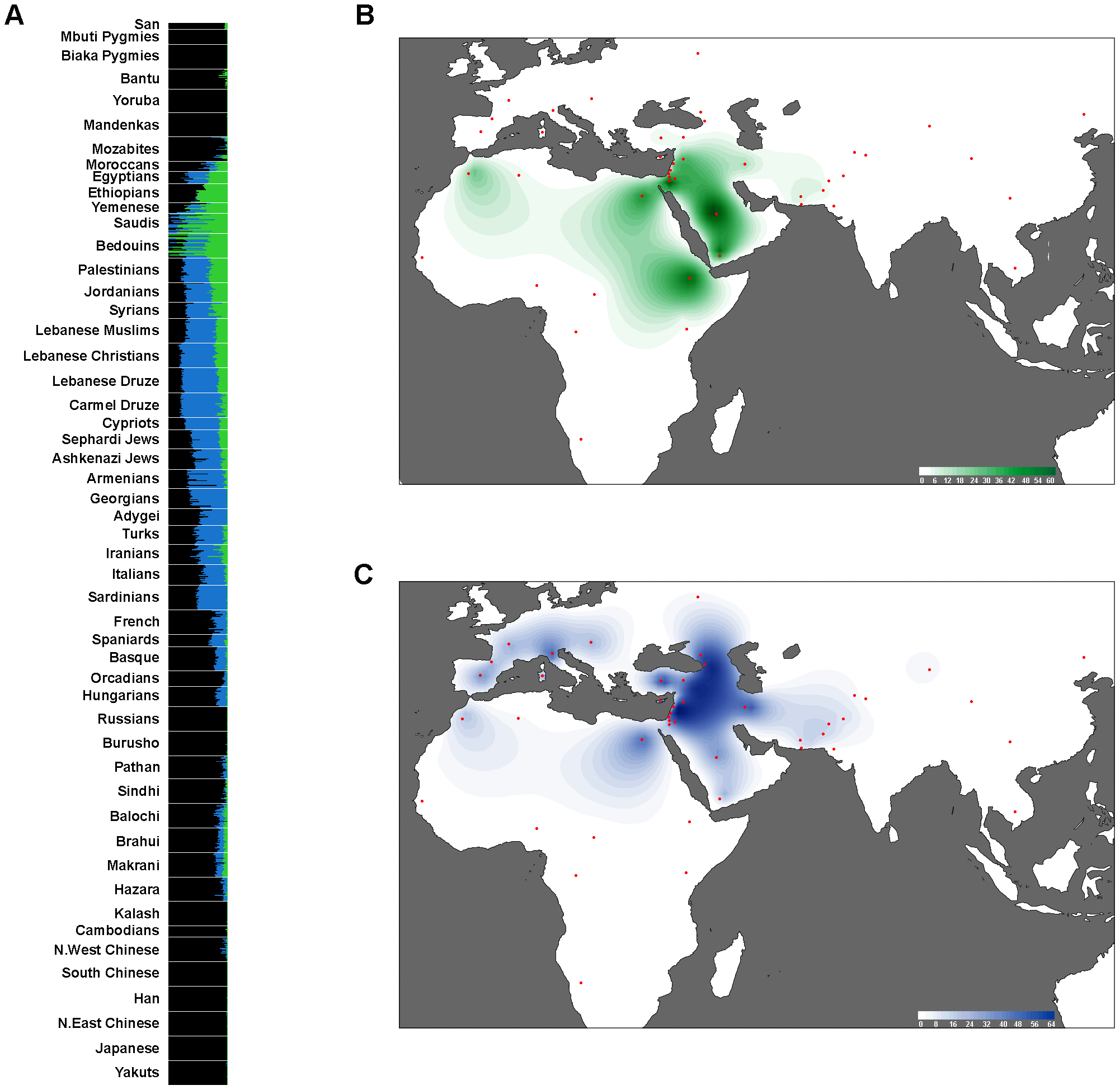
Genetic tests on Syrians were included in many genetic studies. The genetic marker which identifies descendants of the ancient Levantines is found in Syrians in high proportion. Modern Syrians exhibit "high affinity to the Levant" based on studies comparing modern and ancient DNA samples. Syrians cluster closely with ancient Levantine populations of the Neolithic and Bronze Ages. A Levantine ancestral genetic component was identified; it is estimated that the Levantine, the Arabian and East African ancestral components diverged 23,700–15,500 years ago, while the divergence between the Levantine and European components happened 15,900–9,100 years ago. The Levantine ancestral component is the most recurrent in Levantines (42–68%); the Peninsular Arabian and East African ancestral components represent around 25% of Syrian genetic make-up.
The paternal Y-DNA haplogroup J1, which reaches its highest frequencies in Yemen 72.6% and Qatar 58.3%, accounted for 33.6% of Syrians. The J2 group accounted for 20.8% of Syrians; other Y-DNA haplogroups include the E1B1B 12.0%, I 5.0%, R1a 10.0% and R1b 15.0%. The Syrians are closest to other Levantine populations: the Lebanese, the Palestinians and Jordanians; this closeness can be explained by the common Canaanite ancestry and geographical unity which was broken only in the twentieth century with the advent of British and French mandates. Regarding the genetic relation between the Syrians and the Lebanese based on Y-DNA, Muslims from Lebanon show closer relations to Syrians than their Christian compatriots. The people of Western Syria show close relations with the people of Northern Lebanon.
Mitochondrial DNA shows the Syrians to have an affinity with Europe; main haplogroups are H and R. Based on Mitochondrial DNA, the Syrians, Palestinians, Lebanese and Jordanians form a close cluster. Compared to the Lebanese, Bedouins and Palestinians, the Syrians have noticeably more Northern European component, estimated at 7%. Regarding the HLA alleles, Syrians, and other Levantine populations, exhibit "key differences" from other Arab populations; based on HLA-DRB1 alleles, Syrians were close to eastern Mediterranean populations, such as the Cretans and Lebanese Armenians. Studying the genetic relation between Jews and Syrians showed that the two populations share a close affinity. Apparently, the cultural influence of Arabian expansion in the Eastern Mediterranean in the seventh century was more prominent than the genetic influx. However, the expansion of Islam did leave an impact on Levantine genes; religion drove Levantine Muslims to mix with other Muslim populations, who were close culturally despite the geographic distance, and this produced genetic similarities between Levantine Muslims and Moroccan and Yemeni populations. Christians and Druze became a genetic isolate in the predominantly Islamic world.
Language
Arabic is the mother tongue of the majority of Syrians as well as the official state language. The Syrian variety of Levantine Arabic differs from Modern Standard Arabic. Western Neo-Aramaic, the only surviving Western Aramaic dialect, is still spoken in three villages (Maaloula, Bakh'a and Jubb'adin) in the Anti-Lebanon Mountains by both Muslim and Christian Arameans (Syriacs). Syriacs in the northeast of the country are mainly Turoyo-Aramaic speakers but there are also some speakers of Suret-Aramaic, especially in the Khabour Valley. Classical Syriac is also used as a liturgical language by Syriac Christians. English, and to a lesser extent French, is widely understood and used in interactions with tourists and other foreigners.
Religion and minority groups
Main article: Freedom of religion in Syria, Religion in Syria, Islam in Syria, Christianity in Syria
Religious differences in Syria have historically been tolerated, and religious minorities tend to retain distinct cultural, and religious identities. Sunni Islam is the religion of 74% of Syrians. The Alawites, a variety of Shia Islam, make up 12% of the population and mostly live in and around Tartus and Latakia. Christians make up 10% of the country. Most Syrian Christians adhere to the Byzantine Rite; the two largest are the Antiochian Orthodox Church and the Melkite Greek Catholic Church. The Druze are a mountainous people who reside in Jabal al-Druze who helped spark the Great Syrian Revolt. The Ismailis are an even smaller sect that originated in Asia. Many Armenian and Assyrian Christians fled Turkey during the Armenian genocide and the Assyrian genocide and settled in Syria. There are also roughly 500,000 Palestinians, who are mostly descendants of refugees from the 1948 Israeli-Arab War. The community of Syrian Jews inside Syria once numbered 30,000 in 1947, but has only 200 today.
The Syrian people's beliefs and outlooks, similar to those of most Arabs and people of the wider Middle-East, are a mosaic of West and East. Conservative and liberally minded people will live right next to each other. Like the other countries in the region, religion permeates life; the government registers every Syrian's religious affiliation.
Cuisine
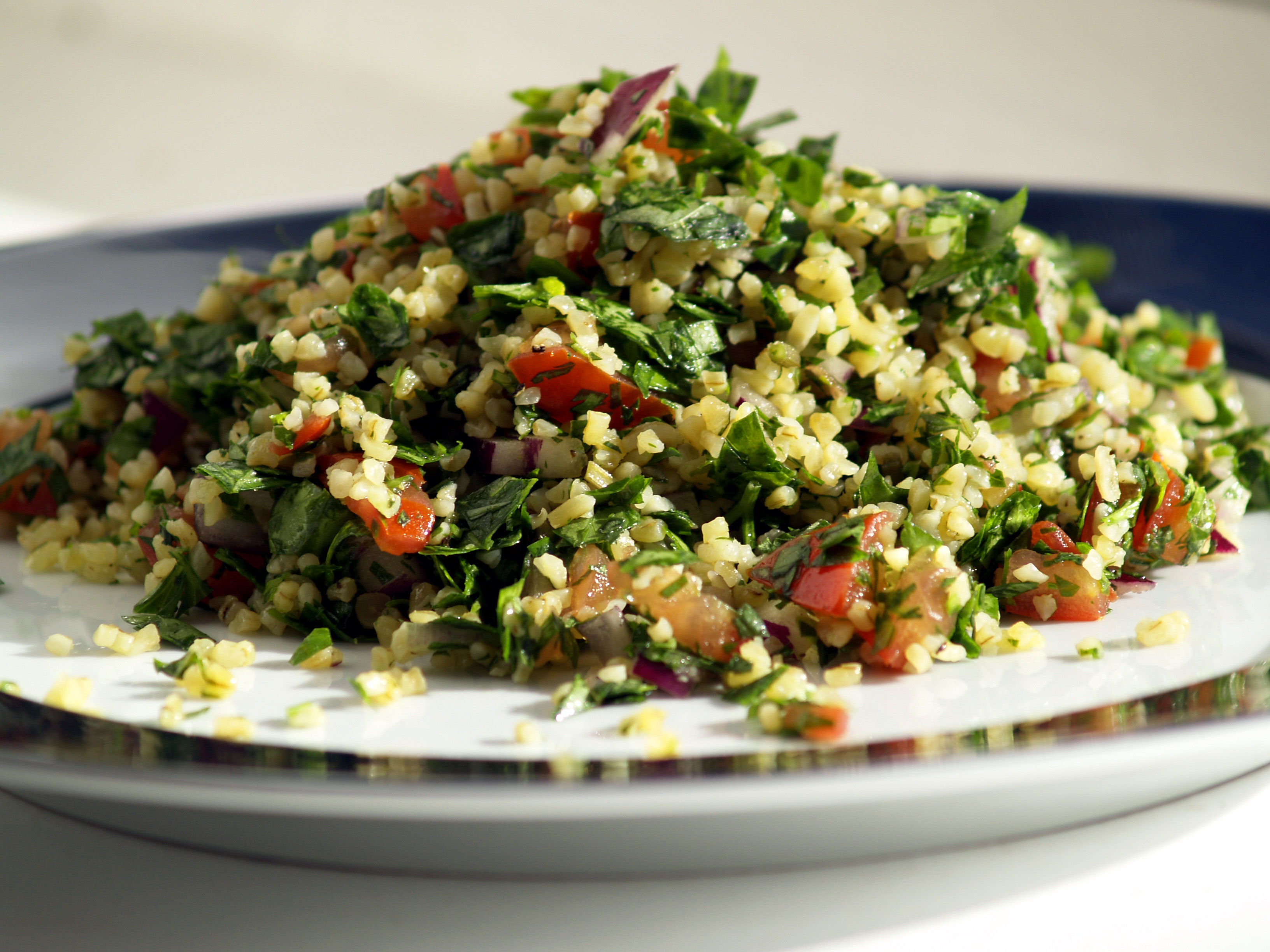
Syrian cuisine is dominated by ingredients native to the region. Olive oil, garlic, olives, spearmint, and sesame oil are some of the ingredients that are used in many traditional meals. Traditional Syrian dishes enjoyed by Syrians include, tabbouleh, labaneh, shanklish, wara' 'enab, makdous, kebab, Kibbeh, sfiha, moutabal, hummus, mana'eesh, bameh, and fattoush.
A typical Syrian breakfast is a meze. It is an assortment platter of foods with cheeses, meats, pickles, olives, and spreads. Meze is usually served with Arab-style tea – highly concentrated black tea, which is often highly sweetened and served in small glass cups. Another popular drink, especially with Christians and non-practicing Muslims, is the arak, a liquor produced from grapes or dates and flavored with anise that can have an alcohol content of over 90% ABV (however, most commercial Syrian arak brands are about 40–60% ABV).
Notable people
Notes
References
Citations
Sources
References
- "Syria Population 2025".
- "Syrian Arabic Republic".
- "UNHCR Turkey: Operational Update – February / March 2021".
- "UNHCR Syria Regional Refugee Response".
- (20 December 2011). "Amerika:La emigración Siria-Libanesa a Argentina". Amerika. Mémoires, identités, territoires.
- "Sirios, turcos y libaneses".
- The UN Migration agency. "Migration Stock in Egypt 2022". International Organization for Migration (IOM).
- "UNHCR Syria Regional Refugee Response".
- "UNHCR Syria Regional Refugee Response".
- Jawhar, Sabria. (10 September 2015). "KSA already home to 500,000 Syrians". Arab news.
- "Saudi Arabia Received 2.5 Million Syrians since Beginning of Conflict | the Embassy of the Kingdom of Saudi Arabia".
- (21 February 2025). "Germany's Syrian community — facts and figures".
- (20 April 2023). "Statistischer Bericht – Mikrozensus – Bevölkerung nach Migrationshintergrund – Erstergebnisse 2022".
- "Bevölkerung in Privathaushalten 2023 nach Migrationshintergrund".
- Salloum, Habeeb. (2000). "Arabs Making Their Mark in Latin America: Generations of Immigrants in Colombia, Venezuela and Mexico". Al Jadid.
- Salloum, Habeeb. "Arabs Making Their Mark in Latin America: Generations of Immigrants in Colombia, Venezuela and Mexico".
- Jordan, Levi. "Syria Steps into Latin America".
- Nachawati, Leila. (March 2013). "Cómo será recordado Chávez en Siria". ElDiario.es.
- Gomez, Diego. (February 2012). "EL LEVANTE Y AMÉRICA LATINA. UNA BITÁCORA DE LATINOAMÉRICA EN SIRIA, LÍBANO, JORDANIA Y PALESTINA".
- "Syrians in Iraq".
- "SELECTED POPULATION PROFILE IN THE UNITED STATES 2016 American Community Survey 1-Year Estimates". U.S. Census Bureau.
- Hitti, Philip. (2005). "The Syrians in America". Gorgias Press.
- Syrian Americans by J. Sydney Jones
- "Befolkning efter födelseland och ursprungsland, 31 december 2023, totalt". Statistiska centralbyrån.
- Swedish residents born either in Syria or Sweden to two Syrian-born parents.
- "Syrierna i Sverige: så har det gått". Svenska Dagbladet.
- McFarlane, Nyree. (28 September 2016). "The UAE is going to start taking in Syrian refugees".
- J. Códoba-Toro. (2015). "Árabes en Chile". Iberoamérica Social.
- (2 September 2015). "Kuwait extends residency permits for Syrians".
- "Terugkeer naar Syrië ligt niet altijd voor de hand: 'Wij zijn hier geworteld'". [[NU.nl]].
- "In afwachting van de ontwikkelingen zet Faber de asielaanvragen van Syriërs in de ijskast". [[de Volkskrant]].
- (2023). "Sudan's descent into chaos shatters illusion of safety for war-weary Syrians".
- (13 November 2019). "The New Lost Boys of Sudan".
- (8 March 2025). "'Syria is not yet safe for everyone': Refugees in France contemplate post-Assad future".
- (5 February 2025). "Des réfugiés aimeraient retourner en Syrie, tout en ayant la garantie d'un retour en France possible".
- (21 June 2023). "Syriens en France 2022".
- "Immigrés par pays de naissance détaillé − Étrangers et immigrés en 2019".
- (31 August 2021). "Qui sont les millions de réfugiés afghans, en France et dans le monde ?". Le Monde.
- [[Statistics Canada]]. (2019-02-20). "2016 Ethnic Origin, both sexes, age (total), Canada, 2016 Census – 25% Sample data: Data tables".
- Koundouno, Tamba François. (3 January 2019). "Algeria Shuts Border to Syrian Refugees, Invokes Terrorism Threat".
- (13 May 2025). "We have welcomed 50,000 Syrians in recent years for humanitarian reasons.". bbc.com.
- (13 May 2025). "Réfugiés dans le pays depuis le début de la guerre en 2011: à quoi rêvent les syriens d'Algérie ?". elmoudjahid.dz.
- (11 February 2025). "Réfugiés dans le pays depuis le début de la guerre en 2011: à quoi rêvent les syriens d'Algérie ?". elmoudjahid.dz.
- (8 March 2025). "Syrians in Maghreb".
- "Syrian-Born Community Information Syrian-Born Community Information".
- (Qatar population statistics). (15 August 2019). "Population of Qatar by nationality – 2019 report".
- (14 June 2016). "Bevölkerung zu Jahresbeginn seit 2002 nach detaillierter Staatsangehörigkeit".
- (11 August 2025). "National statistics of Denmark". statistikbanken.dk.
- (9 March 2020). "Immigrants and Norwegian-born to immigrant parents". Statistics Norway.
- (11 February 2025). "International/ Après la chute de Bachar al-Assad, les Syriens de Côte d'Ivoire se prononcent". agencepresseradio.
- (1 January 2021). "Instituto Nacional de Estadisticas". Statistics Spain.
- (1 January 2021). "Syrie: les Guadeloupéens unis pour la paix". Fr Antilles.
- (1 January 2021). "Ces Syriens réfugiés en Guadeloupe". Fr Antilles.
- "11rs – Origin and background country by language, age (1-year) and sex, 1990–2021". Statistics Finland.
- {{2011CensusEngWalCoB
- {{2011CensusScotlandCoB
- {{2011CensusNICoB
- "Population by country of birth".
- "Major Syrian refugee-hosting countries worldwide 2022".
- "Répartition des réfugiés syriens dans le monde".
- (20 April 2021). "'Living a new life now': Syrian children on resettling here". Ireland's National Public Service Media / Meáin Náisiúnta Seirbhíse Poiblí na hÉireann.
- (10 December 2024). "Les syriens réfugiés en Guyane espèrent que le changement de régime s'inscrira dans la durée". ftvinfo.fr.
- (8 January 2024). "Syrian refugees find a welcome and some familiar fragility in Mali". theguardian.
- (8 January 2024). "Syrian refugees in Yemen: When the Coronavirus Becomes More Severe than the War". Daraj.
- link
- (1 January 2021). "La Martinique a accueilli des migrants syriens... il y a 80 ans".
- Haag, Michael. (2009). "The Templars: The History and the Myth - From Solomon's Temple to the Freemasons". Profile Books Limited.
- (2011-10-03). "The Caribbean History Archives: Syrian-Lebanese community".
- Singh, Shubha. "Like India, Syria has a large diaspora (With stories on Syrian president's visit)". Theindian News.
- (2006). "The terms "Assyria" and "Syria" again". Journal of Near Eastern Studies.
- (1992). "Assyria and Syria: Synonyms". Journal of Near Eastern Studies.
- [[Herodotus]], ''[[Histories (Herodotus). The Histories]]'', VII.63, [[s:History of Herodotus/Book 7]].
- Joseph, John. (2008). "Assyria and Syria: Synonyms?".
- Nigel Wilson. (2013-10-31). "Encyclopedia of Ancient Greece". Routledge.
- Nathanael J. Andrade. (2013-07-25). "Syrian Identity in the Greco-Roman World". Cambridge University Press.
- Aryeh Kasher. (1985). "The Jews in Hellenistic and Roman Egypt: The Struggle for Equal Rights". Mohr Siebeck.
- Nathanael J. Andrade. (2013-07-25). "Syrian Identity in the Greco-Roman World". Cambridge University Press.
- Andrade, Nathanael. (2023). "The Tacitus Encyclopedia". John Wiley & Sons.
- (1779). "An universal history, from the earliest accounts to the present time". Printed for C. Bathurst.
- (1779). "An universal history, from the earliest accounts to the present time". Printed for C. Bathurst.
- John Joseph. (2000). "The Modern Assyrians of the Middle East". BRILL.
- Flavius Josephus. (2004). "The Great Roman-Jewish War". Courier Corporation.
- (2020). "A Genetic History of the Near East from an aDNA Time Course Sampling Eight Points in the Past 4,000 Years". American Journal of Human Genetics.
- {{harvnb. Commins. Irvine. Smith. Hamidé. 2018. Quote:"The Syrian people evolved from several origins over a long period of time. The Greek and Roman ethnic influence was negligible in comparison with that of the Semitic peoples of Arabia and Mesopotamia—Aramaeans, Assyrians, Chaldeans, and Canaanites."
- Folmer, Margaretha. (2020-02-28). "Aramaic as Lingua Franca". Wiley.
- Akopian, Arman. (2017-12-11). "Introduction to Aramean and Syriac Studies". Gorgias Press.
- Shehadeh, Lamia Rustum. (2011). "The Origins of Syrian Nationhood". Routledge.
- Groiss, Arnon. (2011). "The Origins of Syrian Nationhood". Routledge.
- Zisser, Eyal. (2011). "The Origins of Syrian Nationhood". Routledge.
- Salhi, Muhannad. (2011). "The Origins of Syrian Nationhood". Routledge.
- Dawisha, Adeed. "Arab Nationalism in the Twentieth Century: From Triumph to Despair". Princeton University Press.
- Gelvin, James L.. (1999). "Divided Loyalties. Nationalism and Mass Politics in Syria at the Close of Empire". University of California Press.
- Zisser, Eyal. (2006). "Who's Afraid of Syrian Nationalism? National and State Identity in Syria". Routledge.
- Ma'os, Moshe. (2011). "Syria Under Assad: Domestic Constraints and Regional Risks". Routledge.
- [[#CITEREFPerry2007. Perry 2007]]. Quote:"The marker, known as the J2 haplogroup, was found in an unusually high proportion among Lebanese, Palestinians and Syrians tested by Zalloua during more than five years of research. He tested 1,000 people in the region."
- [[#CITEREFMarshallDasPiroozniaElhaik2016. Marshall et al. 2016]]. Quote:"The mixed Near Eastern–Middle Eastern localisation of the Druze, shown using both modern and ancient DNA data, is distinct from that of neighboring Syrians, Palestinians and most of the Lebanese, who exhibit a high affinity to the Levant."
- [[#CITEREFMarshallDasPiroozniaElhaik2016. Marshall et al. 2016]]. Quote:" Druze exhibited genetic similarity to Chalcolithic and Bronze Age Armenians and a Chalcolithic Anatolian. In that study, Druze clustered remotely from all Bronze Age and Neolithic Levantines, whereas Jews, Assyrians, Syrians and a few Lebanese clustered with Levantine populations."
- [[#CITEREFHaberGauguierYouhannaPatterson2013. Haber et al. 2013]]. Quote:"Our estimates show that the Levantine and the Arabian Peninsula/East African components diverged ~23,700–15,500 y.a., while the Levantine and European components diverged ~15,900–9,100 y.a."
- [[#CITEREFHaberGauguierYouhannaPatterson2013
- [[#CITEREFFernandesTriskaPereiraAlshamali2015. Fernandes et al. 2015]]. Quote:1-"In the Near East, we included Iraq, Jordan, Israel/Palestine, Turkey, Lebanon and Syria."
2-"Here it is already possible to distinguish between a Southwest Asian/Caucasian and an Arabian/North African component; these two components have similar proportions of ~30% each in Yemen and UAE, but the Arabian/North African proportion increases to 52–60% in Saudi and Bedouin. In Near Eastern populations, correspondingly, the Southwest Asian/Caucasian component rises to ~50% and the Arabian/North African cluster decreases to ~20–30%, even in Palestinians (similar to the Samaritans and some of the Druze), highlighting their primarily indigenous origin, with the most extreme values for the Druze, carrying the Southwest Asian/Caucasian component at ~80%." - [[#CITEREFEl-SibaiPlattHaberXue2009. El‐Sibai et al. 2009]]. Quote:"J1 frequencies in Syria, Akka and Jordan were more comparable to Lebanon than to the remaining Arabic countries (58.3% in Qatar and 72.5% in Yemen; Fig. 2G")
- [[#CITEREFHajjejAlmawiArnaiz-VillenaHattab2018. Hajjej et al. 2018]]. Quote:"Using genetic distances, correspondence analysis and NJ trees, we showed earlier [61, 62] and in this study that Palestinians, Syrians, Lebanese and Jordanians are closely related to each other."
- [[#CITEREFHajjejAlmawiArnaiz-VillenaHattab2018. Hajjej et al. 2018]]. Quote:"The strong relatedness between Levant Arab populations is explained by their common ancestry, the ancient Canaanites, who came either from Africa or Arabian Peninsula via Egypt in 3300 BC [97], and settled in Levant lowlands after collapse of Ghassulian civilization in 3800–3350 BC [98]. The relatedness is also attributed to the close geographical proximity, which constituted one territory before 19th century British and French colonization."
- [[#CITEREFHaberGauguierYouhannaPatterson2013. Haber et al. 2013]]. Quote:"Lebanese Christians and all Druze cluster together, and Lebanese Muslims are extended towards Syrians, Palestinians, and Jordanians."
- [[#CITEREFHaberPlattBadroXue2011. Haber et al. 2011]]. Quote:"Syria is contained within the range of variation of the Lebanese samples. West Syrian samples lie closest to LN Sunnis, and not far from LN, LB, and LM Maronites."
- [[#CITEREFBadroDouaihyHaberYouhanna2013. Badro et al. 2013]]. Quote:"The haplogroups' geographical distribution shows affinity between the Northern Levant (modern day Lebanon and Syria) and Europe with clear distinctions between the Levant and the Arabian Peninsula with regards to Africa (Fig. 1, Table 1). The main mtDNA haplogroups for both Europe and the Northern Levant are H and R*."
- [[#CITEREFBadroDouaihyHaberYouhanna2013. Badro et al. 2013]]. Quote:"Yemenis and Saudis both associate strongly with Egyptians, whereas the Jordanian, Lebanese, Palestinian, and Syrian populations clustered together."
- [[#CITEREFMarshallDasPiroozniaElhaik2016
- [[#CITEREFHajjejAlmawiArnaiz-VillenaHattab2018. Hajjej et al. 2018]]. Quote:"On the contrary, key differences were noted between Levant Arabs (Lebanese, Palestinians, Syrians), and other Arab populations, highlighted by high frequencies of A24, B35, DRB111:01, DQB103:01, and DRB111:01-DQB103:01 haplotype in Levantine Arabs compared to other Arab populations."
- [[#CITEREFHajjejAlmawiArnaiz-VillenaHattab2018. Hajjej et al. 2018]]. Quote:"Syrians are genetically close to Eastern Mediterranean, as Cretans (−0.0001) and Lebanese Armenians (0.0050)."
- [[#CITEREFHammerReddWoodBonner2000. Hammer et al. 2000]]. Quote:"This Jewish cluster was interspersed with the Palestinian and Syrian populations, whereas the other Middle Eastern non-Jewish populations (Saudi Arabians, Lebanese, and Druze) closely surrounded it."
- [[#CITEREFHajjejAlmawiArnaiz-VillenaHattab2018. Hajjej et al. 2018]]. Quote:1-"The extent of gene Arab exchange with these autochthonous groups is undetermined but is thought to be lower than religious/cultural influence."
2-"On the other hand, Levant Arabs are distant from Saudis, Kuwaitis, and Yeminis, an indication that the contribution of the Arabian Peninsula populations to Levantine gene pool is low, probably due to the absence of the demographic aspect of 7th century invasion." - [[#CITEREFHaberGauguierYouhannaPatterson2013. Haber et al. 2013]]. Quote:1-"We show that religious affiliation had a strong impact on the genomes of the Levantines. In particular, conversion of the region's populations to Islam appears to have introduced major rearrangements in populations' relations through admixture with culturally similar but geographically remote populations, leading to genetic similarities between remarkably distant populations like Jordanians, Moroccans, and Yemenis. Conversely, other populations, like Christians and Druze, became genetically isolated in the new cultural environment. We reconstructed the genetic structure of the Levantines and found that a pre-Islamic expansion Levant was more genetically similar to Europeans than to Middle Easterners."
2-"The predominantly Muslim populations of Syrians, Palestinians and Jordanians cluster on branches with other Muslim populations as distant as Morocco and Yemen."
3-Lebanese Christians and all Druze cluster together, and Lebanese Muslims are extended towards Syrians, Palestinians, and Jordanians, which are close to Saudis and Bedouins." - [https://www.aljazeera.net/encyclopedia/icons/2015/10/2/نزار-قباني ترجمة نزار قباني]، موسوعة الجزيرة {{Webarchive. link. (18 June 2020)
- ترجمة نزار قباني مرجع الطلاب في النقد التطبيقي - صفحة: 175
- عن نزار قباني وأبي خليل القباني - مجلة شؤون عربية - فصلية فكرية تصدرها وحدة المجلات في الأمانة العامة لجامعة الدول العربية - العدد: 155-156
- ترجمة نزار قباني - صفحة: 351 - الفيروزية: ثلاثية شامية "الأردن - سوريا - لبنان" - شيرين عادل
- [https://www.mc-doualiya.com/articles/20160321-غوغل-دودول-نزار-قباني-شاعر-سوري ترجمة نزار قباني]، إذاعة مونت كارلو الدولية {{Webarchive. link. (9 April 2020)
- [https://www.sayidaty.net/node/544006/أسرة-ومجتمع/ثقافة-وتعليم/في-ميلاد-نزار-قباني-ذكرى-وحي-الشعر-الأول-وكثير-من-الأسرار في ميلاد نزار قباني: ذكرى وحي الشعر الأول وكثير من الأسرار]، مجلة سيدتي {{Webarchive. link. (9 April 2020)
- link. (31 December 2018)
- [https://ayyamsyria.net/encyclopedia/%d9%86%d8%b2%d8%a7%d8%b1-%d9%82%d8%a8%d8%a7%d9%86%d9%8a/ ترجمة نزار قباني]، جريدة الأيام السورية {{Webarchive. link. (9 April 2020)
- link. (31 December 2018 {{dead link). (November 2025)
- [https://www.annahar.com/article/233224-17-عاما-على-رحيل-شاعر-الحب-والثورة-نزار-قباني 17 عاماً على رحيل شاعر الحب والثورة نزار قباني]، جريدة النهار اللبنانية {{Webarchive. link. (13 April 2020)
- link. (31 December 2018 {{dead link). (November 2025)
- "The World Factbook". Cia.gov.
- Kamīl Manṣūr, Leila Tarazi Fawaz. (2009). "Transformed Landscapes: Essays on Palestine and the Middle East in Honor of Walid Khalidi". American Univ in Cairo Press.
- George N. Atiyeh, Ibrahim M. Oweiss. (1988-07-08). "Arab Civilization: Challenges and Responses: Studies in Honor of Dr. Constantine Zurayk". SUNY Press.
- (19 September 2008). "Syria". State.gov.
- (2011-12-09). "Guide: Syria's diverse minorities". BBC News.
- Derhally, Massoud A.. (7 February 2011). "Jews in Damascus Restore Synagogues as Syria Tries to Foster Secular Image". [[Bloomberg L.P..
This article was imported from Wikipedia and is available under the Creative Commons Attribution-ShareAlike 4.0 License. Content has been adapted to SurfDoc format. Original contributors can be found on the article history page.
Ask Mako anything about Syrians — get instant answers, deeper analysis, and related topics.
Research with MakoFree with your Surf account
Create a free account to save articles, ask Mako questions, and organize your research.
Sign up freeThis content may have been generated or modified by AI. CloudSurf Software LLC is not responsible for the accuracy, completeness, or reliability of AI-generated content. Always verify important information from primary sources.
Report