From Surf Wiki (app.surf) — the open knowledge base
Syrian desert
Desert in West Asia
Desert in West Asia
| Field | Value |
|---|---|
| other_name | بادية الشام |
| photo | Syrian Desert.png |
| photo_caption | Composite satellite image |
| map_image | Geographical location of the Syrian desert.png |
| country | Syria |
| Jordan | |
| Iraq | |
| Saudi Arabia | |
| coordinates | |
| area_km2 | 500,000 |
| country_type | Countries |
Jordan Iraq Saudi Arabia
The Syrian desert ( Bādiyat Ash-Shām), also known as the North Arabian desert, the Jordanian steppe, the Syrian steppe, or the Badiya, or Badiyat al-Sham, is a region of desert, semi-desert, and steppe, covering about 500,000 km2 of West Asia, including parts of northern Saudi Arabia, eastern Jordan, southern Syria, and western Iraq. It accounts for about 85% of the land area of Jordan and 55% of Syria. To the south, it borders and merges into the Arabian Desert. The land is open, rocky or gravelly desert pavement, cut with occasional wadis, or river valleys, generally dry riverbeds.
Location and name
The desert is bounded by the Orontes Valley and the volcanic field of Harrat al-Shamah to the west, and by the Euphrates to the east. In the north, the desert gives way to the more fertile areas and to the south it runs into the deserts of the Arabian Peninsula.
Several parts of the Syrian Desert have been referred to separately such as the Palmyrene desert around Palmyra, and the Homs desert. The eastern section of the Syrian Desert, that within borders of Iraq, can be referred to (within Iraqi context) as the Western Desert.
The name Shamiyah has also been used for the Syrian Desert. The name has been translated in the past as Badiyat al-Sham or Badiyat ash-Sham.
Geography
The 700-900 m region in the middle of the desert is the Hamad Plateau, a rather flat, stony semi-desert consisting of limestone bedrock covered with chert gravel. What little rain arrives on the plateau flows into local salt flats. The highest peaks of the plateau are those of the 1000 m+ Khawr um Wual in Saudi Arabia, and the 960 m Jebel Aneiza, at the border tripoint of Jordan, Iraq and Saudi Arabia.
Together with the other deserts of the Arabian Peninsula, the Hamad Desert has been described as one of the most arid deserts of the world.
Wildlife
Some of the climax plants in the Syrian Badia are Caroxylon vermiculatum, Stipa barbata, Artemisia herba-alba and Atriplex leucoclada. This desert ecosystem is under threat from drought, over-grazing, hunting and other human activities. Some native animals no longer inhabit this area, and many plant species have died out while grasses with a lower nutritional value to livestock have replaced them.
The Syrian Desert is the origin of the golden hamster.
Storks, herons, cranes, small waders, waterfowl, and also raptors visit the seasonal lakes. Small rodents are common, as are their predators such as snakes, scorpions and camel spiders; previously common were gazelle, wolf, jackal, fox, cat and caracal, also ostrich, cheetah, hartebeest and onager. The large mammals are now locally extinct.
History
Ancient
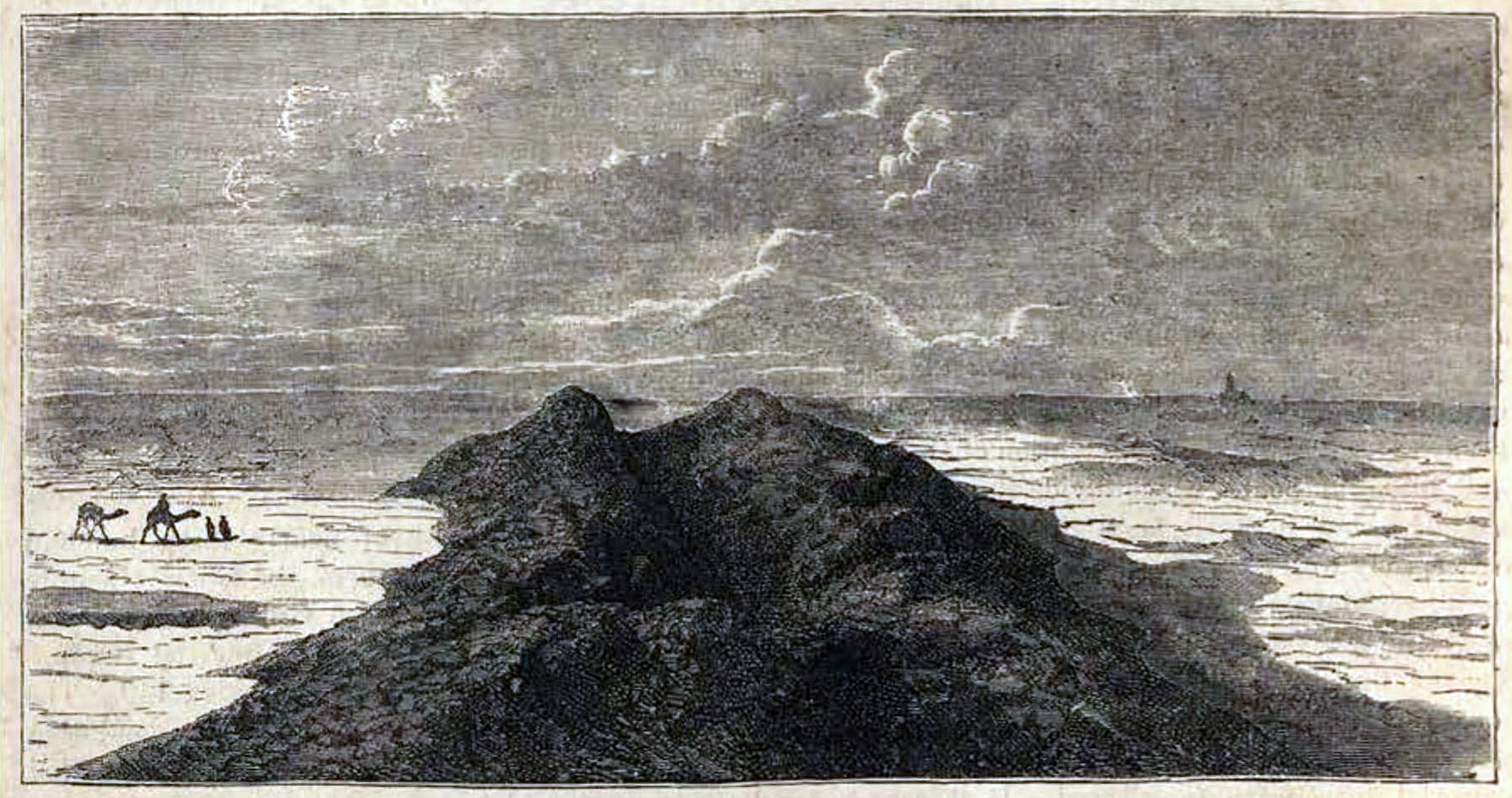
The desert was historically inhabited by nomadic Arabs (Bedouins) and nomadic Aramean tribes, and many tribes still remain in the region, their members living mainly in towns and settlements built near oases. Some Bedouin still maintain their traditional way of life in the desert. Safaitic inscriptions, proto-Arabic texts written by literate Bedouin, are found throughout the Syrian Desert. These date roughly from the first century BC to the fourth century AD.
One of the most important ancient settlements in the Syrian desert is Palmyra; first mentioned in the second millennium BC, the city was an important trading center in Roman times, and its people were renowned merchants who took advantage of its strategic position on the Silk Road linking the Far East to the Mediterranean Sea, by taxing caravans that were passing by, establishing colonies on the silk road, and trading in the rare commodities from the far east, thus bringing enormous wealth to their city.
Another important ancient settlement is the city of Dura-Europos on the Euphrates. Originally a fortress, it was founded during the Seleucid Empire and initially given the name Dura, which means "Fortress", but was called Europos by the Greeks. The combination Dura-Europos is a modern invention. The city prospered, mainly for its location on the Euphrates, fostering commercial and military connections between Mesopotamia to the Mediterranean. After it was raided by the Sasanian emperor Shapur I in the 250s, most of its citizens fled, and under Sasanian rule, the city was abandoned.
Modern
During the Ottoman Empire's Armenian genocide, large numbers of victims were deported across the Euphrates River into the desert to die.
The Syrian desert was first traversed by motor vehicle in 1919.
During the Iraq War, the desert served as a major supply line for the Iraqi resistance, with the Iraq portion of the desert becoming a primary stronghold of the Sunni resistance operating in the Al Anbar Governorate, particularly after the Multi-National Force – Iraq capture of Fallujah during the Second Battle of Fallujah. A series of Coalition military operations were relatively ineffective at removing the insurgency presence in the Desert. As the resistance began to gain control of the surrounding areas, coalition spokesmen began to downplay the importance of the Syrian Desert as a center of operations; nevertheless the Syrian Desert remained one of the primary routes for smuggling equipment and insurgents due to its location near the Syrian border. By September 2006, the resistance had gained control of virtually all of the Anbar Governorate and had moved most of their forces, equipment and leaders further east to resistance-controlled cities near the Euphrates river.
During the Syrian civil war and concurrent War in Iraq, ISIS managed to occupy most of the desert region in both Iraq and Syria between 2013 and 2015 during the Anbar campaign and Eastern Syria offensive. Starting in December 2016 and throughout 2017, several campaigns successfully retook the entire region from the militant group, leaving only sporadic skirmishes.
Economy and agriculture
With low rainfall and poor-quality soils, today the region is principally used as rangeland for livestock. Bedouin herdsmen, many of whom are still nomadic, graze about twelve million sheep and goats here, as well as a smaller number of camels.
The International Fund for Agricultural Development aims to alleviate rural poverty, and in 1995, in cooperation with the Syrian government, it started a project to rehabilitate over a million hectares of degraded land in the Syrian Badia. In some areas, when grazing was restricted, there was a spontaneous return of many of the native plants. In other areas which were more heavily degraded, grazing restrictions were supplemented by reseeding and the planting of fodder species. By the time the project ended in 2010, nearly a quarter of a million hectares had been reseeded, and nearly a hundred thousand hectares had been planted with native fodder shrubs. The result has been a great success, with some herdsmen reporting tenfold increases in the productivity of their livestock.
Gallery
File:Syrian desert near Palmyra, Hills, Syria.jpg|Desert around Palmyra File:Syrian desert near Palmyra 2, Syria.jpg|Road in the desert near Palmyra File:Syrian desert, Trees, Al-Sukhnah, Syria.jpg|Oasis near Al-Sukhnah File:Camels in the desert, Raqqa, Syria.jpg|Camels in the desert near Raqqa File:Resafa, Sergiopolis, View, Syria.jpg|Resafa ruins southwest of Raqqa and the Euphrates. File:Syrian Desert (5079766124).jpg|Rocks, unidentified location
References
References
- "Syrian Desert {{!}} Map & Facts {{!}} Britannica".
- (2005). "Grasslands of the World". FAO.
- "Jordan Badia {{!}} The Hashemite Fund for Development of jordan Badia".
- "The rangelands of the Syrian Arab Republic". FAO.
- (2003). "Atlas of the World's Deserts". Taylor & Francis.
- "Syrian Desert".
- (1914). "New International Encyclopedia". Dodd, Mead.
- (1996). "The Harra and the Hamad: Excavations and surveys in Eastern Jordan, vol. 1.". Collis Publication.
- (1973). "Annual Review, Volume 2". Institute for Defence Studies and Analyses.
- (2005). "Ancient Mesopotamia: New Perspectives". [[ABC-CLIO]].
- (1956). "Area Handbook on Iraq". Pr. by Human Relations Area Files.
- (1964). "Sumer". Directorate General of Antiquities..
- (2011). "Groundwater in the Arab Middle East". Springer.
- "Jebel 'Aneiza, Saudi Arabia".
- (December 2010). "Transboundary Aquifers, Challenges and New Directions". [[UNESCO]].
- "GEF Country Portfolio Evaluation: Syria (1994–2008)". GEF Evaluation Office.
- (1987). "Laboratory hamsters". Academic Press.
- (2009). "The Great Empires of the Ancient World". Getty Publications.
- (1999). "The Palmyrenes of Dura-Europos: A Study of Religious Interaction in Roman Syria". BRILL.
- Naimark, Norman M.. (2017). "Genocide: A World History". Oxford University Press.
- (2003). "The Syrian desert: Caravans, travel and exploration". Taylor and Francis.
- (22 October 2006). "U.S. diplomat apologizes for remarks". NBC News.
- Knickmeyer, Ellen. (29 May 2006). "U.S. Will Reinforce Troops in West Iraq". Washingtonpost.com.
- (30 May 2006). "WP: U.S. to reinforce troops in west Iraq". MSNBC.
- (10 September 2006). "Situation Called Dire in West Iraq". Washington Post.
- Khani, Shoresh. (12 August 2021). "The Regrouping of ISIS in the Deserts of Syria". The Washington Institute.
- "The grass is greener: Rehabilitating the Syrian Badia". IFAD.
This article was imported from Wikipedia and is available under the Creative Commons Attribution-ShareAlike 4.0 License. Content has been adapted to SurfDoc format. Original contributors can be found on the article history page.
Ask Mako anything about Syrian desert — get instant answers, deeper analysis, and related topics.
Research with MakoFree with your Surf account
Create a free account to save articles, ask Mako questions, and organize your research.
Sign up freeThis content may have been generated or modified by AI. CloudSurf Software LLC is not responsible for the accuracy, completeness, or reliability of AI-generated content. Always verify important information from primary sources.
Report