From Surf Wiki (app.surf) — the open knowledge base
Surxondaryo Region
Region of Uzbekistan
Region of Uzbekistan
| Field | Value |
|---|---|
| name | Surkhondaryo Region |
| native_name | Surxondaryo viloyati |
| Сурхондарё вилояти | |
| settlement_type | Region |
| image_skyline | Mausoleum Termez.jpg |
| image_caption | Mausoleum of Hakim al-Termezi in Termez |
| image_map | Surxondaryo Viloyati in Uzbekistan.svg |
| map_caption | Surxondaryo in Uzbekistan |
| coordinates | |
| subdivision_type | Country |
| subdivision_name | Uzbekistan |
| blank_name_sec1 | Districts |
| blank_info_sec1 | 14 |
| blank1_name_sec1 | Cities |
| blank1_info_sec1 | 8 |
| blank2_name_sec1 | Townships |
| blank2_info_sec1 | 7 |
| blank3_name_sec1 | Villages |
| blank3_info_sec1 | 114 |
| seat | Termez |
| seat_type | Capital |
| leader_title | Hokim |
| leader_name | Ulug‘bek Qosimov |
| area_total_km2 | 20099 |
| timezone1 | East |
| utc_offset1 | +5 |
| population_footnotes | |
| population_total | 2680800 |
| population_as_of | 2021 |
| population_density_km2 | auto |
| elevation_m | 535 |
| iso_code | UZ-SU |
| website |
Сурхондарё вилояти
Surxondaryo Region is a region (viloyat) of Uzbekistan, located in the extreme south-east of the country. Established on 6 March 1941, it borders on Qashqadaryo Region internally, and Turkmenistan, Afghanistan and Tajikistan externally, going anticlockwise from the north. It takes its name from the river Surxondaryo, that flows through the region. It covers an area of 20,100 km². According to official data, 83% of the population are Uzbeks and 12.5% Tajiks. The highest point of the Region and also of Uzbekistan is Khazrati Sulton peak reaching 4,643 m/15,233 ft in Gissar Range.
The regional capital is Termez with a population of about 200,000 (2024), and the second largest city is Denov (Denau) with 78,300 inhabitants (data for 2016). Other towns include Boysun, Jarqoʻrgʻon, Qumqoʻrgʻon, Shargʻun, Sherobod, Shoʻrchi, and Sariosiyo.
The climate is continental, with mild wet winters and hot dry summers. The southern part of the region is in the Badkhiz-Karabil semi-desert ecoregion (PA0808), characterized by a savanna of pistachio and desert sedge. The northern portion is characterized by open woodlands (Gissaro-Alai open woodlands ecoregion, PA1306), with characteristic plants being pistachio, almond, walnut, apple, and juniper. Sagebrush is common at lower elevations
Natural resources include petroleum, natural gas, and coal. Light industry, mainly cotton ginning and food processing, is also an important part of the regional economy, particularly in the production of consumer goods. Agriculture is based primarily on cotton and cereals, supplemented with horticulture and viticulture. Surxondaryo is the country's largest supplier of long-fiber cotton. Livestock accounts for 40% of regional agricultural product. The climatic conditions of this region also make it possible to cultivate subtropical crops such as sugarcane.
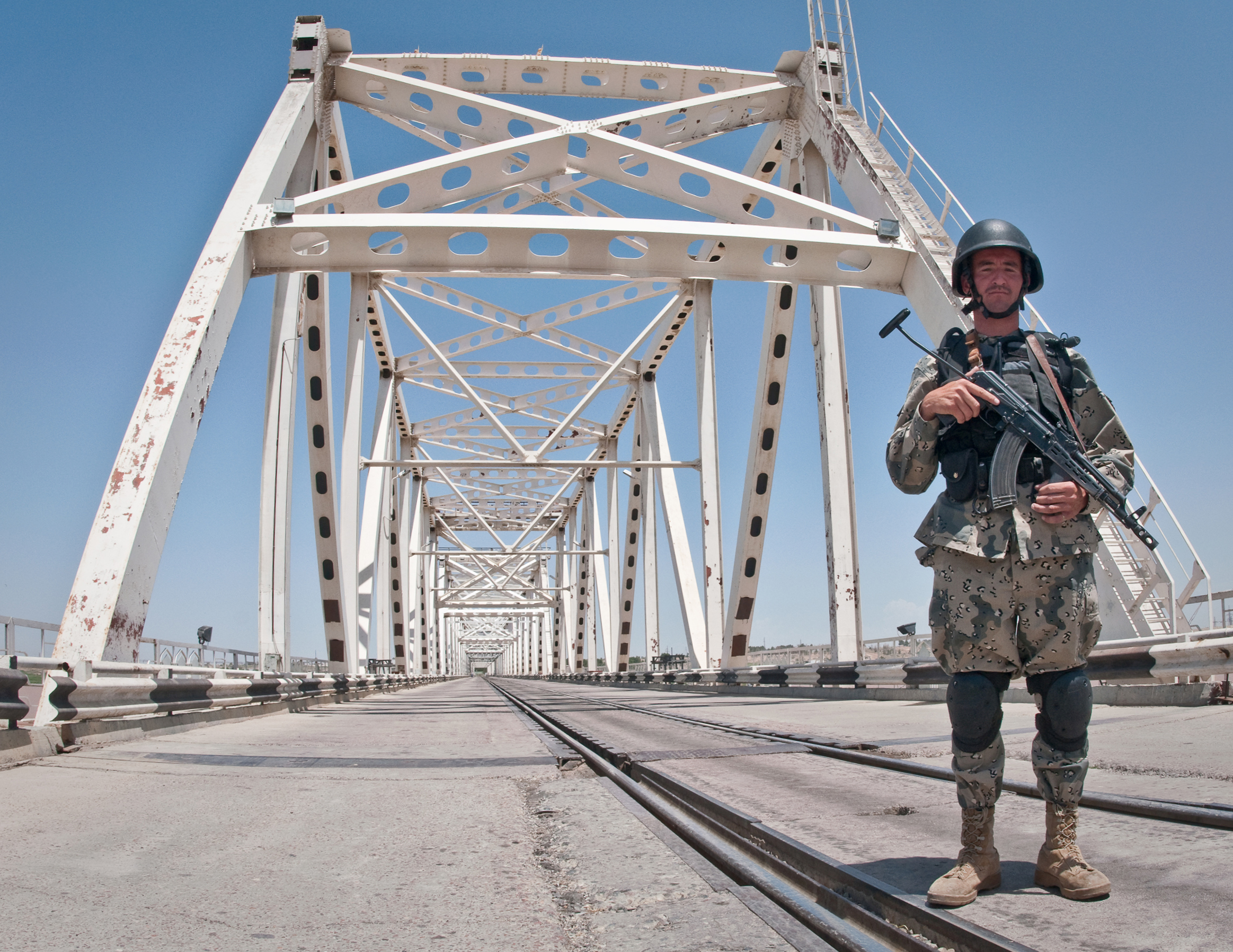
The region has a well-developed transport infrastructure, with 300 km of railways and 2,700 km of surfaced roads. Central Asia's only river port is located at Termez on the Amudarya River.
History
Bitter debates accompanied the Soviet allocation of Surkhandarya Region to the Uzbek SSR rather than the Tajik SSR in 1929, as that region, as well as the areas of Bukhara and Samarkand, had sizable, if not dominant, Tajik populations.
Districts

The Surxondaryo Region consists of 14 districts (listed below) and one district-level city: Termez.
| District name | District capital | |||
|---|---|---|---|---|
| 1 | ||||
| 2 | ||||
| 3 | ||||
| 4 | ||||
| 5 | ||||
| 6 | ||||
| 7 | ||||
| 8 | ||||
| 9 | ||||
| 10 | ||||
| 11 | ||||
| 12 | ||||
| 13 | ||||
| 14 |
There are 8 cities (Termez, Boysun, Denov, Jarqoʻrgʻon, Qumqoʻrgʻon, Shargʻun, Sherobod, Shoʻrchi) and 112 urban-type settlements in the Surxondaryo Region.
Agriculture (2005 data)
Agriculture accounts for 42% of total employment in Surxondaryo Region and produces 8% of Uzbekistan’s agricultural output. Agricultural production is 56% crops and 44% livestock (like the country’s average). Milk yields are less than 1,700 kg per cow per year, on a par with the national average.
Main characteristics of agriculture in Surxondaryo Region
| Surxondaryo | Percent of | |||
|---|---|---|---|---|
| national total | ||||
| Sown area | ||||
| Cereals | ||||
| Cotton | ||||
| Potatoes, vegetables | ||||
| Feed crops | ||||
| Fruit orchards | ||||
| Vineyards | ||||
| Cattle | ||||
| Cows | ||||
| Sheep, goats |
Gallery
File:Khujaypok (uzb. Xo'jaypok), Surkhandarya, Uzbekistan-12.jpg|Two different streams flow into one (a healing spring and the river itself in blue) File:Khujaypok (uzb. Xo'jaypok), Surkhandarya, Uzbekistan-15.jpg|Market at the foot of Khujaypok File:Khujaypok (uzb. Xo'jaypok), Surkhandarya, Uzbekistan-14.jpg|Healing bath from a hydrogen-chloride source. Treats infectious skin diseases and difficult to heal wounds File:Khujaypok (uzb. Xo'jaypok), Surkhandarya, Uzbekistan-16.jpg|The Khujaypok river
Notes
References
References
- (13 March 2023). "Ulug'bek Qosimov Surxondaryo viloyati hokimi etib tasdiqlandi".
- "Ўзбекистонда энг кўп аҳоли қайси вилоятда яшайди?".
- ''Statistical Yearbook of the Regions of Uzbekistan 2005'', State Statistical Committee, Tashkent, 2006 ('''Russian''').
- [http://rus.surxon.net/2007/11/22/pro-surkhandarja.html Ethnic composition of the population in Surxondaryo Region]
- [http://ula.uzsci.net/publishing/ru/etnic.htm ''Ethnic Atlas of Uzbekistan''] {{Webarchive. link. (2008-10-06 , Part 1: Ethnic minorities, Open Society Institute, table with number of Tajiks by region {{in lang). ru.
- "Urban and rural population by district". Surxondaryo regional department of statistics.
- {{NatGeo ecoregion
- {{NatGeo ecoregion
- Hirsch, Francine. (2005). "Empire of Nations: Ethnographic Knowledge and the Making of the Soviet Union". Cornell University Press.
- (July 2021). "Oʻzbekiston Respublikasining maʼmuriy-hududiy boʻlinishi". The State Committee of the Republic of Uzbekistan on statistics.
- (July 2020). "Classification system of territorial units of the Republic of Uzbekistan". The State Committee of the Republic of Uzbekistan on statistics.
- ''Agriculture in Uzbekistan'', State Statistical Committee, Tashkent, 2007 ('''Russian''').
This article was imported from Wikipedia and is available under the Creative Commons Attribution-ShareAlike 4.0 License. Content has been adapted to SurfDoc format. Original contributors can be found on the article history page.
Ask Mako anything about Surxondaryo Region — get instant answers, deeper analysis, and related topics.
Research with MakoFree with your Surf account
Create a free account to save articles, ask Mako questions, and organize your research.
Sign up freeThis content may have been generated or modified by AI. CloudSurf Software LLC is not responsible for the accuracy, completeness, or reliability of AI-generated content. Always verify important information from primary sources.
Report