From Surf Wiki (app.surf) — the open knowledge base
Supine position
Lying horizontally with the face and torso facing up
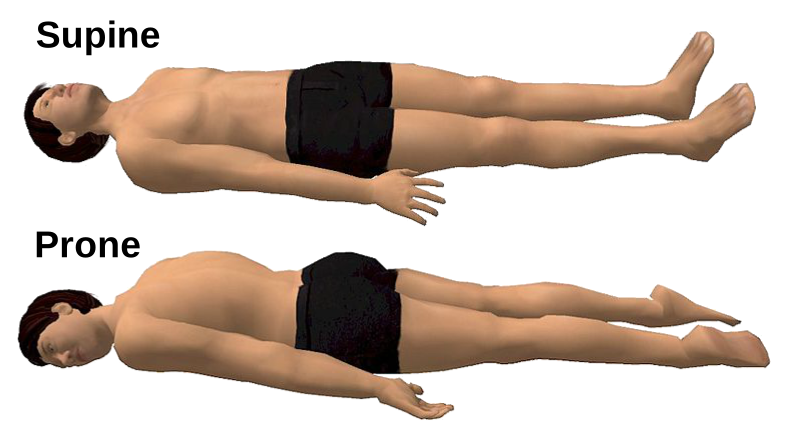
Lying horizontally with the face and torso facing up

The supine position () means lying horizontally, with the face and torso facing up, as opposed to the prone position, which is face down. When used in surgical procedures, it grants access to the peritoneal, thoracic, and pericardial regions; as well as the head, neck, and extremities.
Using anatomical terms of location, the dorsal side is down, and the ventral side is up, when supine.
Semi-supine
In scientific literature "semi-supine" commonly refers to positions where the upper body is tilted (at 45° or variations) and not completely horizontal.
Relation to sudden infant death syndrome
Main article: Sudden infant death syndrome
The decline in death due to sudden infant death syndrome (SIDS) is said to be attributable to having babies sleep in the supine position. The realization that infants sleeping face down, or in a prone position, had an increased mortality rate re-emerged into medical awareness at the end of the 1980s when two researchers, Susan Beal in Australia and Gus De Jonge in the Netherlands, independently noted the association.
It is believed that in the prone position babies are more at risk to re-breathe their own carbon dioxide. Because of the immature state of their central chemoreceptors, infants do not respond to the subsequent respiratory acidosis that develops. Typical non-infants realize autonomic responses of increased rate and depth of respiration (hyperventilation, yawning).
Obstructive sleep apnea
Obstructive sleep apnea (OSA) is a form of sleep apnea that occurs more frequently when throat muscles relax and is most severe when individuals are sleeping in the supine position. Studies and evidence show that OSA related to sleeping in the supine position is related to the airway positioning, reduced lung volume, and the inability of airway muscles to dilate enough to compensate as the airway collapses. With individuals who have OSA, many health care providers encourage their patients to avoid the supine position while asleep and sleep laterally or sleep with the head of their bed up in a 30- or 45-degree angle.
References
References
- Rothrock, J. C. (2007) ''Alexander's Care of the Patient in Surgery 13th Ed.'' Mobsy Elsevier: St Louis, Missouri. p. 148.
- (2006). "Quantitative analysis of semi-supine exercise echocardiography--influence of age on myocardial Doppler imaging indices". Acta Cardiologica.
- (3 May 2014). "Sudden Infant Death Syndrome Could Be Prevented By Making Sure Baby Sleeps On Back". Headlines & Global News.
- (2018-03-01). "Why is a prone sleeping position dangerous for certain infants?". Forensic Science, Medicine and Pathology.
- (1998). "Risk and preventive factors for cot death in The Netherlands, a low-incidence country". Eur. J. Pediatr..
- "The Changing Concept of Sudden Infant Death Syndrome: Diagnostic Coding Shifts, Controversies Regarding the Sleeping Environment, and New Variables to Consider in Reducing Risk". [[American Academy of Pediatrics]].
- "What is sleep apnea therapy? Obstructive sleep apnea".
- (2014-02-01). "Supine position related obstructive sleep apnea in adults: pathogenesis and treatment". Sleep Medicine Reviews.
- (2009-07-01). "Avoiding the Supine Posture during Sleep for Patients with Mild Obstructive Sleep Apnea". American Journal of Respiratory and Critical Care Medicine.
- "Sleep Apnea Treatment".
This article was imported from Wikipedia and is available under the Creative Commons Attribution-ShareAlike 4.0 License. Content has been adapted to SurfDoc format. Original contributors can be found on the article history page.
Ask Mako anything about Supine position — get instant answers, deeper analysis, and related topics.
Research with MakoFree with your Surf account
Create a free account to save articles, ask Mako questions, and organize your research.
Sign up freeThis content may have been generated or modified by AI. CloudSurf Software LLC is not responsible for the accuracy, completeness, or reliability of AI-generated content. Always verify important information from primary sources.
Report