From Surf Wiki (app.surf) — the open knowledge base
Supervolcano
Volcano that has had an eruption with a volcanic explosivity index (VEI) of 8
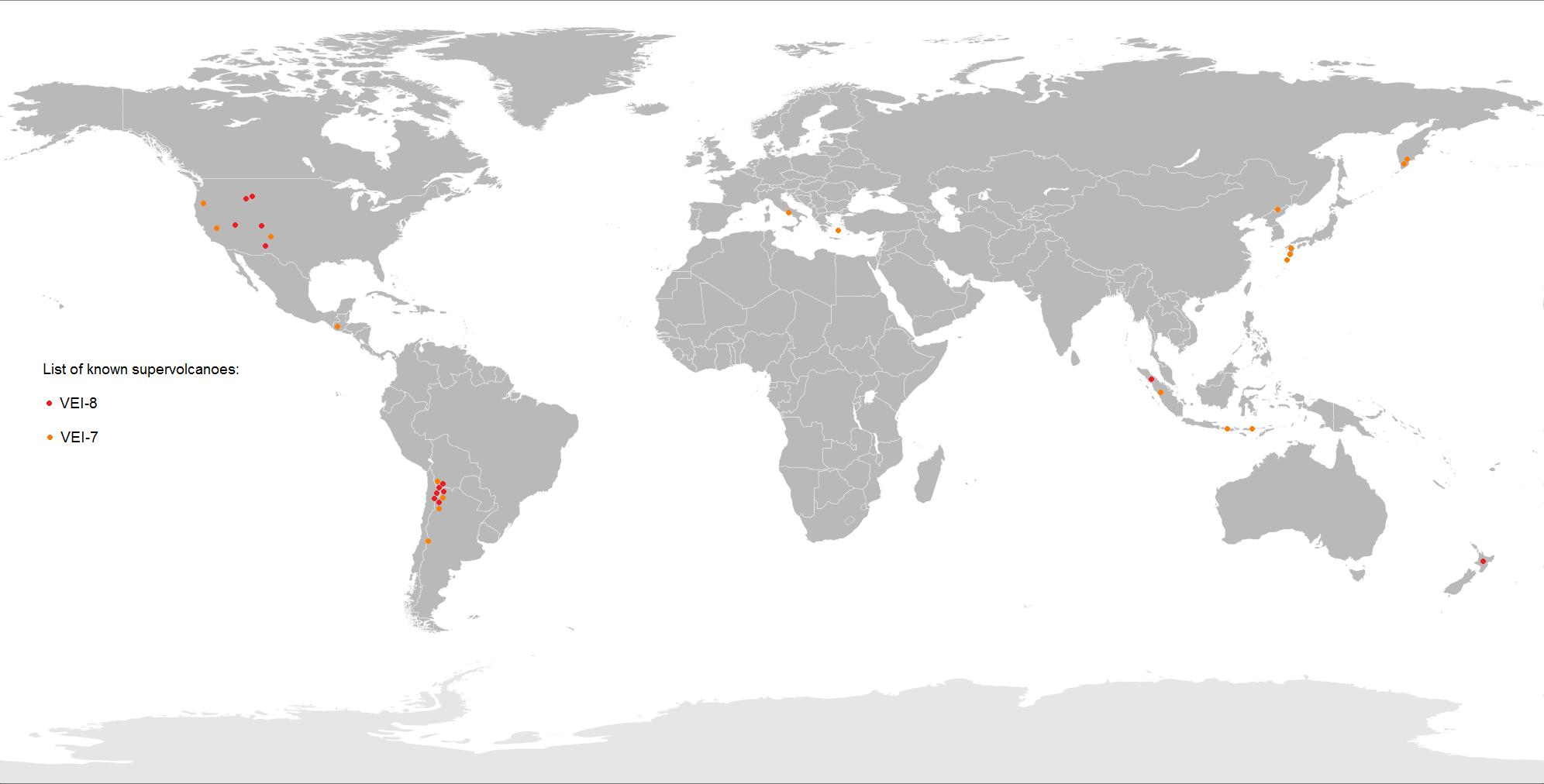
Volcano that has had an eruption with a volcanic explosivity index (VEI) of 8
]]
A supervolcano is a volcano that has had an eruption with a volcanic explosivity index (VEI) of 8, the largest recorded value on the index. This means the volume of deposits for such an eruption is greater than 1,000 km3.
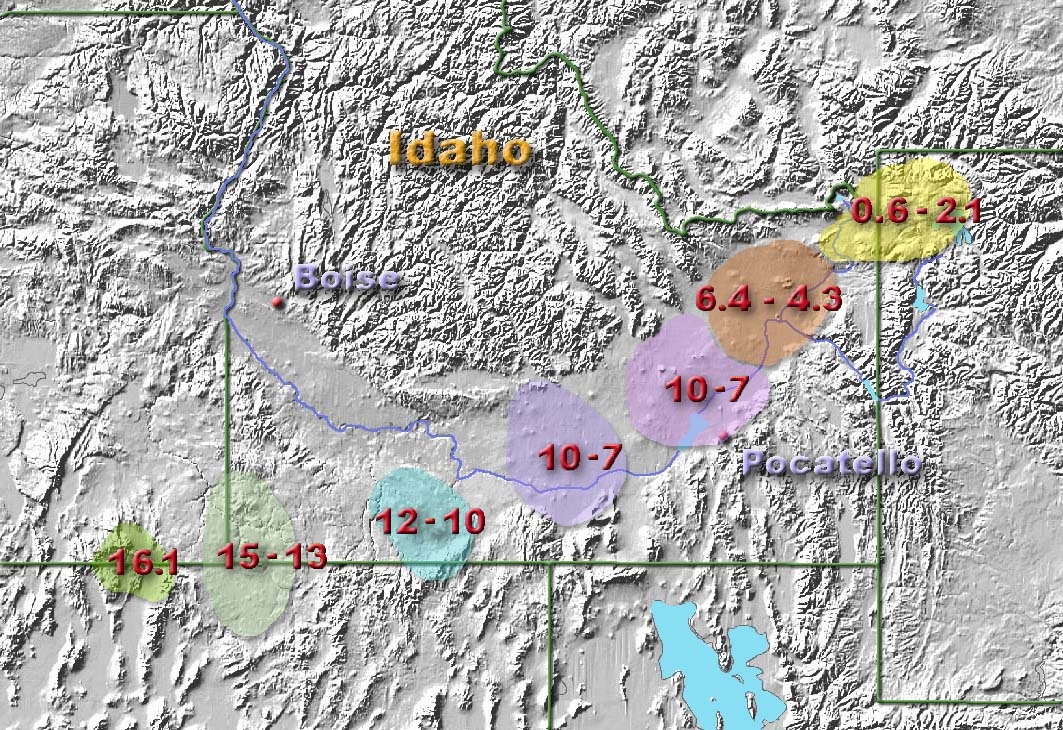

Supervolcanoes occur when magma in the mantle rises into the crust but is unable to break through it. Pressure builds in a large and growing magma pool until the crust is unable to contain the pressure and ruptures. This can occur at hotspots (for example, Yellowstone Caldera) or at subduction zones (for example, Toba).
Large-volume supervolcanic eruptions are also often associated with large igneous provinces, which can cover huge areas with lava and volcanic ash. These can cause long-lasting climate change (such as the triggering of a small ice age) and threaten species with extinction. The Oruanui eruption of New Zealand's Taupō Volcano (about 25,600 years ago) was the world's most recent VEI-8 eruption.
Terminology
The term "supervolcano" was first used in a volcanic context in 1949. Its origins lie in an early 20th-century scientific debate about the geological history and features of the Three Sisters volcanic region of Oregon in the United States. In 1925, Edwin T. Hodge suggested that a very large volcano, which he named Mount Multnomah, had existed in that region.Subsequent research proved that each peak of the Three Sisters was formed independently, and that Mount Multnomah never existed. He believed that several peaks in the Three Sisters area were remnants of Mount Multnomah after it had been largely destroyed by violent volcanic explosions, similarly to Mount Mazama. In his 1948 book The Ancient Volcanoes of Oregon, volcanologist Howel Williams ignored the possible existence of Mount Multnomah, but in 1949 another volcanologist, F. M. Byers Jr., reviewed the book, and in the review, Byers refers to Mount Multnomah as a "supervolcano".
More than fifty years after Byers' review was published, the term supervolcano was popularised by the BBC popular science television program Horizon in 2000, referring to eruptions that produce extremely large amounts of ejecta.
The term megacaldera is sometimes used for caldera supervolcanoes, such as the Blake River Megacaldera Complex in the Abitibi greenstone belt of Ontario and Quebec, Canada.
Though there is no well-defined minimum explosive size for a "supervolcano", there are at least two types of volcanic eruptions that have been identified as supervolcanoes: large igneous provinces and massive eruptions.
Large igneous provinces
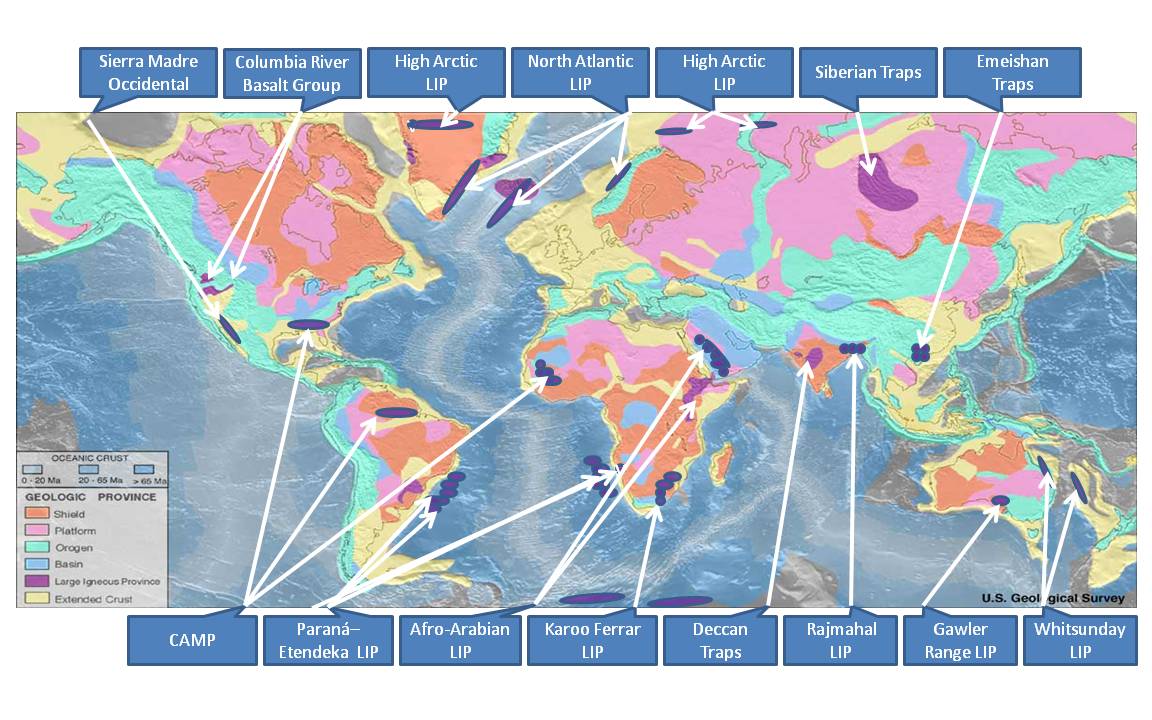
Main article: Large igneous province
Large igneous provinces, such as Iceland, the Siberian Traps, Deccan Traps, and the Ontong Java Plateau, are extensive regions of basalts on a continental scale resulting from flood basalt eruptions. When created, these regions often occupy several thousand square kilometres and have volumes on the order of millions of cubic kilometers. In most cases, the lavas are normally laid down over several million years. They release large amounts of gases.
The Réunion hotspot produced the Deccan Traps about 66 million years ago, coincident with the Cretaceous–Paleogene extinction event. The scientific consensus is that an asteroid impact was the cause of the extinction event, but the volcanic activity may have caused environmental stresses on extant species up to the Cretaceous–Paleogene boundary. Some scientists have hypothesised that the volcanism around the Deccan Traps could have been intensified by the Chicxulub impact, which would have been close to the antipodal point of the Traps at that time.
Additionally, the largest flood basalt event (the Siberian Traps) occurred around 250 million years ago and was coincident with the largest mass extinction in history, the Permian–Triassic extinction event, although it is unknown whether it was solely responsible for the extinction event.
Such outpourings are not explosive, though lava fountains may occur. Many volcanologists consider Iceland to be a large igneous province that is currently being formed. The last major outpouring occurred in 1783–84 from the Laki fissure, which is approximately 40 km long. An estimated 14 km3 of basaltic lava was poured out during the eruption (VEI 4).
The Ontong Java Plateau has an area of about 2000000 km2, and the province was at least 50% larger before the Manihiki and Hikurangi Plateaus broke away.
Massive explosive eruptions
Volcanic eruptions are classified using the volcanic explosivity index. It is a logarithmic scale, and an increase of one in VEI number is equivalent to a tenfold increase in volume of erupted material. VEI 7 or VEI 8 eruptions are so powerful that they often form circular calderas rather than cones because the downward withdrawal of magma causes the overlying rock mass to collapse into the empty magma chamber beneath it.
Known supereruptions
Known super eruptions
Based on incomplete statistics, at least 60 VEI 8 eruptions have been identified.
| Name | Zone | Location | Notes | Years ago (approx.) | Ejecta bulk volume (approx.) | Reference | ||||||||||||||||||||||||||||||||||||||||||
|---|---|---|---|---|---|---|---|---|---|---|---|---|---|---|---|---|---|---|---|---|---|---|---|---|---|---|---|---|---|---|---|---|---|---|---|---|---|---|---|---|---|---|---|---|---|---|---|---|
| Los Chocoyos eruption | Atitlán Caldera, Sololá | Guatemala | 1,220 km3 | |||||||||||||||||||||||||||||||||||||||||||||
| Youngest Toba eruption | Toba Caldera, North Sumatra | Sumatra, Indonesia | Produced 439–631 million tons of sulfuric acid. Largest eruption in the last 25 million years. | 74,000 | journal= Science | doi=10.1126/science.1141564 | year=2007 | title= Middle Paleolithic Assemblages from the Indian Subcontinent Before and After the Toba Super-Eruption | last1= Petraglia | first1= M. | last2= Korisettar | first2= R. | last3= Boivin | first3= N. | last4= Clarkson | first4= C. | last5= Ditchfield | first5= P. | last6= Jones | first6= S. | last7= Koshy | first7= J. | last8= Lahr | first8= M. M. | last9= Oppenheimer | first9= C. | last10=Pyle | first10=D. | last11=Roberts | first11=R. | last12=Schwenninger | first12=J.-L. | last13=Arnold | first13=L. | last14=White | first14=K. | volume= 317 | issue= 5834 | pages= 114–116 | pmid= 17615356 | bibcode = 2007Sci...317..114P | s2cid=20380351 | display-authors=8 | url=https://ro.uow.edu.au/era/2117 | url-access= subscription | hdl= 10072/412769 | hdl-access= free}} | |
| Flat Landing Brook Formation | Tetagouche Group | New Brunswick, Canada | Possibly the largest known supereruption. Existence as a single eruption is controversial, and it could have been a multiple 2,000+ km3 event that spanned less than a million years | 466,000,000 | ||||||||||||||||||||||||||||||||||||||||||||
| Wah Wah Springs Caldera | Indian Peak–Caliente Caldera Complex | Utah, United States | The largest of the Indian Peak-Caliente Caldera Complex eruptions, preserved as the Wah Wah Springs Tuff; includes pyroclastic flows more than 500 m thick | 30,600,000 | ||||||||||||||||||||||||||||||||||||||||||||
| La Garita Caldera | San Juan volcanic field | Colorado, United States | Fish Canyon eruption | 27,800,000 | 5,000 km3 | |||||||||||||||||||||||||||||||||||||||||||
| Grey's Landing Supereruption | Yellowstone hotspot | United States | Deposited the Grey's Landing Ignimbrite | 8,720,000 | 2,800 km3 | last1=Knott | first1=Thomas | last2=Branney | first2=M. | last3=Reichow | first3=Marc | last4=Finn | first4=David | last5=Tapster | first5=Simon | last6=Coe | first6=Robert | title=Discovery of two new super-eruptions from the Yellowstone hotspot track (USA): Is the Yellowstone hotspot waning? | journal=Geology | date=June 2020 | volume=48 | issue=9 | pages=934–938 | doi=10.1130/G47384.1 | bibcode=2020Geo....48..934K | url=https://www.researchgate.net/publication/341810855 | access-date=21 June 2022 | doi-access=free }} | ||||||||||||||||||||
| La Pacana | Andes Central Volcanic Zone | Chile | Responsible for the Antana Ignimbrite | 4,000,000 | 2,500 km3 | last=Lindsay | first=J. M. | date=1 March 2001 | title=Magmatic Evolution of the La Pacana Caldera System, Central Andes, Chile: Compositional Variation of Two Cogenetic, Large-Volume Felsic Ignimbrites | journal=Journal of Petrology | volume=42 | issue=3 | pages=459–486 | doi=10.1093/petrology/42.3.459 | issn=0022-3530 | bibcode=2001JPet...42..459L | doi-access=free}} | |||||||||||||||||||||||||||||||
| Huckleberry Ridge eruption | Yellowstone hotspot | Idaho, United States | Huckleberry Ridge Tuff; consisted of three distinct eruptions separated by years to decades | 2,100,000 | title=What is a supervolcano? What is a supereruption? | date= July 2024 | url= https://www.usgs.gov/faqs/what-a-supervolcano-what-a-supereruption | publisher=USGS}} | ||||||||||||||||||||||||||||||||||||||||
| Whakamaru Caldera | Taupō Volcanic Zone | North Island, New Zealand | Whakamaru Ignimbrite/Mount Curl Tephra | 340,000 | 2,000 km3 | |||||||||||||||||||||||||||||||||||||||||||
| Heise Volcanic Field | Yellowstone hotspot | Idaho, United States | Kilgore Tuff | 4,500,000 | 1,800 km3 | doi=10.1130/B25519.1 | author1=Lisa A. Morgan | author2=William C. McIntosh | s2cid=53648675 | name-list-style=amp | title=Timing and development of the Heise volcanic field, Snake River Plain, Idaho, western USA | journal=GSA Bulletin | year=2005 | volume=117 | issue=3–4 | pages=288–306 | bibcode = 2005GSAB..117..288M }} | |||||||||||||||||||||||||||||||
| McMullen Supereruption | Yellowstone hotspot | Southern Idaho, United States | McMullen Ignimbrite | 8,990,000 | 1,700 km3 | |||||||||||||||||||||||||||||||||||||||||||
| Heise Volcanic Field | Yellowstone hotspot | Idaho, United States | Blacktail Tuff | 6,000,000 | 1,500 km3 | |||||||||||||||||||||||||||||||||||||||||||
| Cerro Guacha | Altiplano–Puna volcanic complex | Sur Lípez, Bolivia | Guacha ignimbrite, two smaller eruptions identified | 5,700,000 | 1,300 km3 | |||||||||||||||||||||||||||||||||||||||||||
| Mangakino Caldera | Taupō Volcanic Zone | North Island, New Zealand | Kidnappers eruption | 1,080,000 | 1,200 km3 | |||||||||||||||||||||||||||||||||||||||||||
| Oruanui eruption | Taupō Volcanic Zone | North Island, New Zealand | Taupō Volcano (Lake Taupō) | 26,500 | 1,170 km3 | |||||||||||||||||||||||||||||||||||||||||||
| Galán | Andes Central Volcanic Zone | Catamarca, Argentina | Consisted of three distinct eruptions, separated by 30-40 thousand years | 2,500,000 | 1,050 km3 | |||||||||||||||||||||||||||||||||||||||||||
| Lava Creek eruption | Yellowstone hotspot | Idaho, Montana, and Wyoming, United States | Lava Creek Tuff; consisted of two distinct eruptions separated by years | 640,000 | 1,000 km3 | url=https://web.archive.org/web/20100213010407/http://www.volcano.si.edu/world/largeeruptions.cfm | date=13 February 2010 }}. Volcano.si.edu. Retrieved on 18 November 2011. |
Media portrayal
- Nova featured an episode "Mystery of the Megavolcano" in September 2006 examining such eruptions in the last 100,000 years.
- Supervolcano is the title of a British-Canadian television disaster film, first released in 2005. It tells a fictional story of a supereruption at Yellowstone.
- In the 2009 disaster film 2012, a supereruption of Yellowstone is one of the events that contributes to a global cataclysm.
- The 2025 political thriller Paradise takes place after an eruption of a fictional Antarctic supervolcano and subsequent megatsunami, causing the United States federal government and other prominent individuals to relocate to an underground city in Colorado.
Gallery
File:Taupo.Volcanic.Zone.North.Island.NZ.JPG|Volcano, lake, and caldera locations in the Taupō Volcanic Zone
Notes
References
References
- de Silva, Shanaka. (2008). "Arc magmatism, calderas, and supervolcanos". Geology.
- (21 August 2015). "Questions About Supervolcanoes". [[USGS]] Yellowstone Volcano Observatory.
- (September 2014). "Linking rapid magma reservoir assembly and eruption trigger mechanisms at evolved Yellowstone-type supervolcanoes". Geology.
- (25 January 2017). "Magma reservoir dynamics at Toba caldera, Indonesia, recorded by oxygen isotope zoning in quartz". Scientific Reports.
- (2001). "The 26.5ka Oruanui eruption, New Zealand: An introduction and overview". Journal of Volcanology and Geothermal Research.
- [http://oed.com/view/Entry/311217 ''supervolcano, n.''] Oxford English Dictionary, third edition, online version June 2012. Retrieved on 17 August 2012.
- Byers Jr., F. M.. (May 1949). "Review of ''The Ancient Volcanoes of Oregon'', by H. Williams". The Journal of Geology.
- Klemetti, Erik. (4 October 2013). "The rise of a supervolcano".
- Harris, Stephen (1988). ''Fire Mountains of the West: The Cascade and Mono Lake Volcanoes''. Missoula, Mountain Press.
- [http://oed.com/view/Entry/311217 ''supervolcano, n.''] Oxford English Dictionary, third edition, online version June 2012. Retrieved on 17 August 2012.
- Byers Jr., F. M.. (May 1949). "Review of ''The Ancient Volcanoes of Oregon'', by H. Williams". The Journal of Geology.
- (3 February 2000). "Supervolcanoes". BBC.
- [https://vulcan.wr.usgs.gov/Volcanoes/Yellowstone/description_yellowstone.html USGS Cascades Volcano Observatory] {{webarchive. link. (4 February 2012 . Vulcan.wr.usgs.gov. Retrieved on 18 November 2011.)
- (January 2009). "An Archean megacaldera complex: The Blake River Group, Abitibi greenstone belt". Precambrian Research.
- Bryan, S.E.. (2010). "The largest volcanic eruptions on Earth". Earth-Science Reviews.
- Keller, G. (2014). "Deccan volcanism, the Chicxulub impact, and the end-Cretaceous mass extinction: Coincidence? Cause and effect?". Geological Society of America Special Papers.
- Richards, M.A., ''et al.'' "[https://pubs.geoscienceworld.org/gsa/gsabulletin/article-abstract/127/11-12/1507/126064/Triggering-of-the-largest-Deccan-eruptions-by-the?redirectedFrom=fulltext Triggering of the largest Deccan eruptions by the Chicxulub impact]," GSA Bulletin (2015) 127 (11-12): 1507–1520. Retrieved 4 March 2025.
- BG, Mason. (2004). "The size and frequency of the largest explosive eruptions on Earth". Bull Volcanol.
- (2021). "A history of violence: magma incubation, timing and tephra distribution of the Los Chocoyos supereruption (Atitlán Caldera, Guatemala)". Journal of Quaternary Science.
- (2024-10-01). "A Bayesian age from dispersed plagioclase and zircon dates in the Los Chocoyos ash, Central America". Earth and Planetary Science Letters.
- (2007). "Middle Paleolithic Assemblages from the Indian Subcontinent Before and After the Toba Super-Eruption". Science.
- Knight, M.D., Walker, G.P.L., Ellwood, B.B., and Diehl, J.F.. (1986). "Stratigraphy, paleomagnetism, and magnetic fabric of the Toba Tuffs: Constraints on their sources and eruptive styles". Journal of Geophysical Research.
- Ninkovich, D., Sparks, R.S.J., and Ledbetter, M.T.. (1978). "The exceptional magnitude and intensity of the Toba eruption, Sumatra: An example of using deep-sea tephra layers as a geological tool". Bulletin Volcanologique.
- (1987). "Dispersal of ash in the great Toba eruption, 75 ka". Geology.
- (1982). "Quaternary geology of the middle son valley, North Central India: Implications for prehistoric archaeology". Palaeogeography, Palaeoclimatology, Palaeoecology.
- (2014). "The magnitude and impact of the Youngest Toba Tuff super-eruption". Frontiers in Earth Science.
- (2023). "Bipolar ice-core records constrain possible dates and global radiative forcing following the ~74 ka Toba eruption". Quaternary Science Reviews.
- "Lexique du substrat rocheux".
- "A mid-Darriwilian super volcano in northern New Brunswick, rapid climate change and the start of the great Ordovician biodiversification event".
- (1 August 2013). "The 36–18 Ma Indian Peak–Caliente ignimbrite field and calderas, southeastern Great Basin, USA: Multicyclic super-eruptions". Geosphere.
- King, Hobart M.. "Volcanic Explosivity Index: Measuring the size of an eruption".
- Ort, Michael. (22 September 1997). "La Garita Caldera". [[Northern Arizona University]].
- Lipman, Peter W.. (2 November 2007). "Geologic Map of the Central San Juan Caldera Cluster, Southwestern Colorado".
- (June 2020). "Discovery of two new super-eruptions from the Yellowstone hotspot track (USA): Is the Yellowstone hotspot waning?". Geology.
- Lindsay, J. M.. (1 March 2001). "Magmatic Evolution of the La Pacana Caldera System, Central Andes, Chile: Compositional Variation of Two Cogenetic, Large-Volume Felsic Ignimbrites". Journal of Petrology.
- (July 2024). "What is a supervolcano? What is a supereruption?". USGS.
- Froggatt, P. C.. (13 February 1986). "An exceptionally large late Quaternary eruption from New Zealand". Nature.
- (2005). "Timing and development of the Heise volcanic field, Snake River Plain, Idaho, western USA". GSA Bulletin.
- (21 December 2010). "40Ar/39Ar chronostratigraphy of Altiplano-Puna volcanic complex ignimbrites reveals the development of a major magmatic province". Geological Society of America Bulletin.
- [http://adsabs.harvard.edu/abs/2012AGUFM.V31C2797C Rejuvenation and Repeated Eruption of a 1.0 Ma Supervolcanic System at Mangakino Caldera, Taupo Volcanic Zone, New Zealand] American Geophysical Union, Fall Meeting 2012, abstract #V31C-2797. Retrieved 10 September 2017.
- Wilson, C. J. N. (1 December 2001). "The 26.5ka Oruanui eruption, New Zealand: an introduction and overview". Journal of Volcanology and Geothermal Research.
- (1 December 2011). "Geochemical, isotopic and single crystal 40Ar/39Ar age constraints on the evolution of the Cerro Galán ignimbrites". Bulletin of Volcanology.
- [http://www.volcano.si.edu/world/largeeruptions.cfm Large Holocene Eruptions]. ''Global Volcanism Program''. {{webarchive. link. (13 February 2010 . Volcano.si.edu. Retrieved on 18 November 2011.)
- [https://www.pbs.org/wgbh/nova/megavolcano/ "Mystery of the Megavolcano"] {{webarchive. link. (17 June 2017 . Pbs.org. Accessed on 12 October 2017.)
- (26 February 2025). "'Paradise' Solves Some Mysteries (and Sets More Up) In Episode 7".
This article was imported from Wikipedia and is available under the Creative Commons Attribution-ShareAlike 4.0 License. Content has been adapted to SurfDoc format. Original contributors can be found on the article history page.
Ask Mako anything about Supervolcano — get instant answers, deeper analysis, and related topics.
Research with MakoFree with your Surf account
Create a free account to save articles, ask Mako questions, and organize your research.
Sign up freeThis content may have been generated or modified by AI. CloudSurf Software LLC is not responsible for the accuracy, completeness, or reliability of AI-generated content. Always verify important information from primary sources.
Report