From Surf Wiki (app.surf) — the open knowledge base
Sulfur tetrafluoride

| Molecular geometry | |-
| NFPA-H = 3 | NFPA-F = 0 | NFPA-R = 2 | NFPA-S = W Selenium tetrafluoride Tellurium tetrafluoride Sulfur difluoride Disulfur decafluoride Sulfur hexafluoride Disulfur dibromide Sulfur trifluoride
Sulfur tetrafluoride is a chemical compound with the formula SF4. It is a colorless corrosive gas that releases dangerous hydrogen fluoride gas upon exposure to water or moisture. Sulfur tetrafluoride is a useful reagent for the preparation of organofluorine compounds, some of which are important in the pharmaceutical and specialty chemical industries.
Structure
Sulfur in SF4 is in the +4 oxidation state, with one lone pair of electrons. The atoms in SF4 are arranged in a see-saw shape, with the sulfur atom at the center. One of the three equatorial positions is occupied by a nonbonding lone pair of electrons. Consequently, the molecule has two distinct types of F ligands, two axial and two equatorial. The relevant bond distances are S–Fax = 164.3 pm and S–Feq = 154.2 pm. It is typical for the axial ligands in hypervalent molecules to be bonded less strongly.
The 19F NMR spectrum of SF4 reveals only one signal, which indicates that the axial and equatorial F atom positions rapidly interconvert via pseudorotation.
Synthesis and manufacture
At the laboratory scale, sulfur tetrafluoride is prepared from elemental sulfur and cobaltic fluoride :S + 4CoF3 → SF4 + 4CoF2
SF4 is industrially produced by the reaction of SCl2 and NaF with acetonitrile as a catalyst :3 SCl2 + 4 NaF → SF4 + S2Cl2 + 4 NaCl At higher temperatures (e.g. 225–450 °C), the solvent is superfluous. Moreover, sulfur dichloride may be replaced by elemental sulfur (S) and chlorine (Cl2).
A low-temperature (e.g. 20–86 °C) alternative to the chlorinative process above uses liquid bromine (Br2) as oxidant and solvent: :S(s) + 2 Br2(l; excess) + 4KF(s) → SF4↑ + 4 KBr(brom)
Use in synthesis of organofluorine compounds
Main article: Fluorination by sulfur tetrafluoride
In organic synthesis, SF4 is used to convert COH and C=O groups into CF and CF2 groups, respectively. The efficiency of these conversions are highly variable.
In the laboratory, the use of SF4 has been superseded by the safer and more easily handled diethylaminosulfur trifluoride, (C2H5)2NSF3, "DAST": This reagent is prepared from SF4: :
Other reactions
Sulfur chloride pentafluoride (), a useful source of the SF5 group, is prepared from SF4. : Hydrolysis of SF4 gives sulfur dioxide: :SF4 + 2 H2O → SO2 + 4 HF This reaction proceeds via the intermediacy of thionyl fluoride, which usually does not interfere with the use of SF4 as a reagent.
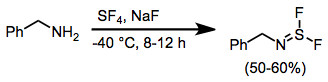
When amines are treated with SF4 and a base, aminosulfur difluorides result.
Toxicity
reacts inside the lungs with moisture, forming sulfur dioxide and hydrogen fluoride which forms highly toxic and corrosive hydrofluoric acid
References
ja:フッ化硫黄#四フッ化硫黄
References
- {{PGCH. 0580
- {{cite encyclopedia. C.-L. J.. Wang. (2004). J. Wiley & Sons
- (2001). "Inorganic Chemistry". Academic Press.
- Kwasnik, W.. (1963). "Fluorine compounds: Sulfur tetrafluoride". Academic Press.
- Fawcett, F. S.. (1963). "Inorganic Syntheses".
- (1960). "The Chemistry of Sulfur Tetrafluoride. I. The Synthesis of Sulfur Tetrafluoride". J. Am. Chem. Soc..
- "Synthesis of Sulfur Tetrafluoride".
- Winter, R.W.; Cook P.W. (2010). "A simplified and efficient bromine-facilitated SF4-preparation method". J. Fluorine Chem. 131: 780-783. {{doi. 10.1016/j.jfluchem.2010.03.016
- Hasek, W. R.. (1961). "1,1,1-Trifluoroheptane".
- (2004). "''N'',''N''-Diethylaminosulfur Trifluoride". J. Wiley & Sons.
- W. J. Middleton. (1977). "Diethylaminosulfur Trifluoride".
- Nyman, F.. (1966). "Inorganic Syntheses". McGraw-Hill.
- {{Greenwood&Earnshaw2nd
- Grunwell, John R.. (1975). "Novel generation of benzonitrile-N-sulfide". Tetrahedron Letters.
- Johnston, H.. (2003). "A Bridge not Attacked: Chemical Warfare Civilian Research During World War II". World Scientific.
This article was imported from Wikipedia and is available under the Creative Commons Attribution-ShareAlike 4.0 License. Content has been adapted to SurfDoc format. Original contributors can be found on the article history page.
Ask Mako anything about Sulfur tetrafluoride — get instant answers, deeper analysis, and related topics.
Research with MakoFree with your Surf account
Create a free account to save articles, ask Mako questions, and organize your research.
Sign up freeThis content may have been generated or modified by AI. CloudSurf Software LLC is not responsible for the accuracy, completeness, or reliability of AI-generated content. Always verify important information from primary sources.
Report