From Surf Wiki (app.surf) — the open knowledge base
Subsatellite
Satellite that orbits a natural satellite
Satellite that orbits a natural satellite
A subsatellite, also known as a submoon or informally a moonmoon, is a "moon of a moon" or a hypothetical natural satellite that orbits the moon of a planet.
It is inferred from the empirical study of natural satellites in the Solar System that subsatellites may be rare, albeit possible, elements of planetary systems. In the Solar System, the giant planets have large collections of natural satellites. The majority of detected exoplanets are giant planets; at least one, Kepler-1625b, may have a very large exomoon, named Kepler-1625b I, which could theoretically host a subsatellite. Nonetheless, aside from human-launched satellites in temporary lunar orbit, no subsatellite is known in the Solar System or beyond. In most cases, the tidal effects of the planet would make such a system unstable on an astronomical timescale.
Terminology
Terms used in scientific literature for subsatellites include "submoons" and "moon-moons". Colloquial terms that have been suggested include moonitos (compare plutino), moonettes, and moooons.
Possible natural instances
Rhea
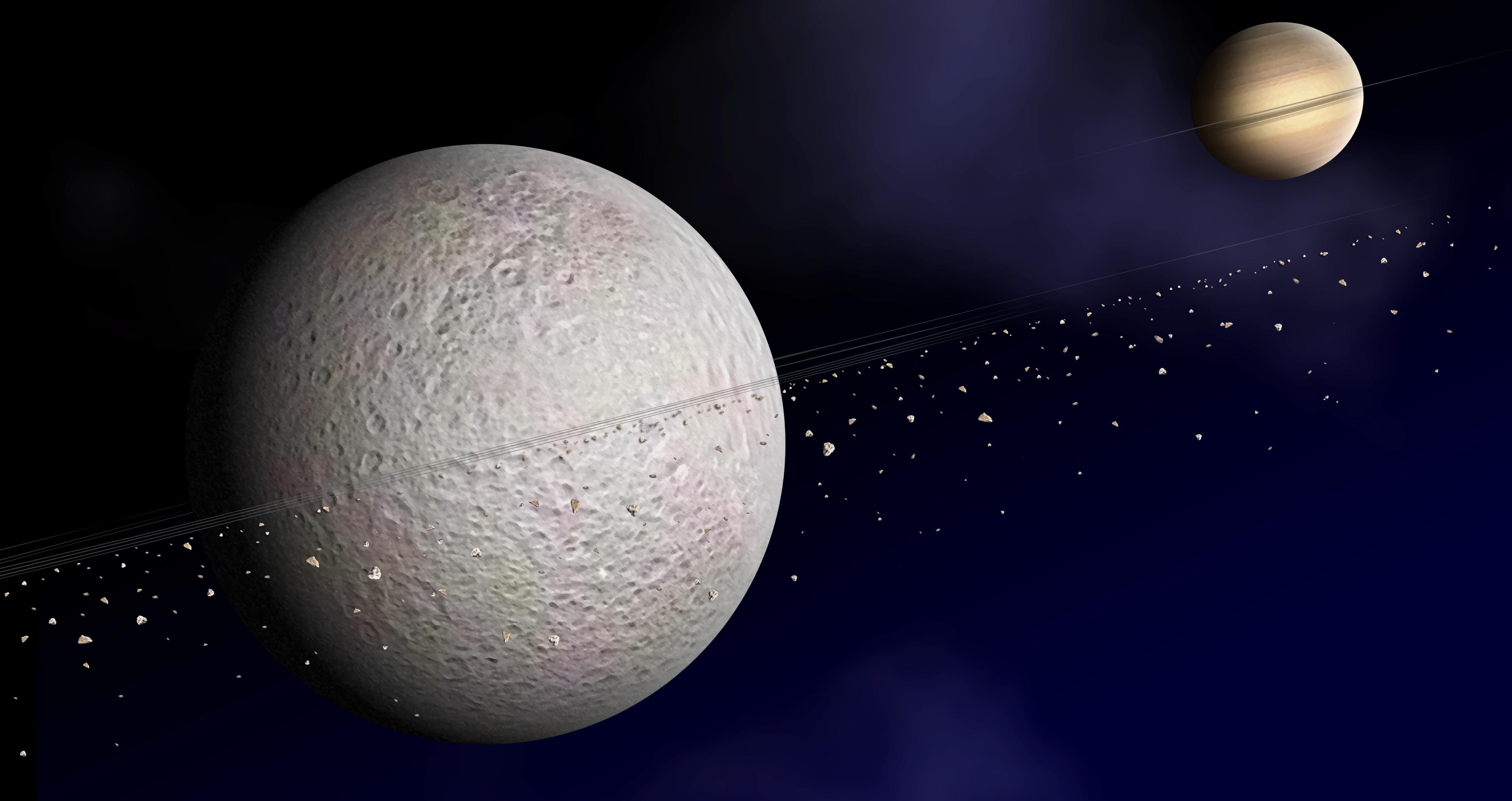
There is a possible detection{{cite journal |display-authors=3 |vauthors=Jones GH, Roussos E, Krupp N, Beckmann U, Coates AJ, Crary F, Dandouras I, Dikarev V, Dougherty MK, Garnier P, Hansen CJ, Hendrix AR, Hospodarsky GB, Johnson RE, Kempf S, Khurana KK, Krimigis SM, Krüger H, Kurth WS, Lagg A, McAndrews HJ, Mitchell DG, Paranicas C, Postberg F, Russell CT, Saur J, Seiß M, Spahn F, Srama R, Strobel DF, Tokar R, Wahlund JE, Wilson RJ, Woch J, Young D |url-access=subscription }} of a ring system around Saturn's natural satellite Rhea that led to calculations that indicated that satellites orbiting Rhea would have stable orbits. The rings suspected were thought to be narrow,{{cite web |access-date=12 October 2018
Iapetus
It has also been proposed that Saturn's satellite Iapetus possessed a subsatellite in the past; this is one of several hypotheses that have been put forward to account for its unusual equatorial ridge. An ancient giant impact on Iapetus could have produced a subsatellite; as Saturn despun Iapetus, the subsatellite's orbit would then decay until it crossed Iapetus' Roche limit, forming a transient ring which then impacted Iapetus to form a ridge. Such a scenario could have happened on the other giant-planet satellites as well, but only for Iapetus and perhaps Oberon would the resulting ridge have formed after the Late Heavy Bombardment and thus survived to the present day.
Irregular moons of Saturn
Light-curve analysis suggests that Saturn's irregular satellite Kiviuq is extremely prolate, and is likely a contact binary or even a binary moon.{{cite conference
Artificial subsatellites
Historical
Many spacecraft have orbited the Moon since the first one in 1966 (Luna 10).
, no spacecraft has successfully orbited any natural satellite other than the Moon. In 1988, the Soviet Union unsuccessfully attempted to put two robotic probes on quasi-orbits around the Martian moon Phobos.
Current
Launched June 18, 2009, the Lunar Reconnaissance Orbiter (LRO) is a NASA robotic spacecraft currently orbiting the Moon in an eccentric polar mapping orbit. Data collected by LRO have been described as essential for planning NASA's future human and robotic missions to the Moon. Its detailed mapping program is identifying safe landing sites, locating potential resources on the Moon, characterizing the radiation environment, and demonstrating new technologies.
CAPSTONE is a project that successfully launched on June 28, 2022. Composed of a 12-unit collection of CubeSats which spent a few months in transit to the Moon to arrive on November 14, 2022. It has spent over 2 years in the Moon's Near-rectilinear halo orbit. CAPSTONE is testing and verifying the viability of the planned NRHO of planned future Lunar Gateway and its communication efficiency.
Future planned artificial moon satellites
The interplanetary spacecraft JUICE launched in 2023 will enter an orbit around Ganymede in 2034, becoming the first spacecraft to orbit a moon other than Earth's.
Additionally, the multi-agency supported Lunar Gateway human-rated space station began construction in April 2024 in a near-rectilinear halo orbit (NRHO), primarily in support of the later stage NASA Artemis program missions to the Moon. Lunar Gateway will also potentially support future missions to Mars and outlying asteroids.
References
References
- Forgan, Duncan. (4 October 2018). "The habitable zone for Earthlike exomoons orbiting Kepler-1625b".
- "Where is Earth's submoon?".
- (3 October 2018). "Astronomers Find First Evidence of Possible Moon Outside Our Solar System". [[NASA]].
- Drake, Nadia. (3 October 2018). "Weird giant may be the first known alien moon - Evidence is mounting that a world the size of Neptune could be orbiting a giant planet far, far away.". [[National Geographic Society]].
- (3 October 2018). "Hubble finds compelling evidence for a moon outside the Solar System". Hubble Space Telescope.
- Daley, Jason. (11 October 2018). "If a Moon Has a Moon, Is Its Moon Called a Moonmoon? - A new study suggests it's possible some moons could have moons and the internet wants to give them a name—but scientists have yet to actually find one". [[Smithsonian (magazine).
- (July 2010). "Cassini imaging search rules out rings around Rhea". Geophysical Research Letters.
- Fitzpatrick, Tony. (13 December 2010). "How Iapetus, Saturn's outermost moon, got its ridge". [[Washington University in St. Louis]].
- (2012). "Delayed formation of the equatorial ridge on Iapetus from a subsatellite created in a giant impact". Journal of Geophysical Research: Planets.
- (2018). "Enceladus and the Icy Moons of Saturn". [[University of Arizona Press]].
- Edwin V. Bell II. (11 April 2016). "Phobos Project Information". [[NASA]].
- Figliozzi, Gianine. (May 20, 2022). "CAPSTONE Spacecraft Launch Targeted No Earlier Than June 6". [[NASA]].
This article was imported from Wikipedia and is available under the Creative Commons Attribution-ShareAlike 4.0 License. Content has been adapted to SurfDoc format. Original contributors can be found on the article history page.
Ask Mako anything about Subsatellite — get instant answers, deeper analysis, and related topics.
Research with MakoFree with your Surf account
Create a free account to save articles, ask Mako questions, and organize your research.
Sign up freeThis content may have been generated or modified by AI. CloudSurf Software LLC is not responsible for the accuracy, completeness, or reliability of AI-generated content. Always verify important information from primary sources.
Report