From Surf Wiki (app.surf) — the open knowledge base
Stuxnet
Computer worm first discovered in 2010

Computer worm first discovered in 2010
| Field | Value |
|---|---|
| common_name | Stuxnet |
| classification | Computer worm |
| type | Dropper |
| origin | United States |
| author | Equation Group |
| platform | Source: |
| file_size | ~0.5MB |
| language | C, [C++](c) and others |
As Stuxnet
- By Microsoft :Worm:Win32/Stuxnet.[Letter] :TrojanDropper:Win32/Stuxnet
- By Symantec :W32.Stuxnet :W32.Stuxnet!lnk
- By Sophos :Troj/Stuxnet-[Letter] :Trojan-Dropper.Win32.Stuxnet.[Letter] :Worm.Win32.Stuxnet.[Letter] :TR/Drop.Stuxnet.[Letter].[Number]
- By Kaspersky :Worm.Win32.Stuxnet
- By F-Secure :Trojan-Dropper:W32/Stuxnet :Rootkit:W32/Stuxnet
- By Trend Micro :RTKT_STUXNET.[Letter] :LNK_STUXNET.[Letter] :WORM_STUXNET.[Letter]
Stuxnet is a malicious computer worm first uncovered on 17 June 2010 and thought to have been in development since at least 2005. Stuxnet targets supervisory control and data acquisition (SCADA) systems and is believed to be responsible for causing substantial damage to the Iran nuclear program after it was first installed on a computer at the Natanz Nuclear Facility in 2009. Although neither the United States nor Israel has openly admitted responsibility, multiple independent news organizations claim Stuxnet to be a cyberweapon built jointly by the two countries in a collaborative effort known as Operation Olympic Games. The program, started during the Bush administration, was rapidly expanded within the first months of Barack Obama's presidency.
Stuxnet specifically targets programmable logic controllers (PLCs), which allow the automation of electromechanical processes such as those used to control machinery and industrial processes including gas centrifuges for separating nuclear material. Exploiting four zero-day flaws in the systems, Stuxnet functions by targeting machines using the Microsoft Windows operating system and networks, then seeking out Siemens Step7 software. Stuxnet reportedly compromised Iranian PLCs, collecting information on industrial systems and causing the fast-spinning centrifuges to tear themselves apart. Stuxnet's design and architecture are not domain-specific and it could be tailored as a platform for attacking modern SCADA and PLC systems (e.g., in factory assembly lines or power plants), most of which are in Europe, Japan and the United States. Stuxnet reportedly destroyed almost one-fifth of Iran's nuclear centrifuges. Targeting industrial control systems, the worm infected over 200,000 computers and caused 1,000 machines to physically degrade.
Stuxnet has three modules: a worm that executes all routines related to the main payload of the attack, a link file that automatically executes the propagated copies of the worm and a rootkit component responsible for hiding all malicious files and processes to prevent detection of Stuxnet. It is typically introduced to the target environment via an infected USB flash drive, thus crossing any air gap. The worm then propagates across the network, scanning for Siemens Step7 software on computers controlling a PLC. In the absence of either criterion, Stuxnet becomes dormant inside the computer. If both the conditions are fulfilled, Stuxnet introduces the infected rootkit onto the PLC and Step7 software, modifying the code and giving unexpected commands to the PLC while returning a loop of normal operation system values back to the users.
Discovery
Stuxnet, discovered by Sergey Ulasen from a Belarusian antivirus company VirusBlokAda, initially spread via Microsoft Windows, and targeted Siemens industrial control systems. While it is not the first time that hackers have targeted industrial systems, nor the first publicly known intentional act of cyberwarfare to be implemented, it is the first discovered malware that spies on and subverts industrial systems,
The worm initially spreads indiscriminately, but includes a highly specialized malware payload that is designed to target only Siemens supervisory control and data acquisition (SCADA) systems that are configured to control and monitor specific industrial processes. Stuxnet infects PLCs by subverting the Step-7 software application that is used to reprogram these devices.
Different variants of Stuxnet targeted five Iranian organizations,{{cite news | access-date=17 February 2011 | archive-date=25 November 2021 | archive-url=https://web.archive.org/web/20211125040044/https://www.bbc.co.uk/news/technology-12465688 | url-status=live | access-date=28 September 2010 | archive-date=14 November 2021 | archive-url=https://web.archive.org/web/20211114141129/https://economictimes.indiatimes.com/news/news-by-industry/et-cetera/Software-smart-bomb-fired-at-Iranian-nuclear-plant-Experts/articleshow/6617686.cms | url-status=live
In May 2011, the PBS program Need To Know cited a statement by Gary Samore, White House Coordinator for Arms Control and Weapons of Mass Destruction, in which he said "we're glad they [the Iranians] are having trouble with their centrifuge machine and that we the U.S. and its allies are doing everything we can to make sure that we complicate matters for them", offering "winking acknowledgement" of United States involvement in Stuxnet. According to The Daily Telegraph, a showreel that was played at a retirement party for the head of the Israel Defense Forces (IDF), Gabi Ashkenazi, included references to Stuxnet as one of his operational successes as the IDF chief of staff.
On 1 June 2012, an article in The New York Times reported that Stuxnet was part of a US and Israeli intelligence operation named Operation Olympic Games, devised by the NSA under President George W. Bush and executed under President Barack Obama.
On 24 July 2012, an article by Chris Matyszczyk from CNET reported that the Atomic Energy Organization of Iran e-mailed F-Secure's chief research officer Mikko Hyppönen to report a new instance of malware.
On 25 December 2012, an Iranian semi-official news agency announced there was a cyberattack by Stuxnet, this time on the industries in the southern area of the country. The malware targeted a power plant and some other industries in Hormozgan province in 2012.
According to Eugene Kaspersky, the worm also infected a nuclear power plant in Russia. Kaspersky noted, however, that since the power plant is not connected to the public Internet, the system should remain safe.
History
The worm was first identified by the security company VirusBlokAda in mid-June 2010. Journalist Brian Krebs's blog post on 15 July 2010 was the first widely read report on the worm.{{cite web | access-date=3 March 2011 | archive-date=2 September 2022 | archive-url=https://web.archive.org/web/20220902123724/https://krebsonsecurity.com/2010/07/experts-warn-of-new-windows-shortcut-flaw/ | url-status=live | access-date=31 December 2015 | archive-date=31 August 2021 | archive-url=https://web.archive.org/web/20210831181802/https://www.vanityfair.com/news/2011/03/stuxnet-201104 | url-status=live
Kaspersky Lab experts initially estimated that Stuxnet began spreading around March or April 2010, but the first variant of the worm appeared in June 2009. On 15 July 2010, the day the worm's existence became widely known, a distributed denial-of-service attack targeted the servers of two leading mailing lists on industrial-systems security. This attack, from an unknown source but possibly related to Stuxnet, disabled one of the lists, interrupting a key information source for power plants and factories. Separately, researchers at Symantec uncovered a version of the Stuxnet computer virus that was used to attack Iran's nuclear program in November 2007, with evidence indicating it was under development as early as 2005, when Iran was still setting up its uranium enrichment facility.
The second variant, with substantial improvements, appeared in March 2010, reportedly due to concerns that Stuxnet was not spreading fast enough. A third variant, with minor improvements, followed in April 2010. The worm contains a component with a build timestamp from 3 February 2010. On 25 November 2010, Sky News in the United Kingdom reported receiving information from an anonymous source at an unidentified IT security organization claiming that Stuxnet, or a variation of the worm, had been traded on the black market.
In 2015, Kaspersky Lab reported that the Equation Group had used two of the same zero-day attacks prior to their use in Stuxnet, in another malware called fanny.bmp. Kaspersky Lab noted that "the similar type of usage of both exploits together in different computer worms, at around the same time, indicates that the Equation Group and the Stuxnet developers are either the same or working closely together".
In 2019, Chronicle researchers Juan Andres Guerrero-Saade and Silas Cutler presented findings indicating that at least four distinct threat actor malware platforms collaborated in developing the different versions of Stuxnet. The collaboration was referred to as 'GOSSIP GIRL', a name derived from a threat group mentioned in classified CSE slides that included Flame. GOSSIP GIRL is described as a cooperative umbrella encompassing the Equation Group, Flame, Duqu, and Flowershop (also known as 'Cheshire Cat').
In 2020, researcher Facundo Muñoz presented findings suggesting that Equation Group may have collaborated with Stuxnet developers in 2009 by providing at least one zero-day exploit, and one exploit from 2008 that was actively used by the Conficker computer worm and Chinese hackers. In 2017, a group of hackers known as The Shadow Brokers leaked a collection of tools attributed to Equation Group, including new versions of both exploits compiled in 2010. Analysis of the leaked data indicated significant code overlaps, as both Stuxnet's exploits and Equation Group's exploits were developed using a set of libraries called the "Exploit Development Framework", also leaked by The Shadow Brokers.
Affected countries
A study of the spread of Stuxnet by Symantec showed that the main affected countries in the early days of the infection were Iran, Indonesia and India:
| Country | Share of infected computers |
|---|---|
| Iran | 58.9% |
| Indonesia | 18.2% |
| India | 8.3% |
| Azerbaijan | 2.6% |
| United States | 1.6% |
| Pakistan | 1.3% |
| Other countries | 9.2% |
Iran was reported to have fortified its cyberwar abilities following the Stuxnet attack, and has been suspected of retaliatory attacks against United States banks in Operation Ababil. Operation Ababil campaign in 2012-2013 against U.S. financial institutions and also the 2012 Shamoon attack against oil giant Saudi Aramco, and the 2014 strike against Las Vegas Sands Corporation.
Operation
Unlike most malware, Stuxnet does little harm to computers and networks that do not meet specific configuration requirements; "The attackers took great care to make sure that only their designated targets were hit ... It was a marksman's job." While the worm is promiscuous, it makes itself inert if Siemens software is not found on infected computers, and contains safeguards to prevent each infected computer from spreading the worm to more than three others, and to erase itself on 24 June 2012.
For its targets, Stuxnet contains, among other things, code for a man-in-the-middle attack that fakes industrial process control sensor signals so an infected system does not shut down due to detected abnormal behavior. Such complexity is unusual for malware. The worm consists of a layered attack against three different systems:
- The Windows operating system,
- Siemens PCS 7, WinCC and STEP7 industrial software applications that run on Windows and
- One or more Siemens S7 PLCs.
Windows infection
Stuxnet attacked Windows systems using an unprecedented four zero-day attacks (plus the CPLINK vulnerability and a vulnerability used by the Conficker worm). It is initially spread using infected removable drives such as USB flash drives, The worm then uses other exploits and techniques such as peer-to-peer remote procedure call (RPC) to infect and update other computers inside private networks that are not directly connected to the Internet. The number of zero-day exploits used is unusual, as they are highly valued and malware creators do not typically make use of (and thus simultaneously make visible) four different zero-day exploits in the same worm. and the LNK/PIF vulnerability, in which file execution is accomplished when an icon is viewed in Windows Explorer, negating the need for user interaction. Stuxnet is unusually large at half a megabyte in size, and written in several different programming languages (including C and C++) which is also irregular for malware. The Windows component of the malware is promiscuous in that it spreads relatively quickly and indiscriminately.
The malware has both user mode and kernel mode rootkit ability under Windows, and its device drivers have been digitally signed with the private keys of two public key certificates that were stolen from separate well-known companies, JMicron and Realtek, both located at Hsinchu Science Park in Taiwan. Both compromised certificates have been revoked by Verisign.
Two websites in Denmark and Malaysia were configured as command and control servers for the malware, allowing it to be updated, and for industrial espionage to be conducted by uploading information. Both of these domain names have subsequently been redirected by their DNS service provider to Dynadot as part of a global effort to disable the malware.
Step 7 software infection
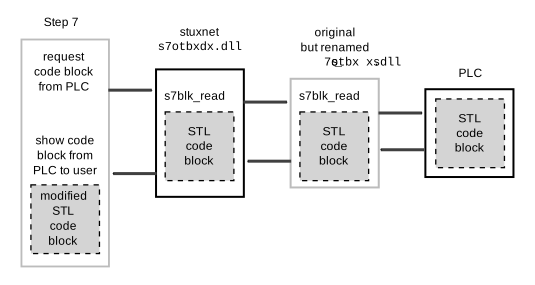
According to researcher Ralph Langner,{{cite journal | access-date=4 March 2011 | archive-date=31 August 2021 | archive-url=https://web.archive.org/web/20210831181802/https://www.vanityfair.com/news/2011/03/stuxnet-201104 | url-status=live | access-date=4 March 2011 | archive-date=25 June 2016 | archive-url=https://web.archive.org/web/20160625153256/http://www.langner.com/en/2010/09/14/ralphs-step-by-step-guide-to-get-a-crack-at-stuxnet-traffic-and-behavior/ | url-status=live | access-date=9 February 2011 | archive-date=3 January 2015 | archive-url=https://web.archive.org/web/20150103013845/http://www.symantec.com/connect/blogs/stuxnet-infection-step-7-projects | url-status=live
The malware also used a zero-day exploit in the WinCC/SCADA database software in the form of a hard-coded database password.
PLC infection

Stuxnet's payload targets only those SCADA configurations that meet criteria that it is programmed to identify.
Stuxnet requires specific subordinate system to be attached to the targeted Siemens S7-300 controller system: variable-frequency drives (frequency converter drives) and its associated modules. It only attacks those PLC systems with variable-frequency drives from two specific vendors: Vacon based in Finland and Fararo Paya based in Iran. Furthermore, it monitors the frequency of the attached motors, and only attacks systems that spin between 807 Hz and 1,210 Hz. This is a much higher frequency than motors typically operate at in most industrial applications, with the notable exception of gas centrifuges. Stuxnet installs malware into memory block DB890 of the PLC that monitors the Profibus messaging bus of the system. When certain criteria are met, it periodically modifies the frequency to 1,410 Hz and then to 2 Hz and then to 1,064 Hz, and thus affects the operation of the connected motors by changing their rotational speed. It also installs a rootkit the first such documented case on this platform that hides the malware on the system and masks the changes in rotational speed from monitoring systems.
Removal
Siemens has released a detection and removal tool for Stuxnet. Siemens recommends contacting customer support if an infection is detected and advises installing Microsoft updates for security vulnerabilities and prohibiting the use of third-party USB flash drives. Siemens also advises immediately upgrading password access codes.
The worm's ability to reprogram external PLCs may complicate the removal procedure. Symantec's Liam O'Murchu warns that fixing Windows systems may not fully solve the infection; a thorough audit of PLCs may be necessary. Despite speculation that incorrect removal of the worm could cause damage,
Control system security
Main article: Control system security
Prevention of control system security incidents, such as from viral infections like Stuxnet, is a topic that is being addressed in both the public and the private sector.
The US Department of Homeland Security National Cyber Security Division (NCSD) operates the Control System Security Program (CSSP). The program operates a specialized computer emergency response team called the Industrial Control Systems Cyber Emergency Response Team (ICS-CERT), conducts a biannual conference (ICSJWG), provides training, publishes recommended practices, and provides a self-assessment tool. As part of a Department of Homeland Security plan to improve American computer security, in 2008 it and the Idaho National Laboratory (INL) worked with Siemens to identify security holes in the company's widely used Process Control System 7 (PCS 7) and its software Step 7. In July 2008, INL and Siemens publicly announced flaws in the control system at a Chicago conference; Stuxnet exploited these holes in 2009.{{cite news |author-link = William Broad |author2-link = John Markoff |author3-link = David E. Sanger |access-date = 16 January 2011 |archive-date = 20 September 2011 |archive-url = https://web.archive.org/web/20110920071931/http://www.nytimes.com/2011/01/16/world/middleeast/16stuxnet.html?_r=1&ref=general&src=me&pagewanted=all |url-status = live
Several industry organizations and professional societies have published standards and best practice guidelines providing direction and guidance for control system end-users on how to establish a control system security management program. The basic premise that all of these documents share is that prevention requires a multi-layered approach, often termed defense in depth. The layers include policies and procedures, awareness and training, network segmentation, access control measures, physical security measures, system hardening, e.g., patch management, and system monitoring, anti-virus and intrusion prevention system (IPS). The standards and best practices also all recommend starting with a risk analysis and a control system security assessment.
Target and origin
Stuxnet may be the largest and costliest development effort in malware history. Developing its abilities would have required a team of capable programmers, in-depth knowledge of industrial processes, and an interest in attacking industrial infrastructure.{{cite web| url=http://www.computerworld.com/article/2515570/network-security/siemens--stuxnet-worm-hit-industrial-systems.html | access-date=16 September 2010 | archive-date=20 February 2019 | archive-url=https://web.archive.org/web/20190220034909/https://www.computerworld.com/article/2515570/network-security/siemens--stuxnet-worm-hit-industrial-systems.html | url-status=live | access-date=22 August 2017 | archive-date=30 August 2017 | archive-url=https://web.archive.org/web/20170830063315/https://www.forbes.com/2010/10/06/iran-nuclear-computer-technology-security-stuxnet-worm.html | url-status=live
In late December 2008, Dutch engineer Erik van Sabben travelled to Iran, allegedly to infiltrate the Natanz nuclear facility on behalf of Dutch intelligence and install equipment infected with Stuxnet. He died two weeks after the Stuxnet attack at age 36 in an apparent single-vehicle motorcycle accident in Dubai.
Iran as a target
Ralph Langner, the researcher who identified that Stuxnet infected PLCs, first speculated publicly in September 2010 that the malware was of Israeli origin, and that it targeted Iranian nuclear facilities.{{cite news | access-date=4 March 2011 | archive-date=6 March 2011 | archive-url=https://web.archive.org/web/20110306114249/http://www.csmonitor.com/World/terrorism-security/2010/1001/Clues-emerge-about-genesis-of-Stuxnet-worm | url-status=live
Natanz nuclear facilities
According to the Israeli newspaper Haaretz, in September 2010 experts on Iran and computer security specialists were increasingly convinced that Stuxnet was meant "to sabotage the uranium enrichment facility at Natanz where the centrifuge operational capacity had dropped over the past year by 30 percent".{{cite news | access-date=1 January 2011 | archive-date=22 January 2011 | archive-url=https://web.archive.org/web/20110122133842/http://www.haaretz.com/print-edition/news/computer-virus-in-iran-actually-targeted-larger-nuclear-facility-1.316052 | url-status=live | access-date=24 November 2010 | archive-date=24 November 2010 | archive-url=https://web.archive.org/web/20101124013831/http://www.haaretz.com/news/international/iran-pauses-uranium-enrichment-at-natanz-nuclear-plant-1.326276 | url-status=live
The Institute for Science and International Security (ISIS) report further notes that Iranian authorities have attempted to conceal the breakdown by installing new centrifuges on a large scale.
The worm worked by first causing an infected Iranian IR-1 centrifuge to increase from its normal operating speed of 1,064 hertz to 1,410 hertz for 15 minutes before returning to its normal frequency. Twenty-seven days later, the worm went back into action, slowing the infected centrifuges down to a few hundred hertz for a full 50 minutes. The stresses from the excessive, then slower, speeds caused the aluminium centrifugal tubes to expand, often forcing parts of the centrifuges into sufficient contact with each other to destroy the machine.
According to The Washington Post, International Atomic Energy Agency (IAEA) cameras installed in the Natanz facility recorded the sudden dismantling and removal of approximately 900–1,000 centrifuges during the time the Stuxnet worm was reportedly active at the plant. Iranian technicians, however, were able to quickly replace the centrifuges and the report concluded that uranium enrichment was likely only briefly disrupted.
On 15 February 2011, the Institute for Science and International Security released a report concluding that:
Although Stuxnet appears to be designed to destroy centrifuges at the Natanz facility, destruction was by no means total. Moreover, Stuxnet did not lower the production of low enriched uranium (LEU) during 2010. LEU quantities could have certainly been greater, and Stuxnet could be an important part of the reason why they did not increase significantly. Nonetheless, there remain important questions about why Stuxnet destroyed only 1,000 centrifuges. One observation is that it may be harder to destroy centrifuges by use of cyber attacks than often believed.}}
Iranian reaction
The Associated Press reported that the semi-official Iranian Students News Agency released a statement on 24 September 2010 stating that experts from the Atomic Energy Organization of Iran met in the previous week to discuss how Stuxnet could be removed from their systems.
The head of the Bushehr Nuclear Power Plant told Reuters that only the personal computers of staff at the plant had been infected by Stuxnet and the state-run newspaper Iran Daily quoted Reza Taghipour, Iran's telecommunications minister, as saying that it had not caused "serious damage to government systems".
In response to the infection, Iran assembled a team to combat it. With more than 30,000 IP addresses affected in Iran, an official said that the infection was fast spreading in Iran and the problem had been compounded by the ability of Stuxnet to mutate. Iran had set up its own systems to clean up infections and had advised against using the Siemens SCADA antivirus since it is suspected that the antivirus contains embedded code which updates Stuxnet instead of removing it.
According to Hamid Alipour, deputy head of Iran's government Information Technology Company, "The attack is still ongoing and new versions of this virus are spreading." He reported that his company had begun the cleanup process at Iran's "sensitive centres and organizations". "We had anticipated that we could root out the virus within one to two months, but the virus is not stable, and since we started the cleanup process three new versions of it have been spreading", he told the Islamic Republic News Agency on 27 September 2010.
On 29 November 2010, Iranian president Mahmoud Ahmadinejad stated for the first time that a computer virus had caused problems with the controller handling the centrifuges at its Natanz facilities. According to Reuters, he told reporters at a news conference in Tehran: "They succeeded in creating problems for a limited number of our centrifuges with the software they had installed in electronic parts."
On the same day two Iranian nuclear scientists were targeted in separate, but nearly simultaneous car bomb attacks near Shahid Beheshti University in Tehran. Majid Shahriari, a quantum physicist, was killed. Fereydoon Abbasi, a high-ranking official at the Ministry of Defense was seriously wounded. Wired speculated that the assassinations could indicate that whoever was behind Stuxnet felt that it was not sufficient to stop the nuclear program. That same Wired article suggested the Iranian government could have been behind the assassinations. In January 2010, another Iranian nuclear scientist, a physics professor at Tehran University, was killed in a similar bomb explosion. On 11 January 2012, a director of the Natanz nuclear enrichment facility, Mostafa Ahmadi Roshan, was killed in an attack quite similar to the one that killed Shahriari.
An analysis by the FAS demonstrates that Iran's enrichment capacity grew during 2010. The study indicated that Iran's centrifuges appeared to be performing 60% better than in the previous year, which would significantly reduce Tehran's time to produce bomb-grade uranium. The FAS report was reviewed by an official with the IAEA who affirmed the study.
European and US officials, along with private experts, told Reuters that Iranian engineers were successful in neutralizing and purging Stuxnet from their country's nuclear machinery.
Given the growth in Iranian enrichment ability in 2010, the country may have intentionally put out misinformation to cause Stuxnet's creators to believe that the worm was more successful in disabling the Iranian nuclear program than it actually was.
Israel
Israel, through Unit 8200,{{cite news | access-date=17 December 2016 | archive-date=30 December 2016 | archive-url=https://web.archive.org/web/20161230195849/https://www.theguardian.com/technology/2010/sep/30/stuxnet-worm-new-era-global-cyberwar | url-status=live |url-status = dead |archive-url = https://web.archive.org/web/20121204121558/http://finance.yahoo.com/video/marketnews-19148628/falkenrath-says-stuxnet-virus-may-have-origin-in-israel-video-22090127#video=22147179 |archive-date = 4 December 2012 | access-date = 23 February 2011 | archive-date = 19 February 2011 | archive-url = https://web.archive.org/web/20110219063134/http://www.telegraph.co.uk/technology/news/8326274/Israeli-security-chief-celebrates-Stuxnet-cyber-attack.html | url-status = live
In 2009, a year before Stuxnet was discovered, Scott Borg of the United States Cyber-Consequences Unit (US-CCU) suggested that Israel may prefer to mount a cyberattack rather than a military strike on Iran's nuclear facilities. Iran uses P-1 centrifuges at Natanz, the design for which A. Q. Khan stole in 1976 and took to Pakistan. His black market nuclear-proliferation network sold P-1s to, among other customers, Iran. Experts believe that Israel also somehow acquired P-1s and tested Stuxnet on the centrifuges, installed at the Dimona facility that is part of its own nuclear program. The equipment may be from the United States, which received P-1s from Libya's former nuclear program.
Some have also cited several clues in the code such as a concealed reference to the word MYRTUS, believed to refer to the Latin name myrtus of the Myrtle tree, which in Hebrew is called hadassah. Hadassah was the birth name of the former Jewish queen of Persia, Queen Esther. However, it may be that the "MYRTUS" reference is simply a misinterpreted reference to SCADA components known as RTUs (Remote Terminal Units) and that this reference is actually "My RTUs"–a management feature of SCADA. Also, the number 19790509 appears once in the code and may refer to the date 1979 May 09, the day Habib Elghanian, a Persian Jew, was executed in Tehran. Another date that appears in the code is "24 September 2007", the day that Iran's president Mahmoud Ahmadinejad spoke at Columbia University and made comments questioning the validity of the Holocaust. Such data is not conclusive, since, as noted by Symantec, "attackers would have the natural desire to implicate another party".
United States
There has also been reports on the involvement of the United States and its collaboration with Israel, with one report stating that "there is vanishingly little doubt that [it] played a role in creating the worm". It has been reported that the United States, under one of its most secret programs, initiated by the Bush administration and accelerated by the Obama administration, has sought to destroy Iran's nuclear program by novel methods such as undermining Iranian computer systems. A leaked diplomatic cable showed how the United States was advised to target Iran's nuclear abilities through 'covert sabotage'. An article in The New York Times in January 2009 credited a then-unspecified program with preventing an Israeli military attack on Iran where some of the efforts focused on ways to destabilize the centrifuges.{{cite news |author-link = David E. Sanger |access-date = 12 October 2013 |archive-date = 16 October 2013 |archive-url = https://web.archive.org/web/20131016065926/http://www.nytimes.com/2009/01/11/washington/11iran.html?pagewanted=all&_r=0 |url-status = live | access-date=18 February 2011 | archive-date=18 February 2011 | archive-url=https://web.archive.org/web/20110218154415/http://www.wired.com/threatlevel/2011/02/cyberwar-issues-likely-to-be-addressed-only-after-a-catastrophe/ | url-status=live
The fact that John Bumgarner, a former intelligence officer and member of the United States Cyber-Consequences Unit (US-CCU), published an article prior to Stuxnet being discovered or deciphered, that outlined a strategic cyber strike on centrifuges{{cite news | access-date=30 October 2011 | archive-date=7 March 2012 | archive-url=https://web.archive.org/web/20120307021747/http://www.stripes.com/news/cone-of-silence-surrounds-u-s-cyberwarfare-1.158090 | url-status=live |access-date = 30 October 2011 |url-status = dead |archive-url = https://web.archive.org/web/20111219174833/http://www.crows.org/images/stories/pdf/IOI/IO%20Journal_Vol2Iss2_0210.pdf |archive-date = 19 December 2011
In a March 2012 interview with 60 Minutes, retired US Air Force General Michael Hayden who served as director of both the Central Intelligence Agency and National Security Agency while denying knowledge of who created Stuxnet said that he believed it had been "a good idea" but that it carried a downside in that it had legitimized the use of sophisticated cyber weapons designed to cause physical damage. Hayden said: "There are those out there who can take a look at this ... and maybe even attempt to turn it to their own purposes". In the same report, Sean McGurk, a former cybersecurity official at the Department of Homeland Security noted that the Stuxnet source code could now be downloaded online and modified to be directed at new target systems. Speaking of the Stuxnet creators, he said: "They opened the box. They demonstrated the capability ... It's not something that can be put back."{{cite news |access-date = 9 March 2012 |archive-date = 15 October 2013 |archive-url = https://web.archive.org/web/20131015171113/http://www.cbsnews.com/8301-18560_162-57390124/stuxnet-computer-worm-opens-new-era-of-warfare/ |url-status = dead
Joint effort and other states and targets
A Wired magazine article about US General Keith B. Alexander stated: "And he and his cyber warriors have already launched their first attack. The cyber weapon that came to be known as Stuxnet was created and built by the NSA in partnership with the CIA and Israeli intelligence in the mid-2000s."{{cite magazine | access-date = 2 June 2014 | archive-date = 24 June 2018 | archive-url = https://web.archive.org/web/20180624045719/https://www.wired.com/2013/06/general-keith-alexander-cyberwar/all/ | url-status = live
China, Jordan, and France are other possibilities, and Siemens may have also participated. Langner speculated that the infection may have spread from USB drives belonging to Russian contractors since the Iranian targets were not accessible via the Internet. In 2019, it was reported that an Iranian mole working for Dutch intelligence at the behest of Israel and the CIA inserted the Stuxnet virus with a USB flash drive or convinced another person working at the Natanz facility to do so.
Sandro Gaycken from the Free University Berlin argued that the attack on Iran was a ruse to distract from Stuxnet's real purpose. According to him, its broad dissemination in more than 100,000 industrial plants worldwide suggests a field test of a cyber weapon in different security cultures, testing their preparedness, resilience, and reactions, all highly valuable information for a cyberwar unit.
The United Kingdom has denied involvement in the worm's creation.
In July 2013, Edward Snowden claimed that Stuxnet was cooperatively developed by the United States and Israel.
Deployment in North Korea
According to a report by Reuters, the NSA also tried to sabotage North Korea's nuclear program using a version of Stuxnet. The operation was reportedly launched in tandem with the attack that targeted Iranian centrifuges in 2009–10. The North Korean nuclear program shares a number of similarities with the Iranian, both having been developed with technology transferred by Pakistani nuclear scientist A.Q. Khan. The effort failed, however, because North Korea's extreme secrecy and isolation made it impossible to introduce Stuxnet into the nuclear facility.
Stuxnet 2.0 cyberattack
In 2018, Gholamreza Jalali, Iran's chief of the National Organization for Passive Defense, claimed that his country fended off a Stuxnet-like attack targeting the country's telecom infrastructure. Iran's Telecommunications minister, Mohammad-Javad Azari Jahromi has since accused Israel of orchestrating the attack. Iran plans to sue Israel through the International Court of Justice (ICJ) and is also willing to launch a retaliation attack if Israel does not desist.
Media coverage
Since 2010, there has been extensive international news media coverage on Stuxnet and its aftermath. In early commentary, The Economist pointed out that Stuxnet was "a new kind of cyber-attack". On 8 July 2011, Wired then published an article detailing how network security experts were able to decipher the origins of Stuxnet. In that piece, Kim Zetter claimed that Stuxnet's "cost–benefit ratio is still in question". Later commentators tended to focus on the strategic significance of Stuxnet as a cyber weapon. Following the Wired piece, Holger Stark called Stuxnet the "first digital weapon of geopolitical importance, it could change the way wars are fought". Meanwhile, Eddie Walsh referred to Stuxnet as "the world's newest high-end asymmetric threat". Ultimately, some claim that the "extensive media coverage afforded to Stuxnet has only served as an advertisement for the vulnerabilities used by various cybercriminal groups". While that may be the case, the media coverage has also increased awareness of cyber security threats.
Alex Gibney's 2016 documentary Zero Days covers the phenomenon around Stuxnet. A zero-day (also known as 0-day) vulnerability is a computer-software vulnerability that is unknown to, or unaddressed by, those who should be interested in mitigating the vulnerability (including the vendor of the target software). Until the vulnerability is mitigated, hackers can exploit it to adversely affect computer programs, data, additional computers or a network.
In 2016, it was revealed that General James Cartwright, the former head of the U.S. Strategic Command, had leaked information related to Stuxnet. He later pleaded guilty for lying to FBI agents pursuing an investigation into the leak. On 17 January 2017, he was granted a full pardon in this case by President Obama, thus expunging his conviction.
Darknet Diaries' Podcast episode Stuxnet, discusses Stuxnet with guest Kim Zetter and references the book Count Down to Zero Day.
In popular culture
Besides the aforementioned Alex Gibney documentary Zero Days (2016), which looks into the malware and the cyberwarfare surrounding it, other works which reference Stuxnet include:
- In Castle, season 8, episode 18 "Backstabber" Stuxnet is revealed to have been (fictionally) created by MI6, and a version of it is used to take down the London power grid.
- Trojan Horse is a novel written by Windows utility writer and novelist Mark Russinovich. It features the usage of the Stuxnet virus as a main plot line for the story, and the attempt of Iran to bypass it.
- In Ghost in the Shell: Arise, Stuxnet is the named type of computer virus which infected Kusanagi and Manamura allowing false memories to be implanted.
- In July 2017, MRSA (Mat Zo) released a track named "Stuxnet" through Hospital Records.
- In Ubisoft's 2013 video game Tom Clancy's Splinter Cell: Blacklist, the protagonist, Sam Fisher, makes use of a mobile, airborne headquarters ("Paladin") which is said at one point within the game's story mode to have been targeted by a Stuxnet-style virus, causing its systems to fail and the plane to careen towards the ocean, and would have crashed without Fisher's intervening.
- In Michael Mann's 2015 movie Blackhat, the code shown as belonging to a virus used by a hacker to cause the coolant pumps explosion in a nuclear plant in Chai Wan, Hong Kong, is actual Stuxnet decompiled code.
- In the third episode of Star Trek: Discovery, "Context Is for Kings", characters identify a segment of code as being part of an experimental transportation system. The code shown is decompiled Stuxnet code. Much of the same code is shown in the episode "Pyre" of The Expanse, this time as a visual representation of a "diagnostic exploit" breaking into the control software for nuclear missiles.
References
References
- (November 2010). "W32.Stuxnet Dossier". [[NortonLifeLock.
- (2010-09-08). "Stuxnet : A worm which targets SCADA systems".
- (2013-02-26). "The Real Story of Stuxnet". IEEE Spectrum.
- Sen, Ashish. (2015-04-10). "Iran's Growing Cyber Capabilities in a Post-Stuxnet Era".
- (June 2012). "Confirmed: US and Israel created Stuxnet, lost control of it". Ars Technica.
- Ellen Nakashima. (2012-06-02). "Stuxnet was work of U.S. and Israeli experts, officials say". [[The Washington Post]].
- (2019-09-04). "The Secret History of the Push to Strike Iran". [[The New York Times Magazine]].
- Sanger, David E.. (2012-06-01). "Obama Order Sped Up Wave of Cyberattacks Against Iran". The New York Times.
- Naraine, Ryan. (2010-09-14). "Stuxnet attackers used 4 Windows zero-day exploits". [[ZDNet]].
- (November 2011). "IECON 2011 – 37th Annual Conference of the IEEE Industrial Electronics Society".
- Kelley, Michael. (2013-11-20). "The Stuxnet Attack on Iran's Nuclear Plant Was 'Far More Dangerous' Than Previously Thought". Business Insider.
- "Sheep dip your removable storage devices to reduce the threat of cyber attacks".
- (January 2012). "STUXNET Malware Targets SCADA Systems". Trend Micro.
- Gross, Michael Joseph. (April 2011). "A Declaration of Cyber-War".
- (23 January 2014). "Exploring Stuxnet's PLC Infection Process". Symantec.
- (30 September 2010). "Building a Cyber Secure Plant". Siemens.
- "Last-minute paper: An indepth look into Stuxnet". Virus Bulletin.
- (26 September 2010). "Stuxnet worm hits Iran nuclear plant staff computers". BBC News.
- Nicolas Falliere. (6 August 2010). "Stuxnet Introduces the First Known Rootkit for Industrial Control Systems". Symantec.
- (25 September 2010). "Iran's Nuclear Agency Trying to Stop Computer Worm".
- Keizer, Gregg. (16 September 2010). "Is Stuxnet the 'best' malware ever?".
- (13 October 2010). "How Stuxnet Is Rewriting the Cyberterrorism Playbook".
- Beaumont, Claudine. (23 September 2010). "Stuxnet virus: worm 'could be aimed at high-profile Iranian targets{{'-}}". The Daily Telegraph.
- MacLean, William. (24 September 2010). "Update 2-Cyber attack appears to target Iran-tech firms". Reuters.
- (29 September 2010). "In a Computer Worm, a Possible Biblical Clue". [[The New York Times]].
- (24 September 2010). "Kaspersky Lab provides its insights on Stuxnet worm". Kaspersky.
- (1 October 2010). "Stuxnet Questions and Answers – F-Secure Weblog". F-Secure.
- [https://www.pbs.org/wnet/need-to-know/security/video-cracking-the-code-defending-against-the-superweapons-of-the-21st-century-cyberwar/9456/ Gary Samore] {{Webarchive. link. (27 April 2018 speaking at the 10 December 2010 Washington Forum of the [[Foundation for Defense of Democracies]] in Washington DC, reported by C-Span and contained in the PBS program ''Need to Know'' ([https://web.archive.org/web/20110522023118/http://www.pbs.org/wnet/need-to-know/security/video-cracking-the-code-defending-against-the-superweapons-of-the-21st-century-cyberwar/9456/ "Cracking the code: Defending against the superweapons of the 21st century cyberwar"], 4 minutes into piece))
- Williams, Christopher. (15 February 2011). "Israel video shows Stuxnet as one of its successes". Telegraph.co.uk.
- Sanger, David E.. (1 June 2012). "Obama Order Sped Up Wave of Cyberattacks Against Iran". [[The New York Times]].
- Matyszczyk, Chris. (24 July 2012). "Thunderstruck! A tale of malware, AC/DC, and Iran's nukes".
- (25 December 2012). "Iran 'fends off new Stuxnet cyber attack{{'-}}". BBC News.
- Shamah, David. (11 November 2013). "Stuxnet, gone rogue, hit Russian nuke plant, space station". [[The Times of Israel]].
- "Rootkit.TmpHider". Wilders Security Forums.
- Shearer, Jarrad. (13 July 2010). "W32.Stuxnet". [[NortonLifeLock.
- Zetter, Kim. (11 July 2011). "How digital detectives deciphered Stuxnet, the most menacing malware in history". arstechnica.com.
- Karl. (26 October 2011). "Stuxnet opens cracks in Iran nuclear program". [[Australian Broadcasting Corporation.
- Gostev, Alexander. (26 September 2010). "Myrtus and Guava: the epidemic, the trends, the numbers".
- Finkle, Jim. (26 February 2013). "Researchers say Stuxnet was deployed against Iran in 2007". Reuters.
- "Stuxnet Under the Microscope, Revision 1.31".
- Kiley, Sam. (25 November 2010). "Super Virus A Target For Cyber Terrorists".
- (17 February 2015). "A Fanny Equation: 'I am your father, Stuxnet{{'-}}". [[Kaspersky Lab]].
- (23 October 2021). "fanny.bmp code".
- "Equation Group Questions and Answers".
- Seals, Tara. (9 April 2019). "SAS 2019: Stuxnet-Related APTs Form Gossip Girl, an 'Apex Threat Actor{{'-}}".
- Chronicle. (2019-04-12). "Who is GOSSIPGIRL?".
- (November 2010). "CSEC SIGINT Cyber Discovery: Summary of the current effort".
- Bencsáth, Boldizsár. "Territorial Dispute – NSA's perspective on APT landscape".
- (25 August 2015). "Big Game Hunting: The Peculiarities of Nation-State Malware Research".
- Barth, Bradley. (10 April 2019). "GOSSIPGIRL – Stuxnet group had '4th man;' unknown version of Flame & Duqu found".
- BetaFred. "Microsoft Security Bulletin MS10-061 – Critical".
- BetaFred. "Microsoft Security Bulletin MS08-067 – Critical".
- fmm. (2020-09-28). "The Emerald Connection: EquationGroup collaboration with Stuxnet".
- (17 September 2010). "W32.Stuxnet". [[NortonLifeLock.
- "[https://www.reuters.com/article/us-iran-cyberattacks-denial-idUSBRE88M06O20120923 Iran denies hacking into American banks] {{Webarchive. link. (24 September 2015 " Reuters, 23 September 2012)
- (13 January 2020). "Iranian Offensive Cyberattack Capabilities".
- "Operation Ababil (2012) {{!}} Research Starters {{!}} EBSCO Research".
- "Compromise of Saudi Aramco and RasGas {{!}} CFR Interactives".
- "Shamoon – Darknet Diaries".
- (2014-12-12). "Las Vegas Sands' network hit by destructive malware in Feb: Bloomberg". Reuters.
- "Las Vegas Sands' Casino Network hit by Destructive Malware".
- (14 December 2011). "Sons of Stuxnet".
- (10 April 2009). "Conficker Worm: Help Protect Windows from Conficker". [[Microsoft]].
- Liam O Murchu. (17 September 2010). "Stuxnet P2P component". [[NortonLifeLock.
- Microsoft. (14 September 2010). "Microsoft Security Bulletin MS10-061 – Critical". [[Microsoft]].
- Microsoft. (2 August 2010). "Microsoft Security Bulletin MS10-046 – Critical". [[Microsoft]].
- Gostev, Alexander. (14 September 2010). "Myrtus and Guava, Episode MS10-061". [[Kaspersky Lab]].
- Kim Zetter. (23 September 2010). "Blockbuster Worm Aimed for Infrastructure, But No Proof Iran Nukes Were Target".
- (22 July 2010). "Vulnerability Summary for CVE-2010-2772". [[National Vulnerability Database]].
- Chien, Eric. (12 November 2010). "Stuxnet: A Breakthrough". Symantec.
- "SIMATIC WinCC / SIMATIC PCS 7: Information concerning Malware / Virus / Trojan". [[Siemens]].
- Espiner, Tom. (20 July 2010). "Siemens warns Stuxnet targets of password risk".
- "Repository of Industrial Security Incidents". Security Incidents Organization.
- "DHS National Cyber Security Division's CSSP". [[United States Department of Homeland Security.
- "ISA99, Industrial Automation and Control System Security". [[International Society of Automation]].
- "Industrial communication networks – Network and system security – Part 2-1: Establishing an industrial automation and control system security program". [[International Electrotechnical Commission]].
- "Chemical Sector Cyber Security Program". ACC ChemITC.
- "Pipeline SCADA Security Standard". [[API]].
- Marty Edwards (Idaho National Laboratory) & Todd Stauffer (Siemens). "2008 Automation Summit: A User's Conference". United States Department of Homeland Security.
- "The Can of Worms Is Open-Now What?". controlglobal.com.
- (16 February 2012). "The 7 Steps to ICS Security". Tofino Security and exida Consulting LLC.
- Halliday, Josh. (24 September 2010). "Stuxnet worm is the 'work of a national government agency{{'-}}". The Guardian.
- Schneier, Bruce. (23 February 2012). "Another Piece of the Stuxnet Puzzle". Schneier on Security.
- Modderkolk, Huib. (8 January 2024). "Sabotage in Iran: Een missie in duisternis". De Volksrant.
- Waterfield, Bruno. (2024-01-08). "Dutch spies hid engineer's role in paralysing Iran nuclear project".
- (10 January 2024). "Dutch Engineer Used Water Pump to Get Billion-Dollar Stuxnet Malware Into Iranian Nuclear Facility: Report".
- Langner, Ralph. (February 2011). "Ralph Langner: Cracking Stuxnet, a 21st-century cyber weapon". [[TED (conference).
- McMillan, Robert. (23 July 2010). "Iran was prime target of SCADA worm".
- Fildes, Jonathan. (23 September 2010). "Stuxnet worm 'targeted high-value Iranian assets{{'-}}". BBC News.
- "6 mysteries about Stuxnet". Blog.foreignpolicy.com.
- Clayton, Mark. (21 September 2010). "Stuxnet malware is 'weapon' out to destroy ... Iran's Bushehr nuclear plant?". [[Christian Science Monitor]].
- (16 July 2009). "Serious nuclear accident may lay behind Iranian nuke chief's mystery resignation". WikiLeaks.
- (16 November 2010). "IAEA Report on Iran". [[Institute for Science and International Security]].
- (22 December 2010). "Did Stuxnet Take Out 1,000 Centrifuges at the Natanz Enrichment Plant?". [[Institute for Science and International Security]].
- Stöcker, Christian. (26 December 2010). "Stuxnet-Virus könnte tausend Uran-Zentrifugen zerstört haben".
- Stark, Holger. (8 August 2011). "Mossad's Miracle Weapon: Stuxnet Virus Opens New Era of Cyber War".
- (15 February 2011). "Iran's Natanz nuclear facility recovered quickly from Stuxnet cyberattack". [[The Washington Post]].
- (15 February 2011). "Stuxnet Malware and Natanz: Update of ISIS December 22, 2010 Report". [[Institute for Science and International Security]].
- (14 July 2010). "Signs of sabotage in Tehran's nuclear programme". Gulf News.
- Williams, Dan. (7 July 2009). "Wary of naked force, Israel eyes cyberwar on Iran". Reuters.
- Aneja, Atul. (26 September 2010). "Under cyber-attack, says Iran". The Hindu.
- link. Irinn.ir
- "Stuxnet worm rampaging through Iran: IT official". AFP.
- (27 September 2010). "IRAN: Speculation on Israeli involvement in malware computer attack". Los Angeles Times.
- (27 September 2010). "Iran struggling to contain 'foreign-made' 'Stuxnet' computer virus". [[The Washington Post]].
- (29 November 2010). "Ahmadinedschad räumt Virus-Attack ein".
- (30 November 2010). "Stuxnet: Ahmadinejad admits cyberweapon hit Iran nuclear program". [[The Christian Science Monitor]].
- Zetter, Kim. (29 November 2010). "Iran: Computer Malware Sabotaged Uranium Centrifuges | Threat Level".
- (7 April 2010). "US Denies Role in Iranian Scientist's Death". Fox News.
- Monica Amarelo. (21 January 2011). "New FAS Report Demonstrates Iran Improved Enrichment in 2010". [[Federation of American Scientists]].
- (22 January 2011). "Report: Iran's nuclear capacity unharmed, contrary to U.S. assessment". [[Haaretz]].
- Jeffrey Goldberg. (22 January 2011). "Report: Report: Iran's Nuclear Program Going Full Speed Ahead".
- (14 February 2012). "Experts say Iran has 'neutralized' Stuxnet virus". Reuters.
- Sanger, David E.. (1 June 2012). "Obama Order Sped Up Wave of Cyberattacks Against Iran". The New York Times.
- (24 September 2010). "The Stuxnet worm: A cyber-missile aimed at Iran?". The Economist.
- Hounshell, Blake. (27 September 2010). "6 mysteries about Stuxnet".
- Williams, Dan. (15 December 2009). "Spymaster sees Israel as world cyberwar leader". Reuters.
- Dan Williams. "Cyber takes centre stage in Israel's war strategy". Reuters, 28 September 2010.
- Antonin Gregoire. "Stuxnet, the real face of cyber warfare". Iloubnan.info, 25 November 2010.
- (18 November 2010). "Worm in Iran Can Wreck Nuclear Centrifuges". The New York Times.
- . ["The U.S. Cyber Consequences Unit"](http://www.usccu.us/).
- (30 September 2010). "A worm in the centrifuge: An unusually sophisticated cyber-weapon is mysterious but important". [[The Economist]].
- Sanger, David E.. (25 September 2010). "Iran Fights Malware Attacking Computers". [[The New York Times]].
- (1 September 2010). "Iran/Critical National Infrastructure: Cyber Security Experts See The Hand of Israel's Signals Intelligence Service in The 'Stuxnet' Virus Which Has Infected Iranian Nuclear Facilities". Mideastsecurity.co.uk.
- Riddle, Warren. (1 October 2010). "Mysterious 'Myrtus' Biblical Reference Spotted in Stuxnet Code". SWITCHED.
- "SCADA Systems Whitepaper". Motorola.
- "W32.Stuxnet Dossier". Symantec Corporation.
- "Symantec Puts 'Stuxnet' Malware Under the Knife".
- Zetter, Kim. (1 October 2010). "New Clues Point to Israel as Author of Blockbuster Worm, Or Not".
- Reals, Tucker. (24 September 2010). "Stuxnet Worm a U.S. Cyber-Attack on Iran Nukes?". CBS News.
- "Snowden Der Spiegel Interview".
- Kelley, Michael B.. (1 June 2012). "Obama Administration Admits Cyberattacks Against Iran Are Part of Joint US-Israeli Offensive".
- Halliday, Josh. (18 January 2011). "WikiLeaks: the US advised to sabotage Iran nuclear sites by German thinktank". The Guardian.
- Koop, Peter. (2013-12-12). "Hoe onderschept de NSA ons dataverkeer?".
- Carr, Jeffrey. (14 December 2010). "Stuxnet's Finnish-Chinese Connection". [[Forbes]].
- (2 September 2019). "Revealed: How a secret Dutch mole aided the U.S.-Israeli Stuxnet cyberattack on Iran".
- Bob, Yonah Jeremy. (2 September 2019). "Secret Dutch mole aided Stuxnet attack on Iran's nuke program – Report". [[Jerusalem Post]].
- Gaycken, Sandro. (26 November 2010). "Stuxnet: Wer war's? Und wozu?". [[Die ZEIT]].
- Hopkins, Nick. (31 May 2011). "UK developing cyber-weapons programme to counter cyber war threat". [[The Guardian]].
- Iain Thomson. (8 July 2013). "Snowden: US and Israel Did Create Stuxnet Attack Code".
- Menn, Joseph. (29 May 2015). "Exclusive: U.S. tried Stuxnet-style campaign against North Korea but failed – sources". Reuters.
- Goud, Naveen. (6 November 2018). "Iran says Israel launched Stuxnet 2.0 Cyber Attack".
- (19 November 2013). "Stuxnet's Secret Twin".
- (14 October 2011). "Duqu: A Stuxnet-like malware found in the wild, technical report". Laboratory of Cryptography of Systems Security (CrySyS).
- (21 October 2011). "Statement on Duqu's initial analysis". Laboratory of Cryptography of Systems Security (CrySyS).
- (20 October 2011). "W32.Duqu – The precursor to the next Stuxnet (Version 1.2)". [[NortonLifeLock.
- Finkle, Jim. (28 December 2011). "Stuxnet weapon has at least 4 cousins: researchers". Reuters.
- Zetter, Kim. (28 May 2012). "Meet 'Flame,' The Massive Spy Malware Infiltrating Iranian Computers". Wired.
- (11 June 2012). "Resource 207: Kaspersky Lab Research Proves that Stuxnet and Flame Developers are Connected". Kaspersky Lab.
- (30 September 2010). "The Meaning of Stuxnet". The Economist.
- Kim Zetter. (8 July 2011). "How Digital Detectives Deciphered Stuxnet, the Most Menacing Malware in History".
- Holger Stark. (8 August 2011). "Mossad's Miracle Weapon: Stuxnet Virus Opens New Era of Cyber War". Der Spiegel.
- Eddie Walsh. (1 January 2012). "2011: The year of domestic cyber threat". Al Jazeera English.
- Vyacheslav Zakorzhevsky. (5 October 2010). "Sality & Stuxnet – Not Such a Strange Coincidence". Kaspersky Lab.
- Ball, James. (16 February 2016). "U.S. Hacked into Iran's Critical Civilian Infrastructure For Massive Cyberattack, New Film Claims". [[BuzzFeed]].
- Savage, Charlie. (17 October 2016). "James Cartwright, Ex-General, Pleads Guilty in Leak Case". The New York Times.
- (23 December 2016). "World War Three, by Mistake".
- (2019-01-02). "Stuxnet – Darknet Diaries".
- (17 September 2013). "Splinter Cell Blacklist – Mission 10 'American Fuel{{'-}}".
- (3 October 2017). "According to Star Trek: Discovery, Starfleet still runs Microsoft Windows".

This article was imported from Wikipedia and is available under the Creative Commons Attribution-ShareAlike 4.0 License. Content has been adapted to SurfDoc format. Original contributors can be found on the article history page.
Ask Mako anything about Stuxnet — get instant answers, deeper analysis, and related topics.
Research with MakoFree with your Surf account
Create a free account to save articles, ask Mako questions, and organize your research.
Sign up freeThis content may have been generated or modified by AI. CloudSurf Software LLC is not responsible for the accuracy, completeness, or reliability of AI-generated content. Always verify important information from primary sources.
Report