From Surf Wiki (app.surf) — the open knowledge base
Stun grenade
Non-lethal grenade
Non-lethal grenade
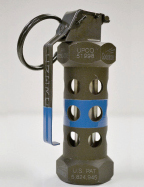
A stun grenade, also known as a flash grenade, flashbang, thunderflash, or sound bomb, is a non-lethal explosive device used to temporarily disorient an enemy's senses. Upon detonation, a stun grenade produces a blinding flash of light and an extremely loud "bang". They are often used in close-quarters combat, door breaching, and riot control, typically to stun enemies or distract them.
Originally developed to simulate explosions during military training, stun grenades were first used by the British Army Special Air Service's counterterrorist wing in the late 1970s, and have been used by police and military forces worldwide since.
Despite their less-lethal nature, stun grenades are still capable of causing harm, and can injure or kill when detonating in close proximity. They are also capable of sparking fires.
Effects

Construction
Unlike a fragmentation grenade, stun grenades are constructed with a casing designed to remain intact during detonation and avoid fragmentation injuries, while having large circular cutouts to allow the light and sound of the explosion through. The filler comprises a pyrotechnic metal-oxidant mix of magnesium or aluminium and an oxidizer such as potassium perchlorate or potassium nitrate.
Hazards
While stun grenades are designed to limit injury, permanent hearing loss has been reported. The concussive blast has the ability to cause injuries, and the heat generated may ignite flammable materials. The fires that occurred during the 1980 Iranian Embassy siege in London were caused by stun grenades.
References
References
- (September 3, 2014). "Drugs raid recovers tonnes of cocaine and marijuana in Chile". [[Daily Telegraph]].
- "Joint Intermediate Force Capabilities Office > Current Intermediate Force Capabilities > M-84 Flash Bang Grenade".
- "SAS - Weapons - Flash Bang | Stun Grenade". Elite UK Forces.
- Bonneville, Leigh, ''The SAS 1983-2014 (Elite)'', Osprey Publishing, 2016, {{ISBN. 1472814037 {{ISBN. 978-1472814036, p.9
- McEvoy, Matthew, et al. "State violence against protesters: Perspectives and trends in use of less lethal weapons." ''Torture Journal'' 34.1 (2024): 35.
- (12 January 2015). "Hotter Than Lava".
- "Measurement of Exposure to Impulsive Noise at Indoor and Outdoor Firing Ranges During Tactical Training Exercises". [[Centers for Disease Control and Prevention]].
- Tumbarska, Adelina. (2018). "4th International Conference on Human Security". University of Belgrade, Faculty of Security Studies, Human Security Research Center.
- "Stun grenades cause permanent hearing loss". Kashmir Observer.
- Hambling, David. (August 6, 2009). "Military Still Trying to Replace Dangerous Stun Grenades".
- Perry, Mike. (April 30, 2020). "40 years ago the British SAS stormed the Iranian Embassy and became world famous". The SOFREP Media Group.
This article was imported from Wikipedia and is available under the Creative Commons Attribution-ShareAlike 4.0 License. Content has been adapted to SurfDoc format. Original contributors can be found on the article history page.
Ask Mako anything about Stun grenade — get instant answers, deeper analysis, and related topics.
Research with MakoFree with your Surf account
Create a free account to save articles, ask Mako questions, and organize your research.
Sign up freeThis content may have been generated or modified by AI. CloudSurf Software LLC is not responsible for the accuracy, completeness, or reliability of AI-generated content. Always verify important information from primary sources.
Report