From Surf Wiki (app.surf) — the open knowledge base
STU-II
Secure telephone
Secure telephone
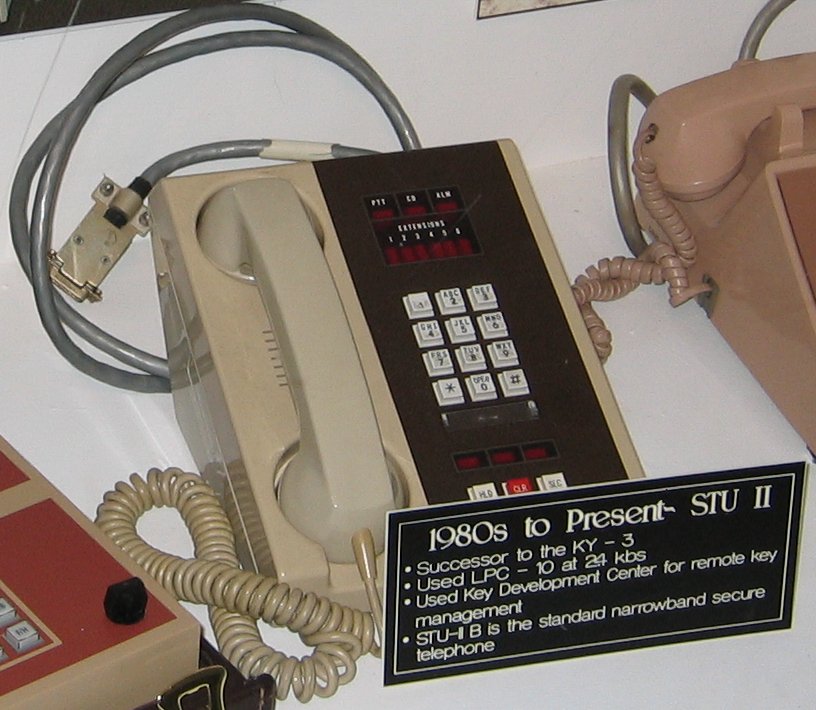
The STU-II (Standard Telephone Unit II) is a secure telephone developed by the U.S. National Security Agency. It permitted up to six users to have secure communications, on a time-shared (e.g.: rotating) basis. It was made by ITT Defense Communications, Nutley, New Jersey. An OEM partner was Northern Telecom.
According to information on display in 2005 at the NSA's National Cryptologic Museum, the STU-II was in use from the 1980s to the present. It uses the linear predictive coding algorithm LPC-10 at 2.4 kilobits/second to digitize voice, and the "Key Distribution Center" (KDC) for key management. The display also stated that the STU-II B is the standard narrow band secure telephone.
STU-II replaced the STU-I, KY-3 and the Navajo I. The last was a secure telephone in a briefcase, of which 110 were built in the 1980s for use by senior government officials when traveling. The Navaho I also used LPC-10.
Some 10 000 STU-II units were produced.
This article was imported from Wikipedia and is available under the Creative Commons Attribution-ShareAlike 4.0 License. Content has been adapted to SurfDoc format. Original contributors can be found on the article history page.
Ask Mako anything about STU-II — get instant answers, deeper analysis, and related topics.
Research with MakoFree with your Surf account
Create a free account to save articles, ask Mako questions, and organize your research.
Sign up freeThis content may have been generated or modified by AI. CloudSurf Software LLC is not responsible for the accuracy, completeness, or reliability of AI-generated content. Always verify important information from primary sources.
Report