From Surf Wiki (app.surf) — the open knowledge base
Stress intensity factor
Quantity in fracture mechanics; predicts stress intensity near a crack's tip

Quantity in fracture mechanics; predicts stress intensity near a crack's tip
In fracture mechanics, the stress intensity factor (K) is used to predict the stress state ("stress intensity") near the tip of a crack or notch caused by a remote load or residual stresses.{{cite book
The magnitude of K depends on specimen geometry, the size and location of the crack or notch, and the magnitude and the distribution of loads on the material. It can be written as:
:K = \sigma \sqrt{\pi a} , f(a/W)
where f(a/W) is a specimen geometry dependent function of the crack length, a, and the specimen width, W, and σ is the applied stress.
Linear elastic theory predicts that the stress distribution (\sigma_{ij}) near the crack tip, in polar coordinates (r,\theta) with origin at the crack tip, has the form {{cite book |author-link = Hiroshi Tada (engineer) |author2-link = Paul C. Paris |author3-link = George Rankine Irwin
: \sigma_{ij}(r, \theta) = \frac {K} {\sqrt{2 \pi r}},f_{ij} ( \theta) + ,,\rm{higher, order, terms}
where K is the stress intensity factor (with units of stress × length1/2) and f_{ij} is a dimensionless quantity that varies with the load and geometry. Theoretically, as r goes to 0, the stress \sigma_{ij} goes to \infty resulting in a stress singularity. Practically however, this relation breaks down very close to the tip (small r) because plasticity typically occurs at stresses exceeding the material's yield strength and the linear elastic solution is no longer applicable. Nonetheless, if the crack-tip plastic zone is small in comparison to the crack length, the asymptotic stress distribution near the crack tip is still applicable.
Stress intensity factors for various modes
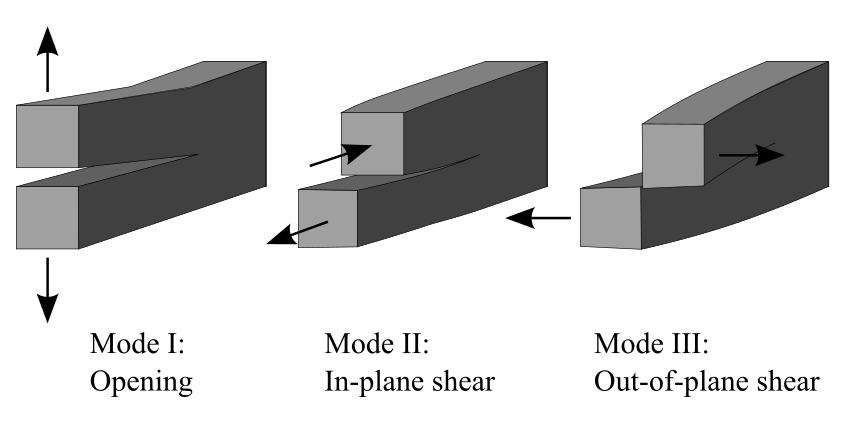
In 1957, G. Irwin found that the stresses around a crack could be expressed in terms of a scaling factor called the stress intensity factor. He found that a crack subjected to any arbitrary loading could be resolved into three types of linearly independent cracking modes. These load types are categorized as Mode I, II, or III as shown in the figure. Mode I is an opening (tensile) mode where the crack surfaces move directly apart. Mode II is a sliding (in-plane shear) mode where the crack surfaces slide over one another in a direction perpendicular to the leading edge of the crack. Mode III is a tearing (antiplane shear) mode where the crack surfaces move relative to one another and parallel to the leading edge of the crack. Mode I is the most common load type encountered in engineering design.
Different subscripts are used to designate the stress intensity factor for the three different modes. The stress intensity factor for mode I is designated K_{\rm I} and applied to the crack opening mode. The mode II stress intensity factor, K_{\rm II}, applies to the crack sliding mode and the mode III stress intensity factor, K_{\rm III}, applies to the tearing mode. These factors are formally defined as:
: \begin{align} K_{\rm I} & = \lim_{r\rightarrow 0} \sqrt{2\pi r},\sigma_{yy}(r,0) \ K_{\rm II} & = \lim_{r\rightarrow 0} \sqrt{2\pi r},\sigma_{yx}(r,0) \ K_{\rm III} & = \lim_{r\rightarrow 0} \sqrt{2\pi r},\sigma_{yz}(r,0) ,. \end{align}
| Equations for stress and displacement fields |
|---|
Relationship to energy release rate and J-integral
In plane stress conditions, the strain energy release rate (G) for a crack under pure mode I, or pure mode II loading is related to the stress intensity factor by: : G_{\rm I} = K_{\rm I}^2\left(\frac{1}{E}\right) : G_{\rm II} = K_{\rm II}^2\left(\frac{1}{E}\right) where E is the Young's modulus and \nu is the Poisson's ratio of the material. The material is assumed to be an isotropic, homogeneous, and linear elastic. The crack has been assumed to extend along the direction of the initial crack
For plane strain conditions, the equivalent relation is a little more complicated: : G_{\rm I} = K_{\rm I}^2\left(\frac{1-\nu^2}{E}\right), : G_{\rm II} = K_{\rm II}^2\left(\frac{1-\nu^2}{E}\right),.
For pure mode III loading, : G_{\rm III} = K_{\rm III}^2\left(\frac{1}{2\mu}\right) = K_{\rm III}^2\left(\frac{1+\nu}{E}\right) where \mu is the shear modulus. For general loading in plane strain, the linear combination holds: : G = G_{\rm I} + G_{\rm II} + G_{\rm III},. A similar relation is obtained for plane stress by adding the contributions for the three modes.
The above relations can also be used to connect the J-integral to the stress intensity factor because : G = J = \int_\Gamma \left(W~dx_2 - \mathbf{t}\cdot\cfrac{\partial\mathbf{u}}{\partial x_1}~ds\right) ,.
Critical stress intensity factor
Main article: Fracture toughness
The stress intensity factor, K, is a parameter that amplifies the magnitude of the applied stress that includes the geometrical parameter Y (load type). Stress intensity in any mode situation is directly proportional to the applied load on the material. If a very sharp crack, or a V-notch can be made in a material, the minimum value of K_\mathrm{I} can be empirically determined, which is the critical value of stress intensity required to propagate the crack. This critical value determined for mode I loading in plane strain is referred to as the critical fracture toughness (K_\mathrm{Ic}) of the material. K_\mathrm{Ic} has units of stress times the root of a distance (e.g. MN/m3/2). The units of K_\mathrm{Ic} imply that the fracture stress of the material must be reached over some critical distance in order for K_\mathrm{Ic} to be reached and crack propagation to occur. The Mode I critical stress intensity factor, K_\mathrm{Ic}, is the most often used engineering design parameter in fracture mechanics and hence must be understood if we are to design fracture tolerant materials used in bridges, buildings, aircraft, or even bells.
Polishing cannot detect a crack. Typically, if a crack can be seen it is very close to the critical stress state predicted by the stress intensity factor.
G–criterion
The G-criterion is a fracture criterion that relates the critical stress intensity factor (or fracture toughness) to the stress intensity factors for the three modes. This failure criterion is written as : K_{\rm c}^2 = K_{\rm I}^2 + K_{\rm II}^2 + \frac{E'}{2\mu},K_{\rm III}^2 where K_{\rm c} is the fracture toughness, E' = E/(1-\nu^2) for plane strain and E' = E for plane stress. The critical stress intensity factor for plane stress is often written as K_{\rm c}.
Examples
Infinite plate: Uniform uniaxial stress
| [[File:CrackInfinitePlate.svg | thumb | 150px | right | Crack in an infinite plate under mode I loading.]] |
|---|
Penny-shaped crack in an infinite domain
| [[File:PennyShapedCrack.svg | thumb | 200px | left | Penny-shaped crack in an infinite domain under uniaxial tension.]] |
|---|
Finite plate: Uniform uniaxial stress
| [[File:CrackFinitePlate.svg | thumb | 175px | left | Crack in a finite plate under mode I loading.]] |
|---|
Edge crack in a plate under uniaxial stress
| [[File:CrackEdgeFinitePlate.svg | thumb | 175px | left | Edge crack in a finite plate under uniaxial stress.]] |
|---|
Infinite plate: Slanted crack in a biaxial stress field
| [[File:CrackSlantedPlateBiaxialLoad.svg | thumb | left | 260px | A slanted crack in a thin plate under biaxial load.]] |
|---|
Crack in a plate under point in-plane force
| [[File:CrackFinitePlatePointForce.svg | thumb | 200px | left | A crack in a plate under the action of a localized force with components F_x and F_y.]] |
|---|
Loaded crack in a plate
| [[File:loadedCrackPlate.svg | thumb | 200px | left | A loaded crack in a plate.]] |
|---|
Stack of Parallel Cracks in an Infinite Plate
Source:
If the crack spacing is much greater than the crack length (h a), the interaction effect between neighboring cracks can be ignored, and the stress intensity factor is equal to that of a single crack of length 2a.
Then the stress intensity factor at crack tip is
\begin{align} K_{\rm I} & = \sigma\sqrt{\pi a} \end{align}
If the crack length is much greater than the spacing (a h ), the cracks can be considered as a stack of semi-infinite cracks.
Then the stress intensity factor at crack tip is
\begin{align} K_{\rm I} & = \sigma\sqrt{h} \end{align}
Compact tension specimen
| [[File:CompactTensionSpecimen.svg | thumb | left | 200px | Compact tension specimen for fracture toughness testing.]] |
|---|
Single-edge notch-bending specimen
| [[File:SingleEdgeNotchBending.svg | thumb | left | 300px | Single-edge notch-bending specimen (also called three-point bending specimen) for fracture toughness testing]] |
|---|
References
References
- Soboyejo, W. O.. (2003). "Mechanical properties of engineered materials". Marcel Dekker.
- Janssen, M. (Michael). (2004). "Fracture mechanics". Spon Press.
- (2015). "An improved semi-analytical solution for stress at round-tip notches". Engineering Fracture Mechanics.
- (2004). "Fatigue of Materials". Cambridge University Press.
- (1974). "Fracture mechanics applied to engineering problems-strain energy density fracture criterion". Engineering Fracture Mechanics.
- (1976). "Compendium of stress intensity factors". HMSO Ministry of Defence. Procurement Executive.
- Isida, M., 1966, ''Stress intensity factors for the tension of an eccentrically cracked strip'', Transactions of the ASME Applied Mechanics Section, v. 88, p.94.
- (1962). "Crack-tip stress intensity factors for the plane extension and plate bending problem". Journal of Applied Mechanics.
- Erdogan, F.. (1962). "On the stress distribution in plates with collinear cuts under arbitrary loads". Proceedings of the Fourth US National Congress of Applied Mechanics.
- Kundu, Tribikram. (2008-01-30). "Fundamentals of Fracture Mechanics".
- Bower, A. F.. "Applied mechanics of solids".
This article was imported from Wikipedia and is available under the Creative Commons Attribution-ShareAlike 4.0 License. Content has been adapted to SurfDoc format. Original contributors can be found on the article history page.
Ask Mako anything about Stress intensity factor — get instant answers, deeper analysis, and related topics.
Research with MakoFree with your Surf account
Create a free account to save articles, ask Mako questions, and organize your research.
Sign up freeThis content may have been generated or modified by AI. CloudSurf Software LLC is not responsible for the accuracy, completeness, or reliability of AI-generated content. Always verify important information from primary sources.
Report