From Surf Wiki (app.surf) — the open knowledge base
Strait
Waterway that connects two larger bodies of water
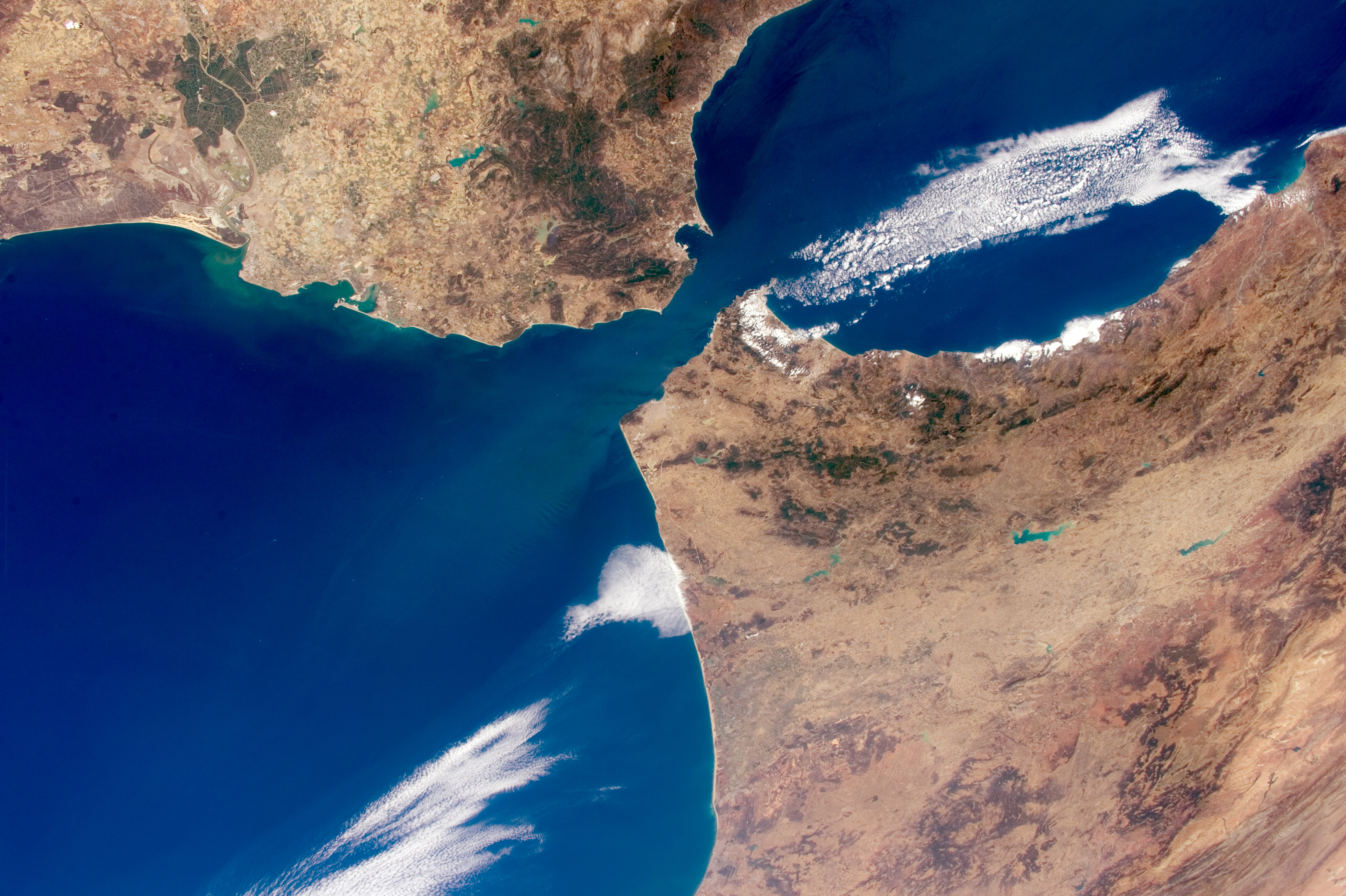
Waterway that connects two larger bodies of water

A strait is a water body connecting two seas or water basins. The surface water is, for the most part, at the same elevation on both sides and can flow through the strait in either direction, although the topography generally constricts the flow somewhat. In some straits, there is a dominant directional current. Most commonly, the strait is a narrow channel that lies between two land masses. Straits are loci for sediment accumulation, with sand-sized deposits usually occurring on the two strait exits, forming subaqueous fans or deltas. Some straits are not navigable because they are too narrow, too shallow, or due to the presence of a reef or archipelago.
Terminology
The terms channel, pass, or passage can be synonymous and used interchangeably with strait, although each is sometimes differentiated with varying senses. In Scotland, firth or Kyle are also sometimes used as synonyms for strait.
Many straits are economically important. Straits can be important shipping routes and wars have been fought for control of them.
Numerous artificial channels, called canals, have been constructed to connect two oceans or seas over land, such as the Suez Canal. Although rivers and canals often provide passage between two large lakes, and these seem to suit the formal definition of strait, they are not usually referred to as such. Rivers and often canals, generally have a directional flow tied to changes in elevation, whereas straits often are free flowing in either direction or switch direction, maintaining the same elevation. The term strait is typically reserved for much larger, wider features of the marine environment. There are exceptions, with straits being called canals; Pearse Canal, for example.
Comparisons
Straits are the converse of isthmuses. That is, while a strait lies between two land masses and connects two large areas of ocean, an isthmus lies between two areas of ocean and connects two large land masses.
Some straits have the potential to generate significant tidal power using tidal stream turbines. Tides are more predictable than wave power or wind power. The Pentland Firth (a strait) may be capable of generating 10 GW. Cook Strait in New Zealand may be capable of generating 5.6 GW even though the total energy available in the flow is 15 GW.
References
Bibliography
- Longhitano S., 2013. A facies-based depositional model for ancient and modern, tectonically–confined tidal straits. Terra Nova, 25,6, 446-452
References
- "Marine Briefing" (December 2006) Scottish Renewables Forum. Glasgow.
- "The Energetics of Large Tidal Turbine Arrays, Ross Vennell, 2012, preprint submitted to Royal Society, 2011."
- "Estimating the power potential of tidal currents and the impact of power extraction on flow speeds. Ross Vennell, 2011" {{doi. 10.1016/j.renene.2011.05.011
- Bugajski, Dariusz R.. (2021). "Navigational rights and freedoms in the international law and practice". Akademia Marynarki Wojennej.
This article was imported from Wikipedia and is available under the Creative Commons Attribution-ShareAlike 4.0 License. Content has been adapted to SurfDoc format. Original contributors can be found on the article history page.
Ask Mako anything about Strait — get instant answers, deeper analysis, and related topics.
Research with MakoFree with your Surf account
Create a free account to save articles, ask Mako questions, and organize your research.
Sign up freeThis content may have been generated or modified by AI. CloudSurf Software LLC is not responsible for the accuracy, completeness, or reliability of AI-generated content. Always verify important information from primary sources.
Report