From Surf Wiki (app.surf) — the open knowledge base
Still engine
Combined-cycle piston engine

Combined-cycle piston engine
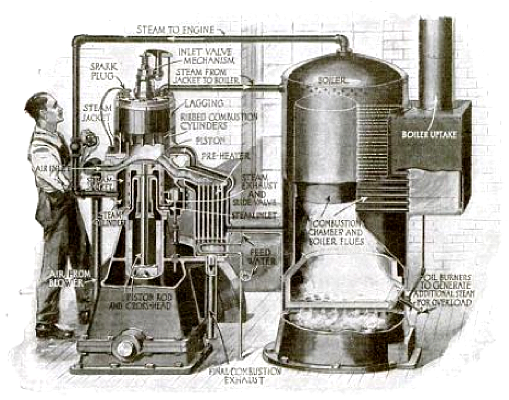
The Still engine was a piston engine that simultaneously used both steam power from an external boiler, and internal combustion from gasoline or diesel, in the same unit. The waste heat from the cylinder and internal combustion exhaust was directed to the steam boiler, resulting in claimed fuel savings of up to 10%.
History
Still was not the first in this field; a similar system, whereby compressed air (instead of gearing) was to transfer the power from an internal combustion engine and steam recovered from its cooling system was to augment the compressed air, had been patented in 1903 by Captain Paul Lucas-Girardville (a French military aviator) and Louis Mékarski.
Development
Marine
In 1924 Scotts Shipbuilding and Engineering Company of Greenock, Scotland, put a diesel-fuelled marine version, the Scott-Still regenerative engine, into production, with the first pair of engines installed in the twin-screw M. V. Dolius, of the Blue Funnel Line. The trial was successful and in 1928 Blue Funnel commissioned a larger and faster ship, the Eurybates, with this propulsion system. However the requirement to carry marine engineering officers certified with both steam and motor qualifications, meaning extra crew members and wages, and the extra complexity with consequent higher maintenance costs, offset the fuel savings and conventional diesel engines were later installed in their place.
Railway
In 1926 Kitson and Company, locomotive builders of Leeds, England, produced a steam–diesel hybrid locomotive, the Kitson Still locomotive. This was loaned for trials to the London and North Eastern Railway and used successfully to haul heavy coal trains, but the difference in the cost of coal used by a conventional locomotive, against the fuel oil used by the hybrid, was not great. When Kitson's failed in 1934, a failure to which the development costs of the hybrid locomotive had contributed, the receivers sold the machine for scrap.
Decline
Developments of larger diesel engines in the 1930s, with improved methods of power transmission, meant that the principal advantages of the Still engine – the ability to provide for direct-drive starts from rest and additional power at times of temporary high load – was lost, and further development ended.
References
- {{Cite journal
References
- (28 May 1919). "New British Engine Surpasses Diesel". [[New York Times]].
- William Joseph Still. (19 June 1917). "U. S. patent 1230617". United States Patent and Trademark Office.
- (27 May 1919). "Waste Heat in Engine Power". [[The Times]].
- (September 1919). "Getting more out of the Gas Engine". [[Popular Science Monthly]].
- "Combined Internal Combustion and Compressed Air Motors". [[European Patent Office]].
- Robinson, William. (1927). "Applied Thermodynamics". Pitman.
- Self, Douglas. (16 November 2008). "The Still Steam-Diesel Engine". The Museum of Retro Technology.
- (1992). "Blue Funnel Legend". Macmillan.
- "The Experimental Kitson-Still Steam/Diesel Hybrid Locomotive".
This article was imported from Wikipedia and is available under the Creative Commons Attribution-ShareAlike 4.0 License. Content has been adapted to SurfDoc format. Original contributors can be found on the article history page.
Ask Mako anything about Still engine — get instant answers, deeper analysis, and related topics.
Research with MakoFree with your Surf account
Create a free account to save articles, ask Mako questions, and organize your research.
Sign up freeThis content may have been generated or modified by AI. CloudSurf Software LLC is not responsible for the accuracy, completeness, or reliability of AI-generated content. Always verify important information from primary sources.
Report