From Surf Wiki (app.surf) — the open knowledge base
Stegodon
Genus of extinct proboscidean
Genus of extinct proboscidean
- S. elephantoides Clift, 1828
- S. florensis Hooijer, 1957
- S. ganesha Faloner & Cautley, 1846
- S. kaisensis Hopwood, 1939
- S. luzonensis von Koenigswald, 1956
- S. miensis Matsumoto, 1941
- S. mindanensis Naumann, 1890
- S. orientalis Owen, 1870
- S. protoaurorae Aiba et al., 2010
- S. sompoensis Hooijer, 1964
- S. sondaari van den Bergh, 1999
- S. trigonocephalus Martin, 1887
- S. zdanskyi Hopwood, 1935
Stegodon (from the Ancient Greek στέγω (stégō), meaning "to cover", and ὀδούς (odoús), meaning "tooth", named for the distinctive ridges on the animal's molars) is an extinct genus of proboscidean, related to elephants. It was originally assigned to the family Elephantidae along with modern elephants but is now placed in the extinct family Stegodontidae. Like elephants, Stegodon had teeth with plate-like lophs that are different from those of more primitive proboscideans like gomphotheres and mammutids. Fossils of the genus are known from Africa and across much of Asia, as far southeast as Timor (with a single record in southeast Europe). The oldest fossils of the genus are found in Late Miocene strata in Asia, likely originating from the more archaic Stegolophodon, subsequently migrating into Africa. While the genus became extinct in Africa during the Pliocene, Stegodon persisted in South, Southeast and Eastern Asia into the Late Pleistocene.
Morphology
The skull of Stegodon is relatively tall but short, and similar in many respects to those of living elephants. The lower jaw in comparison to early elephantimorphs and its ancestor Stegolophodon is shortened (brevirostrine), and lacks lower tusks/incisors. The molar teeth are superficially like those of elephants, consisting of parallel lamellae that form ridges but are generally relatively low crowned (brachydont), the numbers of ridges are greater in later species. Members of the genus lack permanent premolars. The tusks are proportionally large, with those of the biggest species being among the largest known tusks in proboscideans, with a particularly large tusk of S. ganesa from the Early Pleistocene of India measured to be 3.89 m long, with an estimated mass of approximately 140 kg, substantially larger than the largest recorded modern elephant tusk. These tusks have a slight upward curvature, and project forwards and parallel to each other, with the tusks often so close together that they are almost touching, such that the trunk would probably have had to rest on top of the tusks rather than be freely hanging between them as in living elephants.
Size
Similar to modern-day elephants, stegodonts were likely good swimmers, allowing them to disperse to remote islands in Indonesia, the Philippines and Japan. Once present on the islands, due to the process of insular dwarfism, as a result of decreased land area and the reduction of predation and competition pressure, they reduced in body size, with the degree of dwarfism varying between islands as the result of local conditions. One of the smallest species, Stegodon sumbaensis from Sumba in Indonesia, is estimated at around 8% of the size of mainland Stegodon species, with a body mass of 250 kg. Sometimes the same island was colonised multiple times by Stegodon, as in Flores, where the Early Pleistocene strongly dwarfed species Stegodon sondaari, which was 120 cm tall at the shoulder and weighed about 350-400 kg, was replaced by the species Stegodon florensis during the Middle Pleistocene which was initially substantially larger, but progressively reduced in size over time, with the earlier subspecies Stegodon florensis florensis from the Middle Pleistocene estimated to be around 50% the size of mainland Stegodon species with a shoulder height of around 190 cm and a body mass of around 1.7 tons, while the later Stegodon florensis insularis from the Late Pleistocene is estimated to be around 17% the size of mainland Stegodon species, with a shoulder height of around 130 cm, and a body mass of about 570 kg.
During Pliocene-Early Pleistocene (from around 4-1 million years ago), a succession of endemic dwarf species of Stegodon, probably representing a single lineage lived in the Japanese archipelago, probably derived from the mainland Chinese S. zdanskyi. In chronological succession these species are Stegodon miensis (4-3 million years ago) Stegodon protoaurorae (3-2 million years ago) and Stegodon aurorae, (2-1 million years ago) which show a progressive size reduction through time, possibly as a result of reducing land area of the Japanese archipelago. The latest and smallest species S. aurorae is estimated to be 25% the size of its mainland ancestor with a body mass of around 2122 kg. S. aurorae also shows morphological straits associated with dwarfism, like shortened limbs.
Palaeobiology
Palaeoecology

Like modern elephants, but unlike more primitive proboscideans, Stegodon is thought to have chewed using a proal movement (a forward stroke from the back to the front) of the lower jaws. This jaw movement is thought to have evolved independently in elephants and stegodontids. Stegodon populations from the Late Pliocene of the India (including Stegodon insignis) are suggested to have been variable mixed feeders, while those from the earliest Pleistocene (including Stegodon ganesa) of the same region are suggested to have been nearly pure grazers based on isotopic analysis. Based on dental microwear analysis, populations of Stegodon from the Pleistocene of China (Stegodon orientalis and Stegodon huananensis) and mainland southeast Asia (S. orientalis) were found to be browsers, with clear niche differentiation from sympatric Elephas populations, which tended towards mixed feeding (both browsing and grazing), though isotopic analysis of Stegodon cf. orientalis specimens from the late Middle Pleistocene of Thailand suggests that these individuals were mixed feeders that consumed a significant amount of C4 grass. Specimens of Stegodon trigonocephalus from the Early-Middle Pleistocene of Java were found to be mixed feeders to grazers, with a diet similar to that of sympatric Elephas hysudrindicus. The dwarf species from Flores, Stegodon sondaari and Stegodon florensis, are suggested to have been mixed feeders and grazers, respectively, based on stable carbon isotopes. Specimens of Stegodon kaiesensis from the Pliocene of East Africa were found to be browsers to mixed feeders, based on mesowear analysis.
On Flores, where dwarf Stegodon species were the only large herbivores, they were likely the main prey of the Komodo dragon.
Palaeopathology
In the Siwalik Hills assemblage, the Pliocene S. insignis shows a relatively low frequency of enamel hypoplasia, likely due to the relative stability of regional climate during this epoch. The Pleistocene S. ganesha, on the other had, had high rates of enamel hypoplasia that have been attributed to a highly unstable environmental dynamics during the epoch.
Social behaviour
Ichnofossils of a group of Stegodon from the Late Pliocene of Japan suggest that like modern elephants, Stegodon were highly social animals and lived together in herds.
Taxonomy

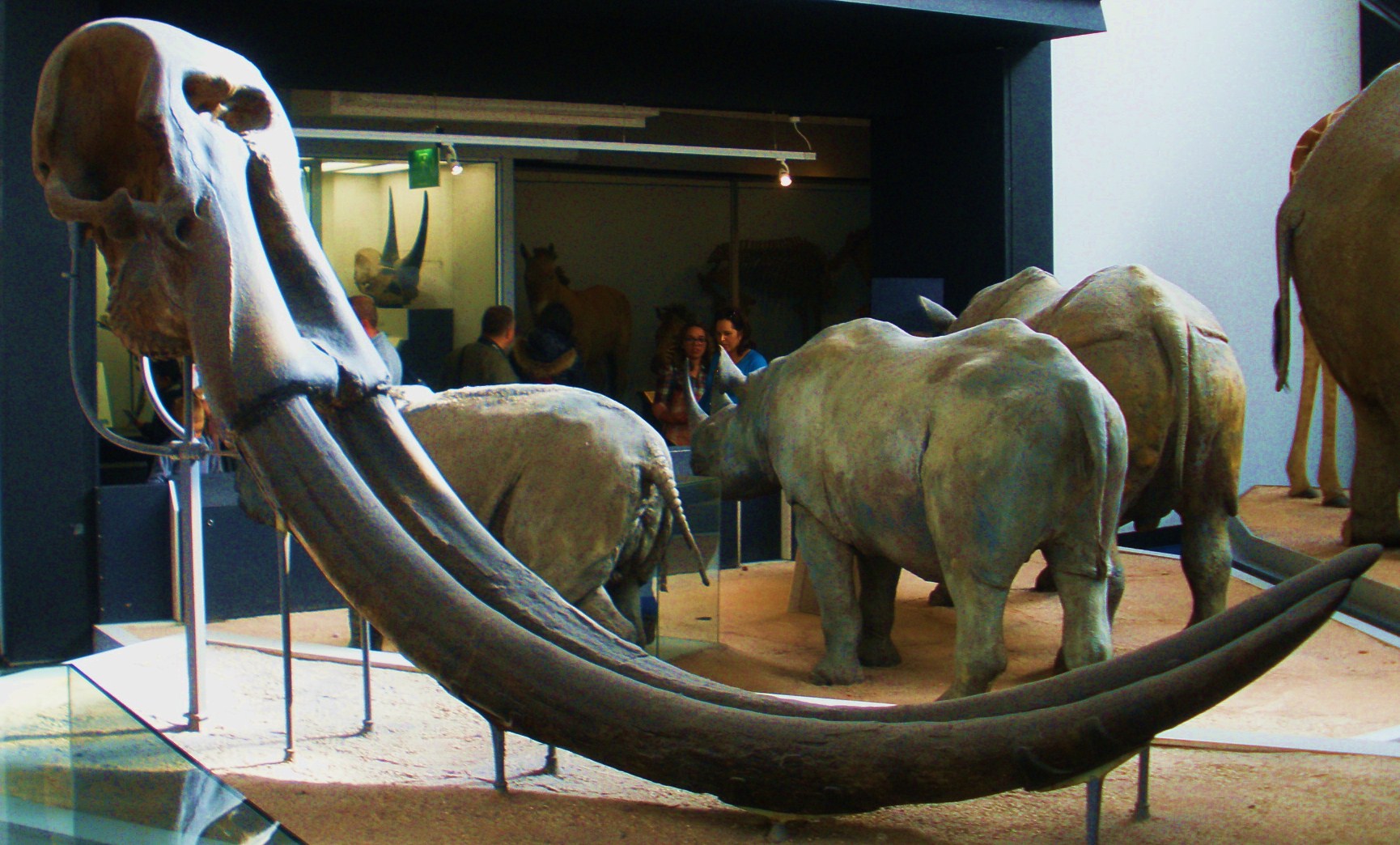

In the past, stegodonts were believed to be the ancestors of the true elephants and mammoths, but currently they are believed to have no modern descendants. Stegodon is likely derived from Stegolophodon, an extinct genus known from the Miocene of Asia, with transitional fossils between the two genera known from the Late Miocene of Southeast Asia and Yunnan in South China. Stegodon is more closely related to elephants and mammoths than to mastodons. Like elephants, stegodontids are believed to have derived from gomphotheres.
Phylogeny
The following cladogram shows the placement of the genus Stegodon among other proboscideans, based on hyoid characteristics, following Shoshani and Tassy (2005):
List of species
- Stegodon kaisensis Late Miocene – Pliocene, Africa
- Stegodon zdanskyi Late Miocene – Pliocene, China
- Stegodon huananensis Early Pleistocene, China
- Stegodon orientalis Middle – Late Pleistocene, China, Southeast Asia, Japan, Taiwan
- Stegodon namadicus/S. insignis/S. ganesa Pliocene – Late Pleistocene, India
- Stegodon miensis Pliocene, Japan
- Stegodon protoaurorae Late Pliocene – Early Pleistocene, Japan
- Stegodon aurorae Early Pleistocene – early Middle Pleistocene, Japan
- Stegodon sondaari Early Pleistocene, Flores, Indonesia
- Stegodon florensis Middle – Late Pleistocene, Flores, Indonesia
- Stegodon luzonensis Middle Pleistocene, Luzon, Philippines
- Stegodon trigonocephalus late Early Pleistocene – early Late Pleistocene, Java, Indonesia
- Stegodon sompoensis Late Pliocene – Early Pleistocene, Sulawesi, Indonesia
- Stegodon sumbaensis Middle – Late Pleistocene, Sumba, Indonesia
- Stegodon timorensis Middle Pleistocene, Timor, Indonesia
- Stegodon mindanensis Pleistocene Mindanao, Philippines An indeterminate Stegodon molar of an uncertain locality and age is known from Greece, representing the only record of the genus in Europe. Indeterminate remains are also known from the Early Pleistocene and early Middle Pleistocene of Israel.
Relationship with humans
Remains at a number of sites suggest that humans (in a broad sense, including archaic humans) interacted with Stegodon. At a cave deposit on Gele Mountain near Chongqing in southwest China, a mandible of Stegodon orientalis was used to make a handaxe, with dating suggesting the bone is around 170,000 years old. At the late Middle Pleistocene Panxian Dadong cave site in southern Guizhou Province, southwest China, dating to around 300-190,000 years ago, numerous remains of juvenile (0-12 years of age) and a much smaller number of adult remains of adult Stegodon orientalis, representing a minimum of 12 individuals were found at the site in association with stone tools and human remains. It suggested that Stegodon remains were brought to the cave by humans though none of the elements show clear evidence of processing. At the Xinlong Cave site in the Three Gorges area of Chongqing, suggested to date to around 200-130,000 years ago, two Stegodon cf. orientalis tusks have been found along with human remains. These tusks appear to have been delibrately engraved with patterns and are suggested to have been brought into the cave by humans. At the Late Pleistocene Ma'anshan site also in Guizhou, remains of Stegodon orientalis including both adults and juveniles among other animals are found in two layers, the older dating to around 53,000 years Before Present (BP), with the younger dates to around 19,295-31,155 years BP with the minimum number of individuals being 7 and 2 for the older and younger layers respectively, with the older layer containing adults and juveniles while in the younger later only juveniles are present. Bones at the site display cut marks indicating butchery, and are thought to have been accumulated at the site by people, likely by hunting or possibly scavenging in the case of the large adults found in the older layer.
At Liang Bua cave on Flores dating to around 80-50,000 years ago, remains of the dwarf Stegodon species Stegodon florensis are associated with stone tools produced by the dwarf archaic human species Homo floresiensis, with a small number of the bones bearing cut marks*.* The ambiguous circumstantial association between bones and stone tools, and the rarity of cut marks makes it unclear to what if to any degree, hunting of Stegodon was practiced by Homo floresiensis.
Evolution and extinction
The oldest fossils of Stegodon in Asia date to the Late Miocene, around 8-11 million years ago, with the oldest fossils of the genus in Africa being around 7-6 million years old. Stegodon became extinct in Africa during the late Pliocene, around 3 million years ago suggested to be the result of expansion of grassland habitats. The earliest records of Stegodon in Java date to the Early Pleistocene, over 2 million years ago. On the islands of the Philippines, remains of Stegodon are suggested to span from at latest 0.8-1 million years ago until at least 400,000 years ago.
The Javanese species Stegodon trigonocephalus became extinct around 130-80,000 years ago during the latest Middle Pleistocene-early Late Pleistocene (Marine Isotope Stage 5) following a change to more humid conditions, which may have reduced grazing habitat. The last records of Stegodon florensis date to around 50,000 years ago, around the time of arrival of modern humans to Flores (the earliest evidence of which dates to 46,000 years ago), suggesting that effects of modern human activity were likely the cause of their extinction.
Stegodon became extinct in the Indian subcontinent (Stegodon namadicus/Stegodon sp*.),* mainland Southeast Asia and China (S. orientalis) at some point during the Late Pleistocene epoch, while Asian elephants, which existed in sympatry with Stegodon in these regions, are still extant. The precise timing of extinction is uncertain for these regions, though in India records of Stegodon may date as recently as 35-30,000 years ago, and to at least 30-20,000 years ago for S. orientalis in China, with young records of this age including those from Guangxi southwest China, as well as southern Shaanxi in northern China. The harsh climate of the Last Glacial Maximum may have contributed to the decline of S. orientalis. The survival of the Asian elephant as opposed to Stegodon orientalis in Southeast Asia and South China has been suggested to be due to its more flexible diet in comparison to S. orientalis. Although some authors have claimed a Holocene survival in China for S. orientalis, these claims cannot be substantiated due to loss of specimens and issues regarding dating.
References
References
- (March 2020). "Stegodontidae and Anancus: Keys to understanding dental evolution in Elephantidae". [[Quaternary Science Reviews]].
- (January 2016). "New magnetochronology of Late Miocene mammal fauna, NE Tibetan Plateau, China: Mammal migration and paleoenvironments". [[Earth and Planetary Science Letters]].
- (1 January 2005). "Large mammal turnover in Africa and the Levant between 1.0 and 0.5 Ma". [[Geological Society, London, Special Publications]].
- (2021-07-01). "The rise and fall of proboscidean ecological diversity". [[Nature Ecology & Evolution]].
- van der Made, J. [https://www.researchgate.net/publication/260869040_The_evolution_of_the_elephants_and_their_relatives_in_the_context_of_changing_climate_and_geography The Evolution of the Elephants and Their Relatives in the Context of Changing Climate and Geography]. In ''Elefantentreich—Eine Fossilwelt in Europa''; Verlag Beier & Beran: Langenweißbach, Germany, 2010; pp. 340–360. {{ISBN. 978-3-939414-48-3.
- Sanders, William J.. (17 February 2018). "Horizontal tooth displacement and premolar occurrence in elephants and other elephantiform proboscideans". [[Historical Biology]].
- Larramendi, Asier. (10 December 2023). "Estimating tusk masses in proboscideans: a comprehensive analysis and predictive model". Historical Biology.
- Nabavizadeh, Ali. (8 October 2024). "Of tusks and trunks: A review of craniofacial evolutionary anatomy in elephants and extinct Proboscidea". [[The Anatomical Record]].
- (2016). "Shoulder height, body mass and shape of proboscideans". [[Acta Palaeontologica Polonica]].
- Simpson, G. (1977). "Too Many Lines; The Limits of the Oriental and Australian Zoogeographic Regions". ''Proceedings of the American Philosophical Society'', 121(2), 107–120. Retrieved from http://www.jstor.org/stable/986523
- (2019). "Early human settlement of Sahul was not an accident". [[Scientific Reports]].
- (August 2016). "The effect of area and isolation on insular dwarf proboscideans". [[Journal of Biogeography]].
- Puspaningrum, Mika; Van Den Bergh, Gerrit; Chivas, Allan; Setiabudi, Erick; Kurniawan, Iwan; Brumm, Adam; and Sutikna, Thomas, "[https://ro.uow.edu.au/smhpapers/2035 Preliminary results of dietary and environmental reconstructions of Early to Middle Pleistocene Stegodons from the So'a Basin of Flores, Indonesia, based on enamel stable isotope records]" (2014). Faculty of Science, Medicine and Health - Papers: part A. 2035.
- (2010-03-10). "A new species of Stegodon (Mammalia, Proboscidea) from the Kazusa Group (lower Pleistocene), Hachioji City, Tokyo, Japan and its evolutionary morphodynamics: STEGODON PROTOAURORAE SP. NOV. AND MORPHODYNAMICS". [[Palaeontology (journal).
- (August 2016). "The effect of area and isolation on insular dwarf proboscideans". [[Journal of Biogeography]].
- (November 2019). "Dietary and habitat shifts in relation to climate of Neogene-Quaternary proboscideans and associated mammals of the Indian subcontinent". [[Quaternary Science Reviews]].
- (25 July 2017). "An examination of feeding ecology in Pleistocene proboscideans from southern China (Sinomastodon, Stegodon, Elephas), by means of dental microwear texture analysis". [[Quaternary International]].
- (15 May 2019). "Ecological flexibility and differential survival of Pleistocene Stegodon orientalis and Elephas maximus in mainland southeast Asia revealed by stable isotope (C, O) analysis". [[Quaternary Science Reviews]].
- (August 2018). "Late Middle Pleistocene ecology and climate in Northeastern Thailand inferred from the stable isotope analysis of Khok Sung herbivore tooth enamel and the land mammal cenogram". [[Quaternary Science Reviews]].
- (January 2020). "Isotopic reconstruction of Proboscidean habitats and diets on Java since the Early Pleistocene: Implications for adaptation and extinction". Quaternary Science Reviews.
- (14 August 2023). "Fluctuating climate and dietary innovation drove ratcheted evolution of proboscidean dental traits". [[Nature Ecology & Evolution]].
- Diamond, Jared M. (1987). "Did Komodo dragons evolve to eat pygmy elephants?". ''Nature''. 326 (6116): 832.
- (30 October 2022). "Tooth marker of ecological abnormality: The interpretation of stress in extinct mega herbivores (proboscideans) of the Siwaliks of Pakistan". [[Ecology and Evolution]].
- (2 October 2015). "Review of Japanese Cenozoic (Miocene–Modern) Vertebrate Tracks". Ichnos.
- (2018-05-16). "A grazing Gomphotherium in Middle Miocene Central Asia, 10 million years prior to the origin of the Elephantidae". Scientific Reports.
- (2005). "Advances in proboscidean taxonomy & classification, anatomy & physiology, and ecology & behavior". Quaternary International.
- (2022). "The Fossil Record of the Neogene Proboscidea (Mammalia) in Greece". Springer International Publishing.
- (September 2013). "New fossil remains of Elephas from the southern Levant: Implications for the evolutionary history of the Asian elephant". Palaeogeography, Palaeoclimatology, Palaeoecology.
- Haynes, Gary. (March 2022). "Late Quaternary Proboscidean Sites in Africa and Eurasia with Possible or Probable Evidence for Hominin Involvement". Quaternary.
- (April 2017). "First discovery of a bone handaxe in China". [[Quaternary International]].
- (October 2015). "Optical dating of flowstone and silty carbonate-rich sediments from Panxian Dadong Cave, Guizhou, southwestern China". [[Quaternary Geochronology]].
- Schepartz, Lynne, and Sari Miller-Antonio. 2010. "[https://www.researchgate.net/publication/235350991_Large_mammal_exploitation_in_Late_Middle_Pleistocene_China_a_comparison_of_rhinoceros_stegodonts_at_Panxian_Dadong Large Mammal Exploitation in Late Middle Pleistocene China: A Comparison of Rhinoceros & Stegodonts at Panxian Dadong]." ''Before Farming'' 4: 1–14.
- (January 2005). "Stegodon orientalis from Panxian Dadong, a Middle Pleistocene archaeological site in Guizhou, South China: taphonomy, population structure and evidence for human interactions". [[Quaternary International]].
- (December 2014). "230Th/U chronology of a paleolithic site at Xinglong Cave in the three-Gorge region of south China". [[Quaternary Geochronology]].
- (August 2010). "Zooarchaeological perspectives on the Chinese Early and Late Paleolithic from the Ma'anshan site (Guizhou, South China)". [[Journal of Archaeological Science]].
- Matthew W. Tocheri, Thomas Sutikna, Jatmiko, E. Wahyu Saptomo. (2022-02-14). "''Homo floresiensis''". Oxford University Press.
- (November 2018). "The spatio-temporal distribution of archaeological and faunal finds at Liang Bua (Flores, Indonesia) in light of the revised chronology for Homo floresiensis". [[Journal of Human Evolution]].
- (2005). "Notes on Asian stegodontids". [[Quaternary International]].
- (October 2024). "Geochronological advances in human and proboscideans first arrival date in the Philippines archipelago (Cagayan valley, Luzon Island)". Quaternary Geochronology.
- Tablizo, Meyrick U.. (November 2025). "Island-hopping across the Wallace Line: A new Pleistocene Stegodon fossil skull from Luzon (Philippines) reveals dispersal links to Wallacea". Palaeogeography, Palaeoclimatology, Palaeoecology.
- (October 2022). "An integrative geochronological framework for the Pleistocene So'a basin (Flores, Indonesia), and its implications for faunal turnover and hominin arrival". Quaternary Science Reviews.
- (2021-01-15). "Late Quaternary extinctions in the Indian Subcontinent". Palaeogeography, Palaeoclimatology, Palaeoecology.
- (January 2021). "Late Quaternary megafaunal extinctions in India: How much do we know?". [[Quaternary Science Reviews]].
- CHEN Qingmin, CHENG Xing, HONG Zenglin, DENG Li, ZHANG Yu, LI Xingwen, GUO Qiming, TANG Li, HU Yi, WANG Peng, WANG Yan, WANG Gaohong, CHENG Hai, R.Lawrence Edwards. [http://zgyr.karst.ac.cn/en/article/doi/10.11932/karst2025y045 Study of tooth fossil chronology of ''Stegodon orientalis''
in Tianxingyan, Hanzhong Tiankeng Group[J]. ] ''CARSOLOGICA SINICA'', 2025, 44(4): 887-896. doi: 10.11932/karst2025y045 (in Chinese with English abstract) - H. Saegusa, [http://www.cq.rm.cnr.it/elephants2001/pdf/345_349.pdf "Comparisons of Stegodon and Elephantid Abundances in the Late Pleistocene of Southern China"] {{webarchive. link. (2006-05-08, The World of Elephants – Second International Congress, (Rome, 2001), 345–349.)
- Samuel T. Turvey, Haowen Tong, Anthony J. Stuart and Adrian M. Lister. (2013). "Holocene survival of Late Pleistocene megafauna in China: a critical review of the evidence". [[Quaternary Science Reviews]].
This article was imported from Wikipedia and is available under the Creative Commons Attribution-ShareAlike 4.0 License. Content has been adapted to SurfDoc format. Original contributors can be found on the article history page.
Ask Mako anything about Stegodon — get instant answers, deeper analysis, and related topics.
Research with MakoFree with your Surf account
Create a free account to save articles, ask Mako questions, and organize your research.
Sign up freeThis content may have been generated or modified by AI. CloudSurf Software LLC is not responsible for the accuracy, completeness, or reliability of AI-generated content. Always verify important information from primary sources.
Report