From Surf Wiki (app.surf) — the open knowledge base
States and territories of Australia
National subdivisions and second level of government of Australia
National subdivisions and second level of government of Australia
| Field | Value |
|---|---|
| name | States and territories of Australia |
| map | Australia states and territories labelled.svg |
| caption | Map depicting Mainland Australia's states and its territories labelled in lime and dark green |
| territory | Australia |
| current_number | 16 (6 states, 3 internal territories, and 7 external territories) |
| population_range | Least populous state: Most populous state: Least populous territories: Most populous territory: |
| area_range | Smallest state:Largest state:Smallest territory:Largest territories: |
| subdivision | Local government areas and unincorporated areas |
The states and territories are the national subdivisions and second level of government of Australia. The states are partially sovereign, administrative divisions that are self-governing polities, having ceded some sovereign rights to the federal government. They have their own constitutions, legislatures, executive governments, judiciaries and law enforcement agencies that administer and deliver public policies and programs. Territories can be autonomous and administer local policies and programs much like the states in practice, but are still legally subordinate to the federal government.
Australia has six federated states: New South Wales (including Lord Howe Island), Queensland, South Australia, Tasmania (including Macquarie Island), Victoria, and Western Australia. Australia also has ten federal territories, out of which three are internal territories: the Australian Capital Territory, the Jervis Bay Territory, and the Northern Territory on the Australian mainland; and seven are external territories: the Ashmore and Cartier Islands, the Australian Antarctic Territory, Christmas Island, the Cocos (Keeling) Islands, the Coral Sea Islands, Heard Island and McDonald Islands, and Norfolk Island that are offshore dependent territories. Every state and internal territory (except the Jervis Bay Territory) is self-governing with its own independent executive government, legislature, and judicial system, while the rest only have local government status overseen by federal departments.
State and territory governments may legislate on matters concerning their citizens, subject to the limits of the federal constitution (notably section 51 and section 109). Each state and internal territory (except Jervis Bay Territory) has its own legislature, although the Federal Parliament can override territorial legislation. The federal High Court of Australia acts as a final court of appeal for all matters, and has the authority to override any state judiciary. While all states and internal territories have their own judicial system (subject to appeal to the High Court), most external territories are subject to the judiciary and legislature of either a state or internal territory. Excluding the Heard Island and McDonald Islands and the Australian Antarctic Territory (which are governed by the Department of Climate Change, Energy, the Environment and Water), the external territories are governed by the federal Department of Infrastructure, Transport, Regional Development, Communications and the Arts. Norfolk Island had its own legislature from 1979 to 2015.
Each state is a successor to a historical British colony, and each has its own constitution. The Australian Capital Territory (ACT) and Northern Territory for the most part operate indistinguishably from the states (for example, both have representation in the Parliament since 1948 and in the Senate since 1975), even though they do not have constitutional status as states and territorial legislation can be overridden.
Geography
Main article: Geography of Australia
Surrounded by the Indian, Pacific, and Southern oceans, Australia is separated from Maritime Southeast Asia and New Guinea by the Arafura Sea, the Timor Sea, and the Torres Strait, from Island Melanesia by the Coral Sea, and from New Zealand by the Tasman Sea. The world's smallest continent, Australia is also the sixth-largest country by land area and sometimes considered the world's largest island. Australia has a mainland coastline of 32994 km and claims an exclusive economic zone of about 8200000 sqkm.
Borders
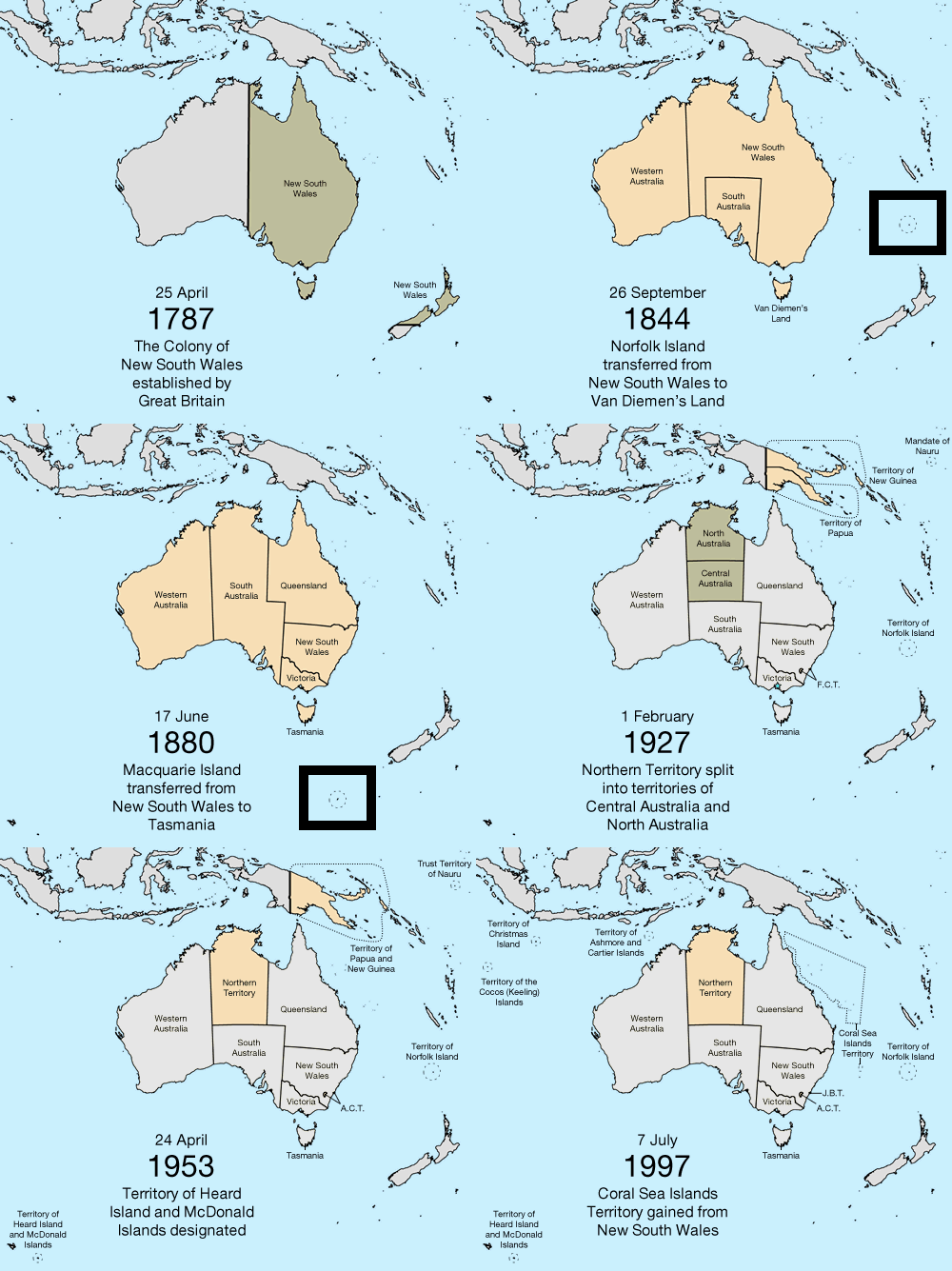
Main article: Territorial evolution of Australia
- Australian Capital Territory borders
- New South Wales borders
- Northern Territory borders
- Queensland borders
- South Australian borders
- Tasmanian borders
- Victorian borders
- Western Australian borders
States and territories
Table
At Federation in 1901, what is now the Northern Territory was within South Australia, what are now the Australian Capital Territory and Jervis Bay Territory were within New South Wales, and the Coral Sea Islands were part of Queensland. Ashmore and Cartier Islands was accepted by Australia in 1934 and was annexed to the Northern Territory prior to adoption of the Statute of Westminster in 1942, deemed effective from 1939; it has thus become part of Australia.
States
| Flag | State | Postal | ISO | Capital | url=https://www.abs.gov.au/statistics/people/population/national-state-and-territory-population/latest-release | title = National, state and territory population | access-date = 17 September 2021 | publisher= Australian Bureau of Statistics | date = 17 September 2021}} | title=Area of Australia – States and Territories | url=http://www.ga.gov.au/scientific-topics/national-location-information/dimensions/area-of-australia-states-and-territories | website=Geoscience Australia: National Location Information | date=15 May 2014 | access-date=2 November 2016}} | Population Density (/km2) | No. members in House of Reps. | Governor | Premier |
|---|---|---|---|---|---|---|---|---|---|---|---|---|---|---|---|---|---|---|
| (Party) | State Government | |||||||||||||||||
| pxx | **New South Wales** | NSW | AU-NSW | Sydney | 800,150 | 10.49 | 47 | Margaret Beazley | Australian Labor Party}}" | Chris Minns (Labor) | ||||||||
| pxx | **Victoria** | VIC | AU-VIC | Melbourne | 227,416 | 30.18 | 38 | Margaret Gardner | Australian Labor Party}}" | Jacinta Allan | ||||||||
| (Labor) | ||||||||||||||||||
| pxx | **Queensland** | QLD | AU-QLD | Brisbane | 1,729,742 | 3.18 | 30 | Jeannette Young | Liberal Party of Australia}}" | David Crisafulli (Liberal National) | ||||||||
| pxx | **Western Australia** | WA | AU-WA | Perth | 2,527,013 | 1.15 | 16 | Chris Dawson | Australian Labor Party}}" | Roger Cook | ||||||||
| (Labor) | ||||||||||||||||||
| pxx | **South Australia** | SA | AU-SA | Adelaide | 984,321 | 1.89 | 10 | Frances Adamson | Australian Labor Party}}" | Peter Malinauskas (Labor) | ||||||||
| pxx | **Tasmania** | TAS | AU-TAS | Hobart | 68,401 | 8.89 | 5 | Barbara Baker | Liberal Party of Australia}}" | Jeremy Rockliff | ||||||||
| (Liberal) |
Territories
Internal territories
| Flag | Territory | Postal | ISO | Capital | ||||||||
|---|---|---|---|---|---|---|---|---|---|---|---|---|
| (or *largest settlement*) | Population | |||||||||||
| (June 2025) | Area (km2) | Population Density (/km2) | No. members in House of Reps. | Administrator | Chief Minister | |||||||
| (Party) | Territory Government | |||||||||||
| pxx | **Australian Capital Territory** | ACT | AU-ACT | Canberra | 2,358 | 198.97 | 3 | Australian Labor Party}}" | Andrew Barr | |||
| (Labor) | ||||||||||||
| pxx | **Northern Territory** | NT | AU-NT | Darwin | 1,347,791 | 0.19 | 2 | Hugh Heggie | Country Liberal Party}}" | Lia Finocchiaro | ||
| (Country Liberal) | ||||||||||||
| **Jervis Bay Territory** | ACT | Jervis Bay Village | 67 | 6.04 | *Administered by the Department of Infrastructure, Transport, Regional Development, Communications, Sport and the Arts*}} |
External territories
| Flag | Territory | Postal | ISO | Capital | |||||||
|---|---|---|---|---|---|---|---|---|---|---|---|
| (*or largest settlement*) | Official language(s) | Population | |||||||||
| (Jun 2018) | Area (km2) | Population Density (/km2) | No. members in House of Reps. | Administrator | Head of Local Government | Local Government | |||||
| pxx | **Norfolk Island** | NSW | NF | Kingston | Norfuk, English | 35 | 74 | George Plant | Lead Administrator | ||
| Scott Mason | Norfolk Island Regional Council | ||||||||||
| pxx | **Christmas Island** | WA | CX | Flying Fish Cove | de jure: None | 135 | 14 | *Part of NT's Division of Lingiari*}} | Farzian Zainal | Shire President | |
| Gordon Thompson | Shire of Christmas Island | ||||||||||
| **Cocos (Keeling) Islands** | WA | CC | West Island | de jure: None | 14 | 39 | Shire President | ||||
| Aindil Minkom | Shire of Cocos (Keeling) Islands | ||||||||||
| pxx | ***Australian Antarctic Territory*** | TAS | AQ | None | |||||||
| *(Davis Station)* | English | 5,896,500 | 0.0000102 | rowspan=4 | *None*}} | ||||||
| **Coral Sea Islands** | QLD | None | |||||||||
| *(Willis Island)* | None | 4 | 780,000 | 0.000005 | |||||||
| **Ashmore and Cartier Islands** | colspan=2 | None | |||||||||
| *(offshore anchorage)* | None | 199 | 0 | ||||||||
| **Heard Island and McDonald Islands** | TAS | HM | None | ||||||||
| *(Atlas Cove)* | None | 372 | 0 |
Each external territory is regulated by an Act of the federal Parliament. These Acts contain the majority of provisions determining the legal and political structure applying in that external territory. Under s 122 of the Australian Constitution the federal Parliament has plenary power to make laws for all territories including all external territories. The Cocos (Keeling) Islands voted for integration in 1984. Together with Christmas Island, these two territories comprise the Australian Indian Ocean Territories. Commonwealth laws apply automatically to the territories unless expressly stated otherwise and residents of both external territories are associated with Northern Territory for federal elections. They are, thus, constitutionally part of Australia.
The Heard Island and McDonald Islands, although uninhabited, are treated as constitutionally part of Australia by the central government.
Norfolk Island's status is controversial, with the present () government taking measures to integrate the territory into Australia proper (including representation in parliament and compulsory voting). The Norfolk Islanders have not formally consented to this change in constitutional status and assert that they are not Australian.
| Territory | Ref. | Subject to laws of | Subject to courts of | Part of electorate of | for House | for Senate |
|---|---|---|---|---|---|---|
| Christmas Island | Western Australia | Division of Lingiari | Northern Territory | |||
| Cocos (Keeling) Islands | ||||||
| Jervis Bay Territory | Australian Capital Territory | Division of Fenner | Australian Capital Territory | |||
| Norfolk Island | ||||||
| Norfolk Island | ||||||
| New South Wales | ||||||
| Queensland | Norfolk Island | Division of Bean | ||||
| Ashmore and Cartier Islands | Northern Territory | *(no permanent population)*}} | ||||
| Australian Antarctic Territory | Australian Capital Territory | |||||
| Heard Island and McDonald Islands | ||||||
| Coral Sea Islands | Australian Capital Territory | Norfolk Island |
;Notes
Former territories
Internal
Two internal territories established by the Australian federal government under Section 122 of the Constitution of Australia no longer exist:
- Central Australia (1926–1931), consisting of the area of the current Northern Territory south of the 20th parallel south
- North Australia (1926–1931), consisting of the area of the current Northern Territory north of the 20th parallel south
External
Two present-day Oceanic countries, Papua New Guinea (PNG) and Nauru, were administered by the federal government of Australia as de facto or de jure external territories for differing periods between 1902 and 1975.
Papua and New Guinea (1883–1975)
- Territory of Papua:
- 1883–1902: A de facto part of Queensland (de jure British territory in 1888–1900)
- 1902–1949: An external territory of Australia
- Territory of New Guinea: 1920–1949, under a League of Nations mandate. The territory was previously known as German New Guinea between 1884 and 1914; it was formally under Australian military occupation in 1914–1920).
Following World War II, the Papua and New Guinea Act 1949 placed the Territory of New Guinea in an "administrative union" with the Territory of Papua, and the combined Territory of Papua and New Guinea was created. However, both territories remained technically distinct for some administrative and legal purposes. Following the passage of the Papua New Guinea Independence Act 1975, the combined entity eventually was given independence as the Independent State of Papua New Guinea.
Nauru (1920–1968)
Nauru was previously under the German colonial empire as part of the German New Guinea. Following World War I, the Australian government received a League of Nations mandate for Nauru. After World War II, the Territory of Papua, Territory of New Guinea and Nauru were all controlled by the Australian government as United Nations trust territories. Following the passage of the Nauru Independence Act 1967, Nauru was granted independence in 1968.
Statistics
The majority of Australians live in the eastern coastal mainland states of New South Wales, Queensland, Victoria, and the Australian Capital Territory, which collectively forms 79% of the entire population of Australia (more than three-quarters of all Australians). Most of the major population centres are located east and south of the Great Dividing Range on the coastal plains and their associated hinterland regions.
| State / territory | Mainland area | Total land area | Marine area | Total area | km2 | sq mi | Rank | km2 | sq mi | Rank | km2 | sq mi | Rank | km2 | sq mi | Rank | ||||||||
|---|---|---|---|---|---|---|---|---|---|---|---|---|---|---|---|---|---|---|---|---|---|---|---|---|
| New South Wales | 801137 km2 | 5 | 801150 km2 | 5 | 8802 km2 | 7 | 809952 km2 | 7 | ||||||||||||||||
| Victoria | 227038 km2 | 6 | 227444 km2 | 6 | 10213 km2 | 6 | 237657 km2 | 6 | ||||||||||||||||
| Queensland | 1723030 km2 | 2 | 1729742 km2 | 2 | 121994 km2 | 1 | 1914736 km2 | 1 | ||||||||||||||||
| Western Australia | 2523924 km2 | 1 | 2527013 km2 | 1 | 115740 km2 | 2 | 2642753 km2 | 2 | ||||||||||||||||
| South Australia | 979651 km2 | 4 | 984321 km2 | 4 | 60032 km2 | 4 | 1044353 km2 | 4 | ||||||||||||||||
| Tasmania | 64519 km2 | 7 | 68401 km2 | 7 | 22357 km2 | 5 | 90758 km2 | 5 | ||||||||||||||||
| Australian Capital Territory | 2358 km2 | 8 | 2358 km2 | 8 | — | — | 8 | 2358 km2 | ||||||||||||||||
| Northern Territory | 1334404 km2 | 3 | 1347791 km2 | 3 | 71839 km2 | 3 | 1419630 km2 | 3 |
| State / territory | Abbreviation | Land area | Population density | Notes | km2 | sq mi | Rank | Number | Rank | /km2 | /sq mi | Rank | % | Rank | ||||||
|---|---|---|---|---|---|---|---|---|---|---|---|---|---|---|---|---|---|---|---|---|
| New South Wales | NSW | 801150 km2 | 9.62 /km2 | 63.0% | ||||||||||||||||
| Victoria | VIC | 227444 km2 | 26.56 /km2 | 71.0% | ||||||||||||||||
| Queensland | QLD | 1729742 km2 | 2.79 /km2 | 46.0% | ||||||||||||||||
| Western Australia | WA | 2527013 km2 | 1.03 /km2 | 73.4% | ||||||||||||||||
| South Australia | SA | 984321 km2 | 1.74 /km2 | 73.5% | ||||||||||||||||
| Tasmania | TAS | 68401 km2 | 7.58 /km2 | 41.0% | ||||||||||||||||
| Australian Capital Territory | ACT | 2358 km2 | 167.6 /km2 | 99.6% | ||||||||||||||||
| Northern Territory | NT | 1347791 km2 | 0.18 /km2 | 54.0% |
Background and overview
The states originated as separate British colonies prior to Federation in 1901. The Colony of New South Wales was founded in 1788 and originally comprised much of the Australian mainland, as well as Lord Howe Island, New Zealand, Norfolk Island, and Van Diemen's Land, in addition to the area currently referred to as the state of New South Wales. During the 19th century, large areas were successively separated to form the Colony of Tasmania (initially established as a separate colony named Van Diemen's Land in 1825), the Colony of Western Australia (initially established as the smaller Swan River Colony in 1829), the Province of South Australia (1836), the Colony of New Zealand (1840), the Victoria Colony (1851) and the Colony of Queensland (1859). Upon federation, the six colonies of New South Wales, Victoria, Queensland, South Australia, Western Australia, and Tasmania became the founding states of the new Commonwealth of Australia. The two territory governments (the Australian Capital Territory [ACT] and the Northern Territory [NT]), were created by legislation of the Federal Parliament—the NT in 1978 and the ACT in 1988.
The legislative powers of the states are protected by the Australian constitution, section 107, and under the principle of federalism, Commonwealth legislation only applies to the states where permitted by the constitution. The territories, by contrast, are from a constitutional perspective directly subject to the Commonwealth government; laws for territories are determined by the Australian Parliament.
Most of the territories are directly administered by the Commonwealth government, while two (the Northern Territory and the Australian Capital Territory) have some degree of self-government although less than that of the states. In the self-governing territories, the Australian Parliament retains the full power to legislate, and can override laws made by the territorial institutions, which it has done on rare occasions. For the purposes of Australian (and joint Australia-New Zealand) intergovernmental bodies, the Northern Territory and the Australian Capital Territory are treated as if they were states.
Each state has a governor, appointed by the monarch (currently ), which by convention he does on the advice of the state premier. The Administrator of the Northern Territory, by contrast, is appointed by the governor-general. The Australian Capital Territory has neither a governor nor an administrator. Instead, since the enacted of the Australian Capital Territory (Self-Government) Act 1988 (Cth), the functions of the head of the Executive – commissioning government, proroguing parliament and enacting legislation – are exercised by the Assembly itself and by the chief minister.
Jervis Bay Territory is the only non-self-governing internal territory. Until 1989, it was administered as if it were a part of the ACT, although it has always been a separate territory. Under the terms of the Jervis Bay Territory Acceptance Act 1915, the laws of the ACT apply to the Jervis Bay Territory insofar as they are applicable and providing they are not inconsistent with an ordinance. Although residents of the Jervis Bay Territory are generally subject to laws made by the ACT Legislative Assembly, they are not represented in the assembly. They are represented in the Parliament of Australia as part of the Electoral Division of Fenner (named the Division of Fraser until 2016) in the ACT and by the ACT's two senators. In other respects, the territory is administered directly by the Federal Government through the Territories portfolio.
The external territory of Norfolk Island possessed a degree of self-government from 1979 until 2015.
Each state has a bicameral parliament, except Queensland, which abolished its upper house in 1922. The lower house is called the "legislative assembly", except in South Australia and Tasmania, where it is called the "house of assembly". Tasmania is the only state to use proportional representation for elections to its lower house; all others elect members from single member constituencies, using preferential voting. The upper house is called the "legislative council" and is generally elected from multi-member constituencies using proportional representation. Along with Queensland, the three self-governing territories, the ACT, the Northern Territory, and Norfolk Island, each have unicameral legislative assemblies. The legislative assembly for the ACT is the only parliament with responsibility for both state/territory and local government functions.
The head of government of each state is called the "premier", appointed by the state's governor. In normal circumstances, the governor will appoint as premier whoever leads the party or coalition which exercises control of the lower house (in the case of Queensland, the only house) of the state parliament. However, in times of constitutional crisis, the governor can appoint someone else as premier. The head of government of the self-governing internal territories is called the "chief minister". The Northern Territory's chief minister, in normal circumstances whoever controls the legislative assembly, is appointed by the administrator.
The term interstate is used within Australia to refer to a number of events, transactions, registrations, travel, etc. which occurs across borders or outside of the particular state or territory of the user of the term. Examples of use include motor vehicle registration, travel, applications to educational institutions out of one's home state.
There are very few urban areas bifurcated by state or territory borders. The Queensland-New South Wales border runs through Coolangatta (Queensland) and Tweed Heads (New South Wales) and splits Gold Coast Airport. Oaks Estate, a contiguous residential of Queanbeyan, was excised out of New South Wales when the Australian Capital Territory was established in 1909. Some Urban Centres and Localities reported by the Australian Bureau of Statistics include some agglomerations of cities spreading across state borders, including Gold Coast–Tweed Heads, Canberra–Queanbeyan, Albury–Wodonga (New South Wales-Victoria) and Mildura–Wentworth (Victoria-New South Wales)
Timeline
- 1788 – British Empire establishes the Colony of New South Wales across central and eastern mainland Australia, the island of Tasmania, both islands of New Zealand and Norfolk Island.
- 1803 – The Coral Sea Islands are claimed by New South Wales.
- 1825 – The island of Tasmania becomes the independent colony of Van Diemen's Land. New South Wales extends its borders further west in mainland Australia.
- 1829 – The British Empire establishes the Swan River Colony in western mainland Australia.
- 1832 – Swan River Colony is renamed the "colony of Western Australia".
- 1836 – The Colony of South Australia is established.
- 1841 – The islands of New Zealand become the independent colony of New Zealand. Much of eastern Antarctica is annexed by Britain as Victoria Land.
- 1844 – New South Wales transfers Norfolk Island to Van Diemen's Land.
- 1846 – Northern central and eastern Australia briefly become the independent Colony of North Australia, then are returned to New South Wales.[[File:Exploration map of Australia, Tallis, 1851.jpg|thumb|Map of Australia, 1851]]
- 1851 – Southeastern mainland Australia becomes the independent colony of Victoria.
- 1856 – Van Diemen's Land is renamed the colony of Tasmania. Norfolk Island becomes the independent colony of Norfolk Island, however it is to be administered by the same governor as New South Wales.
- 1857 – Much of southern central mainland Australia becomes the independent colony of South Australia. The Cocos (Keeling) Islands are annexed by Britain.
- 1859 – Northeastern mainland Australia and Coral Sea Islands become the independent colony of Queensland.
- 1860 – A pocket of New South Wales territory remaining in southern central mainland Australia is transferred to South Australia.
- 1862 – Some of New South Wales' northern central mainland Australian territory is transferred to Queensland.
- 1863 – New South Wales' remaining northern central mainland Australian territory is transferred to South Australia.
- 1878 – Britain annexes Ashmore Island.
- 1884 - Britain annexes British New Guinea.
- 1886 – The Cocos (Keeling) Islands are to be administered by the same governor as the Straits Settlements.
- 1888 – Christmas Island is annexed by Britain and incorporated into the Straits Settlements.
- 1897 – Norfolk Island is officially reintegrated into New South Wales.
- 1901 – New South Wales, Queensland, Tasmania, Western Australia, Victoria and South Australia federate into the Commonwealth of Australia. Queensland transfers the Coral Sea Islands to the federal government, creating a federal external territory.
- 1902 – Britain transfers British New Guinea to Australia, forming Territory of Papua as an external territory.
- 1903 – The Cocos (Keeling) Islands are incorporated into the Straits Settlements.
- 1909 – Britain annexes Cartier Island.
- 1910 – Britain claims Heard Island and the McDonald Islands.
- 1911 – The state of South Australia transfers control of northern central mainland Australia to the federal government, creating the Northern Territory. A small pocket of New South Wales around the city of Canberra is transferred to the federal government (who are seated within it), creating the Federal Capital Territory.
- 1913 – New South Wales transfers Norfolk Island to the federal government, making it a federal external territory.
- 1915 – A small pocket of New South Wales around Jervis Bay is transferred to the federal government and incorporated into the Federal Capital Territory.
- 1920 – Following the defeat of the German Empire in World War I, the League of Nations establishes an Australian mandate in northeastern New Guinea, it becomes the external Territory of New Guinea.
- 1923 – Another conquered German territory, the island of Nauru, is established as an Australian mandate and external territory by the League of Nations, this time as a co-mandate with Britain and New Zealand.
- 1927 – The Northern Territory is split into two territories – North Australia and Central Australia.
- 1930 – The remaining territory in eastern Antarctica is annexed by Britain as Enderby Land.
- 1931 – North Australia and Central Australia are reincorporated as the Northern Territory. Britain recognises Australia as possessors of the uninhabited Ashmore and Cartier Islands, making them an external federal territory.
- 1933 – Britain transfers Victoria Land and Enderby Land to Australia, creating the Australian Antarctic Territory, with ongoing limited international recognition.
- 1938 – The Federal Capital Territory is renamed the "Australian Capital Territory".
- 1942 – The Empire of Japan conquers Nauru from Australia, Britain and New Zealand as part of World War II. Japan also conquers much of the Straits Settlements, including Christmas Island. The Cocos (Keeling) Islands are not conquered and are transferred to the Colony of Ceylon.
- 1946 – The United Nations, the successor to the League of Nations, renews its mandate of New Guinea to Australia.
- 1947 – Following the defeat of Japan in World War II, the United Nations returns Nauru to Australia, Britain and New Zealand as a joint mandate. Christmas Island returns to Britain and is incorporated into the Colony of Singapore. The Cocos (Keeling) Islands are also transferred to Singapore.
- 1949 – Papua and New Guinea are incorporated into the singular Territory of Papua and New Guinea. Britain transfers Heard Island and the McDonald Islands to Australia, creating a federal external territory.
- 1955 – Britain transfers the Cocos (Keeling) Islands to Australia, they become an external territory.
- 1958 – Britain transfers Christmas Island to Australia, it becomes an external territory.
- 1966 – The Republic of Nauru is established, ending Australian-British-New Zealander control of the island.
- 1971 – Papua and New Guinea is renamed Papua New Guinea
- 1972 – Papua New Guinea receives self government
- 1975 – Papua New Guinea becomes the Independent State of Papua New Guinea, ending British-Australian control.
- 1978 – Northern Territory gains self-government with certain Commonwealth control.
- 1979 – Norfolk Island gains self-government with certain Commonwealth control.
- 1989 – The Australian Capital Territory gains self-government with certain Commonwealth control. Jervis Bay becomes independent of the ACT, becoming the Jervis Bay Territory.
- 2015 – Norfolk Island loses self-government with full Commonwealth control.
Comparative terminology
| Entity | Type of entity | Tie to the monarch | Domestic administrator | Head of government | Upper House of Parliament | Lower House of Parliament | Member of Parliament | Upper house | Lower houseThe abbreviations MLA and MHA were previously the acceptable term for members of lower houses in states that now use MP. | |
|---|---|---|---|---|---|---|---|---|---|---|
| Commonwealth of Australia | Federal government | Direct | Governor-general | Prime minister | Senate | House of Representatives | Senator | MP | ||
| South Australia | Federated state | Direct (established by the *Australia Act 1986*) | Governor | Premier | Legislative Council | House of Assembly | MLC | |||
| Tasmania | ||||||||||
| New South Wales | Legislative Assembly | |||||||||
| Victoria | ||||||||||
| Western Australia | MLA | |||||||||
| Queensland | rowspan="6" | MP | ||||||||
| Australian Capital Territory | Self-governing territory | Indirect (through the governor-general acting as "administrator") | Assembly and chief minister | Chief minister | rowspan="5" | MLA | ||||
| Northern Territory | Indirect (through the governor-general) | Administrator | ||||||||
| Christmas Island | External territory | Shire president | Shire Council | Councillor | ||||||
| Cocos (Keeling) Islands | ||||||||||
| Norfolk Island | Mayor | Regional CouncilBetween 1979 and 2015 Norfolk Island was a self-governing external territory with its own legislature, the Norfolk Island Legislative Assembly, until this was abolished by the Commonwealth Parliament. | ||||||||
| Note: |
Politics
.svg)
]]
Governors and administrators
Main article: Governors of the Australian states
| Post | Incumbent | Appointed |
|---|---|---|
| Governor of New South Wales | ||
| Governor of Victoria | Margaret Gardner | 9 August 2023 |
| Governor of Queensland | ||
| Governor of Western Australia | ||
| Governor of South Australia | ||
| Governor of Tasmania | ||
| Administrator of the Northern Territory | ||
| Administrator of Norfolk Island | George Plant | |
| Administrator of the Australian Indian Ocean Territories | Farzian Zainal |
Premiers and chief ministers
Main article: Premiers and chief ministers of the Australian states and territories
| Post | Incumbent | Political party | Appointed | |
|---|---|---|---|---|
| Premier of New South Wales | Australian Labor Party}}" | Labor | ||
| Premier of Victoria | Australian Labor Party}}" | Labor | ||
| Premier of Queensland | Liberal National Party of Queensland}}" | Liberal National | ||
| Premier of Western Australia | MLA | Australian Labor Party}}" | Labor | |
| Premier of South Australia | Australian Labor Party}}" | Labor | ||
| Premier of Tasmania | Liberal Party of Australia}}" | Liberal | ||
| Chief Minister of the Australian Capital Territory | MLA | Australian Labor Party}}" | Labor | |
| Chief Minister of the Northern Territory | MLA | Country Liberal Party}}" | Country Liberal |
Parliaments
Main article: Parliaments of the Australian states and territories
- Parliament of New South Wales
- Parliament of Victoria
- Parliament of Queensland
- Parliament of Western Australia
- Parliament of South Australia
- Parliament of Tasmania
- Australian Capital Territory Legislative Assembly
- Northern Territory Legislative Assembly
Supreme courts
Main article: Australian court hierarchy
- Supreme Court of New South Wales
- Supreme Court of Victoria
- Supreme Court of Queensland
- Supreme Court of Western Australia
- Supreme Court of South Australia
- Supreme Court of Tasmania
- Supreme Court of the Australian Capital Territory
- Supreme Court of the Northern Territory
- Supreme Court of Norfolk Island
Police forces
Main article: Law enforcement in Australia
- New South Wales Police Force
- Victoria Police
- Queensland Police Service
- Western Australia Police Force
- South Australia Police
- Tasmania Police
- Australian Capital Territory Policing (performed by Australian Federal Police)
- Northern Territory Police Force
- Law enforcement in Norfolk Island, also provided by Australian Federal Police
State and territory codes
| State/territory | Abbrev. | Call signs | Postal | Telephone numbers in Australia | Time zone | AM/FM | TV | Amateur | Abbrev. | Postcode | Std | Summer | External territories |
|---|---|---|---|---|---|---|---|---|---|---|---|---|---|
| New South Wales | NSW | 2xx(x) | xx(x)Nn | VK2xx | NSW | 1nnn, 2nnn | +61 2 xxxx xxxxSome exceptions apply to numbers in this state's number range. | +10 (+ +)The state of New South Wales observes Australian Eastern Standard Time except for Broken Hill and the surrounding region, which observes Australian Central Standard Time and Lord Howe Island which is 30 minutes ahead of Australian Eastern Standard Time. | +11 (+)Broken Hill and surrounding region observe Australian Central Summer Time. Lord Howe Island adopts Australian Eastern Summer Time. | ||||
| Victoria | Vic | 3xx(x) | xx(x)Vn | VK3xx | VIC | 3nnn, 8nnn | +61 3 xxxx xxxx | +10 | +11 | ||||
| Queensland | Qld | 4xx(x) | xx(x)Qn | VK4xx | QLD | 4nnn, 9nnn | +61 7 xxxx xxxx | +10 | |||||
| Western Australia | WA | 6xx(x) | xx(x)Wn | VK6xx | WA | 6nnn | +61 8 9xxx xxxx | ||||||
| +61 8 6xxx xxxx | +8 | ||||||||||||
| South Australia | SA | 5xx(x) | xx(x)Sn | VK5xx | SA | 5nnn | +61 8 8xxx xxxx | ||||||
| +61 8 7xxx xxxx | + | + | |||||||||||
| Tasmania | Tas | 7xx(x) | xx(x)Tn | VK7xx | TAS | 7nnn | +61 3 6xxx xxxx | +10 | +11 | ||||
| Australian Capital Territory | ACT | 1xx(x)A number of broadcast stations in the ACT have call signs allocated as if ACT were part of New South Wales. | xx(x)Cn | VK1xx | ACT | 02nn,This is used for some PO box and large users only. 26nn, 29nn | +61 2 62xx xxxx | ||||||
| +61 2 61xx xxxx | +10 | +11 | |||||||||||
| Northern Territory | NT | 8xx(x) | xx(x)Dn | VK8xx | NT | 08nn | +61 8 89xx xxxx | + | |||||
| Christmas Island | 6xx(x) | xx(x)Wn | VK9xx | WA | 6798 | +61 8 9164 xxxx | +7 | ||||||
| Norfolk Island | 2xx(x) | xx(x)Nn | VK2xx | NSW | 2899 | +672 3 xx xxx | +11 | +12 | |||||
| Cocos Island | 6xx(x) | xx(x)Wn | VK9xx | WA | 6799 | +61 8 9162 xxxx | + | ||||||
| Australian Antarctic Territory | AAT | none | VK0xx | TAS | 7151 | +672 1 | +6 to +8 |
Notes
References
References
- [https://www.mawsons-huts.org.au/wp-content/uploads/2019/09/Mawson-FactFile06-Antarctic-Territory-and-Treaty.pdf Antarctic Territory claims and The Antarctic Treaty System]
- Twomey, Anne. (January 2008). "The States, the Commonwealth and the Crown: The Battle for Sovereignty".
- "What's the difference between a territory and a state parliament?". Parliamentary Education Office.
- Section 2B, [[Acts Interpretation Act 1901]]
- (15 July 2010). "10. External territories". Australian Law Reform Commission.
- "Court System in Western Australia".
- "Chapter III. The Judicature.". Parliament of Australia.
- "Territories of Australia".
- (31 January 2023). "Why Isn't the Northern Territory a State?".
- "Territory Representation in the Commonwealth Parliament".
- "Representation of Commonwealth Territories in the Senate". Parliament of Australia.
- (2004). "Border Lengths – States and Territories". Commonwealth of Australia.
- . (7 June 2023). ["Oceans and Seas"](https://www.ga.gov.au/scientific-topics/national-location-information/dimensions/oceans-and-seas). *Australian Government*.
- (4 July 2008). "Ashmore and Cartier Islands Acceptance Act 1933".
- [[ISO 3166-2:AU]] ([[ISO 3166-2]] codes for the states and territories of Australia)
- (17 September 2021). "National, state and territory population". [[Australian Bureau of Statistics]].
- (15 May 2014). "Area of Australia – States and Territories".
- "Number of Members".
- "About Council". Norfolk Island Regional Council.
- "Meet the Council". Shire of Cocos Keeling Islands.
- (28 March 2018). "How Willis Island weather observers survive life working at the remote outpost off Queensland". ABC News.
- (28 February 2005). "Frequently asked questions".
- (21 May 2015). "'We're not Australian': Norfolk Islanders adjust to shock of takeover by mainland".
- [https://www.legislation.gov.au/Series/C1958A00041 Christmas Island Act 1958], Federal Register of Legislation. {{Webarchive. link. (10 January 2017)
- [https://www.legislation.gov.au/Series/C1955A00034 Cocos (Keeling) Islands Act 1955], Federal Register of Legislation. {{Webarchive. link. (22 May 2022)
- [https://www.legislation.gov.au/Series/C1915A00019 Jervis Bay Territory Acceptance Act 1915], Federal Register of Legislation. {{Webarchive. link. (3 April 2022)
- [https://www.legislation.gov.au/Series/C2004A02035 Norfolk Island Act 1979], Federal Register of Legislation. {{Webarchive. link. (22 May 2022)
- (28 June 2023). "Norfolk Island Applied Laws Ordinance 2016". Federal Register of Legislation.
- (4 February 2023). "Norfolk Island Applied Laws and Service Delivery (Queensland) Ordinance 2021". Federal Register of Legislation.
- [https://www.legislation.gov.au/Series/C1933A00060 Ashmore and Cartier Islands Acceptance Act 1933], Federal Register of Legislation. {{Webarchive. link. (22 May 2022)
- [https://www.legislation.gov.au/Series/C1954A00042 Australian Antarctic Territory Act 1954], Federal Register of Legislation. {{Webarchive. link. (22 May 2022)
- [https://www.legislation.gov.au/Series/C1953A00007 Heard Island and McDonald Islands Act 1953], Federal Register of Legislation. {{Webarchive. link. (22 May 2022)
- [https://www.legislation.gov.au/Series/F2006B00277 Application of Laws Ordinance 1973 (Coral Sea Islands)], Federal Register of Legislation. {{Webarchive. link. (5 November 2021)
- [https://www.legislation.gov.au/Series/C1969A00058 Coral Sea Islands Act 1969], Federal Register of Legislation. {{Webarchive. link. (22 May 2022)
- "Norfolk Island Legislation". Norfolk Island Regional Council.
- "Dividing the Territory, 1926–31". National Archives of Australia.
- {{Census 2021 AUS
- {{Census 2021 AUS
- {{Census 2021 AUS
- {{Census 2021 AUS
- {{Census 2021 AUS
- {{Census 2021 AUS
- {{Census 2021 AUS
- {{Census 2021 AUS
- A.H. McLintock (ed), ''An Encyclopaedia of New Zealand'', 3 vols, Wellington, NZ:R.E. Owen, Government Printer, 1966, vol 3 p. 526.'
- "Saving of Power of State Parliaments". Parliament of Australia.
- "Government of territories". Parliament of Australia.
- "What Does A State Governor Do?".
- (21 October 2021). "The Administrator".
- "Australian Capital Territory (Self-Government) Act 1988 (Cth)".
- [https://www.legislation.gov.au/Details/C2004C00038 Jervis Bay Territory Acceptance Act 1915 (Cth)] {{Webarchive. link. (6 July 2017 .)
- "Jervis Bay Territory Governance and Administration". The Department of Regional Australia, Local Government, Arts and Sport.
- Hayward, Philip. (2021). "Australia's oddest jurisdiction : the continuous anomaly of Jervis Bay Territory". Small States & Territories.
- "Overview {{!}} Queensland Parliament".
- Manager, Web. (2022-05-23). "Australian levels of government".
- Twomey, Anne. (September 2011). "Changing the Leader — the Constitutional Conventions concerning the Resignation of Prime Ministers and Premiers". Federal Law Review.
- "Interstate-registered vehicles". Government of South Australia.
- "Interstate travel".
- "Applying interstate".
This article was imported from Wikipedia and is available under the Creative Commons Attribution-ShareAlike 4.0 License. Content has been adapted to SurfDoc format. Original contributors can be found on the article history page.
Ask Mako anything about States and territories of Australia — get instant answers, deeper analysis, and related topics.
Research with MakoFree with your Surf account
Create a free account to save articles, ask Mako questions, and organize your research.
Sign up freeThis content may have been generated or modified by AI. CloudSurf Software LLC is not responsible for the accuracy, completeness, or reliability of AI-generated content. Always verify important information from primary sources.
Report