From Surf Wiki (app.surf) — the open knowledge base
State of Vietnam
1949–1954 associated state of French Union, 1954–1955 independent state

1949–1954 associated state of French Union, 1954–1955 independent state
| Field | Value | |
|---|---|---|
| conventional_long_name | State of Vietnam | |
| native_name | vi | |
| fr | ||
| status | Associated state of the French Union (until 1954) | |
| Independent state (from 1954) | ||
| era | Cold War | |
| event_start | Proclamation | |
| year_start | 1949 | |
| date_start | 2 July | |
| event_pre | Élysée Accords | |
| date_pre | 8 March 1949 | |
| event1 | Matignon Treaty | |
| date_event1 | 4 June 1954 | |
| event2 | [Partition](1954-geneva-conference) | |
| date_event2 | 21 July 1954 | |
| event_end | [Republic founded](1955-state-of-vietnam-referendum) | |
| year_end | 1955 | |
| date_end | 26 October | |
| p1 | Provisional Central Government of Vietnam | |
| flag_p1 | Flag of South Vietnam.svg | |
| s1 | North Vietnam | |
| flag_s1 | Flag of North Vietnam (1955–1975).svg | |
| s2 | South Vietnam | |
| flag_s2 | Flag of South Vietnam.svg | |
| image_flag | Flag of South Vietnam.svg | |
| flag | Flag of South Vietnam | |
| image_coat | Quốc huy Quốc gia Việt Nam (國徽國家越南).svg | |
| symbol_type | Coat of arms | |
| symbol | Emblem of Vietnam#List | |
| other_symbol | **Grand Seal of the State** | |
| 保大國長 | ||
| [[File:Seal of Bảo Đại as Chief of State of Vietnam (1949–1954).svg | 85px]] | |
| (1949–1954) | ||
| image_map | File:South Vietnam Cold War (orthographic projection).svg | |
| map_width | 250px | |
| map_caption | The territory controlled by the State of Vietnam after the 1954 Geneva Conference (dark green); territory claimed but not controlled (light green). | |
| capital | Saigon | |
| coordinates | ||
| national_anthem | Thanh niên Hành Khúc | |
| "The March of Youths" | ||
| national_motto | Dân vi quý | |
| "The people are the most important" | ||
| official_languages | Vietnamese, French | |
| demonym | Vietnamese, Vietnamian | |
| government_type | Unitary semi-constitutional monarchy | |
| religion | Folk religions | |
| Buddhism | ||
| Confucianism | ||
| Taoism | ||
| Catholicism | ||
| Caodaism | ||
| Hoahaoism | ||
| Evangelicalism | ||
| currency | piastre | |
| đồng (from 1953) | ||
| title_leader | Chief of State | |
| leader1 | Bảo Đại | |
| year_leader1 | 1949–1955 | |
| leader2 | Ngô Đình Diệm | |
| year_leader2 | 1955 | |
| title_deputy | Prime Minister | |
| deputy1 | Bảo Đại | |
| year_deputy1 | 1949–1950 | |
| deputy2 | Nguyễn Phan Long | |
| year_deputy2 | 1950 | |
| deputy3 | Trần Văn Hữu | |
| year_deputy3 | 1950–1952 | |
| deputy4 | Nguyễn Văn Tâm | |
| year_deputy4 | 1952–1953 | |
| deputy5 | Bửu Lộc | |
| year_deputy5 | 1954 | |
| deputy6 | Ngô Đình Diệm | |
| year_deputy6 | 1954–1955 | |
| stat_year1 | 1955 | |
| stat_area1 | 173809 | |
| stat_pop1 | 12,000,000 | |
| --> | today | Vietnam |
fr Independent state (from 1954) 保大國長 (1949–1954) "The March of Youths" "The people are the most important" Buddhism Confucianism Taoism Catholicism Caodaism Hoahaoism Evangelicalism đồng (from 1953) --| today = Vietnam The State of Vietnam (; chữ Hán: 國家越南; ) was a state in Southeast Asia that existed from 1949 until 1955, initially as an associated state of the French Union and later as a fully independent state (from July 1954 to October 1955). The state claimed authority over all of Vietnam during the First Indochina War, although large parts of its remote territory were controlled by the Democratic Republic of Vietnam.
The State of Vietnam was formed in 1949 within the framework of the French Union as a compromise between Vietnamese nationalists and the French, in opposition to the communists. It gained international recognition in 1950 and aligned politically with the Western Bloc. Former emperor Bảo Đại became Chief of State. Following the 1954 Geneva Accords between the communist Viet Minh and the French, the State of Vietnam lost its remaining foothold in the northern half of the country, where most rural areas were already controlled by the Viet Minh. Ngô Đình Diệm was appointed prime minister the same year and—after having ousted Bảo Đại in 1955—became president of the Republic of Vietnam.
History
Vietnam after World War II
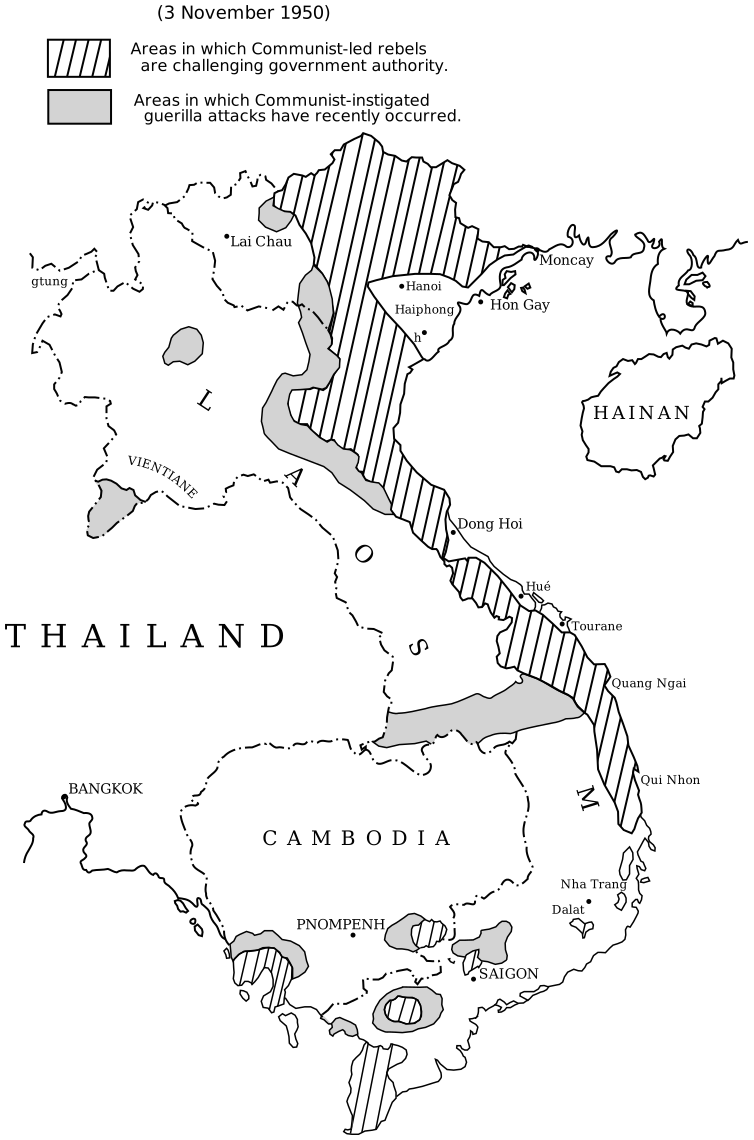
The 16th parallel was established by the Allies on August 2, 1945, following the Potsdam Conference, dividing the former French Indochina into two military zones: Chinese Nationalist forces occupied the North, and British forces the South, to disarm Japanese troops. The communist-led Viet Minh launched the August Revolution to seek control in Vietnam, and Ho Chi Minh declared the independence of the Democratic Republic of Vietnam (DRV).
Beginning in August 1945, the Viet Minh sought to consolidate power by terrorizing and purging rival Vietnamese nationalist groups and Trotskyist activists. On September 23, the British supported a French coup de force that overthrew the DRV government in Saigon and attempted to reinstate French control over southern Indochina. In 1946, the Franco-Chinese and Ho–Sainteny Agreements enabled French forces to replace the Chinese north of the 16th parallel and facilitated a coexistence between the DRV and the French that strengthened the Viet Minh while undermining the nationalists. That summer, the Viet Minh colluded with French forces to eliminate nationalists, targeted for their ardent anti-colonialism.
With most of the nationalist partisans defeated, and negotiations broken down, tensions between the Viet Minh and French authorities erupted into full-scale war in December 1946, a conflict which became entwined with the Cold War. Surviving nationalist partisans and politico-religious groups rallied behind the exiled Bảo Đại to reopen negotiations with France in opposition to communist domination.
On June 5, 1948, the Halong Bay Agreements (Accords de la baie d’Along) allowed the foundation of a unified Vietnamese government replacing the governments of Tonkin (North Vietnam) and Annam (Middle Vietnam) associated to France within the French Union. The Associated States of Indochina then also included the neighboring Kingdom of Laos and Kingdom of Cambodia. Cochinchina (South Vietnam), however, had a different status, both as a colony and as an autonomous republic, and its reunification with the rest of Vietnam had to be approved by its local assembly, and then by the French National Assembly. During the transitional period, a Provisional Central Government of Vietnam was proclaimed: Nguyễn Văn Xuân, until then head of the Provisional Government of South Vietnam (as Cochinchina had been known since 1947), became its president, while Bảo Đại waited for a complete reunification to take office.
Associated State (1949–1954)
On May 20, 1949, the French National Assembly approved the reunification of Cochinchina with the rest of Vietnam. The decision took effect on June 14 and the State of Vietnam (SVN) was officially proclaimed on July 2. From 1949 to 1954, the State of Vietnam had partial autonomy from France as an associated state within the French Union.
Bảo Đại and Hồ Chí Minh competed for international and domestic recognition as the legitimate authority over Vietnam. While the State of Vietnam aligned with the anticommunist Western Bloc, the French exploited it to extend their colonial presence and to bolster their standing within NATO. The State of Vietnam received its strongest support from the United States while Hồ's DRV was backed by the People's Republic of China and the Soviet Union (since 1950).
Following the onset of full-scale war between the Viet Minh and France in December 1946, there emerged nationalists who pursued the quest for a ‘Third Force’ that would be both anticommunist and anticolonialist. This stance led them to maintain an uneasy neutrality in the conflict, and they were at times labeled as attentistes, including Ngô Đình Diệm and certain Đại Việt politicians. With the internationalization of the war in 1950, many of these figures ultimately stepped off the fence and entered the political fray.
Roughly 60% of Vietnamese territory was under the DRV control in 1952. However, most delta and urban areas with large populations were brought under the control of the French and the SVN. As the communist-led Viet Minh became increasingly radicalized, it provoked frustration and disillusionment. Consequently, numerous people left its maquis and returned to the cities in a widespread process known in Vietnamese as dinh tê. Among these defectors were intellectuals, teachers, landlords, administrators, soldiers, civil servants, and even cadres, several of whom came to support the State of Vietnam.
Vietnamese anticommunists were briefly split over the question of accommodation with the SVN. Five major groups opted to work with Bảo Đại's government in order to continue the struggle for independence, assist France in its war against the communist-led Viet Minh, and strengthen their own political and military standing. Known collectively as the 'Big Five' (cinq grands), these groups were the Cao Đài, the Hòa Hảo, the Bình Xuyên, the northern Catholics, and the northern Đại Việt Party. Although these accommodationist groups agreed in principle to cooperate with the SVN, most initially resisted full incorporation into Bảo Đại's administration. Like their earlier relationship with the DRV, they sought to preserve a high degree of autonomy from central authority. The southern "sects" (Cao Đài, Hòa Hảo, Bình Xuyên) and northern Catholics established semi-independent territories that functioned as quasi-states or fiefdoms, supported by their own community welfare systems or parallel economic networks. In contrast, the Đại Việt Party pursued influence through civilian political appointments within the SVN government rather than through military subsidies. The two Catholic Vicariates of Phát Diệm–Bùi Chu, safe havens for anticommunist nationalists in the north, were the last to integrate into the SVN.
The State of Vietnam was not merely a colonial construct, but a fragmented and negotiated state in which sovereignty was unevenly exercised by colonial authorities, local political actors, and religious self-governing entities. Its state transformation was an act of bricolage, cobbled together from layered legacies of the past and evolving contemporary dynamics. The Matignon Treaty on 4 June 1954 was seen as granting Vietnam independence from France. The prominent nationalist Ngo Dinh Diem, who by now no longer believed that attentisme was a viable policy, was appointed by Bảo Đại in June 1954 to lead the Vietnamese government. With the full support of Bảo Đại, Diệm committed himself to rapidly establishing a truly independent state, and formally withdrew the State of Vietnam from the French Union on July 20, 1954.
Partition (1954–55)
The Geneva Accords, signed between the French and the Viet Minh on 21 July 1954, ended the Indochina War by establishing a temporary division of Vietnam at the 17th parallel, with the DRV in the North and the State of Vietnam in the South, pending nationwide elections scheduled for July 1956. Communist forces entered Hanoi on 10 October 1954, replacing the French Union forces that were withdrawing South. During the 300-day period of relocation, around 120,000 Viet Minh personnel moved North. Meanwhile, at least 500,000 Catholics, about 200,000 Buddhists, and tens of thousands from minority groups moved South, many via Operation Passage to Freedom.
The State of Vietnam and the United States were firmly opposed to the final settlement at Geneva and the partition of Vietnam. In July 1955, Prime Minister Ngo Dinh Diem announced in a broadcast that South Vietnam would not participate in the elections specified in the Geneva Accords, as they had not signed the agreement and therefore were not bound by it. In December 1955, Diệm's South Vietnam terminated its existing economic and financial agreements with France and withdrew its representatives from the French Union Assembly.
Politics
Provisional Central Government of Vietnam
On May 27, 1948, Nguyễn Văn Xuân, then President of the Republic of Cochinchina, became President of the Provisional Central Government of Vietnam (Thủ tướng lâm thời) following the merging of the government of Cochin China and Vietnam in what is sometimes referred as "Pre-Vietnam".
State of Vietnam
On June 14, 1949, Bảo Đại was appointed Chief of State (Quốc trưởng) of the State of Vietnam; he was concurrently Prime Minister for a short while (Kiêm nhiệm Thủ tướng).
On October 26, 1955, the Republic of Vietnam was established and Ngô Đình Diệm became the first President of the Republic.
Leaders
| Name | Took office | Left office | Title |
|---|---|---|---|
| Nguyễn Văn Xuân | May 23, 1948 | July 1, 1949 | |
| 1 | **Bảo Đại** | July 1, 1949 | January 21, 1950 |
| 2 | **Nguyễn Phan Long** | January 21, 1950 | April 27, 1950 |
| 3 | **Trần Văn Hữu** | May 6, 1950 | June 3, 1952 |
| 4 | **Nguyễn Văn Tâm** | June 23, 1952 | December 7, 1953 |
| 5 | **Bửu Lộc** | January 11, 1954 | June 26, 1954 |
| 6 | **Ngô Đình Diệm** | June 26, 1954 | October 26, 1955 |
1955 referendum, Republic of Vietnam
Main article: 1955 State of Vietnam referendum
In South Vietnam, a referendum was scheduled for 23 October 1955 to determine the future direction of the south, in which the people would choose Diệm or Bảo Đại as the leader of South Vietnam. During the election, Diệm's brother Ngô Đình Nhu and the Personalist Labor Revolutionary Party (commonly known as "Cần Lao Party") supplied Diệm's electoral base in organizing and supervising the elections, especially the propaganda campaign for destroying Bảo Đại's reputation. Supporters of Bảo Đại were not allowed to campaign, and were physically attacked by Nhu's workers. Official results showed 98.2 per cent of voters favoured Diệm, an implausibly high result that was condemned as fraudulent. The total number of votes far exceeded the number of registered voters by over 380,000, further evidence that the referendum was heavily rigged. For example, only 450,000 voters were registered in Saigon, but 605,025 were said to have voted for Diệm. On 26 October, Diệm proclaimed the Republic of Vietnam—widely known as South Vietnam—whose reformed army, with American assistance, pursued the conflict with North Vietnam; the Viet Cong replaced the Viet Minh, in the Vietnam War.
Military

;Vietnamese National Army Main article: Vietnamese National Army
Following the signing of the 1949 Élysée Accords in Paris, Bảo Đại was able to create a National Army for defense purposes.
It fought under the State of Vietnam's banner and leadership and was commanded by General Nguyễn Văn Hinh.
Economy
Currency
The currency used within the French Union was the French Indochinese piastre. Notes were issued and managed by the "Issue Institute of the States of Cambodia, Laos and Vietnam" (Institut d’Emission des Etats du Cambodge, du Laos et du Viêt-Nam). In 1953, Vietnam introduced its own currency.
Foreign relations
By 1950, a number of countries recognized the State of Vietnam:
- United Kingdom, United States (February 7, 1950)
- Belgium, Australia (February 8, 1950)
- Luxembourg, New Zealand (February 9, 1950)
- Greece (February 12, 1950)
- Italy (February 18, 1950)
- Jordan (February 20, 1950)
- Honduras (February 25, 1950)
- Brazil (February 27, 1950)
- Thailand (February 28, 1950)
- South Korea Republic of Korea, Spain (March 3, 1950)
- Ecuador, Peru (March 10, 1950)
- Holy See, South Africa, Venezuela (March 13, 1950)
- Bolivia, Costa Rica (March 15, 1950)
- Cuba Cuba (March 16, 1950)
- Netherlands (April 12, 1950)
- Paraguay (April 13, 1950)
- Colombia (April 29, 1950)
- Argentina (May 4, 1950)
- Chile, Haiti, Liberia, Nicaragua
- Panama, El Salvador, Philippines, Canada
Membership in international organizations
On 21 October 1949, the United Nations Economic Commission for Asia and the Far East, having considered the applications of both the State of Vietnam and the Democratic Republic of Vietnam, accepted the SVN as an associate member. In 1952, following a veto by the Soviet Union, the United Nations General Assembly adopted a resolution affirming that the State of Vietnam was a peace-loving state and eligible for admission to the United Nations. As of 1952, the State of Vietnam was a member of the following organizations:
- Economic Commission for Asia and the Far East
- World Health Organization
- International Labour Organization
- United Nations Food and Agriculture Organization
- United Nations Educational, Scientific and Cultural Organization
- International Telecommunication Union
- Universal Postal Union
- International Office of Epizootics
Administrative divisions
Three principal regions
Following the creation of the State of Vietnam and the establishment of its government, the Chief of State Bảo Đại signed the two ordinances related to the administration and local governance of the State of Vietnam, namely Ordinance No. 1 ("Organisation and Operation of civil authorities in Vietnam") and Ordinance No. 2 ("Statutes of Government office"). These ordinances divided the State of Vietnam into three principal administrative regions, namely Bắc Việt (former Tonkin), Trung Việt (former Annam), and Nam Việt (former Cochinchina), the local government of each administrative region was headed by a Thủ hiến (Governour). Since 1948, the three regions had also been referred to as Bắc Phần, Trung Phần, and Nam Phần.
On 4 August 1954 the government of the State of Vietnam enacted Ordinance No. 21 which abolished the autonomous status of the three regions and abolished the post of regional governour, replacing them with central government representatives in all parts of its territory.
Domain of the Crown
The Domain of the Crown (; French: Domaine de la Couronne) was originally the Nguyễn dynasty's geopolitical concept for its protectorates and principalities where the Kinh ethnic group didn't make up the majority, later it became a type of administrative unit of the State of Vietnam. It was officially established on 15 April 1950 and dissolved on 11 March 1955. In the areas of the Domain of the Crown Chief of State Bảo Đại was still officially (and legally) titled as the "Emperor of the Nguyễn dynasty".
The Domain of the Crown contained the following five provinces established from the former Montagnard country of South Indochina:
- Đồng Nai Thượng
- Lâm Viên
- Pleiku
- Darlac
- Kontum
In Bắc phần it contained the following provinces:
- Hòa Bình (Mường Autonomous Territory)
- Phong Thổ (Thái Autonomous Territory)
- Lai Châu (Thái Autonomous Territory)
- Sơn La (Thái Autonomous Territory)
- Lào Kay (Mèo Autonomous Territory)
- Hà Giang (Mèo Autonomous Territory)
- Bắc Kạn (Thổ Autonomous Territory)
- Cao Bằng (Thổ Autonomous Territory)
- Lạng Sơn (Thổ Autonomous Territory)
- Hải Ninh (Nùng Autonomous Territory)
- Móng Cái (Nùng Autonomous Territory)
References
Bibliography
References
- [[:File:Letter with photograph, signature, and Grand Seal of the State from his majesty the Chief of State Bảo Đại to Madame Jeanne Leveque (1952) 01.jpg. Letter with photograph, signature, and Grand Seal of the State from his majesty the Chief of State Bảo Đại to Madame Jeanne Leveque in New York City]] (1952).
- (10 September 1949). "25 Juillet 1949". Chronique d'Indochine: Monthly News Bulletin from Indochina.
- Hoàng Cơ Thụy. ''Việt sử khảo luận''. Paris, 2002. Trang 2299.
- (10 August 1949). "[18 Juillet] Hanoi". Chronique d'Indochine: Monthly News Bulletin from Indochina.
- Hammer, Ellen J. "The Bao Dai Experiment". ''Pacific Affairs'', vol. 23, no. 1, Pacific Affairs, University of British Columbia, 1950, p. 55, {{doi. 10.2307/2753754.
- (December 1956). "Indochina--The Last Year of the War". US Army Command and General Staff College.
- (2011). "16th parallel". NIAS Press.
- Guillemot, François. (2004). "Naissance d'un État-Parti: Le Viêt Nam depuis 1945". Les Indes savantes.
- (2011). "23 September 1945". NIAS Press.
- (2023). "Denouncing the 'Việt Cộng': Tales of revolution and betrayal in the Republic of Vietnam". Journal of Southeast Asian Studies.
- (2011). "Aid, American". NIAS Press.
- (2011). "Aid, Chinese communist". NIAS Press.
- (2011). "Aid, Soviet". NIAS Press.
- (2011). "Attentisme". NIAS Press.
- Pierre Montagnon, ''L'Indochine française'', Tallandier, 2016, p. 325
- (2011). "Collaboration". NIAS Press.
- (2009). "'It's time for the Indochinese Revolution to show its true colours': The radical turn of Vietnamese politics in 1948". Journal of Southeast Asian Studies.
- (2011). "Crossovers". NIAS Press.
- (2016). "The Sovereign States of Vietnam, 1945–1955". [[Journal of Vietnamese Studies]].
- [https://mjp.univ-perp.fr/constit/vn1954.htm "Vietnam: Traité d'indépendance du 4 juin 1954"], Digithèque MJP.
- Miller, Edward. (2004). "Vision, Power and Agency: The Ascent of Ngô Đình Diệm, 1945–54". Journal of Southeast Asian Studies.
- (2011). "Geneva Accords". NIAS Press.
- (1986). "The Geneva Conference of 1954 on Indochina". Macmillan Press.
- (2011). "Origins of the Insurgency in South Vietnam, 1954–1960".
- (1956). "Con đường Chính nghĩa: Độc lập, Dân chủ". Sở Báo chí Thông tin, Phủ Tổng thống.
- Ang Cheng Guan. (1997). "Vietnamese Communists' Relations with China and the Second Indochina War (1956–62)". McFarland.
- (2011). "U.S. and France's Withdrawal from Vietnam, 1954–1956".
- "Sắc-lịnh số 1 ngày 23 tháng 5, năm 1948 thành-lập Chánh-phủ Trung-ương Lâm-thời Việt-Nam." In ''Công-báo Việt-Nam – Journal officiel du Viet-nam'', first year, issue 1, 4 June 1948, [https://gallica.bnf.fr/ark:/12148/bpt6k8320244r/f7.item page 7].
- (10 August 1949). "1er Juillet 1949, Dalat". Chronique d'Indochine: Monthly News Bulletin from Indochina.
- Moyar, Mark. (2006). "Triumph Forsaken: The Vietnam War, 1954–1965". Cambridge University Press.
- Karnow, Stanley. (1997). "Vietnam: A History". Penguin Books.
- Jacobs, Seth. (2006). "Cold War Mandarin: Ngo Dinh Diem and the Origins of America's War in Vietnam, 1950–1963". Rowman & Littlefield.
- Phạm Văn Sơn. (1951). "Việt Nam tranh đấu sử". Vũ Hùng.
- "Admission of the State of Viet-Nam as an associate member of the Commission: Resolution of 21 October 1949 (E/CN.11/232 Rev. 1)". In [https://documents.un.org/symbol-explorer?s=E/CN.11/RES/81%20(V)&i=E/CN.11/RES/81_(V)_5367373 "E/CN.11/RES/81 (V), UN Official Documents"], 23/05/1950.
- (2001). "State Succession and Membership in International Organizations: Legal Theories versus Political Pragmatism". Martinus Nijhoff Publishers.
- "Memorandum, Letter dated 7 August 1952 from the Minister for Foreign Affairs of Vietnam addressed to the Secretary-General." In [https://documents.un.org/symbol-explorer?s=A/2168&i=A/2168_6545503 "A/2168, UN Official Documents"], 03/09/1952.
- Royal Woodblocks of Nguyễn Dynasty - World documentary heritage. (2021). "Significant collections § Fonds of the Phủ Thủ hiến Trung Việt or Office of the Governor of Trung Viet.". The National Archives Center No. 4 (State Records and Archives Department of Vietnam).
- Anh Thái Phượng. ''Trăm núi ngàn sông: Tập I''. Gretna, LA: Đường Việt Hải ngoại, 2003. Page: 99. (in [[Vietnamese language. Vietnamese]]).
- Lê Đình Chi. ''Người Thượng Miền Nam Việt Nam.'' [[Gardena, California. Gardena]], [[California]]: Văn Mới, 2006. Pages: 401-449. (in [[Vietnamese language. Vietnamese]]).
- UÔNG THÁI BIỂU. (9 October 2020). "Hoàng đế mãn triều và "Hoàng triều Cương thổ".". [[Nhân Dân]] ([[Communist Party of Vietnam]]).
This article was imported from Wikipedia and is available under the Creative Commons Attribution-ShareAlike 4.0 License. Content has been adapted to SurfDoc format. Original contributors can be found on the article history page.
Ask Mako anything about State of Vietnam — get instant answers, deeper analysis, and related topics.
Research with MakoFree with your Surf account
Create a free account to save articles, ask Mako questions, and organize your research.
Sign up freeThis content may have been generated or modified by AI. CloudSurf Software LLC is not responsible for the accuracy, completeness, or reliability of AI-generated content. Always verify important information from primary sources.
Report