From Surf Wiki (app.surf) — the open knowledge base
State attorney general
Chief law enforcement official in a U.S. state or territory
Chief law enforcement official in a U.S. state or territory
]] The state attorney general in each of the 50 U.S. states, of the federal district, or of any of the territories is the chief legal advisor to the state government and the state's chief law enforcement officer. In some states, the attorney general serves as the head of a state department of justice, with responsibilities similar to those of the United States Department of Justice.
History
The concept of a state attorney general originates with the attorneys general of the Thirteen Colonies, who in turn were modeled after the Attorney General for England and Wales. The first recorded appointment of an attorney general in the colonies was Virginia's appointment of Richard Lee I in 1643. The office may have existed for some time in a colony before it was recorded in official records. For example, Maryland was settled in 1634 but an attorney general is not mentioned in its records until 1658. In the colonial era, the office was poorly defined, and the pay was terrible and not commensurate to the scope and amount of work. The primitive state of statutory law in the colonies meant that practicing English law required a strong grasp of the common law to fill in the gaps. This was quite a problem when most of the people who actually understood the common law were still in England.
Of the 50 states in the Union, 34 states created or continued the office in their state constitution, eight others created the office in statutory law at the time of statehood, and eight others did not have an attorney general when they became states. A few states were slow to establish the office. Vermont's 1793 constitution mentions an attorney general but the legislature did not actually pass legislation to implement that constitutional provision until 1904. Some states went through the odd exercise of creating the office, abolishing it, then reestablishing it. Specifically, Illinois (1848-1867), Indiana (1826-1855), Maryland (1851-1864), and Massachusetts (1843-1849) all went through periods of disestablishing and reestablishing their state attorney general offices. All 50 states, the District of Columbia, and all the inhabited federal territories now have an attorney general or chief legal officer.
Selection
The most prevalent method of selecting a state's attorney general is by popular election. 43 states have an elected attorney general. Elected attorneys general serve a four-year term, except in Vermont, where the term is two years.
Seven states do not popularly elect an attorney general. In Alaska, Hawaii, New Hampshire, New Jersey, and Wyoming, the attorney general is appointed by the governor. The attorney general in Tennessee is appointed by the Tennessee Supreme Court for an eight-year term. In Maine, the attorney general is elected by the state Legislature for a two-year term.
The District of Columbia and two U.S. territories, Guam and the Northern Mariana Islands, elect their attorneys general for a four-year term. 2014 marked the first year that the District of Columbia and the Northern Mariana Islands held an election for the office. In American Samoa, Puerto Rico, and the U.S. Virgin Islands, the attorney general is appointed by the governor. In Puerto Rico, the attorney general is officially called the secretary of justice, but is commonly known as the Puerto Rico attorney general.
Many states have passed term limits limiting the selection to 2 consecutive terms (9 states); 2 terms maximum (4 states), but 33 states have no term limits.
Duties
The specific duties of a state attorney general vary significantly from state to state, but there are several duties common to most offices:
- Control of litigation involving the state (representing the state at the trial and appellate levels in various types of litigation);
- Chief legal officer of the state (chief legal advisor to the governor and various state government agencies);
- Drafting advisory opinions on state law;
- Public advocacy (i.e., child support enforcement, consumer protection, state-level antitrust enforcement, utilities regulation, and crime victim advocacy);
- Criminal law enforcement (most attorneys general have relatively limited authority to initiate criminal prosecutions, but most are responsible for responding to defendants' appeals from prosecutions initiated in trial courts by locally-elected district attorneys);
- Law reform (i.e., serving on a law reform commission);
- Exercising investigative authority (i.e., leading investigations of government misconduct, malfeasance, individual criminal activity, or issues of substantial public interest); and
- Setting public policy (invoking the authority of the statewide office as a platform to "speak with authority and influence on major questions" involving law and justice).
Defense of the state in federal lawsuits
State attorneys general enforce both state and federal laws. Because they are sworn to uphold the United States' constitution and laws as well as the state's, they may decline to defend a state law in a federal preemption case.
Organization
Two of the most common management models for organizing a state attorney general office are the "chief deputy model" and the "multideputy cabinet model".
In the "chief deputy model", the state attorney general delegates supervisory authority over all substantive divisions to a chief deputy attorney general, who acts as the de facto chief executive officer and presides over executive committee meetings.
In the "multideputy cabinet model", there is no chief deputy. The office's substantive divisions are consolidated under a small number of first assistant or chief assistant attorneys general who together form the office's executive committee and function as a de facto cabinet to the state attorney general.
Current attorneys general
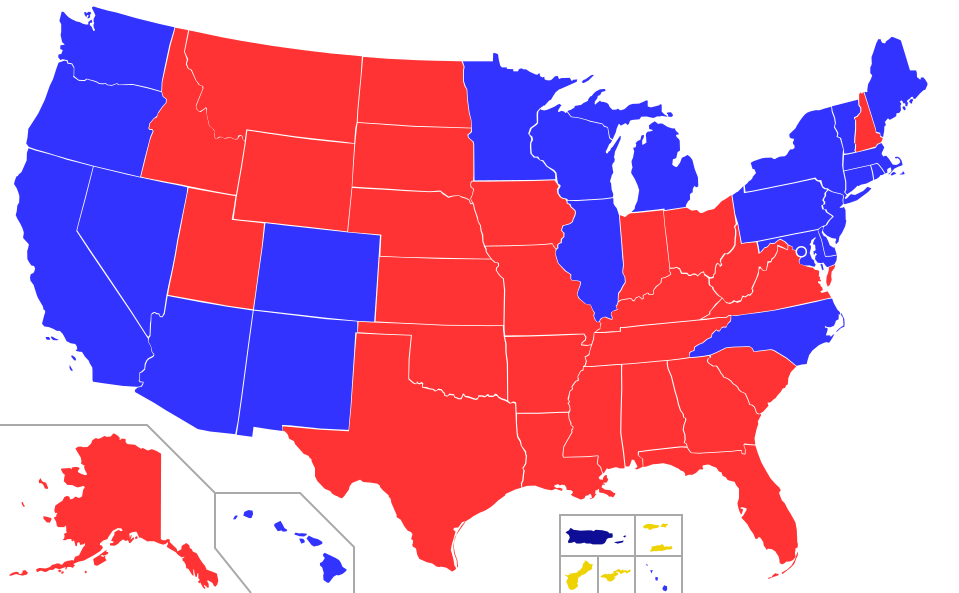
The current party composition of the state attorneys general is:
- 23 Democrats
- 26 Republicans
The composition for the District of Columbia and the 5 populated territories is:
- 2 Democrats
- 1 Republican
- 2 Non-partisan
- 1 New Progressive
Rows of the attorney general table below are color coded indicating the political party of the office holder.
| Officeholder | State | Party | Assumed office | Term expires | Law school | Term limits | |
|---|---|---|---|---|---|---|---|
| Alabama | Republican | 2027 (term limits) | University of Alabama, Tuscaloosa | 2 consecutive terms | |||
| Acting | Alaska | Republican | Appointed | University of Houston | no term limits | ||
| American Samoa | Nonpartisan | Appointed | University of Hawaii, Manoa | ||||
| Arizona | Democratic | 2027 | Arizona State University | 2 consecutive terms | |||
| Arkansas | Republican | 2027 | Tulane University | 2 terms maximum | |||
| California | Democratic | 2027 | Yale University | 2 terms maximum | |||
| Colorado | Democratic | 2027 (term limits) | New York University | 2 consecutive terms | |||
| Connecticut | Democratic | 2027 | University of Chicago | no term limits | |||
| Delaware | Democratic | 2027 | Villanova University | no term limits | |||
| District of Columbia | Democratic | 2027 | Harvard University | ||||
| Florida | Republican | 2027 | Georgetown University | 2 consecutive terms | |||
| Georgia | Republican | 2027 | University of Georgia | no term limits | |||
| Guam | Republican | 2027 | Santa Clara University | ||||
| Hawaii | Democratic | Appointed | University of Hawaii, Manoa | no term limits | |||
| Idaho | Republican | 2027 | University of Washington | no term limits | |||
| Illinois | Democratic | 2027 | Illinois Institute of Technology | no term limits | |||
| Indiana | Republican | 2029 | Indiana University, Indianapolis | no term limits | |||
| Iowa | Republican | 2027 | University of Chicago | no term limits | |||
| Kansas | Republican | 2027 | Yale University | no term limits | |||
| Kentucky | Republican | 2028 | University of Kentucky | 2 consecutive terms | |||
| Louisiana | Republican | 2028 | Louisiana State University | ||||
| Pepperdine University (LLM) | no term limits | ||||||
| Maine | Democratic | 2025 (Elected by the Legislature) | Roger Williams University | 4 two year terms | |||
| Maryland | Democratic | 2027 | Harvard University | no term limits | |||
| Massachusetts | Democratic | 2027 | University of California, Los Angeles | no term limits | |||
| Michigan | Democratic | 2027 (term limits) | Wayne State University | 2 terms max | |||
| Minnesota | Democratic (DFL) | 2027 | University of Minnesota, Twin Cities | no term limits | |||
| Mississippi | Republican | 2028 | University of Mississippi, Oxford | no term limits | |||
| Missouri | Republican | 2029 | Catholic University of America | no term limits | |||
| Montana | Republican | 2029 | University of Montana | 2 terms in 16-year period | |||
| Nebraska | Republican | 2027 | University of Chicago | no term limits | |||
| Nevada | Democratic | 2027 (term limits) | Ohio State University, Columbus | 2 terms max | |||
| New Hampshire | Republican | 2025 (appointed) | George Washington University | no term limits | |||
| New Jersey | Democratic | Appointed | Stanford University | no term limits | |||
| New Mexico | Democratic | 2027 | Stanford University | 2 consecutive terms | |||
| New York | Democratic | 2027 | Howard University | no term limits | |||
| North Carolina | Democratic | 2029 | University of North Carolina, Chapel Hill | no term limits | |||
| North Dakota | Republican | 2027 | American University | no term limits | |||
| Northern Mariana Islands | Democratic | 2027 | Gonzaga University | ||||
| Ohio | Republican | 2027 (term limits) | Capital University | 2 consecutive terms | |||
| Oklahoma | Republican | 2027 | Georgetown University | 2 terms max | |||
| Oregon | Democratic | 2029 | Willamette University | no term limits | |||
| Pennsylvania | Republican | 2029 | Widener University (Delaware) | 2 consecutive terms | |||
| Puerto Rico | New Progressive | Appointed | Pontifical Catholic University of Puerto Rico | ||||
| Rhode Island | Democratic | 2027 (term limits) | Boston College | 2 consecutive terms | |||
| South Carolina | Republican | 2027 | University of South Carolina, Columbia | no term limits | |||
| South Dakota | Republican | 2027 | University of South Dakota | 2 consecutive terms | |||
| Tennessee | Republican | 2030 (Elected by State Supreme Court) | Harvard University | no term limits | |||
| Texas | Republican | ||||||
| Suspended: May 27, 2023 – September 16, 2023 | 2027 | University of Notre Dame | no term limits | ||||
| U.S. Virgin Islands | Nonpartisan | Appointed | Stanford University | ||||
| Utah | Republican | 2029 | Pepperdine University | no term limits | |||
| Vermont | Democratic | 2027 | Boston College | no term limits | |||
| Virginia | Democratic | 2030 | University of Virginia | no term limits | |||
| Washington | Democratic | 2029 | Harvard University | no term limits | |||
| West Virginia | Republican | 2029 | West Virginia University | no term limits | |||
| Wisconsin | Democratic | 2027 | Stanford University | no term limits | |||
| Wyoming | Republican | Appointed | University of Wyoming | no term limits |
Notes
References
References
- (1990). "State Attorneys General: Powers and Responsibilities". BNA Books.
- (1990). "State Attorneys General: Powers and Responsibilities". BNA Books.
- (1990). "State Attorneys General: Powers and Responsibilities". BNA Books.
- (January 23, 2015). "LePage sheds light on plan to strip Legislature of power to elect attorney general, treasurer". Bangor Publishing Company.
- "Elections for Attorney General to Take Place in 30 States". [[National Association of Attorneys General]].
- "2014 State and Territorial Attorneys General Election Results".
- "AG Spotlight: New Attorneys General".
- "Attorneys General with term limits". Ballotpedia.
- (1990). "State Attorneys General: Powers and Responsibilities". BNA Books.
- (1990). "State Attorneys General: Powers and Responsibilities". BNA Books.
- (1990). "State Attorneys General: Powers and Responsibilities". BNA Books.
- (May 15, 2016). "Is it legal for North Carolina's attorney general to not defend the state's bathroom law?". The Washington Post.
- (1990). "State Attorneys General: Powers and Responsibilities". BNA Books.
- The title of the head of Puerto Rico's Justice Department is the [[Secretary of Justice of Puerto Rico. Secretary of Justice]], not Attorney General.
This article was imported from Wikipedia and is available under the Creative Commons Attribution-ShareAlike 4.0 License. Content has been adapted to SurfDoc format. Original contributors can be found on the article history page.
Ask Mako anything about State attorney general — get instant answers, deeper analysis, and related topics.
Research with MakoFree with your Surf account
Create a free account to save articles, ask Mako questions, and organize your research.
Sign up freeThis content may have been generated or modified by AI. CloudSurf Software LLC is not responsible for the accuracy, completeness, or reliability of AI-generated content. Always verify important information from primary sources.
Report