From Surf Wiki (app.surf) — the open knowledge base
Star-mesh transform
Mathematical circuit analysis technique
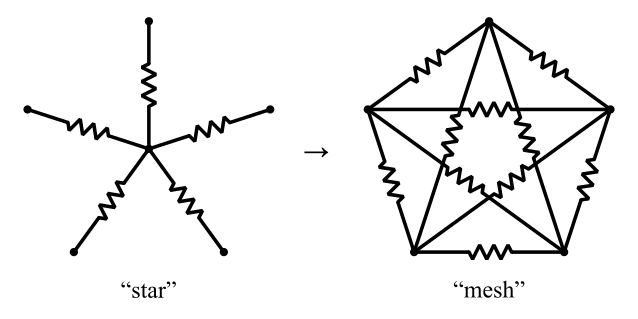
Mathematical circuit analysis technique
The star-mesh transform, or star-polygon transform, is a mathematical circuit analysis technique to transform a resistive network into an equivalent network with one less node. The equivalence follows from the Schur complement identity applied to the Kirchhoff matrix of the network.
The equivalent impedance betweens nodes A and B is given by:
:z_\text{AB} = z_\text{A} z_\text{B} \sum\frac{1}{z},
where z_\text{A} is the impedance between node A and the central node being removed.
The transform replaces N resistors with \frac{1}{2}N(N - 1) resistors. For N 3, the result is an increase in the number of resistors, so the transform has no general inverse without additional constraints.
It is possible, though not necessarily efficient, to transform an arbitrarily complex two-terminal resistive network into a single equivalent resistor by repeatedly applying the star-mesh transform to eliminate each non-terminal node.
Special cases
When N is:
- For a single dangling resistor, the transform eliminates the resistor.
- For two resistors, the "star" is simply the two resistors in series, and the transform yields a single equivalent resistor.
- The special case of three resistors is better known as the Y-Δ transform. Since the result also has three resistors, this transform has an inverse Δ-Y transform.
References
- E.B. Curtis, D. Ingerman, J.A. Morrow. Circular planar graphs and resistor networks. Linear Algebra and its Applications. Volume 283, Issues 1–3, 1 November 1998, pp. 115–150| doi = https://doi.org/10.1016/S0024-3795(98)10087-3.
This article was imported from Wikipedia and is available under the Creative Commons Attribution-ShareAlike 4.0 License. Content has been adapted to SurfDoc format. Original contributors can be found on the article history page.
Ask Mako anything about Star-mesh transform — get instant answers, deeper analysis, and related topics.
Research with MakoFree with your Surf account
Create a free account to save articles, ask Mako questions, and organize your research.
Sign up freeThis content may have been generated or modified by AI. CloudSurf Software LLC is not responsible for the accuracy, completeness, or reliability of AI-generated content. Always verify important information from primary sources.
Report