From Surf Wiki (app.surf) — the open knowledge base
ST depression
Depression of the ST segment on an electrocardiogram
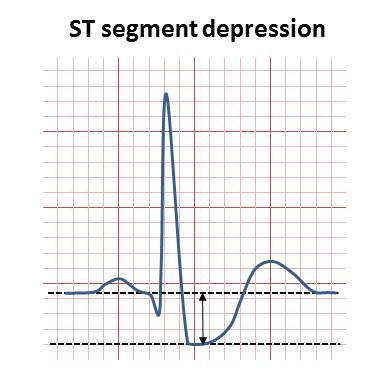
Depression of the ST segment on an electrocardiogram
ST depression refers to a finding on an electrocardiogram, wherein the trace in the ST segment is abnormally low below the baseline.
Causes
It is often a sign of myocardial ischemia, of which coronary insufficiency is a major cause. Other ischemic heart diseases causing ST depression include:
- Subendocardial ischemia or even infarction. Subendocardial means non full thickness ischemia. In contrast, ST elevation is transmural (or full thickness) ischemia
- Non Q-wave myocardial infarction
- Reciprocal changes in acute Q-wave myocardial infarction (e.g., ST depression in leads I & aVL with acute inferior myocardial infarction)
- ST segment depression and T-wave changes may be seen in patients with unstable angina
Depressed but upsloping ST segment generally rules out ischemia as a cause.
Also, it can be a normal variant or artifacts, such as:
- Pseudo-ST-depression, which is a wandering baseline due to poor skin contact of the electrode
- Physiologic J-junctional depression with sinus tachycardia
- Hyperventilation

Other, non-ischemic, causes include:
- Side effect of digoxin
- Hypokalemia
- Right or left ventricular hypertrophy
- Intraventricular conduction abnormalities (e.g., right or left bundle branch block, WPW, etc.)
- Hypothermia
- Tachycardia
- Reciprocal ST elevation
- Mitral valve prolapse
- Central nervous system disease,
Mnemonic
A mnemonic can be used for some causes of ST depression, namely DEPRESSED ST:
D - Drooping valve (mitral valve prolapse) E - Enlargement of the left ventricle P - Potassium loss R - Reciprocal ST depression (e.g. inferior wall MI) E - Encephalon hemorrhage S - Subendocardial infarct S - Subendocardial ischemia E - Embolism (pulmonary) D - Dilated cardiomyopathy S - Shock T - Toxicity (digitalis/quinidine)
Physiology
For non-transmural ischemia (subendocardial ischemia) injured cells are closer to the inside of heart wall, resulting in a systolic injury current. A systolic injury current results from a greater depolarization in healthier cells. Because the subepicardial region is more depolarized (more positive) compared to the endomyocardial cells, the current in the left ventricle flows toward the endomyocardial cells. The current flows from the more positive subepicardium to the less positive subendocardium during phase 2 of the fast fiber type depolarization, which on ECG occurs during ST segment. The positive electrodes on the anterior chest wall detect the movement of positive charge away from the electrode and record it as a downward deflection on the ECG paper.
Measurement
ST segment depression may be determined by measuring the vertical distance between the patient's trace and the isoelectric line at a location 2-3 millimeters from the QRS complex.
It is significant if it is more than 1 mm in V5-V6, or 1.5 mm in AVF or III.
In a cardiac stress test, an ST depression of at least 1 mm after adenosine administration indicates a reversible ischaemia, while an exercise stress test requires an ST depression of at least 2 mm to significantly indicate reversible ischaemia.
References
References
- (April 2001). "Computerized ST depression analysis improves prediction of all-cause and cardiovascular mortality: the strong heart study". Annals of Noninvasive Electrocardiology.
- (April 2004). "Combined echocardiographic left ventricular hypertrophy and electrocardiographic ST depression improve prediction of mortality in American Indians: the Strong Heart Study". Hypertension.
- [http://ecg.utah.edu/lesson/10#ST_up X. ST Segment Abnormalities] Frank G. Yanowitz, MD. University of Utah School of Medicine
- (January 2013). "Electrocardiographic abnormalities in acute cerebrovascular events in patients with/without cardiovascular disease". Annals of Indian Academy of Neurology.
- [http://www.madsci.com/manu/ekg_st-t.htm madscientist software > MicroEKG Manual] Retrieved September 2010
- (2005). "Significance of ST depression during exercise treadmill stress and adenosine infusion myocardial perfusion imaging". The International Journal of Cardiovascular Imaging.
This article was imported from Wikipedia and is available under the Creative Commons Attribution-ShareAlike 4.0 License. Content has been adapted to SurfDoc format. Original contributors can be found on the article history page.
Ask Mako anything about ST depression — get instant answers, deeper analysis, and related topics.
Research with MakoFree with your Surf account
Create a free account to save articles, ask Mako questions, and organize your research.
Sign up freeThis content may have been generated or modified by AI. CloudSurf Software LLC is not responsible for the accuracy, completeness, or reliability of AI-generated content. Always verify important information from primary sources.
Report