From Surf Wiki (app.surf) — the open knowledge base
Sri Lankan elephant
Subspecies of the Asian elephant
_male_head.jpg)
Subspecies of the Asian elephant
The Sri Lankan elephant (Elephas maximus maximus) is native to Sri Lanka and one of three recognised subspecies of the Asian elephant. It is the type subspecies of the Asian elephant and was first described by Carl Linnaeus under the binomial Elephas maximus in 1758. The Sri Lankan elephant population is now largely restricted to the dry zone in the north, east and southeast of Sri Lanka. Elephants are present in Udawalawe National Park, Yala National Park, Lunugamvehera National Park, Wilpattu National Park and Minneriya National Park but also live outside protected areas. It is estimated that Sri Lanka has the highest density of elephants in Asia. Human-elephant conflict is increasing due to conversion of elephant habitat to settlements and permanent cultivation. Since 1986, the Asian elephant has been listed as Endangered on the IUCN Red List as the population has declined by at least 50% over the last three generations, estimated to be 60–75 years. The species is primarily threatened by habitat loss, degradation and fragmentation. --
Characteristics
The Sri Lankan elephant is the largest subspecies reaching a shoulder height of between 2 and, weighing between 2000 and. It has 19 pairs of ribs. Its skin colour is darker than of indicus and of sumatranus with larger and more distinct patches of depigmentation on the ears, face, trunk and belly. Females are usually smaller than males. 90% of tuskless males are called makhna.
Only 7% of males bear tusks that grow up to about 6 ft and weigh up to 35 kg. Millangoda Raja had the longest tusks of 7 ft.
The Sri Lankan subspecies designation is weakly supported by analysis of allozyme loci, but not by analysis of mitochondrial DNA (mtDNA) sequences.
In July 2013, a dwarf Sri Lankan elephant was sighted in Udawalawe National Park. It was over 5 ft tall but had shorter legs than usual and was the main aggressor in an encounter with a younger bull.
Distribution and habitat
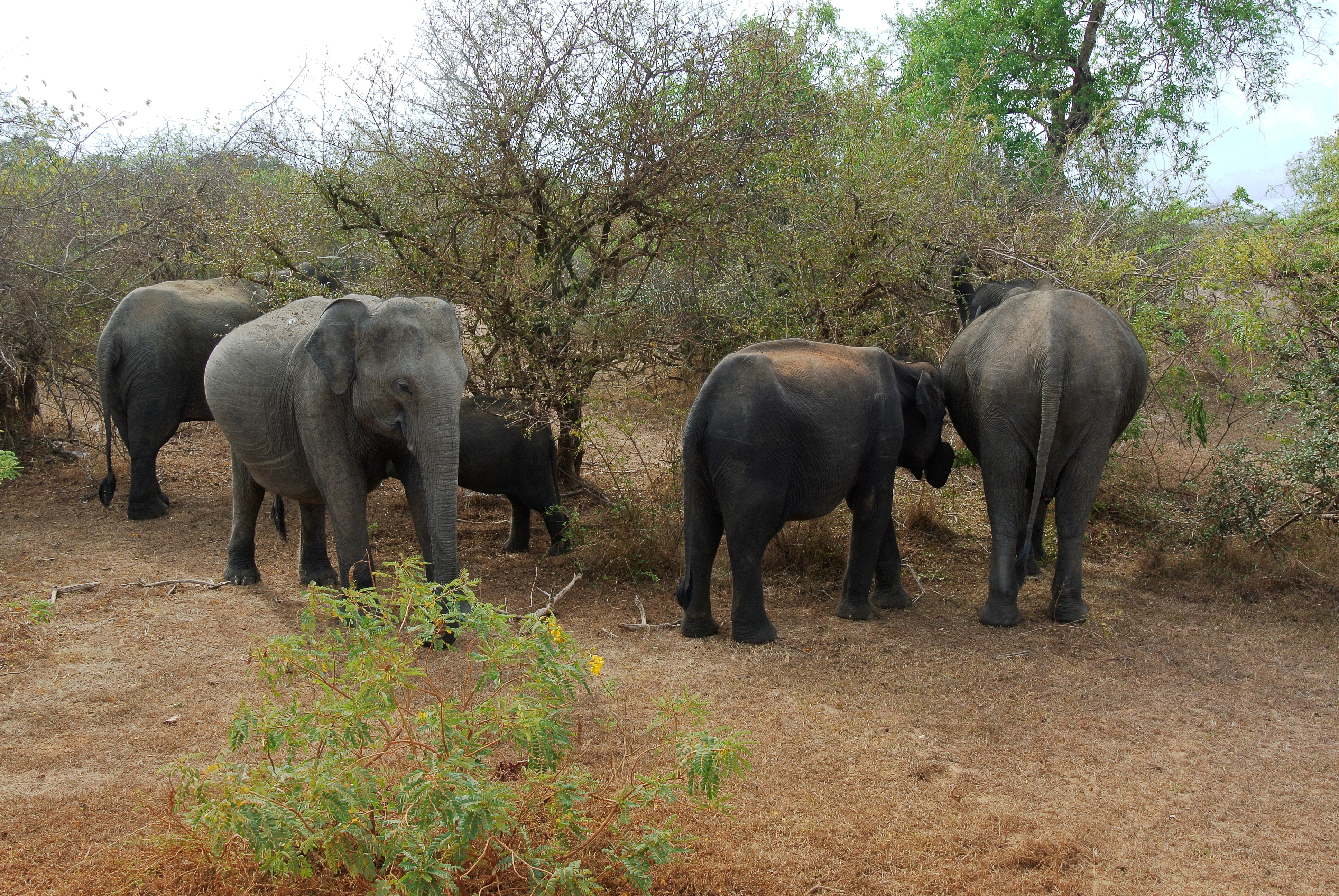
Sri Lankan elephants are restricted mostly to the lowlands in the dry zone where they are still fairly widespread in north, south, east, north-western, north-central and south-eastern Sri Lanka. A small remnant population exists in the Peak Wilderness Sanctuary. They are absent from the wet zone of the country. Apart from Wilpattu and Ruhuna National Parks, all other protected areas are less than 1000 km2 in extent. Many areas are less than 50 km2, and hence not large enough to encompass the entire home ranges of elephants that use them. In the Mahaweli Development Area, protected areas including Wasgomuwa National Park, Flood Plains National Park, and Somawathiya National Park have been linked, resulting in an overall area of 1172 km2 of contiguous habitat for elephants. Nevertheless, about 65% of the elephant's range extends outside protected areas.
Former range
In the historical past, elephants were widely distributed from sea level to the highest mountain ranges. They occurred in the dry zone, in the lowland wet zone as well as in the cold damp montane forests. During the colonial period from 1505 to 1948, the wet zone was converted to commercially used fields and became heavily settled. Until 1830, elephants were so plentiful that their destruction was encouraged by the government, and rewards were paid for any that was killed. In the first half of the 19th century, forests in the montane zone were cleared large-scale for the planting of coffee, and afterward tea. The elephant population in the mountains was extirpated. During the British rule, many bull elephants were killed by trophy hunters. One of the British army majors is credited with having shot over 1,500 elephants, and two others are reputed to have shot half that number each. Many other sportsmen have shot about 250–300 animals during this time. Between 1829 and 1855 alone, more than 6,000 elephants were captured and shot under order of colonial British Empire.
By the turn of the 20th century, elephants were still distributed over much of the island. The area currently known as Ruhuna National Park was the Resident Sportsmen's Shooting Reserve, an area reserved for the sporting pleasure of British residents in the country. In the early 20th century, mega reservoirs were constructed in the dry zone for irrigated agriculture. Ancient irrigation systems were rehabilitated and people resettled. This development gathered momentum after the independence in 1948. As a result, elephant habitat in the dry zone was severely fragmented.
Population trend
The wild Sri Lankan elephant population is thought to have experienced a 21% decline in birth rate since about 2012. The birth rate of male elephants has fallen compared to that of female elephants.
The size of wild elephant populations in Sri Lanka was estimated at:
| Year | Population | |||||||||||||||||
|---|---|---|---|---|---|---|---|---|---|---|---|---|---|---|---|---|---|---|
| early 19th century | 19,500 | |||||||||||||||||
| early 20th century | 10,000 | |||||||||||||||||
| 1969 | last1=Kotagama | first1=S. | year=1991 | title=Sri Lanka – Enhancing the survival of elephants | journal=Gajah | volume=6 | page=24 | url=http://www.asesg.org/PDFfiles/Gajah/06-24-Kotagama.pdf | access-date=3 March 2011 | archive-date=20 October 2022 | archive-url=https://web.archive.org/web/20221020223559/https://www.asesg.org/PDFfiles/Gajah/06-24-Kotagama.pdf | url-status=live}} | ||||||
| 1987 | 2,500–3,435 | |||||||||||||||||
| 1993 | last1=Hendavitharana | first1=W. | last2=Dissanayake | first2=S. | last3=de Silva | first3=M. | last4=Santiapillai | first4=C. | year=1994 | title=The Survey of elephants in Sri Lanka | journal=Gajah | volume=12 | issue=1–30 | url=http://www.asesg.org/PDFfiles/Gajah/12-01-Hendavitharana.pdf | access-date=3 March 2011 | archive-date=25 July 2011 | archive-url=https://web.archive.org/web/20110725015804/http://www.asesg.org/PDFfiles/Gajah/12-01-Hendavitharana.pdf | url-status=live}} |
| 2000 | 3,150–4,400 | |||||||||||||||||
| 2011 | 5,879 | |||||||||||||||||
| 2019 | 7,500 |
| Name of the national park | Size in sq.km | Number of elephants |
|---|---|---|
| Wilpattu | 1,316.9 | 100–150 |
| Ruhuna (Yala) | 1,267.8 | 300–350 |
| Gal Oya | 629.4 | 150–200 |
| Maduru Oya | 588.5 | 150–200 |
| VictoriaRandenigala | 400.8 | 40–60 |
| Somawathiya | 377.6 | 50–100 |
| Wasgomuwa | 377.1 | 150–200 |
| Madhu road | 346.8 | 100–200 |
| Udawalawe | 308.2 | 150–200 |
| Peak Wilderness | 223.8 | 50–60 |
| Flood Plains | 173.5 | 50–100 |
| Sinharaja | 88.6 | 10–50 |
| MinneriayGiritale | 66.9 | 300–400 |
| Bundala | 62.1 | 80–100 |
| LahugalaKitulana | 15.5 | 50–100 |
Behaviour and ecology

The Sri Lankan elephant communicates using visual, acoustic and chemical signals. At least fourteen different vocal and acoustic signals have been described, which include some low-frequency calls that contain infrasonic frequencies. Females and calves generally form small, loosely associated social groups without a hierarchical tier structure.
Elephants are classified as megaherbivores and consume up to 150 kg of plant matter per day. As generalists, they feed on a wide variety of food plants. In Sri Lanka's northwestern region, feeding behaviour of elephants was observed during the period of January 1998 to December 1999. The elephants fed on a total of 116 plant species belonging to 35 families including 27 species of cultivated plants. More than half of the plants were non-tree species, i.e. shrub, herb, grass, or climbers. More than 25% of the plant species belonged to the family Leguminosae, and 19% of the plant species belonged to the family of true grasses. The presence of cultivated plants in dung does not result solely due to raiding of crops as it was observed that elephants feed on leftover crop plants in fallow chenas. Juvenile elephants tend to feed predominantly on grass species.
Food resources are abundant in regenerating forests, but at low density in mature forests. Traditional slash-and-burn agriculture creates optimum habitat for elephants through promoting successional vegetation.
Threats
Main article: Human-elephant conflict in Sri Lanka
During the Sri Lankan Civil War, Sri Lankan elephants were maimed or killed by land mines. Between 1990 and 1994, a total of 261 wild elephants died either as a result of gunshot injuries, or were killed by poachers and land mines. Several elephants stepped on land mines and were crippled. In 1997, 126 elephants were killed by humans: about 2.4 elephants per week.
Poaching for ivory is not a major threat, given the rarity of tuskers. Some ivory trade still goes on, particularly in Kandy. Human population growth and demand for land is a greater threat today, and the range of elephants continues to decline as irrigation and development projects lead to the conversion of natural land to irrigated agriculture and settlements.
Between 1999 and the end of 2006, nearly 100 wild elephants were killed every year to protect crops and houses. During drought seasons many elephants damage agricultural land for food. Nearly 80 elephants were killed in northwestern Sri Lanka, 50 in south and east and another 30 in other parts of the country, totaling 160 elephant deaths in 2006 alone. Sri Lanka has thus become the country with the highest elephant mortality rate worldwide. The Sri Lankan Department of Wildlife Conservation official records showed that 407 elephants were killed in 2019. The next three years after that showed 328, 375, and 439 elephant fatalities, respectively.
| Year | 2010 | 2011 | 2012 | 2013 | 2014 | 2015 | 2016 | 2017 | 2018 | 2019 | 2020 | 2021 | 2022 | 2023 | 2024 | 2025 | Total | ||||
|---|---|---|---|---|---|---|---|---|---|---|---|---|---|---|---|---|---|---|---|---|---|
| **Deaths** | 227 | 255 | 250 | 206 | 239 | 205 | 279 | 256 | 258 | 407 | 328 | 375 | 439 | 488 | title=Over 400 dead as human–elephant conflict turns deadlier - Breaking News Daily Mirror | url=https://www.dailymirror.lk/breaking-news/Over-400-dead-as-humanelephant-conflict-turns-deadlier/108-321553 | access-date=2025-12-05 | website=www.dailymirror.lk | language=en}} | 314 | 4914 |
Another major threat is plastic consumption. Over the past three decades, many elephants have died after consuming plastic waste, and their lifespan has decreased compared to the average wild lifespan. Elephants eat plastic and human rubbish because of habitat loss, which forces them to move into human-inhabited areas. Government mismanagement of waste dumping near national parks has triggered this crisis, and elephants are not the only animals affected.
Conservation

Elephas maximus is listed on CITES Appendix I.
The elephant conservation strategy of the Department of Wildlife Conservation aims at conserving as many viable populations as possible in as wide a range of suitable habitats as is feasible. This means protecting elephants both within the system of protected areas and as many animals outside these areas that the land can support and landholders will accept, and not restricting elephants to the protected area network alone.
- In the Pinnawala Elephant Orphanage in Kegalle injured elephants are treated, and orphaned baby elephants cared for. Nearly 70 elephants live here. Captive breeding is also going on.
- The Udawalawe Elephant Transit Centre in Udawalawe National Park is a rehabilitation centre, where orphaned elephant calves are being kept until they can be released into the wild.
Culture and symbolism

Elephants were a common element in Sinhalese and Sri Lankan Tamils heraldry for over two thousand years and remained so through British colonial rule. The coat of arms and the flag of Ceylon Government from 1875 to 1948 included an elephant and even today many institutions use the Sri Lankan elephant in their coat of arms and insignia. An important cultural symbiosis has continued to exist between the elephant and humans for over two thousand years – no religious procession was complete without its retinue of elephants, and many large Buddhist temples and Hindu Temples in Sri Lanka had their own elephants.

Since time immemorial, elephants have been domesticated for uses as work elephants and war elephants in Sri Lanka by the ancient kings. Elephants were exported from the island for hundreds of years and into the Portuguese and Dutch colonial era. The British did not export elephants, instead took to hunting wild elephants and capture of wild for domestication as work elephants continued. Elephant Kraals were organised to capture large herds of elephants in the late nineteenth and early twentieth century. The capture of wild elephants were regulated under the Fauna and Flora Protection Ordinance in 1937, with the issuance of permits to capture of wild elephants. This practice stopped following the last Elephant Kraal in 1950 by Sir Francis Molamure. A census of the domesticated elephant population in 1970 indicated 532 elephants among 378 owners, while this number had dropped 344 in 1982. These domesticated elephants were used mainly as work elephants and for cultural pageants, the chief of which is the annual Kandy Esala Perahera. In recent years, the domesticated elephant population has dropped further with the need for their labour dropping widespread use of tractors.
However, they remain in use in terrain inaccessible by vehicles for logging and used for tourism. Ownership of elephants are highly prestigious among Sinhalese as a status symbol and calls have been made for permission to capture wild elephants or release of orphaned wild elephants in government care to Temples to take part in pageants. Captive breeding in private ownership does not take place due to the long period of unemployability associated with it.
Legal reforms pertaining to the captive elephant population was introduced in 2021, just as a landmark case into dozens of calves being stolen from their herds in a ten-year period collapsed with the Attorney General's Department dropping charges and releasing the elephants to their former owners.
References
References
- (1760). "Systema naturæ per regna tria naturæ, secundum classes, ordines, genera, species, cum characteribus, differentiis, synonymis, locis". Typis et sumtibus Io. Iac. Curt..
- (2011). "Current Status of Asian Elephants in Sri Lanka". Gajah.
- (2006). "Biology, medicine, and surgery of elephants". Wiley-Blackwell.
- (1982). "''Elephas maximus''". Mammalian Species.
- (1994). "The elephant in Sri Lanka". Wildlife Heritage Trust of Sri Lanka.
- (4 August 2011). "'Longest tusked' elephant in Asia dies in Sri Lanka". BBC News.
- "An elegy to Millangoda Raja".
- (2009). "Genetic differentiation among local populations of Asian elephant". Journal of Zoological Systematics and Evolutionary Research.
- (2005). "Population differentiation within and among Asian elephant ( Elephas maximus ) populations in southern India". Heredity.
- (2003). "DNA Analysis indicates that Asian Elephants are native to Borneo and are therefore a high priority for conservation". PLOS Biology.
- (2001). "Phylogeography of the Asian Elephant (''Elephas maximus'') Based on Mitochondrial DNA". Evolution.
- (2014). "A Dwarf Elephant With Outsized Attitude". WBUR's The Wild Life.
- (2006). "A strategy for the conservation of the Asian elephant in Sri Lanka". Gajah.
- Jayewardene, J.. (2012). "Elephants in Sri Lankan History and Culture". Living Heritage Trust.
- (August 2020). "The Asian Elephant: Ecology and Management". Cambridge University Press.
- (1997). "Tuskers of Ruhuna National Park, Sri Lanka". Gajah.
- (2006). "Principles of Conservation Biology". Sinauer Associates.
- Aravinda, I.S.. (2025). "Birthrate slows among elephant population in Sri Lanka - Breaking News". Daily Mirror.
- "Elephants in Sri Lanka".
- (1991). "Sri Lanka – Elephants slaughtered in civil war". Gajah.
- (1991). "Sri Lanka – Enhancing the survival of elephants". Gajah.
- (1994). "The Survey of elephants in Sri Lanka". Gajah.
- (2000). "Asian elephants in the wild". WWF.
- (2020). "Sri Lanka elephants: 'Record number' of deaths in 2019". BBC News.
- (2003). "Important protected areas for the Asian elephant in Sri Lanka". Department of Wildlife Conservation.
- (2010). "Acoustic communication in the Asian elephant, ''Elephas maximus maximus''". Behaviour.
- (2012). "A Comparison of Social Organization in Asian Elephants and African Savannah Elephants". International Journal of Primatology.
- (2011). "The dynamics of social networks among female Asian elephants". BMC Ecology.
- (2007). "Feeding Behaviour of Asian Elephants in the Northwestern Region of Sri Lanka". Gajah.
- (1997). "Elephants: Unwitting victims in Sri Lanka's civil war". Gajah.
- "Sri Lankan elephants under threat".
- (2020). "Sri Lanka ranks as the country which killed the largest number of Elephants in the world – COPA".
- (2020). "Sri Lanka records highest elephant deaths in world". Hindustan Times.
- (2023). "238 elephants killed in Sri Lanka so far this year, more than 1 daily". Efe.
- (2020). "Human-elephant conflict in Sri Lanka: Patterns and extent". Gajah.
- (2025-11-09). "Human-Elephant Conflict: A tragedy of national proportions".
- "Over 400 dead as human–elephant conflict turns deadlier - Breaking News {{!}} Daily Mirror".
- "Wildlife Photographer of the Year: How plastic is harming Sri Lankan elephants {{!}} Natural History Museum".
- (2020). "Elephas maximus".
- "The care and management of domesticated Asian elephants in Sri Lanka". Food and Agriculture Organization.
- "Sri Lanka prohibits handlers from 'drunk driving' on elephants, bans putting baby elephants to work". insider.com.
This article was imported from Wikipedia and is available under the Creative Commons Attribution-ShareAlike 4.0 License. Content has been adapted to SurfDoc format. Original contributors can be found on the article history page.
Ask Mako anything about Sri Lankan elephant — get instant answers, deeper analysis, and related topics.
Research with MakoFree with your Surf account
Create a free account to save articles, ask Mako questions, and organize your research.
Sign up freeThis content may have been generated or modified by AI. CloudSurf Software LLC is not responsible for the accuracy, completeness, or reliability of AI-generated content. Always verify important information from primary sources.
Report