From Surf Wiki (app.surf) — the open knowledge base
Sri Lanka and state terrorism
None
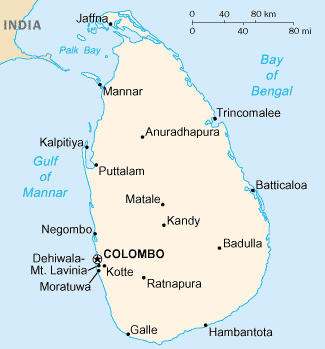
None
The Sri Lankan state has been accused of state terrorism against the Tamil minority as well as the Sinhalese majority, during the two Marxist–Leninist insurrections. The Sri Lankan government and the Sri Lankan Armed Forces have been charged with massacres, indiscriminate shelling and bombing, extrajudicial killings, rape, torture, disappearance, arbitrary detention, forced displacement and economic blockade. According to Amnesty International, state terror was institutionalized into Sri Lanka's laws, government and society.
History
20th century
Sri Lanka gained independence from Britain in 1948 as the Dominion of Ceylon, although the British Royal Navy retained a base there until 1956. In 1972, the country became a republic, adopting the name Sri Lanka. Since this time, the country has experienced several armed conflicts– a civil war, two Marxist uprisings, and other terrorist incidents.
Marxist-Leninist insurrections
From 1985 to 1989, Sri Lanka responded to violent insurrection with equal violence against the Sinhalese majority as part of the counterinsurgency measures against the uprising by the Marxist Janatha Vimukthi Peramuna (JVP) party. In order to subdue support of the JVP uprising, several acts of cruelty committed by the state were recorded, including the torture and mass murder of school children. This repression peaked amongst the Sinhalese population between 1989–90. Approximately 90,000 casualties occurred during between 1971 and 1990, most of whom were Sinhalese male youths.
Civil war
The Sri Lankan Civil War lasted from 1983 to 2009. In 1986, an American-Tamil social anthropologist at Harvard University stated that acts of terrorism had been committed by all sides during the war, but although all parties in the conflict had resorted to the use of these tactics, in terms of scale, duration, and sheer numbers of victims, the Sri Lankan state was particularly culpable. This was echoed by the Secretary of the Movement for Development and Democratic Rights, a non-governmental organisation, which further claimed that the Sri Lankan state viewed killing as an essential political tool. This had originally prompted the demand for a separate state for minority Tamils called Tamil Eelam in the north of the country,{{cite journal | title = Sri Lanka: testimony to state terror
Assaults on Tamils for ethnic reasons have been alleged, and the experience of state terrorism by the people of Jaffna has been alleged to have been instrumental in persuading the United National Party to increase their hostilities there.
Chandrika Kumaratunga was the President of Sri Lanka from 1994 to 2005. In an interview with the British television presenter and news critic David Frost, she stated that at the time that her husband Vijaya Kumaranatunga was assassinated, "Sri Lanka had a killing fields, there was a lot of terror perpetrated by the government itself, state terrorism."{{cite web|url= https://news.bbc.co.uk/2/hi/programmes/breakfast_with_frost/1624615.stm
21st century
Following the collapse of peace talks in 2006, human rights agencies such as the Asian Center of Human Rights (ACHR), the University Teachers for Human Rights (UTHR), and pro-LTTE political parties such as the Tamil National Alliance claimed that the government of Sri Lanka had unleashed state terrorism as part of its counterinsurgency measures against the rebel LTTE movement. The Sri Lankan government responded by claiming that these allegations by the LTTE were an attempt by the LTTE to justify their own acts of terrorism.
The ACHR has also stated that following the collapse of the Geneva talks of February 2006, the government of Sri Lanka perpetrated a campaign of state terrorism by targeting alleged LTTE sympathizers and Tamil civilians. A spokesman for Human Rights Watch was of the opinion that "the Sri Lankan government has apparently given its security forces a green light to use dirty war tactics." International intervention in Sri Lanka was requested by Tamil sources to protect civilians from state terrorism.{{cite web|url= https://www.bbc.com/sinhala/news/story/2007/10/071003_mano_jvp
State terrorist groups
The Sri Lankan government has been accused of the usage state-sponsored paramilitaries to commit war crimes. Many of these groups were created at the height of the second JVP uprising. During the civil war, one of the major state-sponsored paramilitaries was the Tamil Makkal Viduthalai Pulikal, led by Karuna Amman.
Anti-separatist paramilitaries
- Eelam People's Democratic Party – Led by former leader of the Eelam People's Revolutionary Liberation Front, Douglas Devananda
- Tamil Makkal Viduthalai Pulikal – A highly controversial organization which defected from the LTTE in 2004, led by Karuna Amman, former LTTE commander of the Eastern Province.
Anti-communist paramilitaries
- Eagles of the Central Hills – Formerly active in Kandy. Responsible for the massacre of suspected JVP rebels in 1989. Also responsible for killings of workers at Peradeniya University.
- Black Cat group – Responsible for attacks on politicians and civilians. The group would threaten members of the Communist Party of Sri Lanka throughout the late 1980s.
Notes
References
- {{cite book | last1=Danieli | first1=Yael | last2 = Brom |first2=D |last3=Sills |first3=Joe
- {{cite book | last = Asian Center for Human Rights | title = Sri Lanka: Disappearances and the Collapse of the Police System
References
- (2009). "The Separatist Conflict in Sri Lanka: Terrorism, Ethnicity, Political Economy". [[Routledge]].
- (2013-07-31). "Violence, Torture and Memory in Sri Lanka: Life After Terror". [[Routledge]].
- (2005). "Sri Lanka: A Dangerous Interlude". New Dawn Press.
- (2014). "Sri Lanka's Secrets: How the Rajapaksa Regime Gets Away with Murder". [[Monash University Publishing]].
- (1990). "Sri Lanka, a Lost Revolution?: The Inside Story of the JVP". Institute of fundamental studies.
- (2012). "The Trauma of Terrorism: Sharing Knowledge and Shared Care, An International Handbook". [[Routledge]].
- (2004). "11 September and Its Aftermath: The Geopolitics of Terror". [[Routledge]].
- (2009). "South Asia Security". Kalpaz Publications.
- Gananath Obeyesekere, ''Narratives of the self: Chevalier Peter Dillon's Fijian cannibal adventures'', in Barbara Creed, Jeanette Hoorn, ''Body Taade: captivity, cannibalism and colonialism in the Pacific'', Routledge, 2001, p. 100. {{ISBN. 0-415-93884-8. "The 'time of dread' was roughly 1985-89, when ethnic Sinhala youth took over vast areas of the country and practiced enormous atrocities; they were only eliminated by equally dreadful state terrorism." [[Gananath Obeyesekere]]
- "JVP: Lessons for the Genuine Left". Imayavaramban.
- Handelman, Don. (2006). "The Manchester School: Practice and Ethnographic Praxis in Anthropology". Berghahn Books.
- Tambiah, ''Sri Lanka: Ethnic Fratricide and the Dismantling of Democracy'', p 116. [[Stanley Jeyaraja Tambiah]]
- Danieli, Yael, Brom, D and Sills, Joe. ''The trauma of terrorism: sharing knowledge and shared care'', p 216
- (2002). "Child soldiers: Understanding the context". BMJ (Clinical Research Ed.).
- ACHR, ''Sri Lanka: Disappearances and the Collapse of the Police System'', ACHR, pp 34–42
- Hattotuwa, ''From violence to peace: Terrorism and Human Rights in Sri Lanka'', pp 11–13
- [[Kumar Rupesinghe]], '' Ethnic Conflict in South Asia: The Case of Sri Lanka and the Indian Peace-Keeping Force (IPKF)'', pp.337
- Ishtiaq Ahmed, ''State, Nation, and Ethnicity in Contemporary South Asia'', Continuum International Publishing Group, 1996, p. 55. {{ISBN. 1-85567-578-1.
- W. A. Wiswa Warnapala, L. Dias Hewagama, ''Recent Politics in Sri Lanka: The Presidential Election and the Referendum'', Navrang (Original from the University of Michigan), 1983, p. 29. ASIN: B000II886W.
- "Tell the truth or you will be killed".
- "Sri Lanka: Terror Vs State Terror".
- [http://www.uthr.org/bulletins/bul40.htm#_Toc138040843 University Teachers for Human Rights ] {{Webarchive. link. (13 August 2017 , ''[[UTHR]]'', 28 October 2001.)
- "Claims of state terror and genocide by LTTE attempts at justifying terrorism".
- "Claims of state terror and genocide by LTTE attempts at justifying terrorism".
- (2006-11-15). "Sri Lanka: Terror Vs State Terror". [[Asian Human Rights Commission]].
- "Sri Lanka: Government Abuses Intensify". Human Rights Watch.
- "Sri Lanka Trauma: International Community Revisits its Response". V S Subramaniam.
- link. (September 19, 2012 '')
This article was imported from Wikipedia and is available under the Creative Commons Attribution-ShareAlike 4.0 License. Content has been adapted to SurfDoc format. Original contributors can be found on the article history page.
Ask Mako anything about Sri Lanka and state terrorism — get instant answers, deeper analysis, and related topics.
Research with MakoFree with your Surf account
Create a free account to save articles, ask Mako questions, and organize your research.
Sign up freeThis content may have been generated or modified by AI. CloudSurf Software LLC is not responsible for the accuracy, completeness, or reliability of AI-generated content. Always verify important information from primary sources.
Report