From Surf Wiki (app.surf) — the open knowledge base
SpaceX launch vehicles
Launch vehicles developed and operated by SpaceX
Launch vehicles developed and operated by SpaceX
SpaceX manufactures launch vehicles to operate its launch provider services and to execute its various exploration goals. SpaceX manufactures and operates two members of the Falcon 9 family, the Falcon 9 Block 5 medium-lift launch vehicle and the Falcon Heavy heavy-lift launch vehicle – both of which are powered by SpaceX Merlin engines and employ VTVL technologies to reuse the first stage. As of 2024, the company is also developing the fully reusable Starship launch system, which will replace Falcon 9, Falcon Heavy, and Dragon.
SpaceX's first launch vehicle, the Falcon 1, was the first privately developed liquid fueled launch vehicle to be launched into orbit, and used SpaceX's Merlin and Kestrel engines for its first and second stages, respectively. It was launched five times from Omelek Island between 2006 and 2009 – the Falcon 1e and Falcon 5 variants were planned but never developed. The Falcon 9 v1.0, using upgraded Merlin engines on both its stages, was developed as part of the United States Air Force's Evolved Expendable Launch Vehicle program and NASA's Commercial Orbital Transportation Services program. It was first launched from Cape Canaveral in 2010 and later replaced by the Falcon 9 v1.1 series in 2013, which was also launched from Vandenberg Air Force Base in California. The Falcon 9 Full Thrust and Falcon Heavy variants followed in 2015 and 2018. Falcon Heavy launches from Kennedy Space Center in Florida, and Falcon 9 additionally launches from Cape Canaveral Space Force Station in Florida and Vandenberg.
Nomenclature
Elon Musk, CEO of SpaceX, has stated that the Falcon 1, 9, and Heavy are named after the Millennium Falcon from the Star Wars film series.
Launch vehicles
Falcon Heavy
Main article: Falcon Heavy
Falcon Heavy (FH) is a super heavy lift space launch vehicle designed and manufactured by SpaceX. The Falcon Heavy is a variant of the Falcon 9 launch vehicle comprising three Falcon 9 first stages: a reinforced center core, and two additional side boosters. All three boosters are capable of being recovered and reused, although most flights use unrecoverable stripped-down center cores to increase performance. The side boosters assigned to Falcon Heavy's first flight were recovered from two prior Falcon 9 missions. SpaceX successfully launched the Falcon Heavy on February 6, 2018, delivering a payload comprising Musk's personal Tesla Roadster onto a trajectory reaching the orbit of Mars.
Falcon 9 "Full Thrust"{{Needs update|date=October 2024}}
Main article: Falcon 9 Full Thrust
The "Full Thrust" version of Falcon 9 is an upgraded version of the Falcon 9 v1.1. It was used the first time on December 22, 2015, for the ORBCOMM-2 launch at Cape Canaveral SLC-40 launch pad.
The first stage was upgraded with a larger liquid oxygen tank, loaded with subcooled propellants to allow a greater mass of fuel in the same tank volume. The second stage was also extended for greater fuel tank capacity. These upgrades brought a 33% increase to the previous rocket performance. Five sub-variants have been flown; only Falcon 9 Block 5 is still active.
By default the first stage lands and gets reused, although it can be expended to increase the payload capacity.
In development
Starship
Retired
Falcon 1
Main article: Falcon 1
The Falcon 1 was a small, planned to be partially reusable rocket capable of placing several hundred kilograms into low earth orbit. It also functioned as a testbed for developing concepts and components for the larger Falcon 9.
On March 26, 2006, the Falcon 1's maiden flight failed only seconds after leaving the pad due to a fuel line rupture. After a year, the second flight was launched on March 22, 2007, and it also ended in failure, due to a spin stabilization problem that automatically caused sensors to turn off the Kestrel 2nd-stage engine. The third Falcon 1 flight used a new regenerative cooling system for the first-stage Merlin engine, and the engine development was responsible for the almost 17-month flight delay. The new cooling system turned out to be the major reason the mission failed; because the first stage rammed into the second-stage engine bell at staging, due to excess thrust provided by residual propellant left over from the higher-propellant-capacity cooling system. On September 28, 2008, the Falcon 1 succeeded in reaching orbit on its fourth attempt, becoming the first privately funded, liquid-fueled rocket to do so. The Falcon 1 carried its first and only successful commercial payload into orbit on July 13, 2009, on its fifth launch. No launch attempts of the Falcon 1 have been made since 2009, and SpaceX is no longer taking launch reservations for the Falcon 1 in order to concentrate company resources on its larger Falcon 9 launch vehicle and other development projects.
Falcon 9 v1.0
The first version of the Falcon 9 launch vehicle, Falcon 9 v1.0, was developed in 2005–2010, and was launched for the first time in 2010. Falcon 9 v1.0 made five flights in 2010–2013, when it was retired.
Falcon 9 v1.1
Main article: Falcon 9 v1.1
On September 8, 2005, SpaceX announced the development of the Falcon 9 rocket, which has nine Merlin engines in its first stage. The design is an EELV-class vehicle, intended to compete with the Delta IV and the Atlas V, along with launchers of other nations as well. Both stages were designed for reuse. A similarly designed Falcon 5 rocket was also envisioned to fit between the Falcon 1 and Falcon 9, but development was dropped to concentrate on the Falcon 9.
The first version of the Falcon 9, Falcon 9 v1.0, was developed in 2005–2010, and flew five orbital missions in 2010–2013. The second version of the launch system—Falcon 9 v1.1—has been retired meanwhile.
Falcon 9 v1.1 was developed in 2010–2013, and made its maiden flight in September 2013. The Falcon 9 v1.1 is 60 percent heavier, with 60 percent more thrust than the v1.0 version of the Falcon 9. and 60 percent longer fuel tanks, making it more susceptible to bending during flight. The engines themselves have been upgraded to the more powerful Merlin 1D. These improvements increased the payload capability from 10450 to.
The stage separation system has been redesigned and reduces the number of attachment points from twelve to three, and the vehicle has upgraded avionics and software.
The new first stage was also supposed to be used as side boosters on the Falcon Heavy launch vehicle.
The company purchased the McGregor, Texas, testing facilities of defunct Beal Aerospace, where it refitted the largest test stand at the facilities for Falcon 9 testing. On November 22, 2008, the stand tested the nine Merlin 1C engines of the Falcon 9, which deliver 350 tf of thrust, well under the stand's capacity of 1,500 tf.
The first Falcon 9 vehicle was integrated at Cape Canaveral on December 30, 2008. NASA was planning for a flight to take place in January 2010; however the maiden flight was postponed several times and took place on June 4, 2010. At 2:50pm EST (14:50 ET), the Falcon 9 rocket successfully reached orbit.
The second flight for the Falcon 9 vehicle was the COTS Demo Flight 1, the first launch under the NASA Commercial Orbital Transportation Services (COTS) contract designed to provide "seed money" for development of new boosters. The original NASA contract called for the COTS Demo Flight 1 to occur the second quarter of 2008; this flight was delayed several times, occurring at 15:43 GMT on December 8, 2010. The rocket successfully deployed an operational Dragon spacecraft at 15:53 GMT. Dragon orbited the Earth twice, and then made a controlled reentry burn that put it on target for a splashdown in the Pacific Ocean off the coast of Mexico. With Dragon's safe recovery, SpaceX became the first private company to launch, orbit, and recover a spacecraft; prior to this mission only government agencies had been able to recover orbital spacecraft. The first flight of the Falcon 9 v1.1 was September 29, 2013, from Vandenberg Air Force Base carrying several payloads including Canada's CASSIOPE technology demonstration satellite. The Falcon 9 v1.1 features stretched first and second stages, and a new octagonal arrangement of the 9 Merlin-1D engines on the first stage (replacing the square pattern of engines in v1.0). SpaceX notes that the Falcon 9 v1.1 is cheaper to manufacture, and longer than v1.0. It also has a larger payload capacity: 13,150 kilograms to low Earth orbit or 4,850 kg to geosynchronous transfer orbit.
Grasshopper
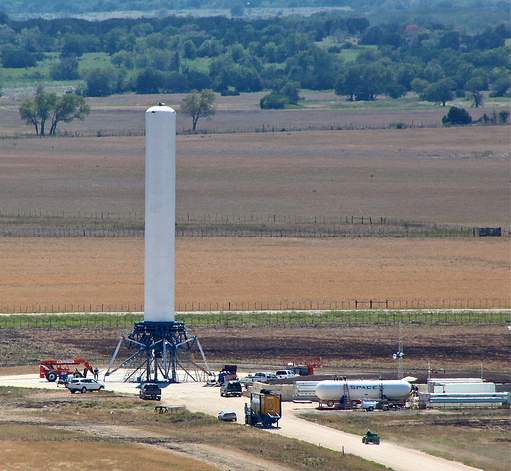
Main article: Falcon 9 prototypes
Grasshopper was an experimental technology-demonstrator, suborbital reusable launch vehicle (RLV), a vertical takeoff, vertical landing (VTVL) rocket. The first VTVL flight test vehicle—Grasshopper, built on a Falcon 9 v1.0 first-stage tank—made a total of eight test flights between September 2012 and October 2013. All eight flights were from the McGregor, Texas, test facility.
Grasshopper began flight testing in September 2012 with a brief, three-second hop. It was followed by a second hop in November 2012, which consisted of an 8-second flight that took the testbed approximately 5.4 m off the ground. A third flight occurred in December 2012 of 29 seconds duration, with extended hover under rocket engine power, in which it ascended to an altitude of 40 m before descending under rocket power to come to a successful vertical landing. Grasshopper made its eighth and final test flight on October 7, 2013, flying to an altitude of 744 m before making its eighth successful vertical landing. The Grasshopper test vehicle is now retired.
Cancelled
Falcon 1e
The Falcon 1e was a proposed upgrade of the SpaceX Falcon 1. The Falcon 1e would have featured a larger first stage with a higher thrust engine, an upgraded second stage engine, a larger payload fairing, and was intended to be partially reusable. Its first launch was planned for mid-2011, but the Falcon 1 and Falcon 1e were withdrawn from the market, with SpaceX citing "limited demand," before its debut. Payloads that would have flown on the Falcon 1 were instead to be flown on the Falcon 9 using excess capacity.
The Falcon 1e was to be 6.1 m longer than the Falcon 1, with an overall length of 27.4 m, but with the same 1.68 m diameter. Its first stage had a dry mass of 5680 lb, and was powered by an upgraded pump-fed
The Falcon 1e planned to use Aluminum Lithium alloy 2195 in the second stage, a change from the 2014 Aluminum used in the Falcon 1 second stages.
Falcon 1e launches were intended to occur from Omelek Island, part of Kwajalein Atoll in the Marshall Islands, and from Cape Canaveral, however SpaceX had announced that they would consider other locations as long as there is a "business case for establishing the requested launch site". Following a demonstration flight, the Falcon 1e was intended to make a series of launches carrying Orbcomm O2G spacecraft, with a total of eighteen satellites being launched, several per rocket. EADS Astrium had been responsible for marketing the Falcon 1e in Europe.
Falcon 5

The Falcon 5 was a proposed two-stage-to-orbit partially reusable launch vehicle designed by SpaceX.{{cite web |access-date = September 21, 2019 |url-status = usurped |archive-url=https://web.archive.org/web/20220412010845/http://www.spacelaunchreport.com/falcon9.html |archive-date = April 12, 2022
The first stage of Falcon 5 was to be powered by five Merlin engines, and the upper stage by one Merlin engine, both burning RP-1 with a liquid oxygen oxidizer. Along with the Falcon 9, it would have been the world's only launch vehicle with its first stage designed for reuse.
The Falcon 5 would have been the first American rocket since the Saturn V to have full engine-out capability, meaning that with the loss of one engine, it can still meet mission requirements by burning the other four engines longer to achieve the correct orbit. |access-date=August 18, 2010 |url-status=dead |archive-url=https://web.archive.org/web/20111111212400/http://www.astronautix.com/lvs/falcon5.htm |archive-date=November 11, 2011
In 2006, SpaceX stated that the Falcon 5 was a Falcon 9 with four engines removed. Since the launchers were being co-developed, work on the Falcon 9 was also applicable to the Falcon 5.
Falcon 9 Air
Falcon 9 Air would have been an air-launched multi-stage launch vehicle under development by SpaceX in 2011–2012. Falcon 9 Air was to be carried to launch position and launch altitude by a Stratolaunch Systems carrier aircraft, the world's largest aircraft by wingspan. Payload to low Earth orbit was projected to be 6100 kg.
Propulsion for the rocket was planned to be provided by four Merlin 1D rocket engines, engines that were also to be used in the Falcon 9 v1.1 beginning in 2013, and also on the Falcon Heavy in 2014. Its first flight was notionally planned for 2016.
In December 2011 Stratolaunch Systems announced that it would contract with SpaceX to develop an air-launched, multiple-stage launch vehicle, as a derivative of Falcon 9 technology, called the Falcon 9 Air, as part of the Stratolaunch project. |access-date=December 14, 2011 |archive-url=https://web.archive.org/web/20111216191203/http://www.nasaspaceflight.com/2011/12/stratolaunch-rutan-designed-air-launched-system-falcon-rockets/ |archive-date=December 16, 2011 |url-status=dead
A month after the initial announcement, Stratolaunch confirmed that the first stage of the F9A launch vehicle would have only four engines, not the five that were shown in the mission video in December, and that they would be SpaceX Merlin 1D engines.
As initially announced, Stratolaunch Systems was a collaborative project that included subcontractors SpaceX, Scaled Composites, and Dynetics, with funding provided by Microsoft co-founder Paul G. Allen's Vulcan investment and project management company. |access-date=November 14, 2011 |archive-url=https://web.archive.org/web/20120107211612/http://www.wired.com/autopia/2011/12/rutan-allen-musk-team-up-for-orbit |archive-date=January 7, 2012 |url-status=dead
As the Stratolaunch development program progressed, it became clear that Stratolaunch and the system integrator, Dynetics, wanted modifications to the SpaceX basic launch-vehicle design that SpaceX felt were not strategic to the direction they were growing the company. These included requested modifications to the launch vehicle to add chines.
Development ceased in the fourth quarter of 2012, as SpaceX and Stratolaunch "amicably agreed to end [their] contractual relationship because the [Stratolaunch] launch vehicle design [had] departed significantly from the Falcon derivative vehicle envisioned by SpaceX and does not fit well with [SpaceX's] long-term strategic business model".
On November 27, 2012, Stratolaunch announced that they would partner with Orbital Sciences Corporation—initially on an air-launched vehicle study contract—instead of SpaceX, effectively ending development of the Falcon 9 Air.
In May 2013, the Falcon 9 Air was eventually replaced in the development plan by the Orbital Sciences Pegasus II air-launched rocket.
Competitive position
SpaceX Falcon rockets are being offered to the launch industry at highly competitive prices, allowing SpaceX to build a large manifest of over 50 launches by late 2013, with two-thirds of them for commercial customers exclusive of US government flights.
In the US launch industry, SpaceX prices its product offerings well below its competition. Nevertheless, "somewhat incongruously, its primary US competitor, United Launch Alliance (ULA), still maintained (in early 2013) that it requires a large annual subsidy, which neither SpaceX nor Orbital Sciences receives, in order to remain financially viable, with the reason cited as a lack of market opportunity, a stance which seems to be in conflict with the market itself.Citation Needed "
SpaceX launched its first satellite to geostationary orbit in December 2013 (SES-8) and followed that a month later with its second, Thaicom 6, beginning to offer competition to the European and Russian launch providers that had been the major players in the commercial communications satellite market in recent years.
SpaceX prices undercut its major competitors—the Ariane 5 and Proton—in this market.
Moreover, SpaceX prices for Falcon 9 and Falcon Heavy are much lower than the projected prices for Ariane 6, projected to be available in 2024.
As a result of additional mission requirements for government launches, SpaceX prices US government missions somewhat higher than similar commercial missions, but has noted that even with those added services, Falcon 9 missions contracted to the government are still priced well below (even with approximately in special security charges for some missions) which is a very competitive price compared to ULA prices for government payloads of the same size.
ULA prices to the US government are nearly $400 million for current launches of Falcon 9- and Falcon Heavy-class payloads.
SpaceX had a rare coincidence of four rockets (all types of operational and under-development rockets) on all four of its orbital launch pads and two Dragon 2s (both types of Dragon 2s) on orbit on January 10, 2023. This was coupled before the end of the year with SpaceX igniting all of their rockets within 24 hours on December 28–29, 2023 (Falcon family rockets launching on their missions and both Starship stages performing static fires).
Comparison
| Falcon 1 | Falcon 1e | Falcon 9 v1.0 | Falcon 9 v1.1 | Falcon 9 Full Thrust | Falcon Heavy | Starship Block 1 | Booster Stage | Stage 1 | Stage 2 | Max. height (m) | Diameter (m) | Initial thrust (kN) | Takeoff mass (tonnes) | Inner fairing diameter (m) | LEO payload (kg) | GTO payload (kg) | Price history(mil. USD) | Current price (mil. USD) | Success ratio (successful/total) | |||||||||||||||
|---|---|---|---|---|---|---|---|---|---|---|---|---|---|---|---|---|---|---|---|---|---|---|---|---|---|---|---|---|---|---|---|---|---|---|
| − | − | − | − | − | 2 boosters with 9 × Merlin 1D (with minor upgrades) | − | ||||||||||||||||||||||||||||
| 1 × Merlin 1C | 1 × Merlin 1C | 9 × Merlin 1C | 9 × Merlin 1D | last1=Foust | first1=Jeff | title=SpaceX To Debut Upgraded Falcon 9 on Return to Flight Mission | url=http://spacenews.com/spacex-to-debut-upgraded-falcon-9-on-return-to-flight-mission/ | website=SpaceNews | access-date=September 18, 2015 | date=August 31, 2015}} | title=Falcon 9 Launch Vehicle Payload User's Guide, Rev 2 | url=http://www.spacex.com/sites/spacex/files/falcon_9_users_guide_rev_2.0.pdf | access-date=January 27, 2016 | date=October 21, 2015 | archive-url=https://web.archive.org/web/20170314002928/http://www.spacex.com/sites/spacex/files/falcon_9_users_guide_rev_2.0.pdf | archive-date=March 14, 2017 | url-status = dead}} | 33 × Raptor 2 | ||||||||||||||||
| 1 × Kestrel | 1 × Kestrel | 1 × Merlin Vacuum (1C) | 1 × Merlin 1D Vacuum | 1 × Merlin 1D Vacuum (with minor upgrades) | 1 × Merlin 1D Vacuum (with minor upgrades) | 3 × Raptor 2, 3 × Raptor 2 Vacuum | ||||||||||||||||||||||||||||
| 21.3 | 26.83 | 54.9 | url=http://www.spacex.com/falcon9 | title=Falcon 9 | publisher=SpaceX | year=2013 | access-date=December 4, 2013 | url-status = dead | archive-url=https://web.archive.org/web/20130715094112/http://www.spacex.com/falcon9 | archive-date=July 15, 2013 }} | 70 | 70 | last=Berger | first=Eric | date=April 8, 2024 | title=Elon Musk just gave another Mars speech—this time the vision seems tangible | url=https://arstechnica.com/space/2024/04/elon-musk-just-gave-another-mars-speech-this-time-the-vision-seems-tangible/ | access-date=October 21, 2024 | website=Ars Technica | language=en-US}} | ||||||||||||||
| 1.7 | 1.7 | 3.6 | title=Space Launch Report : Vehicle Configurations | url=http://www.spacelaunchreport.com/falcon9.html | archive-url=https://archive.today/20120910173619/http://www.spacelaunchreport.com/falcon9.html | url-status=usurped | archive-date=September 10, 2012 | work=SLR SpaceX Falcon Data Sheet (tertiary source) | date=December 17, 2012 | publisher=Space Launch Report | access-date=December 25, 2012 }} | 3.7 | url=http://www.spacex.com/falcon-heavy | title=Falcon Heavy | year=2013 | publisher=SpaceX | access-date=December 4, 2013 | archive-date=May 19, 2020 | archive-url=https://web.archive.org/web/20200519020710/https://www.spacex.com/falcon-heavy | url-status=dead}} | 9 | |||||||||||||
| 318 | 454 | 1100000 lbf | 5,885 | {{unbulleted list | 6,804 | 7,607 | user=elonmusk | number=726650591359819776 | title=F9 thrust at liftoff will be raised to 1.71M lbf later this year. It is capable of 1.9M lbf in flight. | date=May 1, 2016 | title=Falcon 9 | url=http://www.spacex.com/falcon9 | publisher=SpaceX | url-status = dead | archive-url=https://web.archive.org/web/20130715094112/http://www.spacex.com/falcon9 | archive-date=July 15, 2013 }} (late 2016) | 22,819 | 69,900 | ||||||||||||||||
| 27.2 | 38.56 | 333 | 506 | 549 | 1,421 | 5,000 | ||||||||||||||||||||||||||||
| 1.5 | 1.71 | 3.7 or 5.2 | 5.2 | 5.2 | 5.2 | 9 | ||||||||||||||||||||||||||||
| 570 | 1,010 | 10,450 | 13,150 | 22,800 (expendable, from Cape Canaveral){{cite web | title = Capabilities & Services | url = http://www.spacex.com/about/capabilities | publisher = SpaceX | access-date = May 3, 2016 | archive-date = October 7, 2013 | archive-url = https://web.archive.org/web/20131007205105/http://www.spacex.com/about/capabilities | url-status = dead | 63,800 (expendable) | date=April 17, 2024 | title=SpaceX – Starship | url=https://www.spacex.com/vehicles/starship/ | access-date=April 17, 2024 | website=SpaceX}} | |||||||||||||||||
| − | − | 4,540 | 4,850 | {{unbulleted list | 8,500 (expendable) | 5,500 (reusable) | 26,700 (expendable) | date=March 2020 | title=Starship Users Guide | url=https://www.spacex.com/media/starship_users_guide_v1.pdf | url-status=live | archive-url=https://web.archive.org/web/20210806173133/https://www.spacex.com/media/starship_users_guide_v1.pdf | archive-date=August 6, 2021 | access-date=October 6, 2021 | website=SpaceX}} | |||||||||||||||||||
| url = http://www.spacelaunchreport.com/falcon.html#config | archive-url = https://archive.today/20130104191629/http://www.spacelaunchreport.com/falcon.html#config | url-status = usurped | archive-date = January 4, 2013 | title = SpaceX Falcon Data Sheet | date = July 5, 2007 | publisher = Space Launch Report}} | ||||||||||||||||||||||||||||
| 2007: 6.9 | ||||||||||||||||||||||||||||||||||
| 2008: 7.9 | 2007: 8.5 | |||||||||||||||||||||||||||||||||
| 2008: 9.1 | ||||||||||||||||||||||||||||||||||
| 2010: 10.9 | 2005: 27 (3.6 m fairing to LEO) 35 (5.2 m fairing to LEO) | |||||||||||||||||||||||||||||||||
| 2011: 54 to 59.5 | url=http://www.spacex.com/falcon_heavy.php | title=Falcon Heavy Overview | publisher=SpaceX | year=2013 | access-date=April 25, 2013 | archive-date=October 5, 2011 | archive-url=https://web.archive.org/web/20111005015956/http://www.spacex.com/falcon_heavy.php | url-status=dead }} – 56.5 | 2014: 61.2 | title = Capabilities & Services | url = http://www.spacex.com/about/capabilities | publisher = SpaceX | access-date = May 3, 2016 | archive-url = https://web.archive.org/web/20140901165450/http://www.spacex.com/about/capabilities | archive-date = September 1, 2014 | url-status = live}} | url=http://www.spacex.com/falcon_heavy.php | title=Falcon Heavy Overview | publisher=SpaceX | year=2011 | access-date=December 1, 2011 | archive-url=https://web.archive.org/web/20111005015956/http://www.spacex.com/falcon_heavy.php | archive-date=October 5, 2011 | url-status = dead}} | ||||||||||
| 2012: 83 to 128 | ||||||||||||||||||||||||||||||||||
| 2013: 77.1 (≤6,400 kg to GTO) | last=Smith | first=Rich | date=February 11, 2024 | title=The Secret to SpaceX's $10 Million Starship, and How SpaceX Will Dominate Space for Years to Come | url=https://www.fool.com/investing/2024/02/11/the-secret-to-spacexs-10-million-starship-and-how/ | url-status=live | archive-url=https://web.archive.org/web/20240212055454/https://www.fool.com/investing/2024/02/11/the-secret-to-spacexs-10-million-starship-and-how/ | archive-date=February 12, 2024 | access-date=February 11, 2024 | work=The Motley Fool}} | ||||||||||||||||||||||||
| − | − | − | — | url=http://www.spacex.com/about/capabilities | title=Capabilities and Services | publisher=SpaceX | year=2014 | access-date=August 27, 2014 | archive-date=October 7, 2013 | archive-url=https://web.archive.org/web/20131007205105/http://www.spacex.com/about/capabilities | url-status=dead }} | 90 (≤8,000 kg to GTO) | ||||||||||||||||||||||
| 2/5 | − | 5/5 | 14/15 (CRS-7 lost in flight) | / (not including loss of AMOS-6) | / | / |
For Falcon 1 Flights 3 through 5. Merlin 1A was used for Falcon 1 Flights 1 and 2.
References
References
- Berger, Eric. (November 18, 2024). "SpaceX president predicts rapid increase in Starship launch rate".
- "Joseph Gordon-Levitt at SpaceX". Youtube.
- Harwood, William. (February 6, 2018). "SpaceX Falcon Heavy launch puts on spectacular show in maiden flight". [[CBS News]].
- (September 15, 2015). "SES Betting on SpaceX, Falcon 9 Upgrade as Debut Approaches". SpaceNews.
- SpaceX. (December 21, 2015). "ORBCOMM-2 Full Launch Webcast".
- Berger, Eric. (June 28, 2018). "SpaceX has flown its last Block 4 version of the Falcon 9 rocket [Updated]".
- Foust, Jeff. (April 28, 2024). "Falcon 9 launches Galileo navigation satellites".
- (2011). "Falcon 9 Overview". SpaceX.
- Cane, Fraser. (March 22, 2007). "SpaceX'sFalcon-1 Briefly Reaches Space". The Universe Today.
- Malik, Tariq. (March 26, 2006). "Article: Fuel Leak and Fire Led to Falcon 1 Rocket Failure, SpaceX Says". Space.com.
- Malik, Tariq. (March 26, 2006). "SpaceX's Inaugural Falcon 1 Rocket Lost Just After Launch". Space.com.
- O'Neill, Ian. (August 16, 2008). "Video of SpaceX Falcon 1 Flight 3 Launch Shows Stage Separation Anomaly". The Universe Today.
- (September 28, 2008). "SpaceX Successfully Launches Falcon 1 To Orbit". SpaceX.
- Rowe, Aaron. (July 14, 2009). "SpaceX Launch Successfully Delivers Satellite Into Orbit". Wired Science.
- "Falcon 5".
- (September 8, 2005). "SpaceX announces the Falcon 9 fully reusable heavy lift launch vehicle". SpaceX.com.
- "Falcon 9's commercial promise to be tested in 2013". Spaceflight Now.
- Klotz, Irene. (September 6, 2013). "Musk Says SpaceX Being "Extremely Paranoid" as It Readies for Falcon 9's California Debut". Space News.
- "Space Launch report, SpaceX Falcon Data Sheet".
- (November 22, 2008). "Falcon 9 Progress Update: 22 November 2008". SpaceX.
- "Launches – Mission Set Database". NASA GSFC.
- "NASA Mission Set Database". NASA.
- (April 22, 2008). "NASA Awards Launch Services Contract to SpaceX". [[NASA]].
- "COTS contract". NASA.
- "Mission Status Center". SpaceFlightNow.
- Sarti, Doug. (2010-12-08). "SpaceX’s Dragon becomes first private spacecraft to orbit the Earth {{!}} Georgia Straight Vancouver’s source for arts, culture, and events".
- Graham. (September 29, 2013). "SpaceX successfully launches debut Falcon 9 v1.1". NASASpaceFlight.com.
- Klotz, Irene. (September 27, 2011). "A rocket that lifts off—and lands—on launch pad". MSNBC.
- Klotz, Irene. (October 17, 2013). "SpaceX Retires Grasshopper, New Test Rig To Fly in December". Space News.
- Boyle, Alan. (December 24, 2012). "SpaceX launches its Grasshopper rocket on 12-story-high hop in Texas". MSNBC Cosmic Log.
- (October 12, 2013). "Grasshopper flies to its highest height to date". SpaceX.
- de Selding, Peter B. (September 13, 2010). "Astrium to Market SpaceX Falcon 1 Launches in Europe". SpaceNews.com.
- O'Neill, Ian. (September 30, 2011). "The Falcon is Dead, Long Live the Falcon?". Discovery News.
- "Falcon 1 User's Guide".
- (May 2008). "Falcon 1 Launch Vehicle Payload User's Guide". Space Exploration Technologies Corporation.
- Ferster, Warren. (September 3, 2009). "SpaceX Lands Orbcomm 18 Satellite Launch Deal". SpaceNews.com.
- (September 8, 2005). "SpaceX announces the Falcon 9 fully reusable heavy lift launch vehicle". SpaceX.
- Musk, Elon. (August 17, 2007). "Monster Progress Update (Mostly Falcon 9)". [[SpaceX]].
- Mecham, Michael. (December 14, 2011). "Stratolaunch Aims to Break Affordability Barrier". [[Aviation Week]].
- Belfiore, Michael. (January 5, 2012). "Stratolaunch: world's biggest airplane to launch spaceships".
- Chow, Denise. (December 13, 2011). "Microsoft Co-Founder Paul Allen Unveils Giant Plane for Private Space Launches". [[Space.com]].
- Bergin, Chris. (May 25, 2013). "Stratolaunch and Orbital – The Height of Air Launch". NASA SpaceFlight.
- Dean, James. (December 4, 2013). "SpaceX makes its point with Falcon 9 launch". USA Today.
- Money, Stewart. (January 30, 2013). "SpaceX Wins New Commercial Launch Order". Innerspace.net.
- Stephen Clark. (December 3, 2013). "Falcon 9 rocket launches first commercial telecom payload". Spaceflight Now.
- Clark. (November 24, 2013). "Sizing up America's place in the global launch industry". Spaceflight Now.
- "Ariane 6 series production begins with first batch of 14 launchers". [[Arianespace]].
- (March 21, 2014). "Broadcast 2212: Special Edition, interview with Gwynne Shotwell". The Space Show.
- William Harwood. (March 5, 2014). "SpaceX, ULA spar over military contracting". Spaceflight Now.
- (January 10, 2023). "SpaceX had four rockets on four pads and two Dragons on orbit today—as CRS-26 Dragon departed the @space_station with Crew-5 Dragon still attached to the orbiting lab, Falcon Heavy rolled out of the hangar, two Falcon 9's readied for launch, and Ship 24 was stacked onto Booster 7".
- Lea, Robert (last update). (December 28, 2023). "SpaceX Falcon 9 rocket launches 23 Starlink satellites into orbit in final flight of 2023".
- Berger, Eric. (December 20, 2023). "SpaceX completes static fire test in push toward third Starship launch".
- (August 31, 2015). "SpaceX To Debut Upgraded Falcon 9 on Return to Flight Mission".
- (October 21, 2015). "Falcon 9 Launch Vehicle Payload User's Guide, Rev 2".
- (2013). "Falcon 9". SpaceX.
- Berger, Eric. (April 8, 2024). "Elon Musk just gave another Mars speech—this time the vision seems tangible".
- (December 17, 2012). "Space Launch Report : Vehicle Configurations". Space Launch Report.
- (2013). "Falcon Heavy". SpaceX.
- Jax. (March 9, 2024). "The PEZ Dispenser: Starship's Payload Deployment System".
- (April 17, 2024). "SpaceX – Starship".
- (March 2020). "Starship Users Guide".
- (July 5, 2007). "SpaceX Falcon Data Sheet". Space Launch Report.
- Hoffman, Carl. (May 22, 2007). "Elon Musk Is Betting His Fortune on a Mission Beyond Earth's Orbit". Wired Magazine.
- (September 8, 2005). "SpaceX to Tackle Fully Reusable Heavy Lift Launch Vehicle".
- (2013). "Falcon Heavy Overview". SpaceX.
- (2011). "Falcon Heavy Overview". SpaceX.
- (December 3, 2011). "Space Exploration Technologies Corporation — Falcon Heavy". SpaceX.
- (2013). "SpaceX Capabilities and Services". SpaceX.
- Smith, Rich. (February 11, 2024). "The Secret to SpaceX's $10 Million Starship, and How SpaceX Will Dominate Space for Years to Come". [[The Motley Fool]].
- (2014). "Capabilities and Services". SpaceX.
- (March 1, 2013). "Dragon spacecraft heads toward International Space Station". SpaceX.
- (December 10, 2007). "Updates Archive". SpaceX.
This article was imported from Wikipedia and is available under the Creative Commons Attribution-ShareAlike 4.0 License. Content has been adapted to SurfDoc format. Original contributors can be found on the article history page.
Ask Mako anything about SpaceX launch vehicles — get instant answers, deeper analysis, and related topics.
Research with MakoFree with your Surf account
Create a free account to save articles, ask Mako questions, and organize your research.
Sign up freeThis content may have been generated or modified by AI. CloudSurf Software LLC is not responsible for the accuracy, completeness, or reliability of AI-generated content. Always verify important information from primary sources.
Report