From Surf Wiki (app.surf) — the open knowledge base
Space Launch Initiative
US NASA & DOD program 2000-2002

US NASA & DOD program 2000-2002
The Space Launch Initiative (SLI) was a NASA and U.S. Department of Defense joint research and technology project to determine the requirements to meet all the nation's hypersonics, space launch and space technology needs. It was also known as the "2nd Generation Reusable Launch Vehicle (RLV) program.".
The primary goal of the research was to increase safety and reliability and to reduce overall costs associated with building, flying and maintaining the nation's next generation of space launch vehicles. NASA anticipated that these advances would revitalize the nation's space transportation capabilities, and dramatically improve NASA's ability to conduct science and exploration missions in space. This program was evolved into the Orbital Space Plane Program and the Next Generation Launch Technology program in November 2002.
In 2004 NASA moved on to the Constellation Program, part of the Vision for Space Exploration, after the Columbia disaster.
COBRA rocket engine

"Co-optimized Booster for Reusable Applications".
RS-83 rocket engine
Main article: RS-83

The RS-83 was a rocket engine design for a reusable LH2/LOX rocket larger and more powerful than any other. The RS-83 was developed by Rocketdyne Propulsion and Power in Canoga Park, California to power the launch vehicle as part of the Space Launch Initiative program. This engine was designed to produce a thrust of 664000 lbf at sea level and 750000 lbf in a vacuum with an Isp of 395 and 446 seconds (3.87 and 4.37 kN·s/kg), respectively.
The RS-83 is loosely based on the RS-68 that powers the Delta IV expendable launch vehicle. The RS-83 design is more efficient, lighter, slightly stronger, and yet reusable. The RS-83 was designed to last 100 missions, and was intended for use on the first stage of a two-stage-to-orbit reusable launch vehicle.
RS-84 rocket engine
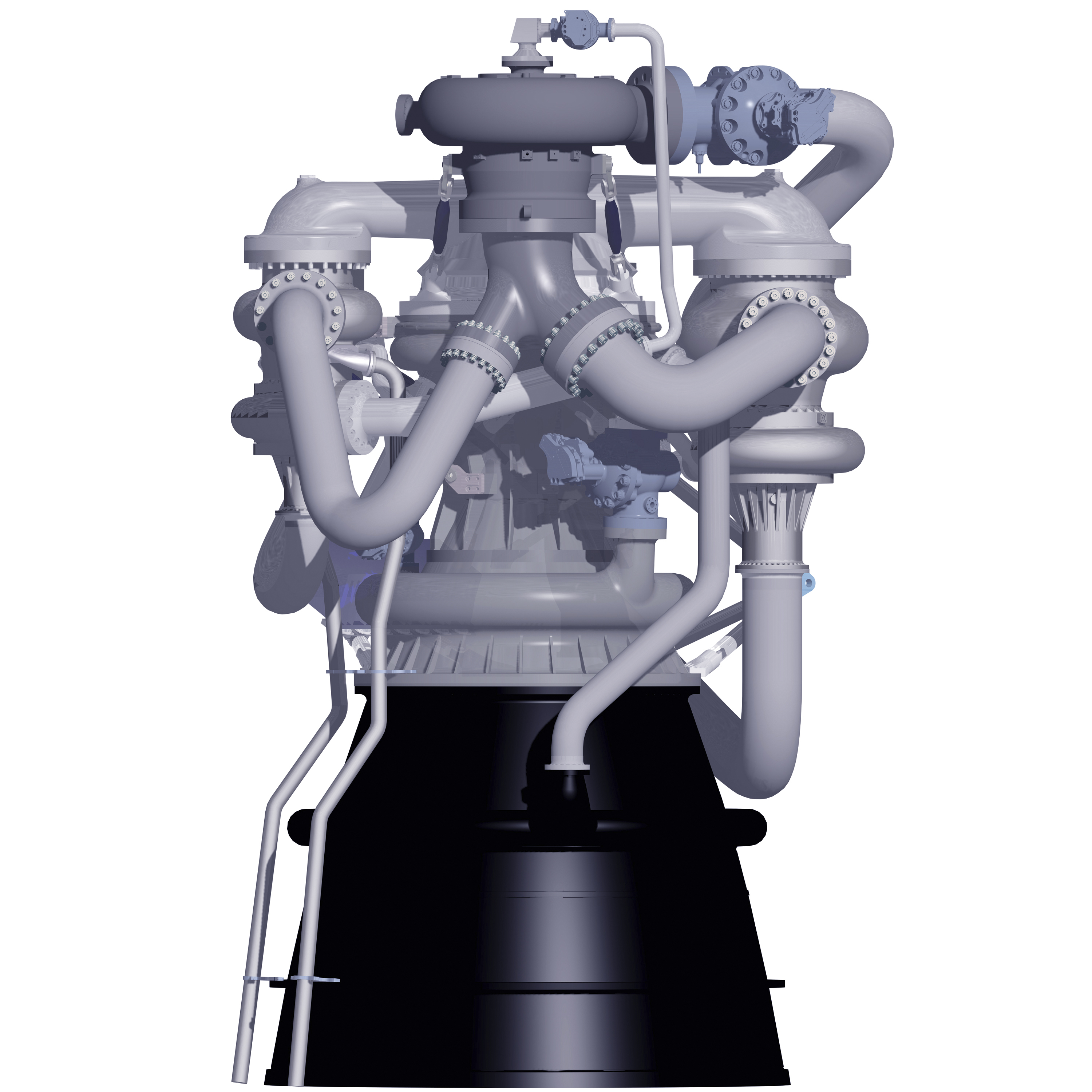
As part of the Space Launch Initiative, Rocketdyne developed a plan for the RS-84 rocket engine. It would have been the first reusable, staged combustion cycle, liquid rocket engine produced by the US to use a hydrocarbon fuel. In contrast, the Soviet Union developed the RD-170 reusable staged combustion hydrocarbon engine for the Energia rocket in the 1980s.
The prototype engine would have 4732 kN at sea level; 5026 kN in vacuum; an 8-shift turn time; a specific impulse of 305 at sea level and 324 in vacuum.
NASA cancelled further development in 2005.
TR-106 / TR-107 rocket engines
The TR-106 or Low Cost Pintle Engine (LCPE) was a developmental LH2/LOX rocket engine designed by TRW under the Space Launch Initiative. It had a planned sea-level thrust of 650,000 lbf. Development of the engine was temporarily discontinued with the cancellation of the Space Launch Initiative.
Since 2000, TRW has been acquired by Northrop Grumman and development of the TR-107 RP-1/LOX rocket engine began in 2001 for potential use on next-generation launch and space transportation vehicles is continuing under contract to NASA.
Technology lessons from the Low Cost Pintle Engine project assisted subcontractor development of engines by SpaceX. Tom Mueller was a lead engineer on the LCPE project, and later designed the Merlin engine for SpaceX.
Air Force Reusable Booster Program
The Air Force Reusable Booster System program initiated in 2010, and cancelled in 2012, was hoped to renew interest in further development of these engines.
References
References
- (April 2002). "Space Launch Initiative fact sheet". [[NASA]].
- [[S:NASA FACTS/The Next Generation Launch Technology Program. "The Next Generation Launch Technology Program"]] (wikisource). NASA, May 2003.
- (May 2003). "The Next Generation Launch Technology Program.". NASA.
- [https://web.archive.org/web/20160304035506/http://www.dtic.mil/get-tr-doc/pdf?AD=ADA471183 A Review of United States Air Force and Department of Defense Aerospace Propulsion Needs. 2006]
- (April 2003). "RS-84 Rocket Engine Overview". [[Rocketdyne]].
- (July 24, 2009). "RS-84 Next Generation Launch Technology (NGLT) Testing". NASA.
- {{rp. link. (2013-12-30)
- (Nov 2003). "Booster Engine Prototype Project". NASA.
- [http://www.as.northropgrumman.com/products/booster_vehicle_eng/index.html Northrop Grumman booster vehicle engines] {{webarchive. link. (2010-05-23)
- (September 2010). "Air Force studying reusable upper stage systems for reusable booster". RLV and Space Transport News.
This article was imported from Wikipedia and is available under the Creative Commons Attribution-ShareAlike 4.0 License. Content has been adapted to SurfDoc format. Original contributors can be found on the article history page.
Ask Mako anything about Space Launch Initiative — get instant answers, deeper analysis, and related topics.
Research with MakoFree with your Surf account
Create a free account to save articles, ask Mako questions, and organize your research.
Sign up freeThis content may have been generated or modified by AI. CloudSurf Software LLC is not responsible for the accuracy, completeness, or reliability of AI-generated content. Always verify important information from primary sources.
Report