From Surf Wiki (app.surf) — the open knowledge base
South Asia
Subregion of the Asian continent

Subregion of the Asian continent
| Field | Value | ||
|---|---|---|---|
| title | South Asia | ||
| image | South Asia (orthographic projection).svg | ||
| area | 5,222,321 km2 | ||
| population | 2.04 billion (2024) | ||
| density | 362.3 /km2 | ||
| GDP_nominal | $5.04 trillion (2024) | ||
| GDP_PPP | $18.05 trillion (2024) | ||
| GDP_per_capita | $2,650 (nominal) (2024) | ||
| $9,470 (PPP) (2024) | |||
| HDI | 0.672 (2022) (*medium*) | ||
| ethnic_groups | |||
| religions | * Hinduism (majority in India and Nepal) | ||
| demonym | |||
| countries | {{collapsible list | ||
| title | 7 countries | ||
| title | 1 often included | ||
| dependencies | {{Collapsible list | ||
| titlestyle | background:transparent;text-align:left;font-weight:normal; | ||
| title | External (1) | ||
| {{refn | group | note | Administered by the United Kingdom, claimed by Mauritius as the Chagos Archipelago.}} (United Kingdom) |
| languages | {{collapsible list | ||
| title | Official languages (national level) | ||
| title | Other official languages (provincial/regional level) | ||
| titlestyle | text-align:left;padding-right:4em;font-weight:normal;background-color:white; | ||
| bullets | true | ||
| time | {{collapsible list | ||
| title | 5 time zones | ||
| titlestyle | text-align:left;padding-right:4em;font-weight:normal;background-color:white; | ||
| bullets | true | ||
| internet | .af, .bd, .bt, .in, .io, .lk, .mv, .np, .pk | ||
| calling_code | Zone 8 & 9 | ||
| cities | |||
| title | 10 largest cities in South Asia | ||
| titlestyle | text-align:left;padding-right:4em;font-weight:normal;background-color:white; | ||
| m49 | `034` – Southern Asia | ||
| `142` – Asia | |||
| `001` – World |
the geographical subregion of Asia
$9,470 (PPP) (2024)
- Islam (majority in Pakistan, Bangladesh, Afghanistan and Maldives)
- Christianity
- Buddhism (majority in Sri Lanka and Bhutan)
- Sikhism
- Jainism
- Other: folk religion, Zoroastrianism, irreligion | | Bangladesh | Bhutan | India | Maldives | Nepal | Pakistan | Sri Lanka |Afghanistan | British Indian Ocean Territory (United Kingdom) | Bengali | Dari (Persian) | Urdu | Hindi | Pashto | Nepali | Dzongkha | Dhivehi | English | Sinhala | Tamil | Austroasiatic: | Khasi | Santali | Dravidian: | Malayalam | Kannada | Kurukh | Telugu | Indo-Iranian: | Assamese | Bhojpuri | Chhattisgarhi | Dogri | Gujarati | Kamtapuri | Kashmiri | Konkani | Kurmali | Maithili | Marathi | Odia | Punjabi | Rajbanshi | Sanskrit | Sindhi | Tibeto-Burman: | Bodo | Gurung | Limbu | Mizo | Meitei | Sikkimese | Tamang | Tibetan | Newari | Turkic: | Turkmen | Uzbek | UTC+04:30: | Afghanistan | UTC+05:00: | Maldives | Pakistan | UTC+05:30: | India | Sri Lanka | UTC+05:45: | Nepal | UTC+06:00: | Bangladesh | Bhutan |
- India Delhi
- India Mumbai
- Bangladesh Dhaka
- Pakistan Karachi
- India Kolkata
- Pakistan Lahore
- Afghanistan Kabul
- India Bangalore
- India Chennai
- India Hyderabad
142– Asia001– World
South Asia is the southern subregion of Asia that is defined in both geographical and ethnic-cultural terms. South Asia, with a population of 2.04 billion, contains a quarter (25%) of the world's population. As commonly conceptualised, the modern states of South Asia include Bangladesh, Bhutan, India, the Maldives, Nepal, Pakistan, and Sri Lanka, with Afghanistan also often included, which may otherwise be classified as part of Central Asia. South Asia borders East Asia to the northeast, Central Asia to the northwest, West Asia to the west and Southeast Asia to the east. Southeast Asia and Maritime South Asia are the only subregions of Asia that lie partly within the Southern Hemisphere. The British Indian Ocean Territory and two out of 26 atolls of the Maldives in South Asia lie entirely within the Southern Hemisphere. Topographically, it is dominated by the Indian subcontinent and is bounded by the Indian Ocean in the south, and the Himalayas, Karakoram, and Pamir Mountains in the north.
Settled life emerged on the Indian subcontinent in the western margins of the Indus River Basin 9,000 years ago, evolving gradually into the Indus Valley Civilisation of the third millennium BCE.
- .
- . By , an archaic form of Sanskrit, an Indo-European language, had diffused into India from the northwest,
- : "It is known from internal evidence that the Vedic texts were orally composed in northern India, at first in the Greater Punjab and later on also in more eastern areas, including northern Bihar, between ca. 1500 BCE and ca. 500–400 BCE. The oldest text, the Rgveda, must have been more or less contemporary with the Mitanni texts of northern Syria/Iraq (1450–1350 BCE); [...] The Vedic texts were orally composed and transmitted, without the use of script, in an unbroken line of transmission from teacher to student that was formalised early on. This ensured an impeccable textual transmission superior to the classical texts of other cultures; it is in fact something of a tape-recording of ca. 1500–500 BCE. Not just the actual words, but even the long-lost musical (tonal) accent (as in old Greek or in Japanese) has been preserved up to the present. [...] The RV text was composed before the introduction and massive use of iron, that is before ca. 1200–1000 BCE."
- : "A Chronology of Hinduism: ca. 1500–1000 BCE Rig Veda; ca. 1200–900 BCE Yajur Veda, Sama Veda and Atharva Veda [...] Hindu texts began with the Rig Veda ('Knowledge of Verses'), composed in northwest India around 1500 BCE; the first of the three Vedas, it is the earliest extant text composed in Sanskrit, the language of ancient India."
- : "In Punjab, a dry region with grasslands watered by five rivers (hence 'panch' and 'ab') draining the western Himalayas, one prehistoric culture left no material remains, but some of its ritual texts were preserved orally over the millennia. The culture is called Aryan, and evidence in its texts indicates that it spread slowly south-east, following the course of the Yamuna and Ganga Rivers. Its elite called itself Arya (pure) and distinguished themselves sharply from others. Aryans led kin groups organized as nomadic horse-herding tribes. Their ritual texts are called Vedas, composed in Sanskrit. Vedic Sanskrit is recorded only in hymns that were part of Vedic rituals to Aryan gods. To be Aryan apparently meant to belong to the elite among pastoral tribes. Texts that record Aryan culture are not precisely datable, but they seem to begin around 1200 BCE with four collections of Vedic hymns (Rg, Sama, Yajur, and Artharva)."
- : "Although the collapse of the Indus valley civilization is no longer believed to have been due to an 'Aryan invasion' it is widely thought that, at roughly the same time, or perhaps a few centuries later, new Indo-Aryan-speaking people and influences began to enter the subcontinent from the north-west. Detailed evidence is lacking. Nevertheless, a predecessor of the language that would eventually be called Sanskrit was probably introduced into the north-west sometime between 3,900 and 3,000 years ago. This language was related to one then spoken in eastern Iran; and both of these languages belonged to the Indo-European language family. [...] It seems likely that various small-scale migrations were involved in the gradual introduction of the predecessor language and associated cultural characteristics. However, there may not have been a tight relationship between movements of people on the one hand, and changes in language and culture on the other. Moreover, the process whereby a dynamic new force gradually arose—a people with a distinct ideology who eventually seem to have referred to themselves as 'Arya'—was certainly two-way. That is, it involved a blending of new features which came from outside with other features—probably including some surviving Harappan influences—that were already present. Anyhow, it would be quite a few centuries before Sanskrit was written down. And the hymns and stories of the Arya people—especially the Vedas and the later Mahabharata and Ramayana epics—are poor guides as to historical events. Of course, the emerging Arya were to have a huge impact on the history of the subcontinent. Nevertheless, little is known about their early presence."
- : "The expansion of Aryan culture is supposed to have begun around 1500 BCE. It should not be thought that this Aryan emergence (though it implies some migration) necessarily meant either a sudden invasion of new peoples, or a complete break with earlier traditions. It comprises a set of cultural ideas and practices, upheld by a Sanskrit-speaking elite, or Aryans. The features of this society are recorded in the Vedas." with the Dravidian languages being supplanted in the northern and western regions. By , stratification and exclusion by caste had emerged within Hinduism, and Buddhism and Jainism had arisen, proclaiming social orders unlinked to heredity.
In the early medieval era, Christianity, Islam, Judaism, and Zoroastrianism became established on South Asia's southern and western coasts.
- .
- .
- . Muslim armies from Central Asia intermittently overran the plains of northern India,
- .
- . eventually founding the Delhi Sultanate in the 13th century, and drawing the region into the cosmopolitan networks of medieval Islam.
- .
- . The Islamic Mughal Empire, in 1526, ushered in two centuries of relative peace, leaving a legacy of luminous architecture. Gradually expanding rule of the British East India Company followed, turning most of South Asia into a colonial economy, but also consolidating its sovereignty.
- .
- . British Crown rule began in 1858. The rights promised to Indians were granted slowly, but technological changes were introduced, and modern ideas of education and the public life took root. In 1947, the British Indian Empire was partitioned into two independent dominions, a Hindu-majority Dominion of India and a Muslim-majority Dominion of Pakistan, amid large-scale loss of life and an unprecedented migration.
- .
- . The 1971 Bangladesh Liberation War, a Cold War episode resulting in East Pakistan's secession, was the most recent instance of a new nation being formed in the region.
South Asia has a total area of 5.2 million km2 (2 million sq.mi), which is 10% of the Asian continent. The population of South Asia is estimated to be 2.04 billion or about one-fourth of the world's population, making it both the most populous and the most densely populated geographical region in the world.
In 2022, South Asia had the world's largest populations of Hindus, Muslims, Sikhs, Jains, and Zoroastrians. South Asia alone accounts for 90.47% of Hindus, 95.5% of Sikhs, and 31% of Muslims worldwide, as well as 35 million Christians and 25 million Buddhists.
The South Asian Association for Regional Cooperation (SAARC) is an economic cooperation organisation in the region which was established in 1985 and includes all of the South Asian nations.
Definition
{{Anchor|Northwestern boundary (Afghanistan and Pakistan)}}Ambiguity
The geographical extent is not clear cut as systemic and foreign policy orientations of its constituents are quite asymmetrical. Beyond the core territories of the Indian Empire (territories of the British Empire which were under the system of British Raj), there is a high degree of variation as to which other countries are included in South Asia. There is no clear boundary – geographical, geopolitical, socio-cultural, economical, or historical – between South Asia and other parts of Asia, especially Southeast Asia and West Asia. Most of this region is peninsular, resting on the Indian Plate and being isolated from the rest of Asia by mountain barriers; "Asia" Geology and Geography . The Columbia Electronic Encyclopedia, 6th ed. Columbia University Press, 2003: "Asia can be divided into six regions, each possessing distinctive physical, cultural, economic, and political characteristics... South Asia (Afghanistan and the nations of the Indian Peninsula) is isolated from the rest of Asia by great mountain barriers." it resembles a diamond which is delineated by the Himalayas on the north, the Hindu Kush in the west, and the Arakanese in the east, and which extends southward into the Indian Ocean with the Arabian Sea to the southwest and the Bay of Bengal to the southeast.
The common definition of South Asia is largely inherited from the administrative boundaries of the Indian Empire, with several exceptions. The current territories of Bangladesh, India, and Pakistan which were the core territories of the British Empire from 1857 to 1947 also form the core territories of South Asia. The mountain countries of Nepal and Bhutan, two independent countries that were not under the British Raj but were protectorates of the Empire, and the island countries of Sri Lanka and the Maldives are generally included. By various definitions based on substantially different reasons, the British Indian Ocean Territory and the Tibet Autonomous Region may be included as well. Myanmar (Burma), a former British colony and now largely considered a part of Southeast Asia, is also sometimes included. Afghanistan is also included by some sources.
Organisational definitions
United Nations Cartographic Centre Retrieved 18 June 2015 However, the United Nations does not endorse any definitions or area boundaries.]]
The South Asian Association for Regional Cooperation (SAARC), a contiguous block of countries, started in 1985 with seven countriesBangladesh, Bhutan, India, the Maldives, Nepal, Pakistan, and Sri Lankaand admitted Afghanistan as an eighth member in 2007. China and Myanmar have also applied for the status of full members of SAARC. The South Asia Free Trade Agreement admitted Afghanistan in 2011.
The World Bank and United Nations Children's Fund (UNICEF) recognises the eight SAARC countries as South Asia, while the Hirschman–Herfindahl index of the United Nations Economic and Social Commission for Asia and the Pacific for the region excludes Afghanistan from South Asia. Population Information Network (POPIN) excludes Maldives which is included as a member Pacific POPIN subregional network. The United Nations Statistics Division's scheme of subregions, for statistical purpose, includes Iran along with all eight members of the SAARC as part of Southern Asia.
Indian subcontinent
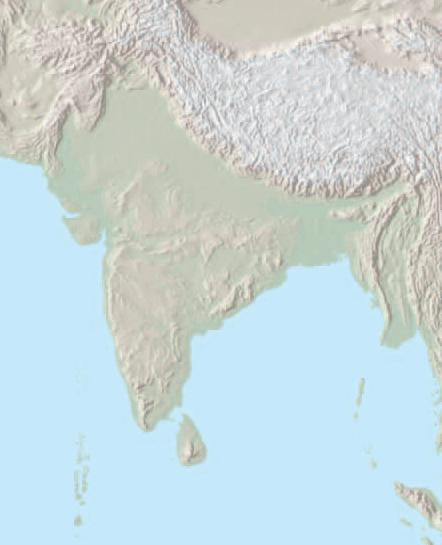
The terms "Indian subcontinent" and "South Asia" are sometimes used interchangeably. The Indian subcontinent is largely a geological term referring to the land mass that drifted northeastwards from ancient Gondwana, colliding with the Eurasian plate nearly 55 million years ago, towards the end of Palaeocene. This geological region largely includes Bangladesh, Bhutan, India, Maldives, Nepal, Pakistan, and Sri Lanka. Historians Catherine Asher and Cynthia Talbot state that the term "Indian subcontinent" describes a natural physical landmass in South Asia that has been relatively isolated from the rest of Eurasia.
The use of the term Indian subcontinent began in the British Empire, and has been a term particularly common in its successors. South Asia as the preferred term is particularly common when scholars or officials seek to differentiate this region from East Asia. According to historians Sugata Bose and Ayesha Jalal, the Indian subcontinent has come to be known as South Asia "in more recent and neutral parlance." This "neutral" notion refers to the concerns of Pakistan and Bangladesh, particularly given the recurring conflicts between India and Pakistan, wherein the dominant placement of "India" as a prefix before the subcontinent might offend some political sentiments. This region has also been labelled as "India" (in its classical and pre-modern sense) and "Greater India".
Asian context
According to Robert M. Cutler – a scholar of political science at Carleton University, the terms South Asia, Southwest Asia, and Central Asia are distinct, but the confusion and disagreements have arisen due to the geopolitical movement to enlarge these regions into Greater South Asia, Greater Southwest Asia, and Greater Central Asia. The frontier of Greater South Asia, states Cutler, between 2001 and 2006 has been geopolitically extended to eastern Iran and western Afghanistan in the west, and in the north to northeastern Iran, northern Afghanistan, and southern Uzbekistan.
Identification with a South Asian identity was found to be significantly low among respondents in an older two-year survey across Bangladesh, India, Nepal, Pakistan, and Sri Lanka.
History
Pre-history
The history of core South Asia begins with evidence of human activity of Homo sapiens, as long as 75,000 years ago, or with earlier hominids including Homo erectus from about 500,000 years ago. The earliest prehistoric culture have roots in the Mesolithic sites as evidenced by the rock paintings of Bhimbetka rock shelters dating to a period of 30,000 BCE or older, as well as Neolithic times.
Ancient era
The Indus Valley Civilisation, which spread and flourished in the northwestern part of South Asia from to 1300 BCE in present-day Pakistan, North India, and Afghanistan, was the first major civilisation in South Asia. A sophisticated and technologically advanced urban culture developed in the Mature Harappan period, from 2600 to 1900 BCE. According to anthropologist Possehl, the Indus Valley civilisation provides a logical, if somewhat arbitrary, starting point for South Asian religions, but these links from the Indus religion to later-day South Asian traditions are subject to scholarly dispute.
The Vedic period, named after the Vedic religion of the Indo-Aryans, lasted from to 500 BCE. The Indo-Aryans were Indo-European-speaking pastoralists who migrated into north-western India after the collapse of the Indus Valley Civilization. Linguistic and archaeological data show a cultural change after 1500 BCE, with the linguistic and religious data showing links with Indo-European languages and religion. By about 1200 BCE, the Vedic culture and agrarian lifestyle were established in the northwest and northern Gangetic plain of South Asia. Rudimentary state-forms appeared, of which the Kuru-Pañcāla union was the most influential. The first recorded state-level society in South Asia existed around 1000 BCE. The Brahmanas and Aranyakas, and the Upanishads into which they merged, began to ask the meaning of a ritual, adding increasing levels of philosophical and metaphysical speculation, or "Hindu synthesis".
Increasing urbanisation of South Asia between 800 and 400 BCE, and possibly the spread of urban diseases, contributed to the rise of ascetic movements and of new ideas which challenged the orthodox Brahmanism. These ideas led to Sramana movements, of which Mahavira (–477 BCE), proponent of Jainism, and Buddha (), founder of Buddhism, was the most prominent icons.
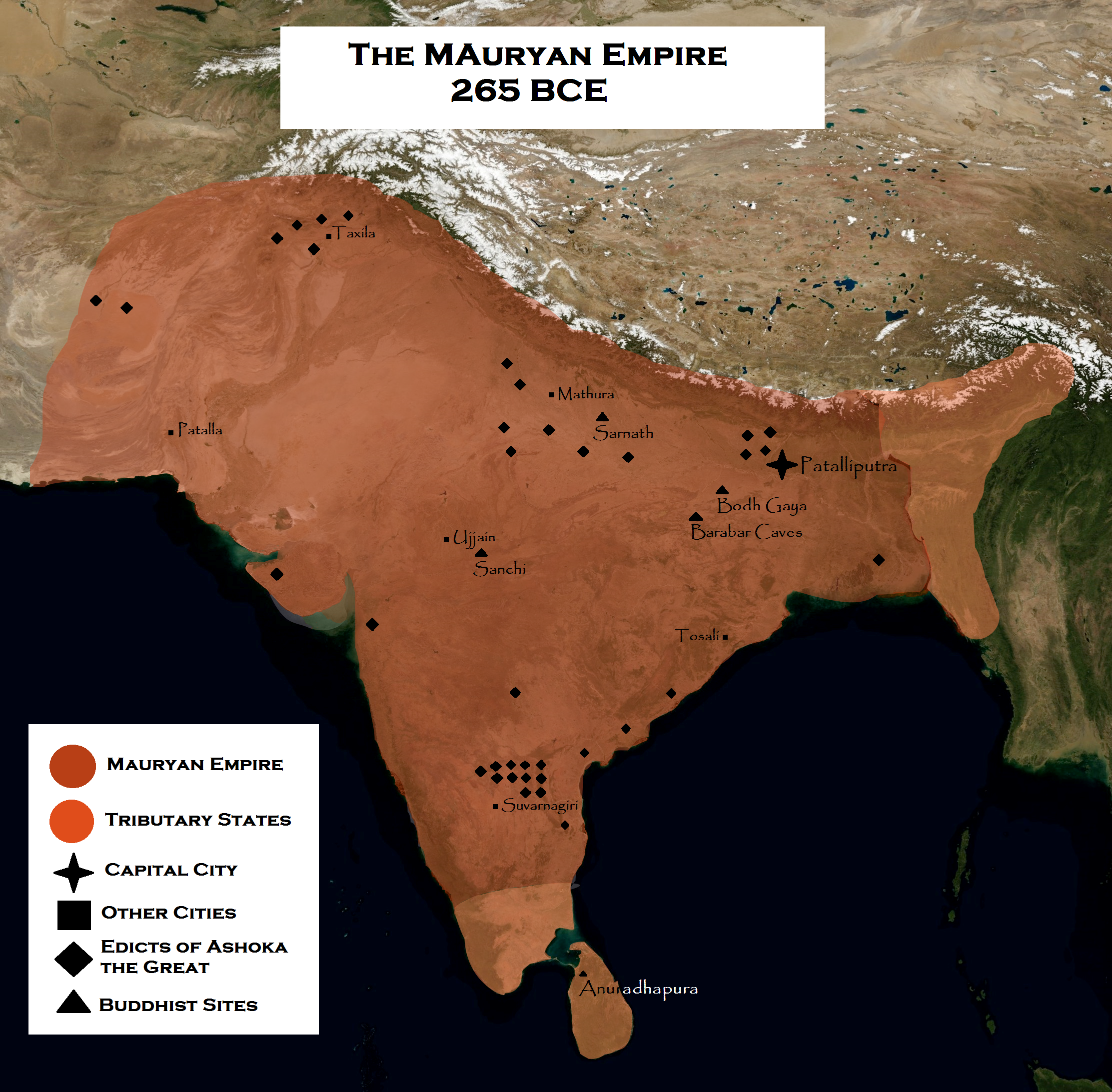
The Greek army led by Alexander the Great stayed in the Hindu Kush region of South Asia for several years and then later moved into the Indus valley region. Later, the Maurya Empire extended over much of South Asia in the 3rd century BCE. Buddhism spread beyond south Asia, through northwest into Central Asia. The Bamiyan Buddhas of Afghanistan and the edicts of Aśoka suggest that the Buddhist monks spread Buddhism (Dharma) in eastern provinces of the Seleucid Empire, and possibly even farther into West Asia. The Theravada school spread south from India in the 3rd century BCE, to Sri Lanka, later to Southeast Asia. Buddhism, by the last centuries of the 1st millennium BCE, was prominent in the Himalayan region, Gandhara, Hindu Kush region, and Bactria.
From about 500 BCE through about 300 CE, the Vedic-Brahmanic synthesis or "Hindu synthesis" continued. Classical Hindu and Sramanic (particularly Buddhist) ideas spread within South Asia, as well as outside South Asia. The Gupta Empire ruled over a large part of the region between the 4th and 7th centuries, a period that saw the construction of major temples, monasteries and universities such as the Nalanda. During this era, and through the 10th century, numerous cave monasteries and temples such as the Ajanta Caves, Badami cave temples, and Ellora Caves were built in South Asia.
Medieval era
Islam came as a political power in the fringe of South Asia in 8th century CE when the Arab general Muhammad bin Qasim conquered Sindh, and Multan in southern Punjab, in modern-day Pakistan. By 962 CE, Hindu and Buddhist kingdoms in South Asia were under a wave of raids from Muslim armies from Central Asia.See:
- ; see discussion of earliest raids in Gujarat Among them was Mahmud of Ghazni, who raided and plundered kingdoms in north India from east of the Indus river to west of Yamuna river seventeen times between 997 and 1030.
The wave of raids on north Indian and western Indian kingdoms by Muslim warlords continued after Mahmud of Ghazni, plundering and looting these kingdoms. The raids did not establish or extend permanent boundaries of their Islamic kingdoms. The Ghurid Sultan Mu'izz al-Din Muhammad began a systematic war of expansion into North India in 1173. He sought to carve out a principality for himself by expanding the Islamic world, and thus laid the foundation for the Muslim kingdom that became the Delhi Sultanate. Some historians chronicle the Delhi Sultanate from 1192 due to the presence and geographical claims of Mu'izz al-Din in South Asia by that time.
The Delhi Sultanate covered varying parts of South Asia and was ruled by a series of dynasties: Mamluk, Khalji, Tughlaq, Sayyid, and Lodi dynasties. Muhammad bin Tughlaq came to power in 1325, launched a war of expansion and the Delhi Sultanate reached it largest geographical reach over the South Asian region during his 26-year rule. A Sunni Sultan, Muhammad bin Tughlaq persecuted non-Muslims such as Hindus, as well as non-Sunni Muslims such as Shia and Mahdi sects.
Revolts against the Delhi Sultanate sprang up in many parts of South Asia during the 14th century. In the northeast, the Bengal Sultanate became independent in 1346 CE. It remained in power through the early 16th century. The state religion of the sultanate was Islam. In South India, the Hindu Vijayanagara Empire came to power in 1336 and persisted until the middle of the 16th century. It was ultimately defeated and destroyed by an alliance of the Muslim Deccan sultanates at the Battle of Talikota.
About 1526, the Punjab governor Dawlat Khan Lodī reached out to the Mughal Babur and invited him to attack the Delhi Sultanate. Babur defeated and killed Ibrahim Lodi in the Battle of Panipat in 1526. The death of Ibrahim Lodi ended the Delhi Sultanate, and the Mughal Empire replaced it. Lodi Dynasty Encyclopædia Britannica (2009)
Modern era
The modern history period of South Asia, that is the 16th century onwards, witnessed the establishment of the Mughal Empire, with Sunni Islam theology. The first ruler was Babur had Turco-Mongol roots and his realm included the northwestern and Indo-Gangetic Plain regions of South Asia. Several regions of South Asia were largely under Hindu kings such as those of the Vijayanagara Empire and the Kingdom of Mewar. Parts of modern Telangana and Andhra Pradesh were under local Muslim rulers, namely those of the Deccan sultanates.
The Mughal Empire continued its wars of expansion after Babur's death. With the fall of the Rajput kingdoms and Vijayanagara, its boundaries encompassed almost the entirety of the Indian subcontinent. The Mughal Empire was marked by a period of artistic exchanges and a Central Asian and South Asian architecture synthesis, with remarkable buildings such as the Taj Mahal.
However, this time also marked an extended period of religious persecution. Two of the religious leaders of Sikhism, Guru Arjan, and Guru Tegh Bahadur were arrested under orders of the Mughal emperors after their revolts and were executed when they refused to convert to Islam. Religious taxes on non-Muslims called jizya were imposed. Buddhist, Hindu, and Sikh temples were desecrated. However, not all Muslim rulers persecuted non-Muslims. Akbar, a Mughal ruler for example, sought religious tolerance and abolished jizya.
The death of Aurangzeb and the collapse of the Mughal Empire, which marks the beginning of modern India, in the early 18th century, provided opportunities for the Marathas, Sikhs, Mysoreans, and Nawabs of Bengal to exercise control over large regions of the Indian subcontinent. By the mid-18th century, India was a major proto-industrializing region.
Maritime trading between South Asia and European merchants began at the turn of the 16th century after the Portuguese discovery of the sea route to India. British, French, and Portuguese colonial interests struck treaties with these rulers and established their trading ports. In northwestern South Asia, a large region was consolidated into the Sikh Empire by Ranjit Singh. After the defeat of the Nawab of Bengal and Tipu Sultan and his French allies, British traders went on to dominate much of South Asia through divide-and-rule tactics by the early 19th century. The region experienced significant de-industrialisation in its first few decades of British rule. Control over the subcontinent was then transferred to the British government after the Indian Rebellion of 1857, with the British cracking down to some extent afterwards.
An increase of famines and extreme poverty characterised the colonial period, though railways built with British technology eventually provided crucial famine relief by increasing food distribution throughout India. Millions of South Asians began to migrate throughout the world, impelled by the economic/labour needs and opportunities presented by the British Empire. The introduction of Western political thought inspired a growing Indian intellectual movement, and so by the 20th century, British rule began to be challenged by the Indian National Congress, which sought full independence under the leadership of Mahatma Gandhi.
Britain, under pressure from Indian freedom fighters, increasingly gave self-rule to British India. By the 1940s, two rival camps had emerged among independence activists: those who favored a separate nation for Indian Muslims, and those who wanted a united India. As World War II raged, over 2 million Indians fought for Britain; by the end of the war, Britain was greatly weakened, and thus decided to grant independence to the vast majority of South Asians in 1947, though this coincided with the Partition of India into a Hindu-majority India and a Muslim-majority Pakistan, which resulted in significant displacement and violence and harder religious divides in the region.
Contemporary era
In 1947, the newly independent India and Pakistan had to decide how to deal with the hundreds of princely states that controlled much of the subcontinent, as well as what to do with the remaining European (non-British) colonies. A combination of referendums, military action, and negotiated accessions took place in rapid succession, leading to the political integration of the vast majority of India and Pakistan within a few years.[[File:India and Pakistan November 1971.png|thumb|182x182px|South Asia on the eve of the de jure commencement of the [[Indo-Pakistani war of 1971|1971 Indo-Pakistani war]], which concluded with [[East Pakistan]] becoming the independent nation of [[Bangladesh]].]] India and Pakistan clashed several times in the decades after Independence, with disputes over Kashmir playing a significant role. In 1971, the eastern half of Pakistan seceded with help from India and became the People's Republic of Bangladesh after the traumatic Bangladesh Liberation War. This, along with India and Pakistan gaining nuclear weapons soon afterwards, increased tensions between the two countries. The Cold War decades also contributed to the divide, as Pakistan aligned with the West and India with the Soviet Union; other factors include the time period after the 1962 Sino-Indian War, which saw India and China move apart while Pakistan and China built closer relations.
Pakistan has been beset with terrorism, economic issues, and military dominance of its government since Independence, with none of its Prime Ministers having completed a full 5-year term in office. India has grown significantly, having slashed its rate of extreme poverty to below 20% and surpassed Pakistan's GDP per capita in the 2010s due to economic liberalisation from the 1980s onward. Bangladesh, having struggled greatly for decades due to conflict with and economic exploitation by Pakistan, is now one of the fastest-growing countries in the region, beating India in terms of GDP per capita. Afghanistan has gone through several invasions and Islamist regimes, with many of its refugees having gone to Pakistan and other parts of South Asia and bringing back cultural influences such as cricket. Religious nationalism has grown across the region, with persecution causing millions of Hindus and Christians to flee Pakistan and Bangladesh, and Hindu nationalism having grown in India with the election of the Bharatiya Janata Party in 2014.
A recent phenomenon has been that of India and China fighting on their border, as well as vying for dominance of South Asia, with China partnering with Pakistan and using its superior economy to attract countries surrounding India, while America and other countries have strengthened ties with India to counter China in the broader Indo-Pacific. (See also: 2025 India–Pakistan standoff)
Geography
According to Saul Cohen, early colonial era strategists treated South Asia with East Asia, but in reality, the South Asia region excluding Afghanistan is a distinct geopolitical region separated from other nearby geostrategic realms, one that is geographically diverse. The region is home to a variety of geographical features, such as glaciers, rainforests, valleys, deserts, and grasslands that are typical of much larger continents. It is surrounded by three water bodiesthe Bay of Bengal, the Indian Ocean and the Arabian Seaand has acutely varied climate zones. The tip of the Indian Peninsula had the highest quality pearls.
Indian Plate
Main article: Indian Plate
Most of this region is resting on the Indian Plate, the northerly portion of the Indo-Australian Plate, separated from the rest of the Eurasian Plate. The Indian Plate includes most of South Asia, forming a land mass which extends from the Himalayas into a portion of the basin under the Indian Ocean, including parts of South China and Eastern Indonesia, as well as Kunlun and Karakoram ranges, and extending up to but not including Ladakh, Kohistan, the Hindu Kush range, and Balochistan. It may be noted that geophysically the Yarlung Tsangpo River in Tibet is situated at the outside the border of the regional structure, while the Pamir Mountains in Tajikistan are situated inside that border.
The Indian subcontinent formerly formed part of the supercontinent Gondwana, before rifting away during the Cretaceous period and colliding with the Eurasian Plate about 50–55 million years ago and giving birth to the Himalayan range and the Tibetan Plateau. It is the peninsular region south of the Himalayas and Kuen Lun mountain ranges and east of the Indus River and the Iranian Plateau, extending southward into the Indian Ocean between the Arabian Sea (to the southwest) and the Bay of Bengal (to the southeast).
Climate

The climate of this vast region varies considerably from area to area from tropical monsoon in the south to temperate in the north. The variety is influenced by not only the altitude but also by factors such as proximity to the seacoast and the seasonal impact of the monsoons. Southern parts are mostly hot in summers and receive rain during monsoon periods. The northern belt of Indo-Gangetic plains also is hot in summer, but cooler in winter. The mountainous north is colder and receives snowfall at higher altitudes of Himalayan ranges.
As the Himalayas block the north-Asian bitter cold winds, the temperatures are considerably moderate in the plains down below. For the most part, the climate of the region is called the monsoon climate, which keeps the region humid during summer and dry during winter, and favours the cultivation of jute, tea, rice, and various vegetables in this region.
South Asia is largely divided into four broad climate zones:
- The northern Indian edge and northern Pakistani uplands have a dry subtropical continental climate
- The far south of India and southwest Sri Lanka have an equatorial climate
- Most of the peninsula has a tropical climate with variations:
- Hot subtropical climate in northwest India
- Cool winter hot tropical climate in Bangladesh
- Tropical semi-arid climate in the center
- The Himalayas and most of the Hindu Kush have an Alpine climate
Maximum relative humidity of over 80% has been recorded in Khasi and Jaintia Hills and Sri Lanka, while the area adjustment to Pakistan and western India records lower than 20%–30%. Climate of South Asia is largely characterised by monsoons. South Asia depends critically on monsoon rainfall. Two monsoon systems exist in the region:
- The summer monsoon: Wind blows from the southwest to most parts of the region. It accounts for 70%–90% of the annual precipitation.
- The winter monsoon: Wind blows from the northeast. Dominant in Sri Lanka and Maldives.
The warmest period of the year precedes the monsoon season (March to mid June). In the summer the low pressures are centered over the Indus-Gangetic Plain and high wind from the Indian Ocean blows towards the center. The monsoons are the second coolest season of the year because of high humidity and cloud covering. But, at the beginning of June, the jetstreams vanish above the Tibetan Plateau, low pressure over the Indus Valley deepens and the Intertropical Convergence Zone (ITCZ) moves in. The change is violent. Moderately vigorous monsoon depressions form in the Bay of Bengal and make landfall from June to September.
Climate change
Main article: Climate change in Asia

South Asian countries are expected to experience more flooding in the future as the monsoon pattern intensifies. Across Asia as a whole, 100-year extremes in vapour transport (directly related to extreme precipitation) would become 2.6 times more frequent under 1.5 C-change of global warming, yet 3.9 and 7.5 times more frequent under 2 C-change and 3 C-change. In parts of South Asia, they could become up to 15 times more frequent. At the same time, up to two-thirds of glacier ice in the Hindu Kush region may melt by 2100 under high warming, and these glaciers feed the water basin of over 220 million people. As glacier meltwater flow diminishes after 2050, Hydropower generation would become less predictable and reliable, while agriculture would become more reliant on the intensified monsoon than ever before. Around 2050, people living in the Ganges and Indus river basins (where up to 60% of non-monsoon irrigation comes from the glaciers) may be faced with severe water scarcity due to both climate and socioeconomic reasons.
By 2030, major Indian cities such as Mumbai, Kolkata, Cuttack, and Kochi are expected to end up with much of their territory below the tide level. In Mumbai alone, failing to adapt to this would result in damages of US$112–162 billion by 2050, which would nearly triple by 2070. Sea level rise in Bangladesh will displace 0.9–2.1 million people by 2050 and may force the relocation of up to one third of power plants by 2030. Food security will become more uneven, and some South Asian countries could experience significant social impacts from global food price volatility. Infectious diarrhoea mortality and dengue fever incidence is also likely to increase across South Asia. Parts of South Asia would also reach "critical health thresholds" for heat stress under all but the lowest-emission climate change scenarios. Under the high-emission scenario, 40 million people (nearly 2% of the South Asian population) may be driven to internal migration by 2050 due to climate change.
India is estimated to have the world's highest social cost of carbon - meaning that it experiences the greatest impact from greenhouse gas emissions. Other estimates describe Bangladesh as the country most likely to be the worst-affected. In the 2017 edition of Germanwatch's Climate Risk Index, Bangladesh and Pakistan ranked sixth and seventh respectively as the countries most affected by climate change in the period from 1996 to 2015, while India ranked fourth among the list of countries most affected by climate change in 2015. Some research suggests that South Asia as a whole would lose 2% of its GDP to climate change by 2050, while these losses would approach 9% by the end of the century under the most intense climate change scenario.
Regions
Main article: Regions of South Asia
Northern South Asia
Ethnolinguistically, Northern South Asia is predominantly Indo-Aryan, along with Iranic populations in Afghanistan and Balochistan, and diverse linguistic communities near the Himalayas. Its borders have been heavily contested (primarily between India and its neighbours Pakistan and China, as well as separatist movements in Northeast India.) This tension in the region has contributed to difficulties in sharing river waters among Northern South Asian countries; climate change is projected to exacerbate the issue. Dominated by the Indo-Gangetic Plain, the region is home to about half a billion people and is the poorest South Asian subregion.
Northwestern South Asia
Northwestern South Asia is the site of many of the first civilisations of the world, such as the Indus Valley Civilisation. It was historically the most-conquered region of South Asia because it is the first region that invading armies coming from the west had to cross to enter the Indian subcontinent; because of these many invasions, Northwestern South Asia has significant influences from various sources outside of South Asia, mainly from the Muslim world.
Eastern South Asia
Eastern South Asia includes Bangladesh (East Bengal), Bhutan, eastern and northeastern parts of India, and Nepal. Major Hindu and Buddhist kingdoms and empires of the region include Kikata, Videha, Vṛji, Magadha, Nanda, Gangaridai, Mauryan, Anga, Kalinga, Kamarupa, Samatata, Kanva, Gupta, Pala, Gauda, Sena, Khadga, Candra, and Deva. Geographically, it lies between the Eastern Himalayas and the Bay of Bengal. Two of the world's largest rivers, the Ganges and the Brahmaputra, flow into the sea through the Bengal region. The region includes the world's largest delta, the Ganges Delta, and has a climate ranging from alpine and subalpine to subtropical and tropical. Since Nepal, Bhutan, Northeast India and parts of East India are landlocked, the coastlines of Bangladesh and East India (in West Bengal and Odisha) serve as the principal gateways to the region. With more than 441 million inhabitants, Eastern South Asia is home to 6%of the world's population and 25% of South Asia's population.
Central-West Coastal South Asia
Central South Asia
Southern South Asia
Southern South Asia includes South India, the Maldives, and Sri Lanka, and is predominantly Dravidian. Southern South Asia was a hub of global trade in ancient times because of its position in the important Indian Ocean corridor.
Historically, governments throughout Southern South Asia adopted Sanskrit for public political expression beginning around 300 CE and ending around 1300, resulting in greater integration into the broader South Asian cultural sphere. This significantly influenced the languages of the region, making all of the major Dravidian languages except for Tamil highly Sanskritised. Tamil influence in the region is quite significant, with prominent empires such as the Chola dynasty taking Tamil culture to Sri Lanka and beyond South Asia, and Sri Lanka having an ancient Tamil minority and a Dravidian-influenced majority language of Sinhala.
Land and water area
This list includes dependent territories within their sovereign states (including uninhabited territories), but does not include claims on Antarctica. EEZ+TIA is exclusive economic zone (EEZ) plus total internal area (TIA) which includes land and internal waters.
| Country | Area in km2 | EEZ | Shelf | EEZ+TIA | **Total** | **5,221,093** | **4,137,476** | **587,808** | **9,300,997** | ||||
|---|---|---|---|---|---|---|---|---|---|---|---|---|---|
| 652,864 | 0 | 0 | 652,864 | ||||||||||
| 148,460 | 86,392 | 66,438 | 230,390 | ||||||||||
| 38,394 | 0 | 0 | 38,394 | ||||||||||
| 3,287,263 | 2,305,143 | 402,996 | 5,592,406 | ||||||||||
| 147,181 | 0 | 0 | 147,181 | ||||||||||
| 298 | 923,322 | 34,538 | 923,622 | ||||||||||
| 881,913 | 290,000 | 51,383 | 1,117,911 | ||||||||||
| 65,610 | 532,619 | 32,453 | 598,229 |
Society
Population
The population of South Asia is about 1.938 billion which makes it the most populated region in the world. United Nations, Department of Economic and Social Affairs, Population Division (2014). World Urbanization Prospects: The 2014 Revision, custom data acquired via website. http://esa.un.org/unpd/wpp/Excel-Data/population.htm It is socially very mixed, consisting of many language groups and religions, and social practices in one region that are vastly different from those in another.
| Country | Population in thousands | % of South Asia | % of world | Density (per km2) | Population growth rate | Population projection (in thousands) | 2005–10 | 2010–15 | 2015–20 | 1950 | 1975 | 2000 | 2025 | 2050 | 2075 | 2100 | South Asia | **1,938,407** | **100%** | 24.094% | **377.5** | - | - | - | 476,220 | 800,335 | 1,390,946 | 1,974,898 | 2,376,939 | 2,488,455 | 2,353,676 |
|---|---|---|---|---|---|---|---|---|---|---|---|---|---|---|---|---|---|---|---|---|---|---|---|---|---|---|---|---|---|---|---|
| 42,240 | 2.17% | 0.525% | 61.8 | 2.78 | 3.16 | 2.41 | 7,752 | 12,689 | 20,779 | 44,516 | 74,075 | 98,732 | 110,855 | ||||||||||||||||||
| 172,954 | 8.92% | 2.15% | 1301 | 1.18 | 1.16 | 1.04 | 37,895 | 70,066 | 127,658 | 170,937 | 203,905 | 201,891 | 176,366 | ||||||||||||||||||
| 787 | 0.04% | 0.00978% | 20.3 | 2.05 | 1.58 | 1.18 | 177 | 348 | 591 | 797 | 874 | 803 | 654 | ||||||||||||||||||
| 1,428,628 | 73.7% | 17.5% | 473.4 | 1.46 | 1.23 | 1.10 | 376,325 | 623,103 | 1,056,576 | 1,454,607 | 1,670,491 | 1,676,035 | 1,529,850 | ||||||||||||||||||
| 521 | 0.03% | 0.00647% | 1738.2 | 2.68 | 2.76 | 1.85 | 74 | 136 | 279 | 515 | 570 | 543 | 469 | ||||||||||||||||||
| 30,897 | 1.59% | 0.384% | 204.1 | 1.05 | 1.17 | 1.09 | 8,483 | 13,420 | 23,941 | 31,577 | 37,401 | 38,189 | 33,770 | ||||||||||||||||||
| 240,486 | 12.4% | 2.98% | 300.2 | 2.05 | 2.09 | 1.91 | 37,542 | 66,817 | 142,344 | 249,949 | 367,808 | 453,262 | 487,017 | ||||||||||||||||||
| 21,894 | 1.13% | 0.272% | 347.2 | 0.68 | 0.50 | 0.35 | 7,971 | 13,755 | 18,778 | 22,000 | 21,815 | 19,000 | 14,695 | ||||||||||||||||||
| Population of South Asian countries in 1950, 1975, 2000, 2025, 2050, 2075 and 2100 projection from the United Nations has been displayed in table. The given population projections are based on medium fertility index. With India and Bangladesh approaching replacement rates fast, population growth in South Asia is facing steep decline and may turn negative in mid 21st century. |
Languages
Main article: Languages of South Asia}}{{See also, Hindustani-speaking world
File:States of South Asia by language.png|thumb|400px|A clickable map of the official language or lingua franca spoken in each state/province of South Asia excluding the Maldives. Indo-Aryan languages are in green, Iranic languages in dark green, Dravidian languages in purple, Tibeto-Burman languages in red, and Turkic languages in orange.
rect 30 70 355 230 w:Provinces of Afghanistan#UN Regions rect 10 130 430 305 w:Pashtunistan rect 185 435 330 585 w:Sindh rect 215 590 450 695 w:Gujarat rect 90 320 275 500 w:Balochistan, Pakistan rect 375 270 515 430 w:Punjab rect 445 255 670 565 w:Hindi belt rect 320 480 900 720 w:Hindi belt rect 430 50 710 255 w:Kashmir rect 980 345 1075 510 w:Bhutan rect 670 380 920 500 w:Nepal rect 900 540 1070 685 w:Bengal rect 985 360 1250 640 w:Northeast India rect 550 805 740 1070 w:Telugu states rect 410 690 660 845 w:Maharashtra rect 760 660 980 850 w:Odisha rect 460 830 550 1100 w:Karnataka rect 430 1100 550 1380 w:Kerala rect 550 1070 655 1160 w:Tamil Nadu rect 660 1140 760 1220 w:Sri Lankan Tamils rect 650 1220 780 1520 w:Sinhalese people There are numerous languages in South Asia. The spoken languages of the region are largely based on geography and shared across religious boundaries, but the written script is sharply divided by religious boundaries. In particular, Muslims of South Asia such as in Afghanistan and Pakistan use the Arabic alphabet and Persian Nastaliq. Till 1952, Muslim-majority Bangladesh (then known as East Pakistan) also mandated only the Nastaliq script, but after that adopted regional scripts and particularly Bengali, after the Language Movement for the adoption of Bengali as the official language of the then East Pakistan. Non-Muslims of South Asia, and some Muslims in India, on the other hand, use scripts such as those derived from Brahmi script for Indo-European languages and non-Brahmi scripts for Dravidian languages and others.
The Nagari script has been the primus inter pares of the traditional South Asian scripts. The Devanagari script is used for over 120 South Asian languages, including Hindi, Marathi, Nepali, Pali, Konkani, Bodo, Sindhi, and Maithili among other languages and dialects, making it one of the most used and adopted writing systems in the world. The Devanagari script is also used for classical Sanskrit texts.
The largest spoken language in this region is Hindustani language, followed by Bengali, Telugu, Tamil, Marathi, Gujarati, Kannada, and Punjabi. In the modern era, new syncretic languages developed in the region such as Urdu that are used by the Muslim community of northern South Asia (particularly Pakistan and northern states of India). Shamsur Rahman Faruqi (2008), Urdu Literary Culture: The Syncretic Tradition , Shibli Academy, Azamgarh The Punjabi language spans three religions: Islam, Hinduism, and Sikhism. The spoken language is similar, but it is written in three scripts. The Sikh use Gurmukhi alphabet, Muslim Punjabis in Pakistan use the Nastaliq script, while Hindu Punjabis in India use the Gurmukhi or Nāgarī script. The Gurmukhi and Nāgarī scripts are distinct but close in their structure, but the Persian Nastaliq script is very different.
Sino-Tibetan languages are spoken across northern belts of the region in the Himalayan areas, often using the Tibetan script. These languages are predominantly spoken in Bhutan and Nepal as well as parts of Burma and northern India in the state of Sikkim and the Ladakh region. The national language of Bhutan is Dzongkha, while Lepcha, Limbu, Gurung, Magar, Rai, Newari, Tamang, Tshangla, Thakali, and Sikkimese are also spoken in Bhutan, Nepal and Sikkim, and Ladakhi is spoken in Ladakh. Both Buddhism and Bon are often predominant in areas where these languages are present. Some areas in Gilgit-Baltistan also speak Balti language, however speakers write with the Urdu script. The Tibetan script fell out of use in Pakistani Baltistan hundreds of years ago upon the region's adoption of Islam.
English, with British spelling, is commonly used in urban areas and is a major economic lingua franca of South Asia (see also South Asian English).
Religions
Main article: Religion in South Asia
In 2010, South Asia had the world's largest population of Hindus, about 510 million Muslims, over 27 million Sikhs, 35 million Christians and over 25 million Buddhists. Hindus make up about 68 per cent or about 900 million and Muslims at 31 per cent or 510 million of the overall South Asia population, while Buddhists, Jains, Christians, and Sikhs constitute most of the rest. The Hindus, Buddhists, Jains, Sikhs, and Christians are concentrated in India, Nepal, Sri Lanka, and Bhutan, while the Muslims are concentrated in Afghanistan (99%), Bangladesh (90%), Pakistan (96%), and Maldives (100%). With all major religions practised in the subcontinent, South Asia is known for its religious diversity and one of the most religiously diverse regions on earth.
Indian religions are the religions that originated in the Indian subcontinent; namely Hinduism, Jainism, Buddhism, and Sikhism. The Indian religions are distinct yet share terminology, concepts, goals and ideas, and from South Asia spread into East Asia and southeast Asia. Early Christianity and Islam were introduced into coastal regions of South Asia by merchants who settled among the local populations. Later Sindh, Balochistan, and parts of the Punjab region saw conquest by the Arab caliphates along with an influx of Muslims from Persia and Central Asia, which resulted in spread of both Shia and Sunni Islam in parts of northwestern region of South Asia. Subsequently, under the influence of Muslim rulers of the Islamic sultanates and the Mughal Empire, Islam spread in South Asia. About one-third of the world's Muslims are from South Asia.
| Country | State religion | Religious population as a percentage of total population | Buddhism | Christianity | Hinduism | Islam | Kiratism | Sikhism | Others | Year reported | ||||||
|---|---|---|---|---|---|---|---|---|---|---|---|---|---|---|---|---|
| Religion in | Islam | – | – | – | 99.7% | – | – | 0.3% | url=https://www.cia.gov/the-world-factbook/countries/afghanistan/ | title=CIA The World Factbook – Afghanistan | publisher=CIA | access-date=27 March 2012 }} | ||||
| Religion in | Islam | 0.6% | 0.4% | 9.5% | 90.4% | – | – | – | url=https://2009-2017.state.gov/documents/organization/256513.pdf | script-title=bn:জানুন | language=bn | trans-title=Bangladesh | publisher=US department of States | access-date=16 October 2019 }} | ||
| Religion in | Vajrayana Buddhism | 74.8% | 0.5% | 22.6% | 0.1% | – | – | 2% | url=https://www.cia.gov/the-world-factbook/countries/bhutan/ | title=CIA The World Factbook | publisher=CIA | access-date=27 March 2012 }} | ||||
| Religion in | Secular | 0.7% | 2.3% | 79.8% | 14.2% | – | 1.7% | 1.3% | url=http://www.censusindia.gov.in/2011census/C-01/DDW00C-01%20MDDS.XLS | title=C −1 Population by religious community – 2011 | publisher=Office of the Registrar General & Census Commissioner | access-date=25 August 2015 | url-status=dead | archive-url=https://web.archive.org/web/20150825155850/http://www.censusindia.gov.in/2011census/C-01/DDW00C-01%20MDDS.XLS | archive-date=25 August 2015}} | |
| Religion in the | Islam | – | – | – | 100% | – | – | – | url=http://www.themaldives.com/Maldives/Maldives_Religion.htm | title=religion | publisher=Maldives | access-date=23 August 2010 | archive-url=https://web.archive.org/web/20070928220750/http://www.themaldives.com/Maldives/Maldives_Religion.htm | archive-date=28 September 2007 | url-status=live }} | |
| Religion in | Secular | 8.21% | 1.76% | 81.2% | 5.09% | 3.17% | – | 0.57% | 2021 | |||||||
| Religion in | Islam | – | 1.59% | 1.85% | 96.28% | – | – | 0.07% | 2010 | |||||||
| Religion in | Theravada Buddhism | 70.2% | 6.2% | 12.6% | 9.7% | – | – | 1.4% | title=Census of Population and Housing 2011 | url=http://www.statistics.gov.lk/PopHouSat/CPH2011/index.php?fileName=SriLanka&gp=Activities&tpl=3 | publisher=Department of Census and Statistic | access-date=16 October 2019 | archive-date=6 January 2020 | archive-url=https://web.archive.org/web/20200106095548/http://www.statistics.gov.lk/PopHouSat/CPH2011/index.php?fileName=SriLanka&gp=Activities&tpl=3 | url-status=dead }} |
Largest urban areas
South Asia is home to some of the most populated urban areas in the world. According to the 2023 edition of Demographia World Urban Areas, the region contains 8 of the world's 35 megacities (urban areas over 10 million population):
| Rank | Urban Area | State/Province | Country | Skyline | Population | Area (km2) | Density (/km2) | ||||
|---|---|---|---|---|---|---|---|---|---|---|---|
| 1 | Delhi | National Capital Region | [[File:Skyline of Cannaught Place, New Delhi.jpg | center | 100x100px]] | 31,190,000 | 2,344 | 13,307 | |||
| 2 | Mumbai | Maharashtra | [[File:R16f3ncq53gc1.jpg | center | 100x100px]] | 25,189,000 | 1,046 | 24,073 | |||
| 3 | Kolkata | West Bengal | 21,747,000 | 1,352 | 16,085 | ||||||
| 4 | Karachi | Sindh | [[File:Sadar Neighborhood Karachi.jpg | center | 100x100px]] | 20,249,000 | 1,124 | 18,014 | |||
| 5 | Dhaka | Dhaka Division | [[File:Dhaka Skyline at Night.jpg | center | 100x100px]] | 19,134,000 | 619 | 30,911 | |||
| 6 | Bangalore | Karnataka | [[File:Ubcity2.jpg | center | 100x100px]] | 15,257,000 | 1,743 | 8,753 | |||
| 7 | Lahore | Punjab | [[File:Eye Of Lahore (Minar e Pakistan) evening.jpg | center | 100x100px]] | 13,504,000 | 945 | 14,285 | |||
| 8 | Chennai | Tamil Nadu | [[File:Chennai skyline.JPG | center | 100x100px]] | 11,570,000 | 1,225 | 9,444 | |||
| 9 | Hyderabad | Telangana | [[File:High Rise buildings in Madhapur from Golkonda hill.jpg | center | 100x100px]] | 9,797,000 | 1,689 | 5,802 | |||
| 10 | Ahmedabad | Gujarat | [[File:SG Highway Skyline.jpg | center | 100x100px]] | 8,006,000 | 505 | 15,852 |
Migration
Ancient migrations into South Asia shaped the region's unique demographics, and later migrations often corresponded with conquest, as with the British diaspora in India.
Contemporary immigration to South Asian countries often takes a uniquely regional form; for example, most migrants in India are from other South Asian countries, and 97% of Bangladeshi migrants in India live in the Bangladesh-bordering regions of India (East India and Northeast India).
Diaspora
Culture
Main article: Culture of South Asia
Sports
Main article: Sport in South Asia, South Asian physical culture
Field hockey has been the official national sport of many South Asian nations, additionally these countries collectively claim the majority of medals in field hockey at the Summer Olympics. However, cricket is the most popular sport in South Asia, with 90% of the sport's worldwide fans being in the Indian subcontinent. There are also traditional games, such as kabaddi and kho-kho, which are played across the region and officially at the South Asian Games and Asian Games; the leagues created for these traditional sports (such as Pro Kabaddi League and Ultimate Kho Kho) are some of the most-watched sports competitions in the region.
Cinema
Music
Main article: Music of South Asia
Cuisine
Main article: South Asian cuisine
Economy
Main article: Economy of South Asia


India is the largest economy in the region (US$4.18 trillion) and makes up almost 82% of the South Asian economy; it is the world's 4th largest in nominal terms and the world's 3rd largest by purchasing power adjusted exchange rates (US$17.64 trillion). India is the member of G-20 major economies and BRICS from the region. It is the fastest-growing major economy in the world and one of the world's fastest registering a growth of 7.2% in FY 2022–23.
India is followed by Bangladesh, which has a GDP of ($446 billion). It has the fastest GDP growth rate in Asia. It is one of the emerging and growth-leading economies of the world, and is also listed among the Next Eleven countries. It is also one of the fastest-growing middle-income countries. It has the world's 33rd largest GDP in nominal terms and is the 25th largest by purchasing power adjusted exchange rates ($1.476 trillion). Bangladesh's economic growth was 6.4% in 2022. The next one is Pakistan, which has an economy of ($340 billion). Next is Sri Lanka, which has the 2nd highest GDP per capita and the 4th largest economy in the region. According to a World Bank report in 2015, driven by a strong expansion in India, coupled with favourable oil prices, from the last quarter of 2014 South Asia became the fastest-growing region in the world.
While in East Asia, regional trade accounts for 50% of total trade, it accounts for only a little more than 5% in South Asia. Certain parts of South Asia are significantly wealthier than others; the four Indian states of Maharashtra, Tamil Nadu, Gujarat, and Karnataka are projected to account for almost 50% of India's GDP by 2030, while the five South Indian states comprising 20% of India's population are expected to contribute 35% of India's GDP by 2030.
| Country | |||||||||||||||||||
|---|---|---|---|---|---|---|---|---|---|---|---|---|---|---|---|---|---|---|---|
| GDP | Inflation | HDI | Nominal GDP | ||||||||||||||||
| (million US$) (2025) | GDP per capita (2025) | GDP (PPP) | |||||||||||||||||
| (in millions) (2025) | GDP (PPP) per capita (2025) | GDP growth (2025) | HDI (Rank) (2025) | Inequality-adjusted HDI (Rank) (2025) | **South Asia** | ** 5,200,404 (100%)** | **$2,632** | **$21,727,230 (100%)** | **$11,045** | **-** | **-** | 0.672 (*medium*) | - | ||||||
| 17,152 (2023) | *$409 (2023)* | *$72,512 (2022) (0.33)* | *$2,093 (2022)* | *2.3% (2023)* | *5.6% (2020)* | 0.496 (181nd) (*low*) | 0.321 (156th) (*low*) | ||||||||||||
| 467,218 | $2,689 | $1,783,420 (8.20%) | $10,265 | 3.9% | 8.48% | 0.685 (130th) (*medium*) | 0.482 (113th) (*low*) | ||||||||||||
| 3,422 | $4,302 | $14,106 (0.06%) | $17,735 | 8.5% | 3.8% | 0.698 (125th) (*medium*) | 0.478 (115th) (*low*) | ||||||||||||
| 4,187,017 | $2,878 | $17,647,050 (81.22%) | $12,132 | 6.5% | 2.10% | 0.685 (130th) (*medium*) | 0.475 (120th) (*low*) | ||||||||||||
| 7,480 | $18,207 | $15,030 (0.07%) | $36,585 | 4.5% | 4.6% | 0.766 (93rd) (*high*) | 0.602 (88th) (*medium*) | ||||||||||||
| 46,080 | $1,458 | $180,640 (0.83%) | $6,140 | 4.5% | 5.0% | 0.622 (145th) (*medium*) | 0.437(126st) (*low*) | ||||||||||||
| 373,072 (2024) | $1,484 (2024) | $1,671,868 (7.69%) | $6,951 | 2.7% | 7.5% | 0.544 (168th) (*low*) | 0.364(138th) (*low*) | ||||||||||||
| 98,963 (2024) | $4,325 (2024) | $342,604 (2024) (1.57%) | $14,455 (2023) | 3.5% | -0.7% | 0.776 (89th) (*high*) | 0.630 (80th) (*medium*) |
Poverty
According to the World Bank's 2011 report, based on 2005 ICP PPP, about 24.6% of the South Asian population was below the international poverty line of $1.25/day. Bhutan, Maldives and Sri Lanka had the lowest number of people below the poverty line, with 2.4%, 1.5% and 4.1% respectively.
According to the 2023 MPI (multidimensional poverty index) report by the UN, around 20% of South Asians are poor.
51.7% of Afghanistan's population was under the MPI poverty threshold in 2019, while 24.1% of Bangladesh's population was under the threshold in 2021. India lifted 415 million people from MPI-poverty from 2005/06 to 2019/21; 16.4% of India's population was MPI-poor in 2019/2021, compared to 55.1% in 2005/2006. 10% of India's population was under the international poverty line of $2.15/day in 2021.
| Country | ||||||||||||||
|---|---|---|---|---|---|---|---|---|---|---|---|---|---|---|
| Population below poverty line (at $1.9/day) | Global Hunger Index (2021) | Population under-nourished (2015) | Life expectancy (2023) (global rank) | Global wealth report (2019) | title=Poverty headcount ratio at national poverty lines (% of population) Data | url=http://data.worldbank.org/indicator/SI.POV.NAHC?locations=CO&view=map&year_high_desc=true | access-date=26 August 2017 | website=World Bank}} (year) | 2022 Multidimensional Poverty Index Report (MPI source year) | Population in Extreme poverty (2022) | CIA Factbook (2015) | Total national wealth in billion USD (global rank) | Wealth per adult in USD | Median wealth per adult in USD (global rank) |
| **** | 54.5% (2016) | 55.91% (2015–16) | 18% | 36% | 28.3 (103rd) | 26.8% | 66.03 (178th) | 25 (116th) | 1,463 | 640 (156th) | ||||
| **** | 24.3% (2016) | 24.64% (2019) | 4% | 31.5% | 19.1 (76th) | 16.4% | 74.67 (105th) | 697 (44th) | 6,643 | 2,787 (117th) | ||||
| **** | 8.2% (2017) | 37.34% (2010) | 4% | 12% | No data | No data | 72.97 (120th) | No Data | No Data | No Data | ||||
| **** | 21.9% (2011) | 16.4% (2019–21) | 3% | 29.8% | 27.5 (101st) | 15.2% | 72.00 (131st) | 12,614 (7th) | 14,569 | 3,042 (115th) | ||||
| **** | 8.2% (2016) | 0.77% (2016–17) | 4% | 16% | No data | 5.2% | 81.04 (43rd) | 7 (142nd) | 23,297 | 8,555 (74th) | ||||
| **** | 25.2% (2010) | 17.50% (2019) | 8% | 25.2% | 19.1 (76th) | 7.8% | 70.35 (146th) | 68 (94th) | 3,870 | 1,510 (136th) | ||||
| **** | 24.3% (2015) | 38.33% (2017–18) | 5% | 12.4% | 24.7 (94th) | 22% | 67.65 (164th) | 465 (49th) | 4,096 | 1,766 (128th) | ||||
| **** | 4.1% (2016) | 2.92% (2016) | 5% | 8.9% | 16 (65th) | 22% | 77.48 (73rd) | 297 (60th) | 20,628 | 8,283 (77th) |
Stock exchanges
The major stock exchanges in the region are National Stock Exchange (NSE) of India with market capitalisation of $5.70 trillion (5th largest in the world), Bombay Stock Exchange (BSE) of India with market capitalisation of $5.30 trillion (7th largest in the world), Dhaka Stock Exchange (DSE) of Bangladesh, Colombo Stock Exchange (CSE) of Sri Lanka, and Pakistan Stock Exchange (PSX) with market capitalisation of $72 billion. Economic data is sourced from the International Monetary Fund, current as of April 2017, and is given in US dollars.
Education


One of the key challenges in assessing the quality of education in South Asia is the vast range of contextual difference across the region, complicating any attempt to compare between countries. In 2018, 11.3 million children at the primary level and 20.6 million children at the lower secondary level were out-of-school in South Asia, while millions of children completed primary education without mastering the foundational skills of basic numeracy and literacy.
According to UNESCO, 241 million children between six and fourteen years or 81 per cent of the total were not learning in Southern and Central Asia in 2017. Only sub-Saharan Africa had a higher rate of children not learning. Two-thirds of these children were in school, sitting in classrooms. Only 19% of children attending primary and lower secondary schools attain a minimum proficiency level in reading and mathematics. According to a citizen-led assessment, only 48% in Indian public schools and 46% of children in Pakistan public schools could read a class two level text by the time they reached class five. This poor quality of education in turn has contributed to some of the highest drop-out rates in the world, while over half of the students complete secondary school with acquiring requisite skills.
In South Asia, classrooms are teacher-centred and rote-based, while children are often subjected to corporal punishment and discrimination.
The larger and poorer countries in the region, like India and Bangladesh, struggle financially to get sufficient resources to sustain an education system required for their vast populations, with an added challenge of getting large numbers of out-of-school children enrolled into schools. Their capacity to deliver inclusive and equitable quality education is limited by low levels of public finance for education, while the smaller emerging middle-income countries like Sri Lanka, Maldives, and Bhutan have been able to achieve universal primary school completion, and are in a better position to focus on quality of education.
Children's education in the region is also adversely affected by natural and human-made crises including natural hazards, political instability, rising extremism and civil strife that makes it difficult to deliver educational services. Afghanistan and India are among the top ten countries with the highest number of reported disasters due to natural hazards and conflict. The precarious security situation in Afghanistan is a big barrier in rolling out education programmes on a national scale.
According to UNICEF, girls face incredible hurdles to pursue their education in the region, Between 1900 and 2005, most of the countries in the region had shown progress in girls' education with Sri Lanka and the Maldives significantly ahead of the others, while the gender gap in education has widened in Pakistan and Afghanistan. Bangladesh made the greatest progress in the region in the period increasing girls' secondary school enrolment from 13 per cent to 56 per cent in ten years.
With about 21 million students in 700 universities and 40 thousand colleges India had one of the largest higher education systems in the world in 2011, accounting for 86 per cent of all higher-level students in South Asia. Bangladesh (two million) and Pakistan (1.8 million) stood at distant second and third positions in the region. In Nepal (390 thousand) and Sri Lanka (230 thousand) the numbers were much smaller. Bhutan with only one university and Maldives with none hardly had between them about 7000 students in higher education in 2011. The gross enrolment ratio in 2011 ranged from about 10 per cent in Pakistan and Afghanistan to above 20 per cent in India, much below the global average of 31 per cent.
| Parameters | Afghanistan | Bangladesh | Bhutan | India | Maldives | Nepal | Pakistan | Sri Lanka | |||||||
|---|---|---|---|---|---|---|---|---|---|---|---|---|---|---|---|
| Primary School Enrollment | 29% | ||||||||||||||
| Secondary School Enrollment | 49% |
Health and nutrition
According to World Health Organization (WHO), South Asia is home to two out of the three countries in the world still affected by polio, Pakistan and Afghanistan, with 306 & 28 polio cases registered in 2014 respectively. Attempts to eradicate polio have been badly hit by opposition from militants in both countries, who say the program is cover to spy on their operations. Their attacks on immunisation teams have claimed 78 lives since December 2012.
The World Bank estimates that India is one of the highest ranking countries in the world for the number of children suffering from malnutrition. The prevalence of underweight children in India is among the highest in the world and is nearly double that of sub-Saharan Africa with dire consequences for mobility, mortality, productivity, and economic growth.

According to the World Bank, 64% of South Asians lived in rural areas in 2022. In 2008, about 75% of South Asia's poor lived in rural areas and most relied on agriculture for their livelihood according to the UN's Food and Agricultural Organisation.
In 2021, approximately 330 million people in the region were malnourished. A 2015 report says that Nepal reached both the WFS target as well as MDG and is moving towards bringing down the number of undernourished people to less than 5% of the population. Bangladesh reached the MDG target with the National Food Policy frameworkwith only 16.5% of the population undernourished. In India, the malnourished comprise just over 15 per cent of the population. While the number of malnourished people in the neighbourhood has shown a decline over the last 25 years, the number of under-nourished in Pakistan displays an upward trend. There were 28.7 million hungry in Pakistan in the 1990sa number that has steadily increased to 41.3 million in 2015 with 22% of the population malnourished. Approximately 194.6 million people are undernourished in India, which accounts for the highest number of people suffering from hunger in any single country.
The 2006 report stated, "the low status of women in South Asian countries and their lack of nutritional knowledge are important determinants of high prevalence of underweight children in the region." Corruption and the lack of initiative on the part of the government has been one of the major problems associated with nutrition in India. Illiteracy in villages has been found to be one of the major issues that need more government attention. The report mentioned that although there has been a reduction in malnutrition due to the Green Revolution in South Asia, there is concern that South Asia has "inadequate feeding and caring practices for young children."
Governance and politics
Systems of government
| Country | Capital | Form of government | Head of state | Head of government | Legislature | Official language | Currency | Coat of arms / National Emblems | ||
|---|---|---|---|---|---|---|---|---|---|---|
| Kabul | Unitary totalitarian theocratic Islamic emirate | Supreme Leader | Prime Minister | None | Pashto | |||||
| Dari | **؋** Afghani | [[File:Arms of the Islamic Emirate of Afghanistan.svg | 50x50px | link=Emblem of Afghanistan]] | ||||||
| Dhaka | Unitary parliamentary constitutional republic | President | Prime Minister | Jatiya Sangsad | Bengali | |||||
| English | **৳** Taka | [[File:Coat of arms of Bangladesh.svg | 50x50px | link=Coat of arms of Bangladesh]] | ||||||
| Thimphu | Unitary parliamentary constitutional monarchy | King | Prime Minister | National Council | ||||||
| National Assembly | Dzongkha | **Nu.** Ngultrum | [[File:Emblem of Bhutan.svg | 50x50px | link=Emblem of Bhutan]] | |||||
| New Delhi | Federal parliamentary constitutional republic | President | Prime Minister | Rajya Sabha | ||||||
| Lok Sabha | Hindi | |||||||||
| English | **₹** Indian rupee | [[File:Emblem of India.svg | 85x85px | link=Emblem of India]] | ||||||
| Malé | Unitary presidential constitutional republic | President | People's Majlis | Maldivian | **ރ** Rufiyaa | [[File:Emblem of Maldives.svg | 56x56px | link=Emblem of Maldives]] | ||
| Kathmandu | Federal parliamentary constitutional republic | President | Prime Minister | National Assembly | ||||||
| House of Representatives | Nepali | **रु** Nepalese rupee | [[File:Emblem of Nepal.svg | 57x57px | link=Emblem of Nepal]] | |||||
| Islamabad | Federal parliamentary Islamic republic | President | Prime Minister | Senate | ||||||
| National Assembly | Urdu | |||||||||
| English | **₨** Pakistani rupee | [[File:State emblem of Pakistan.svg | 57x57px | link=State emblem of Pakistan]] | ||||||
| Sri Jayawardenepura Kotte | Unitary semi-presidential constitutional republic | President | Prime Minister | Parliament | Sinhala | |||||
| Tamil | ||||||||||
| English | **රු/₨** Sri Lankan rupee | [[File:Emblem of Sri Lanka.svg | 71x71px | link=Emblem of Sri Lanka]] |
India is a secular federative parliamentary republic with the prime minister as head of government. With the most populous functional democracy in world and the world's longest written constitution, India has been stably sustaining the political system it adopted in 1950 with no regime change except that by a democratic election. India's sustained democratic freedoms are unique among the world's newer establishments. Since the formation of its republic abolishing British law, it has remained a democracy with civil liberties, an active Supreme Court, and a largely independent press. India leads region in Democracy Index. It has a multi-party system in its internal regional politics whereas alternative transfer of powers to alliances of Indian left-wing and right-wing political parties in national government provide it with characteristics of a two-party state. India has been facing notable internal religious conflicts and separatism however consistently becoming more and more stable with time.
The foundation of Pakistan lies in the Pakistan movement which began in colonial India based on Islamic nationalism. Pakistan is a federal parliamentary Islamic republic and was the world's first country to adopt Islamic republic system to modify its republican status under its otherwise secular constitution in 1956. Pakistan's governance is one of the most conflicted in the world. The military rule and the unstable governments in Pakistan have become a concern for the South Asian region. Out of 22 appointed Pakistani Prime ministers, none of them have ever been able to complete a full term in office. The nature of Pakistani politics can be characterised as a multi-party system.
The unitary semi-presidential constitutional republic of Sri Lanka is the oldest sustained democracy in Asia. Tensions between the Sinhalese and the Tamils led to the emergence of the Liberation Tigers of Tamil Eelam, a separatist Sri Lankan Tamil militant group and the outbreak of the Sri Lankan Civil War. The war, which ended in 2009, would undermine the country's stability for more than two and a half decades. Sri Lanka, however, has been leading the region in HDI with per capita GDP well ahead of India, Pakistan, and Bangladesh. Sri Lanka has a multi-party system, and the political situation in Sri Lanka has been dominated by an increasingly assertive ideology of Sinhalese nationalism.
Bangladesh is a unitary parliamentary republic. The law of Bangladesh defines it as Islamic as well as secular. The nature of Bangladeshi politics can be characterised as a multi-party system. Bangladesh is a unitary state and parliamentary democracy. Bangladesh also stands out as one of the few Muslim-majority democracies. "It is a moderate and generally secular and tolerant — though sometimes this is getting stretched at the moment — alternative to violent extremism in a very troubled part of the world", said Dan Mozena, the US ambassador to Bangladesh. Although Bangladesh's legal code is secular, more citizens are embracing a conservative version of Islam, with some pushing for sharia law, analysts say. Experts say that the rise in conservatism reflects the influence of foreign-financed Islamic charities and the more austere version of Islam brought home by migrant workers in Persian Gulf countries.
By the 18th century, the Hindu Gorkha Kingdom achieved the unification of Nepal. Hinduism became the state religion and Hindu laws were formulated as national policies. A small oligarchic group of Gorkha region based Hindu Thakuri and Chhetri political families dominated the national politics, military and civic affairs until the abdication of the Rana dynasty regime and establishment of Parliamentary democratic system in 1951, which was twice suspended by Nepalese monarchs, in 1960 and 2005. It was the last Hindu state in world before becoming a secular democratic republic in 2008. The country's modern development suffered due to the various significant events like the 1990 Nepalese revolution, 1996–2006 Nepalese Civil War, April 2015 Nepal earthquake, and the 2015 Nepal blockade by India leading to the grave 2015–2017 Nepal humanitarian crisis. There is also a huge turnover in the office of the Prime Minister of Nepal leading to serious concerns of political instability. The country has been ranked one of the poor countries in terms of GDP per capita but it has one of the lowest levels of hunger problem in South Asia. When the stability of the country ensured as late as recent, it has also made considerable progress in development indicators outpacing many other South Asian states.
Afghanistan has been a unitary theocratic Islamic emirate since 2021. Afghanistan has been suffering from one of the most unstable regimes on earth as a result of multiple foreign invasions, civil wars, revolutions and terrorist groups. Persisting instability for decades have left the country's economy stagnated and torn and it remains one of the most poor and least developed countries on the planet, leading to the influx of Afghan refugees to neighbouring countries like Iran.
Bhutan is a Buddhist state with a constitutional monarchy. The country has been ranked as the least corrupt and most peaceful country in the region, with the most economic freedom, in 2016.
Maldives is a unitary presidential republic with Sunni Islam strictly as the state religion.
| Parameters | Afghanistan | Bangladesh | Bhutan | India | Maldives | Nepal | Pakistan | Sri Lanka | |||||||
|---|---|---|---|---|---|---|---|---|---|---|---|---|---|---|---|
| Fragile States Index | 102.9 | ||||||||||||||
| Corruption Perceptions Index (2019) (Global rank out of 179 countries) | 16 (173rd) | ||||||||||||||
| The Worldwide Governance | |||||||||||||||
| Indicators (2015) | Government Effectiveness | ||||||||||||||
| Political stability and absence | |||||||||||||||
| of violence/terrorism | 1% | ||||||||||||||
| Rule of law | 2% | ||||||||||||||
| Voice and accountability | 16% |
Regional politics

India has been the dominant geopolitical power in the region and alone accounts for most part of the landmass, population, economy and military expenditure in the region. India is a major economy, member of G4, has world's third highest military budget and exerts strong cultural and political influence over the region. Sometimes referred as a great power or emerging superpower primarily attributed to its large and expanding economic and military abilities, India acts as fulcrum of South Asia.
Bangladesh, Pakistan, and Sri Lanka are middle powers with sizeable populations and economies with significant impact on regional politics.

During the Partition of India in 1947, subsequent violence and territorial disputes left relations between India and Pakistan sour and very hostile and various confrontations and wars which largely shaped the politics of the region and contributed to the emergence of Bangladesh as an independent country. With Yugoslavia, India founded the Non-Aligned Movement but later entered an agreement with the former Soviet Union following Western support for Pakistan. Amid the Indo-Pakistani War of 1971, US sent its USS Enterprise to the Indian Ocean in what was perceived as a nuclear threat by India. India's nuclear test in 1974 pushed Pakistan's nuclear program who conducted nuclear tests in Chagai-I in 1998, just 18 days after India's series of nuclear tests for thermonuclear weapons.
The Soviet invasion of Afghanistan in 1979 accelerated efforts to form a union to restrengthen deteriorating regional security. After agreements, the union, known as the South Asian Association for Regional Cooperation (SAARC), was finally established in Dhaka in December 1985. However, deterioration of India-Pakistan ties have led India to emphasise more on sub-regional groups SASEC, BIMSTEC, and BBIN.
Populism is a general characteristic of internal politics of India.
Regional groups of countries
| Name | Area | ||||||
|---|---|---|---|---|---|---|---|
| (km2) | Population | Population density | |||||
| (per km2) | Capital or Secretariat | Currency | Countries | Official language | |||
| Core definition of South Asia | 5,220,460 | 1,726,907,000 | 330.79 | Bangladesh, Bhutan, India, Maldives, Nepal, Pakistan, Sri Lanka | |||
| UNSD definition of Southern Asia | 6,778,083 | 1,702,000,000 | 270.77 | Afghanistan, Bangladesh, Bhutan, India, Iran, Maldives, Nepal, Pakistan, Sri Lanka | |||
| SAARC | 4,637,469 | 1,626,000,000 | 350.6 | Kathmandu | Afghanistan, Bangladesh, Bhutan, India, Maldives, Nepal, Pakistan, Sri Lanka | English | |
| SASEC | 3,565,467 | 1,485,909,931 | 416.75 | Bangladesh, Bhutan, India, Maldives, Myanmar, Nepal, Sri Lanka | |||
| BBIN | 3,499,559 | 1,465,236,000 | 418.69 | Bangladesh, Bhutan, India, Nepal |
Notes
References
Citations
Sources
References
- "GDP, Current Prices, Purchasing Power Parity; Billions of International Bollars, Billions of U.S. Dollars". International Monetary Fund.
- "GDP, current prices".
- "GDP per capita, current prices".
- (6 May 2025). "Human Development Report 2025". [[United Nations Development Programme]].
- "South Asia".
- (11 March 2002). "The Changing Geography of Asia". Routledge.
- Lowe, John J.. (2015). "Participles in Rigvedic Sanskrit: The syntax and semantics of adjectival verb forms". [[Oxford University Press]].
- {{harvnb. Dyson. 2018
- {{harvnb. Dyson. 2018
- {{harvnb. Fisher. 2018
- {{harvnb. Asher. Talbot. 2006
- {{harvnb. Fisher. 2018
- Taylor, Miles. (2016). "Crowns and Colonies: European Monarchies and Overseas Empires". [[Manchester University Press]].
- (1988). "Sources of Indian Tradition: Modern India and Pakistan". [[Columbia University Press]].
- {{harvnb. Fisher. 2018
- (2013). "Routledge Handbook of the South Asian Diaspora". Routledge.
- (2009). "The Partition of India". Cambridge University Press.
- Khan, Yasmin. (2017). "The Great Partition: The Making of India and Pakistan". Yale University Press.
- "How the Cold War Shaped Bangladesh's Liberation War".
- "[http://www.bookrags.com/research/indian-subcontinent-ema-03/ Indian Subcontinent] {{webarchive. link. (21 January 2012" ''Encyclopedia of Modern Asia'' Macmillan Reference USA (Gale Group), 2006: "The area is divided between five major nation-states, Bangladesh, India, Nepal, Pakistan, and Sri Lanka, and includes as well the two small nations of Bhutan and the Maldives Republic... The total area can be estimated at 4.4 million square kilometres or exactly 10 percent of the land surface of Asia.")
- "South Asia Regional Overview".
- (2012). "Religion population totals in 2010 by Country".
- (27 January 2011). "Region: Asia-Pacific".
- "Standard Country or Area Codes for Statistical Use". United Nations.
- Ghosh, Partha Sarathy. (1989). "Cooperation and Conflict in South Asia". Technical Publications.
- Bertram Hughes Farmer, ''An Introduction to South Asia'', pages 1, Routledge, 1993, {{ISBN. 0-415-05695-0
- Razzaque, Jona. (2004). "Public Interest Environmental Litigation in India, Pakistan, and Bangladesh". Kluwer Law International.
- Mann, Michael. (2014). "South Asia's Modern History: Thematic Perspectives". Taylor & Francis.
- (2013). "An Atlas of Middle Eastern Affairs". Routledge.
- Dallen J. Timothy and Gyan P. Nyaupane, ''Cultural Heritage and Tourism in the Developing World: A Regional Perspective'', page 127, Routledge, 2009, {{ISBN. 978-1-134-00228-3
- [http://www.britannica.com/EBchecked/topic/38479/Asia "Asia" > Geologic history – Tectonic framework] {{webarchive. link. (1 May 2011. ''Encyclopædia Britannica''. Encyclopædia Britannica Online, 2009: "The paleotectonic evolution of Asia terminated some 50 million years ago as a result of the collision of the Indian Plate with Eurasia. Asia's subsequent neotectonic development has largely disrupted the continent's preexisting fabric. The first-order neotectonic units of Asia are Stable Asia, the Arabian and Indian cratons, the Alpide plate boundary zone (along which the Arabian and Indian platforms have collided with the Eurasian continental plate), and the island arcs and marginal basins.")
- (2002). "The Changing Geography of Asia". Taylor & Francis.
- (2002). "The History of India". Greenwood Press.
- Navnita Chadha Behera, ''International Relations in South Asia: Search for an Alternative Paradigm'', page 129, SAGE Publications India, 2008, {{ISBN. 978-81-7829-870-2
- "The World Bank".
- "Institute of Development Studies: Afghanistan".
- Saul Bernard Cohen. (2008). "Geopolitics: The Geography of International Relations". Rowman & Littlefield Publishers.
- (2002). "The History of India". Greenwood Press.
- (1936). "A Constitutional History of India: 1600–1935". Methuen & Co.
- N. D. Arora, ''Political Science for Civil Services Main Examination'', page 42:1, Tata McGraw-Hill Education, 2010, 9780070090941
- Stephen Adolphe Wurm, Peter Mühlhäusler & Darrell T. Tryon, ''Atlas of languages of intercultural communication in the Pacific, Asia, and the Americas'', pages 787, International Council for Philosophy and Humanistic Studies, Published by Walter de Gruyter, 1996, {{ISBN. 3-11-013417-9
- [http://www.answers.com/topic/south-asia#Columbia_Encyclopedia_d_ans "Indian subcontinent" > Geology and Geography] {{webarchive. link. (20 February 2012.)
- Haggett, Peter. (2001). "Encyclopedia of World Geography (Vol. 1)". Marshall Cavendish.
- [http://www.janes.com/articles/Janes-Sentinel-Security-Assessment-South-Asia/Territories-British-Indian-Ocean-Territory.html Territories (British Indian Ocean Territory)], Jane's Information Group
- Robbins, Keith. (2012). "Transforming the World: Global Political History since World War II". Palgrave Macmillan.
- Sarkar, Sudeshna. (16 May 2007). "SAARC: Afghanistan comes in from the cold". Swiss Federal Institute of Technology, Zürich.
- "South Asian Organisation for Regional Cooperation (official website)". SAARC Secretariat, Kathmandu, Nepal..
- Chatterjee Aneek, ''International Relations Today: Concepts and Applications'', page 166, Pearson Education India, {{ISBN. 978-81-317-3375-2
- (2 December 2014). "SAARC Membership: India blocks China's entry for the time being". The Economic Times.
- link. (12 July 2020, SAARC)
- [http://web.worldbank.org/WBSITE/EXTERNAL/COUNTRIES/SOUTHASIAEXT/0,,pagePK:158889~piPK:146815~theSitePK:223547,00.html South Asia: Data, Projects and Research] {{webarchive. link. (14 April 2008, The World Bank)
- "SAFTA Protocol".
- "South Asia".
- "UNICEF ROSA".
- [http://www.unescap.org/tid/projects/agrnego_sama.pdf Mapping and Analysis of Agricultural Trade Liberalization in South Asia] {{webarchive. link. (19 March 2009, Trade and Investment Division (TID), United Nations Economic and Social Commission for Asia and the Pacific)
- [https://www.un.org/Depts/escap/pop/bulletin/v07n2ft1.htm Asia-Pacific POPIN Consultative Workshop Report] {{webarchive. link. (25 October 2012, Asia-Pacific POPIN Bulletin, Vol. 7, No. 2 (1995), pages 7–11)
- [http://millenniumindicators.un.org/unsd/methods/m49/m49regin.htm#asia Geographical region and composition] {{webarchive. link. (13 July 2011, Composition of macro geographical (continental) regions, geographical sub-regions, and selected economic and other groupings, United Nations)
- New Oxford Dictionary of English]]'' ({{ISBN. 0-19-860441-6) New York: Oxford University Press, 2001; p. 929: "the part of Asia south of the Himalayas which forms a peninsula extending into the Indian Ocean, between the Arabian Sea and the Bay of Bengal. Historically forming the whole territory of greater India, the region is now divided between India, Pakistan, and Bangladesh."
- ''The Columbia Electronic Encyclopedia'', 6th ed. Columbia University Press, 2003: "region, S central Asia, comprising the countries of Pakistan, India, and Bangladesh and the Himalayan states of Nepal, and Bhutan. Sri Lanka, an island off the southeastern tip of the Indian peninsula, is often considered a part of the subcontinent."
- Robert Wynn Jones. (2011). "Applications of Palaeontology: Techniques and Case Studies". Cambridge University Press.
- (16 March 2006). "India Before Europe". Cambridge University Press.
- (2005). "Worldwide Destinations: The Geography of Travel and Tourism". Butterworth-Heinemann.
- Ronald B. Inden, ''Imagining India'', page 51, C. Hurst & Co. Publishers, 2000, {{ISBN. 1-85065-520-0, Quote:"It is very common today in academic and official circles to speak of the Indian subcontinent as 'South Asia', thereby distinguishing it from an 'East Asia'."
- (2004). "Modern South Asia". Routledge.
- (2011). "International Relations Theory and South Asia: Security, Political Economy, Domestic Politics, Identities, and Images". Oxford University Press.
- Sushil Mittal and Gene Thursby, ''Religions of South Asia: An Introduction'', page 3, Routledge, 2006, {{ISBN. 978-1-134-59322-4
- Cutler, Robert M.. (2007). "The Greater Middle East in Global Politics: Social Science Perspectives on the Changing Geography of the World Politics". BRILL.
- Kishore C. Dash, ''Regionalism in South Asia'', pages 172–175, Routledge, 2008, {{ISBN. 0-415-43117-4
- Bongard-Levin, G. M.. (1979). "'A History of India". Progress Publishers.
- Neusner, Jacob. (2009). "World Religions in America: An Introduction". Westminster John Knox Press.
- Klimburg-Salter, Deborah. (1989). "The Kingdom of Bamiyan: Buddhist art and culture of the Hindu Kush". Istituto Universitario Orientale & Istituto Italiano per il Medio ed Estremo Oriente.
- Crossette, Barbara. (1996). "So Close to Heaven: The Vanishing Buddhist Kingdoms of the Himalayas". Vintage.
- (2000). "History of Civilizations of Central Asia". UNESCO.
- Scharfe, Hartmut. (2002). "Handbook of Oriental Studies". BRILL Academic.
- Lockard, Craig. (2007). "Societies, Networks, and Transitions: Volume I: A Global History". Houghton Mifflin.
- Spink, Walter M.. (2005). "Ajanta: History and Development, Volume 5: Cave by Cave". BRILL Academic.
- "Ellora Caves – UNESCO World Heritage Centre". UNESCO.
- Owen, Lisa. (2012). "Carving Devotion in the Jain Caves at Ellora". BRILL Academic.
- "History in Chronological Order". Government of Pakistan.
- (1995). "The Military in British India: The Development of British Forces in South Asia:1600–1947". Manchester University Press.
- Barnett, Lionel D.. (1999). "Antiquities of India: An Account of the History and Culture of Ancient Hindustan". Atlantic Publishers and Distributors.
- Richard Davis (1994), Three styles in looting India, History and Anthropology, 6(4), pp 293–317, {{doi. 10.1080/02757206.1994.9960832
- Muhammad B. Sam Mu'izz Al-Din, T. W. Haig, Encyclopaedia of Islam, Vol. VII, ed. C. E. Bosworth, E. van Donzel, W. P. Heinrichs and C. Pellat, (Brill, 1993)
- (2003). "The Delhi Sultanate: A Political and Military History". Cambridge University Press.
- [http://afe.easia.columbia.edu/timelines/southasia_timeline.htm History of South Asia: A Chronological Outline] {{Webarchive. link. (11 December 2013 Columbia University (2010))
- [http://www.britannica.com/EBchecked/topic/396460/Muhammad-ibn-Tughluq Muḥammad ibn Tughluq] {{Webarchive. link. (27 April 2015 Encyclopædia Britannica)
- Firoz Shah Tughlak, [https://archive.org/stream/cu31924073036737#page/n393/mode/2up Futuhat-i Firoz Shahi – Autobiographical memoirs] {{Webarchive. link. (19 October 2016 , Translated in 1871 by Elliot and Dawson, Volume 3 – The History of India, Cornell University Archives, pp 377–381)
- (1919). "The Oxford History of India". Oxford University Press.
- (1980). "Islam in the Indian Subcontinent". E.J. Brill.
- Lewis, David. (2011). "Bangladesh: Politics, Economy and Civil Society". Cambridge University Press.
- (2003). "The Bengal Sultanate: Politics, Economy and Coins (A.D. 1205–1576)". Manohar.
- (2004). "A History of India". Routledge.
- Nilakanta Sastri, K. A.. (2002). "A history of South India from prehistoric times to the fall of Vijayanagar". Oxford University Press.
- Pathak, Guptajit. (2008). "Assam's history and its graphics". Mittal.
- Bosworth, Clifford Edmund. (2014). "The New Islamic Dynasties". Edinburgh University Press.
- Böröcz, József. (10 September 2009). "The European Union and Global Social Change". [[Routledge]].
- Catherine Blanshard Asher. (1992). "Architecture of Mughal India". Cambridge University Press.
- [[Lawrence Harrison (academic). (2006). "Developing cultures: case studies". [[Routledge]].
- Richards, John F.. (1995). "The Mughal Empire". Cambridge University Press.
- Singh, Pashaura. (3 March 2016 }}, Journal of Punjab Studies, 12(1), pages 29–62; Quote (p. 29): "most of the Sikh scholars have vehemently presented this event as the first of the long series of religious persecutions that Sikhs suffered at the hands of Mughal authorities.";
{{cite book). "Life and Work of Guru Arjan: History, Memory, and Biography in the Sikh Tradition". Oxford University Press. - Seiple, Chris. (2013). "The Routledge handbook of religion and security". Routledge.
- (2014). "The Oxford handbook of Sikh studies". Oxford University Press.
- (2004). "The Empire of the Great Mughals: History, Art and Culture". Reaktion.
- White, Matthew. (2011). "The Great Big Book of Horrible Things". W. W. Norton.
- [https://archive.org/stream/oxfordhistoryofi00smituoft#page/436/mode/2up/search/aurangzeb The Oxford History of India] {{Webarchive. link. (26 March 2016 , Oxford University Press, page 437)
- Bowman, John. (2005). "Columbia Chronologies of Asian History and Culture". Columbia University Press.
- (2012). "A History of State and Religion in India". Routledge.
- ''History of Mysore Under Hyder Ali and Tippoo Sultan'' by Joseph Michaud p. 143
- Roy, Tirthankar. (2010). "The Ashgate Companion to the History of Textile Workers, 1650–2000". [[Ashgate Publishing]].
- J. S. Grewal. (1990). "The Sikhs of the Punjab". Cambridge University Press.
- Singh, Patwant. (2008). "Empire of the Sikhs: The Life and Times of Maharaja Ranjit Singh". Peter Owen.
- "How British colonialism killed 100 million Indians in 40 years". Al Jazeera.
- "The Indian Uprising of 1857 and its aftermath".
- Persaud, Alexander. (27 August 2020). "Indian Merchant Migration within the British Empire".
- "Indian migration and empire : a colonial genealogy of the modern state {{!}} Western Libraries {{!}} Western Washington University".
- (4 February 2013). "The Encyclopedia of Global Human Migration". Wiley.
- (2017). "War and Religion: An Encyclopedia of Faith and Conflict [3 volumes]". Bloomsbury Publishing.
- McLane, John R.. (1977). "Indian Nationalism and the Early Congress". Princeton University Press.
- Darwin, John. (3 March 2011). "BBC – History – British History in depth: Britain, the Commonwealth and the End of Empire". BBC.
- Tharoor, Shashi. "The Partition: The British game of 'divide and rule'". Al Jazeera.
- Dalrymple, William. (22 June 2015). "The Mutual Genocide of Indian Partition".
- "Goa Remained a Portuguese Colony when India Became Independent".
- Asrar, Shakeeb. "How British India was divided".
- (14 August 2021). "Why Pakistan ended up with so few princely states".
- (25 January 2023). "India and Pakistan came close to nuclear war: Pompeo". BBC News.
- "What has been the Impact of the Creation of Bangladesh? {{!}} History Today".
- "The nuclear arsenals of China, India and Pakistan are growing". The Economist.
- Sen, Somdeep. "Why is India standing with Putin's Russia?". Al Jazeera.
- [https://carnegieendowment.org/research/2022/09/russia-and-india-a-new-chapter?lang=en Russia and India: A New Chapter] https://carnegieendowment.org/ Rajan Menon, Eugene Rumer
- "How India Sees China's Ties with Pakistan and Bhutan".
- Mir, Asfandyar. (28 February 2023). "Pakistan's Twin Crises". Foreign Affairs.
- "No Pakistani prime minister has completed a full term in office". Al Jazeera.
- "India's rise is beyond doubt".
- (10 November 2022). "There are lessons for Pakistan in the 1971 secession of Bangladesh".
- Bangal. "Bangladesh Liberation War: Economic Exploitation".
- "Bangladesh's economic miracle is in jeopardy". The Economist.
- Sinha, Shishir. (7 May 2023). "Per capita GDP for Bangladesh higher than India till 2022".
- (4 May 2011). "A historical timeline of Afghanistan".
- (1 February 2014). "From refugee camps to Kabul: The story of Afghan cricket". BBC News.
- Malji, Andrea. (2022). "Religious Nationalism in Contemporary South Asia". Elements in Religion and Violence.
- (21 August 2023). "Muqtedar Khan on Why Religious Nationalism Is Poisoning South Asia".
- Kumar, Navtan. (30 November 2019). "Hindus under attack in Bangladesh, Pakistan, face annihilation".
- (1 February 2023). "The Past has yet to Leave the Present: Genocide in Bangladesh".
- Tanveer Ahmad Khan. (24 April 2023). "Limited Hard Balancing: Explaining India's Counter Response to Chinese Encirclement". Air University.
- Schuman, Michael. (1 March 2023). "What Limits Any U.S. Alliance With India Over China".
- Saul Bernard Cohen, ''Geopolitics of the world system'', pages 304–305, Rowman & Littlefield, 2003, {{ISBN. 0-8476-9907-2
- Xinru, Liu. (2010). "The Silk Road in World History". Oxford University Press.
- Sinvhal, ''Understanding Earthquake Disasters'', page 52, Tata McGraw-Hill Education, 2010, {{ISBN. 978-0-07-014456-9
- (1999). "A new seismic hazard map for the Indian plate region under the global seismic hazard assessment programme". Current Science.
- M. Asif Khan, ''Tectonics of the Nanga Parbat syntaxis and the Western Himalaya'', page 375, Geological Society of London, 2000, {{ISBN. 978-1-86239-061-4
- Srikrishna Prapnnachari, ''Concepts in Frame Design'', page 152, Srikrishna Prapnnachari, {{ISBN. 978-99929-52-21-4
- A. M. Celâl Şengör, ''Tectonic evolution of the Tethyan Region'', Springer, 1989, {{ISBN. 978-0-7923-0067-0
- Valentin Semenovich Burtman & Peter Hale Molnar, ''Geological and Geophysical Evidence for Deep Subduction of Continental Crust Beneath the Pamir'', page 10, Geological Society of America, 1993, {{ISBN. 0-8137-2281-0
- (3 February 2012). "Updated world map of the Köppen–Geiger climate classification". Hydrol. Earth Syst. Sci..
- John E. Olive, ''The Encyclopedia of World Climatology'', page 115-117, Springer, 2005, {{ISBN. 978-1-4020-3264-6
- Shaw, R., Y. Luo, T. S. Cheong, S. Abdul Halim, S. Chaturvedi, M. Hashizume, G. E. Insarov, Y. Ishikawa, M. Jafari, A. Kitoh, J. Pulhin, C. Singh, K. Vasant, and Z. Zhang, 2022: [https://www.ipcc.ch/report/ar6/wg2/downloads/report/IPCC_AR6_WGII_Chapter10.pdf Chapter 10: Asia]. In [https://www.ipcc.ch/report/ar6/wg2/ Climate Change 2022: Impacts, Adaptation and Vulnerability] [H.-O. Pörtner, D. C. Roberts, M. Tignor, E. S. Poloczanska, K. Mintenbeck, A. Alegría, M. Craig, S. Langsdorf, S. Löschke, V. Möller, A. Okem, B. Rama (eds.)]. Cambridge University Press, Cambridge, United Kingdom and New York, New York, US, pp. 1457–1579
- (1 August 2023). "Future Projections of Extreme Integrated Water Vapor Transport and Population Exposure Over the Asian Monsoon Region". Earth's Future.
- (5 January 2019). "The Hindu Kush Himalaya Assessment".
- (5 January 2019). "The Hindu Kush Himalaya Assessment".
- (5 January 2019). "The Hindu Kush Himalaya Assessment".
- (July 2019). "Importance of snow and glacier meltwater for agriculture on the Indo-Gangetic Plain". Nature Sustainability.
- (5 November 2021). "These Indian Cities Could Be Underwater in Less Than 9 Years Due to Climate Change".
- (1 October 2018). "New study finds incredibly high carbon pollution costs – especially for the US and India". [[The Guardian]].
- (2 October 2014). "Mainstreaming climate change adaptation into development in Bangladesh". Climate and Development.
- (2013). "Agriculture and Adaptation in Bangladesh: Current and Projected Impacts of Climate Change". IFPRI.
- (2018). "Bangladesh I: Climate Change Impacts, Mitigation and Adaptation in Developing Countries".
- (November 2016). "Global Climate Risk Index 2017". Germanwatch e.V..
- (30 August 2021). "Indo-Aryan – a house divided? Evidence for the east–west Indo-Aryan divide and its significance for the study of northern South Asia". Journal of South Asian Languages and Linguistics.
- (2007). "Social Dynamics in Northern South Asia". Manohar.
- (2020). ""Langscapes" and language borders: Linguistic boundary-making in northern South Asia". Eurasia Border Review.
- (2023). "The Routledge Handbook of Sociolinguistics Around the World". Routledge.
- (3 March 2014). "Borderland Lives in Northern South Asia". Duke University Press.
- (25 October 2022). "In the North of South Asia, an arc of peace".
- (4 July 2023). "Dispossession, Border and Exception in South Asia: An Introduction". Journal of Borderlands Studies.
- Hill, Doug. "Alternative Institutional Arrangements: Managing Transboundary Water Resources in South Asia". Academia.
- (2008). "The management of inter-state rivers as demands grow and supplies tighten: India, China, Nepal, Pakistan, Bangladesh".
- (26 March 2019). "Putting policy into practice to clean up South Asia's dirty air (commentary)".
- "Decline of the Indus River Valley Civilization (c. 3300-1300 BCE)".
- (2016). "Introduction: Between Two Civilizations". University of Pennsylvania, Museum of Archaeology and Anthropology.
- [https://www.files.ethz.ch/isn/120933/2010_08_South%20Asias%20Geography%20of%20Conflict_Robert%20D.%20Kaplan_0.pdf South Asia's Geography of Conflict] https://www.files.ethz.ch/ Robert D. Kaplan
- Neelis, Jason. (2010). "Early Buddhist Transmission and Trade Networks: Mobility and Exchange within and beyond the Northwestern Borderlands of South Asia". Brill.
- Cardoso, Hugo. "The synchrony and diachrony of an Asian-Portuguese causal morpheme". Academia.
- [https://www.orfonline.org/expert-speak/balances-and-benefits-in-the-southern-south-asia/ Balances and benefits in Southern South Asia: The Maldives and Sri Lanka in 2021] https://www.orfonline.org/ Aditya Gowdara Shivamurthy
- [https://www.asianz.org.nz/assets/Uploads/Future-Potential-and-the-Invisible-Diaspora-New-Zealand-and-South-Asia-diaspora.pdf Future potential and the invisible diaspora: New Zealand and South Asia diasporas] https://www.asianz.org.nz/ Robert Didham
- (2017). "Eurasian Literature through the Eighteenth Century".
- "Patrick Roberts Made National Geographic 'Explorer'".
- [http://buddhism.lib.ntu.edu.tw/FULLTEXT/JR-BJ001/bj001564378.pdf Comparing East Asian and Southeast Asian Buddhism: Looking at Traditional China from the Margins] http://buddhism.lib.ntu.edu.tw/ John R. McRae
- "Setting the record straight". The Economist.
- (7 January 2023). "Sanskrit is the mother of all Indian languages: Bhyrappa". The Hindu.
- (31 August 2020). "The Sri Lankan Civil War and Its History, Revisited in 2020".
- (30 December 2021). "Against the Nation: Thinking Like South Asians". Bloomsbury Publishing.
- Kamalakaran, Ajay. (23 March 2022). "How a unique Tamil dialect survived among a fishing community in Sri Lanka".
- Baten, Jörg. (2016). "A History of the Global Economy. From 1500 to the Present.". Cambridge University Press.
- "World Population prospects – Population division". United Nations.
- "Overall total population". United Nations.
- "World Population Prospects 2017 Key Findings". United Nations.
- "United Nations Population Div, World Population Prospects 2017, File: Population Growth Rate, retrieved 5/20/18".
- (2003). "The Indo-Aryan Languages". Routledge.
- link. (2 July 2017 , Script Features and Description, [[SIL International]] (2013), United States)
- [http://www.omniglot.com/writing/hindi.htm Hindi] {{Webarchive. link. (28 May 2012 , Omniglot Encyclopedia of Writing Systems and Languages)
- Templin, David. "Devanagari script". Omniglot.
- (1996). "The World's Writing Systems". Oxford University Press.
- (21 April 2011). "Himalayan Languages and Linguistics: Studies in Phonology, Semantics, Morphology and Syntax". BRILL.
- (2004). "Himalayan Languages: Past and Present". Walter de Gruyter.
- (June 1876). "The Census of British India of 1871–72". Journal of the Statistical Society of London Vol. 39, No. 2.
- (27 January 2011). "Region: South Asia".
- Adams, C. J., [http://www.britannica.com/eb/article-38030/classification-of-religions Classification of religions: Geographical] {{Webarchive. link. (14 December 2007 , [[Encyclopædia Britannica]], 2007. Retrieved 15 July 2010; Quote: "Indian religions, including early Buddhism, Hinduism, Jainism, and Sikhism, and sometimes also Theravāda Buddhism and the Hindu- and Buddhist-inspired religions of South and Southeast Asia".)
- (2013). "Intercultural Exchange in Southeast Asia: History and Society in the Early Modern World". I.B. Tauris.
- Balabanlilar, Lisa. (2012). "Imperial Identity in Mughal Empire: Memory and Dynastic Politics in Early Modern Central Asia". I.B. Tauris.
- (2 April 2015). "10 Countries With the Largest Muslim Populations, 2010 and 2050".
- Pillalamarri, Akhilesh. (8 January 2016). "How South Asia Will Save Global Islam".
- "CIA The World Factbook – Afghanistan". CIA.
- link. US department of States
- "CIA The World Factbook". CIA.
- [http://www.pewforum.org/files/2012/12/globalReligion-tables.pdf Pew Research Center – Global Religious Landscape 2010 – religious composition by country] {{Webarchive. link. (13 December 2016 .)
- "C −1 Population by religious community – 2011". [[Office of the Registrar General & Census Commissioner]].
- Ahmadiyyas are considered a sect of Islam in India. Other minorities are 0.4 [[Jainism. Jains]] and 0.23% irreligious population.
- "religion". Maldives.
- (21 February 1920). "Maldives". Law.emory.edu.
- (2021). "National Population and Housing Census 2021". National Statistics Office.
- "Population by Religion". Pakistan Burau of Statistics, Government of Pakistan.
- "Census of Population and Housing 2011". Department of Census and Statistic.
- Cox, Wendell. (June 2020). "Demographia World Urban Areas". [[Demographia]].
- [https://www.migrationpolicy.org/article/india-migration-country-profile Origins of World's Largest Migrant Population, India Seeks to Leverage Immigration] [[Migration Policy Institute]]
- Nanda, Aswini Kumar. (2005). "Immigration from Bangladesh to India Based on Census Data". Asian and Pacific Migration Journal.
- (21 December 2006). "South Asia's cricket obsession". BBC News.
- "India constitutes 90 percent of one billion cricket fans: ICC research". The Economic Times.
- (25 October 2016). "Indian Traditional Games for Children, Traditional Games of Tamilnadu for Kids, Old Ancient Tamil Games of Tamil Nadu".
- "OCA » Ancient tag game of kho kho catching on fast".
- [https://olympics.com/en/news/kabaddi-asian-games-history-winners-champions-list Kabaddi at Asian Games: Indian men and women rule the roost] https://olympics.com/ Rahul Venkat
- Khosla, Varuni. (17 January 2023). "Ultimate Kho Kho S1 claims total reach of 41 million viewers from India". mint.
- Taneja, Nidhima. (27 January 2023). "Pro kabaddi, kho-kho leagues chase IPL viewership. India rediscovering regional sports". ThePrint.
- "India needs its own $1 trillion states; Is Mumbai the answer?". Financial Express.
- "Report for Selected Countries and Subjects".
- Dhoot, Vikas. (31 May 2023). "India's GDP expanded 6.1% in 2022-23's last quarter". The Hindu.
- Ventura, Luca. (18 July 2023). "Global Finance Magazine – Countries with Highest GDP Growth 2022".
- "South Asia, now the fastest-growing region in the world, could take greater advantage of cheap oil to reform energy pricing".
- (9 October 2018). "Realizing the Promise of Regional Trade in South Asia". [[World Bank]].
- (9 June 2023). "Southern states to contribute 35% of India's $7 trillion economy by 2030". The Times of India.
- (22 April 2025). "WEO Database, April 2025. Report for Selected Countries and Subjects: World, European Union". [[International Monetary Fund]].
- Individual country percentages may not add up to 100% due to rounding. Afghanistan not included in 2022 totals due to year mismatch. World Economic Outlook also does not count Afghanistan in the South Asia subtotals.
- "Poverty & Equity Data Portal".
- "25 Countries Halved Multidimensional Poverty Within 15 Years, but 1.1 Billion Remain Poor {{!}} United Nations Development Programme".
- "Half of Afghans suffer from multidimensional poverty: gov't". Xinhua News Agency.
- (8 December 2021). "24.1% Bangladeshis multidimensionally poor: Report". The Business Standard.
- (11 July 2023). "UN praises 'remarkable' India as 415 million exit poverty levels in 15 years".
- Kumar, Manoj. (17 July 2023). "One-tenth of India's population escaped poverty in 5 years – government report". Reuters.
- "Field Listing :: Names". CIA.
- (2007). "UNGEGN List of Country Names". United Nations Group of Experts on Geographical Names.
- (9 August 2011). "List of countries, territories and currencies". Europa.
- "Global Hunger Index Scores by 2021 GHI Rank".
- (2015). "Regional Overview of Food Insecurity Asia and the Pacific - Towards a Food Secure Asia and the Pacific". Food and Agriculture Organization of the United Nations.
- (October 2019). "Global wealth report".
- "Global wealth report 2019".
- (October 2019). "Global wealth databook 2019".
- "Poverty headcount ratio at national poverty lines (% of population) {{!}} Data".
- Nations, United. (17 October 2022). "2022 Global Multidimensional Poverty Index (MPI)". United Nations.
- "World Poverty Clock".
- "The World Factbook — Central Intelligence Agency".
- "Company Profile".
- "Report for Selected Countries and Subjects".
- Brinkmann, Suzana. (2018). "Improving Education Quality in South Asia (I)". UNICEF Regional Office for South Asia.
- [https://www.unicef.org/rosa/what-we-do/education#:~:text=Education%20is%20a%20basic%20human,are%20out%2Dof%2Dschool. Education: South Asia], UNICEF
- [http://uis.unesco.org/sites/default/files/documents/fs46-more-than-half-children-not-learning-en-2017.pdf ''More than One-Half of Children and Adolescents are not learning worldwide''], Fact Sheet No.46, UNESCO Institute for Statistics September 2017
- Brinkmann, Suzana. (2018). "Improving Education Quality in South Asia (I)". UNICEF Regional Office for South Asia.
- [http://aserpakistan.org/report ASER Pakistan] (2015). Annual Status of Education Report (Facilitated by SAFED). ASER Centre
[http://www.asercentre.org//p/289.html ASER India] {{Webarchive. link. (3 September 2020 (2016). Annual Status of Education Report (Facilitated by Pratham). ASER Centre) - Different South Asian countries have different education structures. While by 2018 India and Pakistan has two of the most developed and increasingly decentralised education systems, Bangladesh still had a highly centralised system, and Nepal is in a state of transition from a centralised to a decentralised system. In most South Asian countries children's education is theoretically free; the exceptions are the Maldives, where there is no constitutionally guaranteed free education, as well as Bhutan and Nepal, where fees are charged by primary schools. But parents are still faced with unmanageable secondary financial demands, including private tuition to make up for the inadequacies of the education system.[https://oxfamilibrary.openrepository.com/bitstream/handle/10546/120598/pi-girls%27-education-south-asia-192305-en.pdf?sequence=1&isAllowed=y Girls' Education in South Asia], page 4, Education and Gender Equality Series, Programme Insights, Oxfam GB. February 2006
- (February 2006). "Girls' Education in South Asia". Oxfam GB.
- (2005). "A Scorecard on gender equality and girls' education in Asia 1990–2000". UNESCO.
- (February 2006). "Girls' Education in South Asia". Oxfam GB.
- Jandhyala B.G. Tilak, [https://www.jstor.org/stable/24372963?read-now=1&seq=1#page_scan_tab_contents Higher Education in South Asia: Crisis and Challenges], page 5, Social Scientist, Vol. 43, No. 1/2 (January–February 2015)
- "School enrollment, primary (% net) {{!}} Data".
- "Gross enrolment ratio, secondary, both sexes (%) – Data".
- "GPEI".
- (31 December 2014). "Lost — The battle against polio". Dawn.
- (2009). "World Bank Report". The World Bank.
- "World Bank Open Data".
- "Agriculture in South Asia". World Bank.
- "Hunger in Asia".
- (29 May 2015). "India home to world's largest number of hungry people: report". Dawn.
- Pandey, Geeta. (13 October 2006). "'Hunger critical' in South Asia". BBC News.
- "India: world's largest democracy".
- Krithika, R.. (21 January 2016). "Celebrate the supreme law". [[N. Ram]].
- Pylee, Moolamattom Varkey. (1994). "India's Constitution". R. Chand & Company.
- "Political Parties in India". electionaffairs.com.
- (25 July 2018). "No One Has Ever Completed a Term as Pakistan's PM".
- (18 May 2009). "LTTE defeated; Sri Lanka liberated from terror". Ministry of Defence.
- "2A. The state religion".
- "12.".
- "The world factbook-Bangladesh". CIA.
- "Bangladesh's political unrest threatens economic gains, democracy". The Washington Post.
- (11 May 2020). "Fragile States Index 2020". [[Fund for Peace.
- (24 January 2020). "Corruption Perceptions Index 2019".
- (2015). "Worldwide Governance Indicators".
- Lou, Chunhao. (3 July 2022). "Geopolitical "Entanglements" and the China-India-Pakistan Nuclear Trilemma". Journal for Peace and Nuclear Disarmament.
- Perkovich, George. "Is India a Major Power?". The Washington Quarterly.
- {{harvnb. Buzan. Wæver. 2003
- Shaurya Karanbir Gurung. (27 April 2020). "India third largest military spender in world, after US and China". The Economic Times.
- Fussman, Gérard. (2008–2009). "History of India and Greater India". La Lettre du Collège de France.
- Deepa M. Ollapally. (July–August 2020). "India's Evolving National Identity Contestation: What Reactions to the "Pivot" Tell Us". [[Asan Institute for Policy Studies#Asan Forum.
- Wallerstein, Immanuel. (1 June 2017). "India: The In-Between Great Power".
- Bhasin, Madhavi. "India's Role in South Asia Perceived Hegemony or Reluctant Leadership?".
- "A Balancing Act: The Role of Middle Powers in Contemporary Diplomacy". [[Netherlands Institute of International Relations Clingendael.
- "India and Pakistan: A tale of two economies". Livemint.
- (2013). "13 South Asia".
- Cohen, Stephen P.. (2004). "The Idea of Pakistan". Brookings Institution Press.
- V.K. Nayar. (2005). "Crossing the Frontiers of Conflict in the North East and Jammu and Kashmir: From Real Politik to Ideal Politik". Shipra Publications.
- {{Harvnb. Hanhimaki. 2004
- Burne, Lester H.. (2003). "Chronological History of U.S. Foreign Relations: 1932–1988". Routledge.
- Bhutto, Zulfikar Ali. (18 May 1974). "Prime minister Secretariat Press Release". Associated Press of Pakistan (APP) and Pakistan Television (PTV).
- "Official press release by India". Ministry of External Affairs, 1998.
- Muhammad, Jamshed Iqbal. "SAARC: Origin, Growth, Potential and Achievements". National Institute of Historical and Cultural Research in Islamabad.
- "About SAARC".
- (10 December 2016). "The Global Populist Surge Is More than Just a Western Story—Just Look at Asia".
This article was imported from Wikipedia and is available under the Creative Commons Attribution-ShareAlike 4.0 License. Content has been adapted to SurfDoc format. Original contributors can be found on the article history page.
Ask Mako anything about South Asia — get instant answers, deeper analysis, and related topics.
Research with MakoFree with your Surf account
Create a free account to save articles, ask Mako questions, and organize your research.
Sign up freeThis content may have been generated or modified by AI. CloudSurf Software LLC is not responsible for the accuracy, completeness, or reliability of AI-generated content. Always verify important information from primary sources.
Report