From Surf Wiki (app.surf) — the open knowledge base
Solyanka
Thick and sour soup of Russian origin
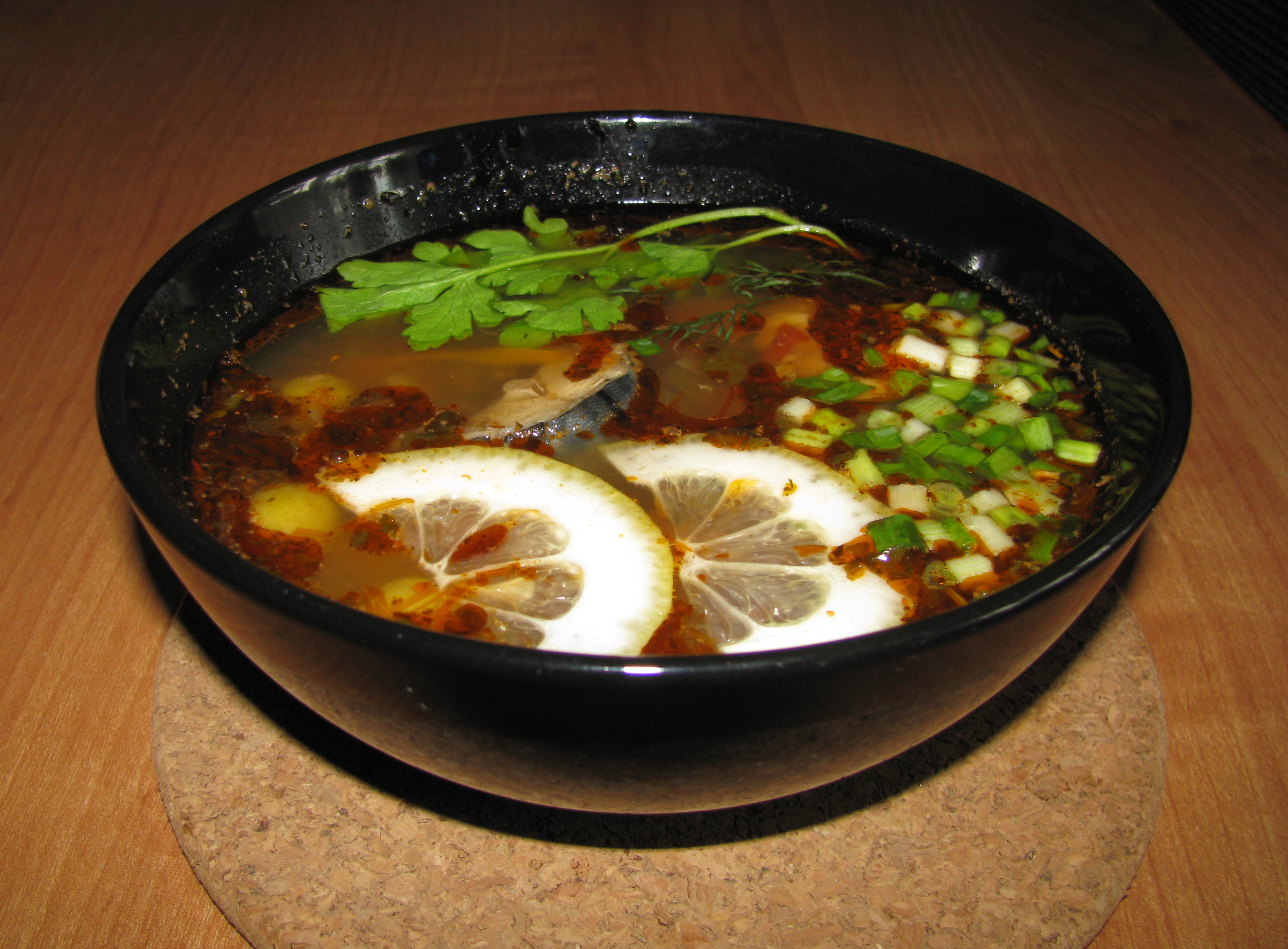
Thick and sour soup of Russian origin
| Field | Value |
|---|---|
| name | Solyanka |
| image | Soljanka food 05.jpg |
| image_size | 250px |
| caption | Solyanka |
| alternate_name | Selyanka |
| country | Russia |
| national_cuisine | Russian, Ukrainian, Latvian, Georgian, East German |
| type | Soup |
| served | Hot |
| main_ingredient | Meat, fish, or mushrooms, pickled cucumbers, cabbage, onions, often potatoes, smetana, dill |
Solyanka (; initially selyanka; , ) is a thick and sour soup of Russian origin. It is a common dish in Russia, Ukraine, Belarus, the Baltic states, and other post-Soviet states and other parts of the former Eastern Bloc. It was one of the most reliably available dishes in East Germany ().
Name
The original name selyanka can be translated as "settler's soup" in English. There are many theories about the origin of the name, but a common one is that the soup was often eaten after the wedding before the newlyweds "settled down" and started their new life together. Other translations include "food of the villager" or "villager's stew". Later, the name was transformed to solyanka, using the word sol (salt) as a reference to the soup's saltiness.
Due to its astringent sour taste that is believed to relieve a hangover, solyanka has also earned the nickname "hangover soup."
History
The first written mention of solyanka or selyanka dates back to the 17th century, where it is described as a hot dish with cabbage, salted cucumbers, meat, poultry, fish, mushrooms or other products. One of the first recipes of selyanka in Russian culinary literature comes from Nikolai Osipov's book Ancient Russian Housewives, Housekeepers and Troublemakers (1794). In the Dictionary of the Russian Academy (1822), solyanka is still described as a main course, rather than a soup.
A soup version of solyanka emerged in the 1830s. It was mentioned by Russian chef Gerasim Stepanov in 1834 under the section on "Miscellaneous Shti" (shchi), alongside nettle soups and Ukrainian borscht. Since the 1840s, solyanka soup has been increasingly mentioned as a separate dish. Yekaterina Avdeyeva's 1842 book The Handbook of an Experienced Russian Hostess (1842) gives a version of solyanka soup made with mushrooms. In the second half of the 19th century, solyanka received the modern form of its name.
Variations
There are three basic types of solyanka, with the main ingredient being either meat, fish, or mushrooms. Meat solyanka is the most popular. All three types of solyanka contain pickled mushrooms or cucumbers, cabbage, smetana and dill.
- For meat solyanka, ingredients like beef, veal, ham, sausages, liver, chicken breast together with pickled mushrooms or cucumbers, onions, potatoes, tomato paste, pitted olives, allspice, cardamom, bay leaf, parsley, and fresh dill are all cut fine and mixed in a pot of broth.
- Fish solyanka is prepared similarly, but salt-cured and smoked fish, such as salmon or trout, is used instead of meat.
- For mushroom solyanka, cut cabbage is heated in butter together with vinegar, tomatoes, cucumber pickles, and a little brine. Separately, mushrooms and onions are heated, and grated lemon zest is added. Cabbage and mushrooms are added in layers, breadcrumbs and butter are added, and the soup is briefly baked. Non-soup variants of solyanka also exist
Distribution
Solyanka was also popular in East Germany and the Soviet occupation zone, which includes the current German states of Brandenburg, Mecklenburg-Vorpommern, Saxony, Saxony-Anhalt, and Thuringia, along with the eastern half of Berlin. It is still commonly found in restaurants and available in canned form in grocery stores. The German transliteration is Soljanka. This practice stems from the era when the Soviet Army was stationed in East Germany, and Soljanka was found on the menu at many East German restaurants. The former German chancellor Angela Merkel, who was raised in East Germany, has stated that she is fond of solyanka.
References
References
- (2014). "From Peasant to Pleasant. The Cuisine of Latvia". The Latvian Institute.
- Goldstein, Darra. (2013). "The Georgian Feast: The Vibrant Culture and Savory Food of the Republic of Georgia". [[University of California Press]].
- Heinzelmann, Ursula. (2014). "Beyond Bratwurst: A History of Food in Germany". [[Reaktion Books]].
- (October 2005). "A Cook's Dictionary: International Food and Cooking Terms from A to Z". Bloomsbury Publishing Plc.
- (29 January 2009). "A Dictionary of Food and Nutrition". OUP Oxford.
- (26 February 2008). "Recipes for Russia: Food and Nationhood under the Tsars". Cornell University Press.
- (8 February 2024). "Russian Food since 1800: Empire at Table". Bloomsbury Publishing.
- Zak, Zuza. (2021). "Amber & Rye: A Baltic Food Journey". [[Interlink Books]].
- Grierson, Ian. (2022). "World Foods with Strange Names". [[AuthorHouse]] UK.
- Malinka, Vasilisa. (17 May 2019). "How to cook solyanka: A villager's soup, and cure for a hangover".
- Grierson, Ian. (2022). "World Foods with Strange Names". [[AuthorHouse]] UK.
- (24 September 2022). "How Russian Solyanka Was Born From Polish Bigos". [[The Moscow Times]].
- (19 February 2014). "Delicious Russia: Solyanka, thick and spicy soup for the cold winter".
- https://www.russianfood.com/recipes/recipe.php?rid=122128 Грибная солянка с капустой/ Mushroom solyanka with cabbage
- "Солянка с куриными бедрышками и адыгейским сыром. Рецепт с фотоинструкцией".
- Connolly, Kate. (28 September 2010). "Angela Merkel reveals her East German food stockpiling habit". [[The Guardian]].
This article was imported from Wikipedia and is available under the Creative Commons Attribution-ShareAlike 4.0 License. Content has been adapted to SurfDoc format. Original contributors can be found on the article history page.
Ask Mako anything about Solyanka — get instant answers, deeper analysis, and related topics.
Research with MakoFree with your Surf account
Create a free account to save articles, ask Mako questions, and organize your research.
Sign up freeThis content may have been generated or modified by AI. CloudSurf Software LLC is not responsible for the accuracy, completeness, or reliability of AI-generated content. Always verify important information from primary sources.
Report