From Surf Wiki (app.surf) — the open knowledge base
Solar updraft tower
Thermal convection power plant

Thermal convection power plant
a type of power plant
The solar updraft tower (SUT) is a design concept for a renewable-energy power plant for generating electricity from low-temperature solar heat. Sunshine heats the air beneath a very wide greenhouse-like roofed collector structure surrounding the central base of a very tall chimney tower. The resulting convection causes a hot air updraft in the tower by the chimney effect. This airflow drives wind turbines, placed in the chimney updraft or around the chimney base, to produce electricity.
As of mid 2018, although several prototype models have been built, no full-scale practical units are in operation. Scaled-up versions of demonstration models are planned to generate significant power. They may also allow development of other applications, such as to agriculture or horticulture, to water extraction or distillation, or to remediate urban air pollution.
Commercial investment may have been discouraged by the high initial cost of building a very large novel structure, the large land area required, and the risk of investment. A few prototypes have been built in Spain in 1981, in Iran in 2011, and in China in 2010 (see below), and projects were proposed for parts of Africa, the US and Australia.
In 2014, National Geographic published a popular update, including an interview with an informed engineering proponent. A solar updraft tower power plant can generate electricity from the low temperature atmospheric heat gradient between ground or surface level and structurally reachable altitude. Functional or mechanical feasibility is now less of an issue than capitalisation. A comprehensive review of theoretical and experimental aspects of solar updraft tower power plant (SUTPP) development is available, recommending commercial development. A review of progress in demonstration and modelled data was presented in 2020 by Dogan Eyrener, and included in publication of proceedings. A review of combined technologies to address intermittency of power output, of hybrid solar updraft tower with complementary technologies was published in 2022. Combined, multiple or hybrid technologies include combined updraft-downdraft towers, and solar updraft-gas turbine waste heat transfer.
Design
Power output depends primarily on two factors: collector area and chimney height. A larger area collects and warms a greater volume of air to flow up the chimney; collector areas as large as 7 km in diameter have been discussed. A larger chimney height increases the pressure difference via the stack effect; chimneys as tall as 1000 m have been discussed.
Heat is stored inside the collector area allowing SUTs to operate 24 hours a day. The ground beneath the solar collector, water in bags or tubes, or a saltwater thermal sink in the collector could add thermal capacity and inertia to the collector. Humidity of the updraft and release of the latent heat of condensation in the chimney could increase the energy flux of the system.
Turbines with a horizontal axis can be installed in a ring around the base of the tower, as once planned for an Australian project and seen in the diagram above; or—as in the prototype in Spain—a single vertical axis turbine can be installed inside the chimney.
A nearly negligible amount of carbon dioxide is produced as part of operations, while construction material manufacturing can create emissions. Net energy payback is estimated to be 2–3 years.
As of 2019, the efficiency of SUTs, which primarily depends on chimney height, was less than 2%. Since solar collectors occupy significant amounts of land, deserts and other low-value sites are most likely. Improvements in the solar heat collection efficiency by using unglazed transpired collector can significantly reduce the land required for the solar array.
A small-scale solar updraft tower may be an attractive option for remote regions in developing countries. The relatively low-tech approach could allow local resources and labour to be used for construction and maintenance.
Locating a tower at high latitudes could produce up to 85 percent of the output of a similar plant located closer to the equator, if the collection area is sloped significantly toward the equator. The sloped collector field, which also functions as a chimney, is built on suitable mountainsides, with a short vertical chimney on the mountaintop to accommodate the vertical axis air turbine. The results showed that solar chimney power plants at high latitudes may have satisfactory thermal performance.
History and progress

A chimney turbine was envisioned as a smoke jack, and illustrated 500 years ago by Leonardo da Vinci. An animal spitted above a fire or in an oven could be turned by a vertical axis turbine with four angled vanes in the chimney updraft.
Alfred Rosling Bennett published the first patent describing a "Convection Mill" in 1896. Even if in the title of the patent and in the claims the word "Toy" clearly appears and even if in the overall description made inside the patent it is evident that the idea was to produce small devices, in page 3 at lines 49–54 Bennett envisions much larger devices for bigger scale applications. A model of this "convection mill", built in 1919 by Albert H. Holmes & Son (London) to demonstrate the phenomenon of convection currents, is on display in the Science Museum, London.
In 1903, Isidoro Cabanyes, a colonel in the Spanish army, proposed a solar chimney power plant in the magazine La energía eléctrica. Another early description was published in 1931 by German author Hanns Günther. Beginning in 1975, Robert E. Lucier applied for patents on a solar chimney electric power generator; between 1978 and 1981 patents (since expired) were granted in Australia, Canada, Israel, and the US.
In 1926 Prof Engineer Bernard Dubos proposed to the French Academy of Sciences the construction of a Solar Aero-Electric Power Plant in North Africa with its solar chimney on the slope of a large mountain.
In 1956, Edgard Nazare, after observing several dust devils in the southern Sahara, filed his first patent in Algiers on the artificial cyclone generator. This patent was re-filed later in Paris
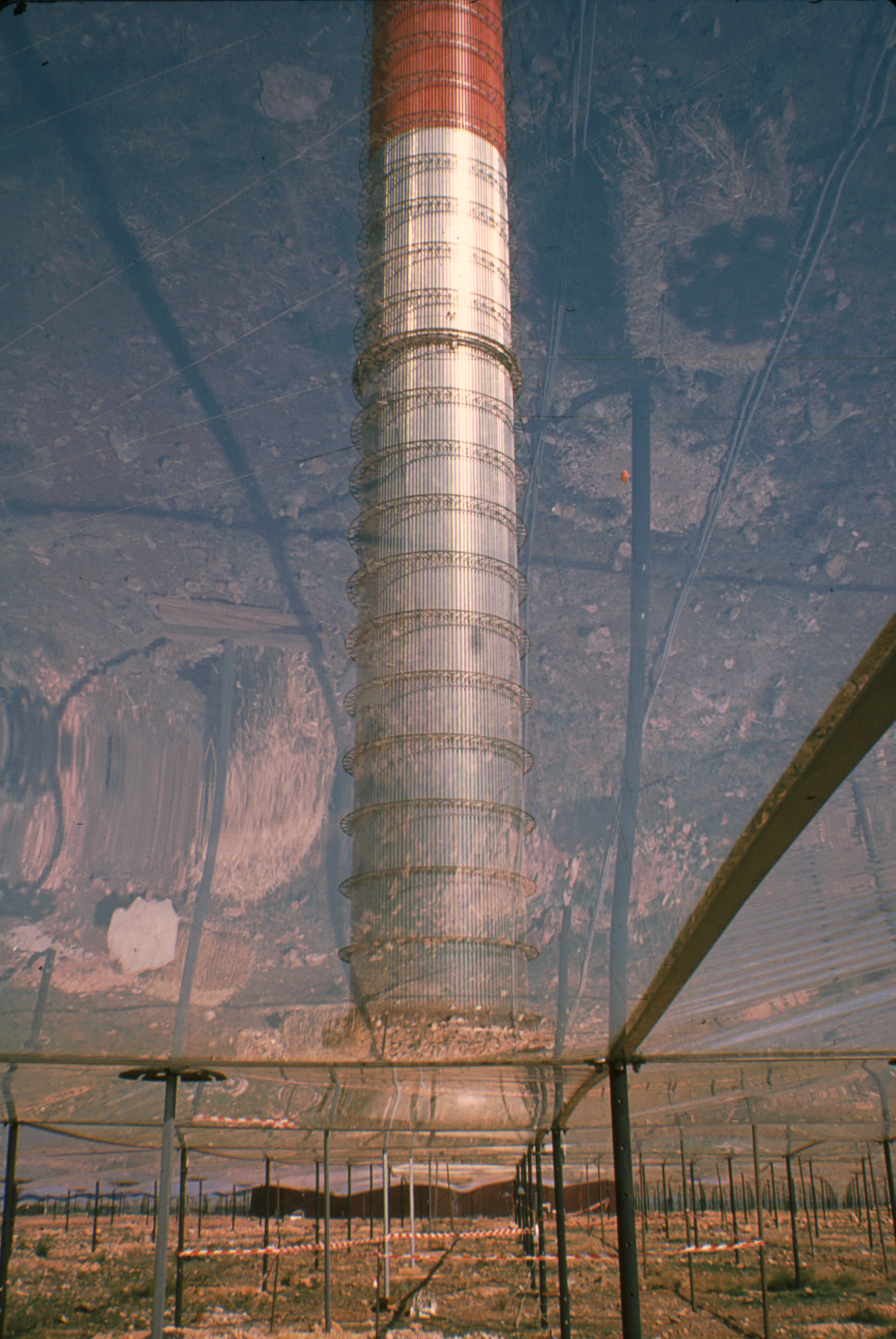
In 1982, a small-scale experimental model of a solar draft tower was built in Manzanares, Ciudad Real, 150 km south of Madrid, Spain at . The power plant operated for approximately eight years. The tower's guy-wires were not protected against corrosion and failed due to rust and storm winds. The tower blew over and was decommissioned in 1989.

Inexpensive materials were used in order to evaluate their performance. The solar tower was built of iron plating only 1.25 mm thick under the direction of a German engineer, Jörg Schlaich. The project was funded by the German government.
The chimney had a height of 195 m and a diameter of 10 m with a collection area (greenhouse) of 4.6 ha and a diameter of 244 m, obtaining a maximum power output of about 50 kW. Various materials were used for testing, such as single or double glazing or plastic (which turned out not to be durable enough). One section was used as an actual greenhouse. During its operation, 180 sensors measured inside and outside temperature, collecting humidity and wind speed data on a second-by-second basis. This experimental setup did not sell energy.
In December 2010, a tower in Jinshawan in Inner Mongolia, China started operation, producing 200 kilowatts. The 1.38 billion RMB (USD 208 million) project was started in May 2009. It was intended to cover 277 ha and produce 27.5 MW by 2013, but had to be scaled back. The solar chimney plant was expected to improve the climate by covering loose sand, restraining sandstorms. Critics have said that the 50m tall tower is too short to work properly and that it was a mistake to use glass in metal frames for the collector, as many of them cracked and shattered in the heat.

A proposal to construct a solar updraft tower in Fuente el Fresno, Ciudad Real, Spain, entitled Ciudad Real Torre Solar would be the first of its kind in the European Union and would stand 750 m tall, covering an area of 350 ha. It is expected to produce 40 MW. At that height, it would be nearly twice as tall as the Belmont TV Mast, which was once the tallest structure in the European Union, before being shortened by 24 metres.

In 2001, EnviroMission proposed to build a solar updraft tower power generating plant known as Solar Tower Buronga near Buronga, New South Wales. The company did not complete the project. They have plans for a similar plant in Arizona, and most recently (December 2013) in Texas, but there is no sign of 'breaking ground' in any of Enviromission's proposals.
In December 2011, Hyperion Energy, controlled by Western Australians Tony Sage and Dallas Dempster, was reported to be planning to build a 1-km-tall solar updraft tower near Meekatharra to supply power to Mid-West mining projects.

In mid-2008, the Namibian government approved a proposal for the construction of a 400 MW solar chimney called the 'Greentower'. The tower is planned to be 1.5 km tall and 280 m in diameter, and the base will consist of a 37 km2 greenhouse in which cash crops can be grown.
A model solar updraft tower was constructed in Turkey as a civil engineering project. Functionality and outcomes are obscure.
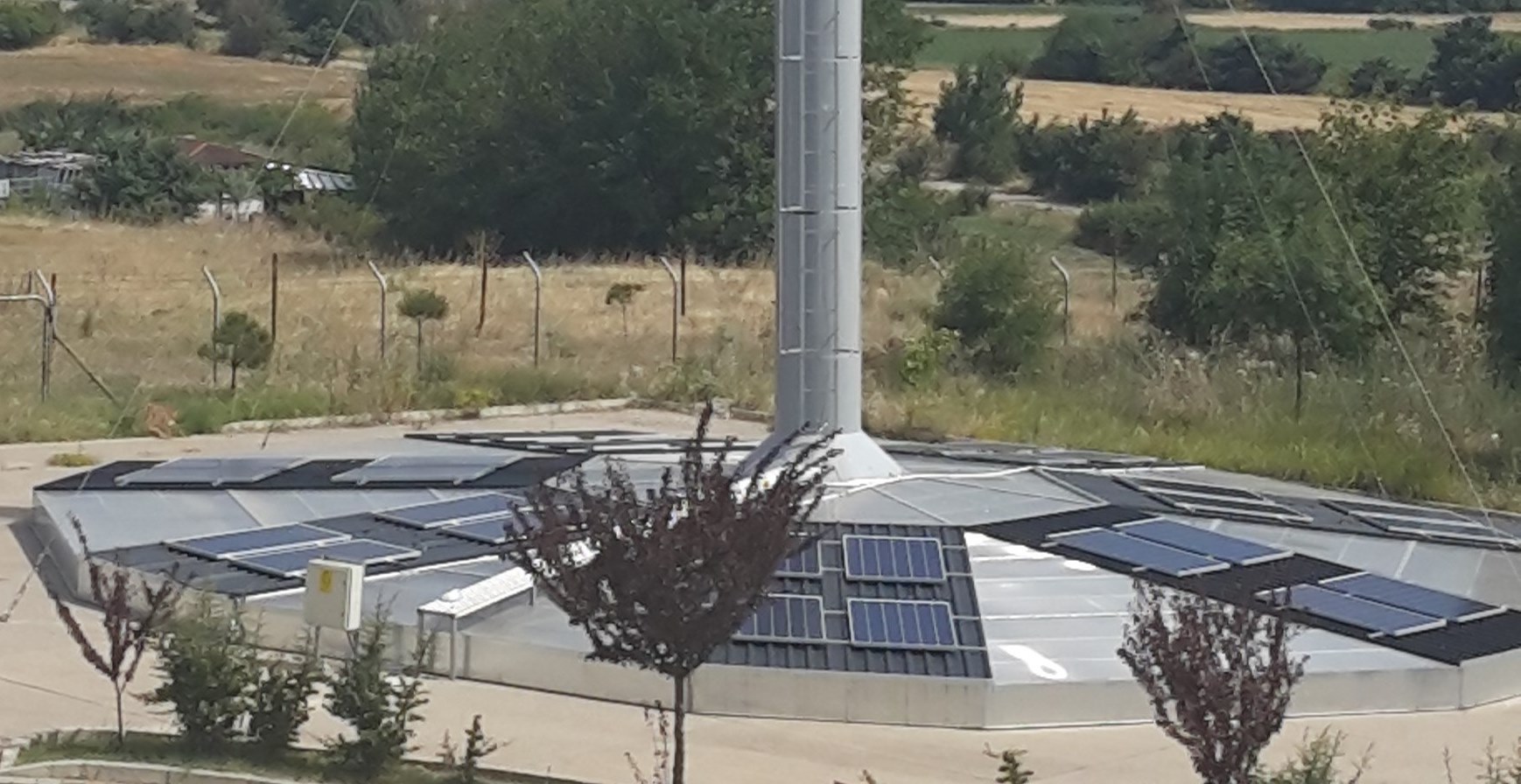
A second solar updraft tower using a transpired collector is operating at Trakya University in Edirne, Turkey, and is being used to test various innovations in SUT designs including the ability to recover heat from photovoltaic (PV) arrays.
A grade-school pupil's home do-it-yourself SUT demonstration for a school science fair was constructed and studied in 2012, in a suburban Connecticut setting. With a 7-metre stack and 100 square metre collector, this generated a daily average 6.34 mW, from a computer fan as a turbine. Insolation and wind were the major factors on variance (range from 0.12 to 21.78 mW) in output.
In Xi'an, central China, a 60-metre urban chimney with surrounding collector has significantly reduced urban air pollution. This demonstration project was led by Cao Jun Ji, a chemist at the Chinese Academy of Sciences' Key Laboratory of Aerosol Chemistry and Physics. This work has since been published on, with performance data and modelling.
Efficiency
The traditional solar updraft tower has a power conversion rate considerably lower than many other designs in the (high temperature) solar thermal group of collectors. The low conversion rate is balanced to some extent by the lower cost per square metre of solar collection.
Model calculations estimate that a 100 MW plant would require a 1,000 m tower and a greenhouse of 20 km2. A 200 MW tower of the same height would require a collector 7 kilometres in diameter (total area of about 38 sqkm). One 200 MW power station will provide enough electricity for around 200,000 typical households and will abate over 900,000 tons of greenhouse producing gases from entering the environment annually. The glazed collector area is expected to extract about 0.5 percent, or 5 W/m2 of 1 kW/m2, of the solar energy that falls upon it. If a transpired solar collector is used in place of the glazed collector, the efficiency is doubled.
Additional efficiency improvements are possible by modifying the turbine and chimney design to increase air speed using a venturi configuration. Concentrating thermal (CSP) or photovoltaic (CPV) solar power plants range between 20% and 31.25% efficiency (dish Stirling). Overall CSP/CPV efficiency is reduced because collectors do not cover the entire footprint. Without further tests, the accuracy of these calculations is uncertain. Most of the projections of efficiency, costs and yields are calculated theoretically, rather than empirically derived from demonstrations, and are seen in comparison with other collector or solar heat transducing technologies.
An innovative concept recombining a thermal power plant dry cooling tower with a solar chimney was first introduced by Zandian and Ashjaee in 2013 to increase the efficiency of the solar updraft towers. This hybrid cooling-tower-solar-chimney (HCTSC) system was shown to be able to produce an over ten times increase in output power compared to the conventional solar chimney power plants like Manzanares, Ciudad Real, with similar geometrical dimensions. In addition, it was shown that with an increase in chimney diameter, the power generation can reach to MW-graded power output without the necessity of building huge individual solar chimney panels. The results showed a maximum of 3 MW power output from the HCTSC system which resulted in 0.37% increase in the thermal efficiency of a typical 250 MW fossil fuel power plant, with a chimney diameter of only 50 m. The new hybrid design made the solar updraft tower feasible again, and proved it to be economical in saving much construction cost and time. This concept also recaptures the heat of radiators that are thrown out into the atmosphere without efficient utilization, and prevents generation of excessive greenhouse gasses.
The performance of an updraft tower may be degraded by factors such as atmospheric winds, by drag induced by the bracings used for supporting the chimney, and by reflection off the top of the greenhouse canopy. However, updraft may be enhanced by crosswind at the upper level – creating a low pressure vortex across the top of the chimney would increase updraft.
Capitalisation
A solar updraft power station would require a large initial capital outlay, but would have relatively low operating cost.
Capital outlays would be roughly the same as next-generation nuclear plants such as the AP-1000 at roughly $5 per watt of capacity. As with other renewable power sources, towers have no need for fuel. Overall costs are largely determined by interest rates and years of operation, varying from 5 eurocents per kWh for 4% and 20 years to 15 eurocents per kWh for 12% and 40 years.
Estimates of total costs range from 7 (for a 200 MW plant) and 21 (for a 5 MW plant) euro cents per kWh to 25–35 cents per kWh. The levelized cost of energy (LCOE) is approximately 3 Euro cents per KWh for a 100 MW wind or natural gas plant. No actual data are available for a utility-scale power plant.
References
References
- Arif, Muhammad. (2019). "Power Generation Technologies: An Introduction". Pakistan Institute of Engineering and Applied Science (PIEAS).
- (17 April 2014). "Solar Chimneys Can Convert Hot Air to Energy, but is Funding a Mirage?".
- (July 2020). "Solar chimney power plant and its correlation with ambient wind effect". Journal of Thermal Analysis and Calorimetry.
- (2016). "Solar updraft tower power generation". Solar Energy.
- (2020). "Accelerating the Transition to a 100% Renewable Energy Era".
- (November 2022). "Hybrid solar chimneys: A comprehensive review". Energy Reports.
- (June 2024). "An innovative twin-technology solar system design for electricity production". Energy Reports.
- (11 July 2023). "Improvment of combined solar chimney power plant with gas power plant". Scientific Reports.
- (2007). "Renewable energy technology, economics, and environment". Springer.
- "Solar pond tower for 5 €ct/kWh". GreenIdeaLive.
- (2005). "Design of Commercial Solar Updraft Tower Systems—Utilization of Solar Induced Convective Flows for Power Generation". Journal of Solar Energy Engineering.
- (July 2009). "The Solar Updraft Power Plant: Design and Optimization of the Tower for Wind Effects". Firenze University Press.
- Arif, Muhammad. (2019). "Power Generation Technologies: An Introduction". Pakistan Institute of Engineering and Applied Sciences (PIEAS).
- (2006). "The potential of solar chimney for application in rural areas of developing countries". Fuel.
- (2003). "Case study of solar chimney power plants in Northwestern regions of China". Renewable Energy.
- (2005). "Solar chimney power plants for high latitudes". Solar Energy.
- "An improved differential temperature air motor, adapted for scientific applications, for philosophical toys, and for advertising and other purposes".
- "Las chimeneas solares:De una propuesta española en 1903 a la Central de Manzanares". De Los Archivos Históricos De La Energía Solar.
- Günther, Hanns. (1931). "In hundert Jahren — Die künftige Energieversorgung der Welt". Kosmos, Gesellschaft der Naturfreunde.
- "Apparatus for converting solar to electrical energy".
- "Utilization of solar energy".
- "System and apparatus for converting solar heat to electrical energy".
- "System for converting solar heat to electrical energy".
- "Air filtering chimney to clean pollution from a city and generate electric power".
- "Générateur de cyclones artificiels".
- "Solar Updraft Tower Pilot Plant Manzanares". Schlaich Bergermann Partner.
- (2004). "Advances in solar thermal electricity technology". Solar Energy.
- (2007). "Solar Chimneys Part I: Principle and Construction of the Pilot Plant in Manzanares". International Journal of Solar Energy.
- (2007). "Solar Chimneys Part II: Preliminary Test Results from the Manzanares Pilot Plant". International Journal of Solar Energy.
- "download".
- (2010-12-28). "China's first solar chimney plant starts operating in desert". Gov.cn.
- www.margotweb.net. (2010-09-30). "NEW about solar chimney power plants". Solar-chimney.biz.
- (2010-12-27). "Xianha: China's first solar chimney plant starts operating in desert". News.xinhuanet.com.
- Muñoz-Lacuna, J.V.. (13 February 2006). "Ciudad Real tendrá una torre solar que doblará en alturaa las Torres Gemelas". lasprovincias.es.
- (2007). "Ciudad Real Torre Solar, Ciudad Real - SkyscraperPage.com". SkyscraperPage.com.
- Plaza, Julio. (28 February 2006). "La Torre Solar". HispaLibertas.
- (13 February 2006). "Torre Solar de 750 metros en Ciudad Real". Urbanity.es.
- Davey, R. (6 August 2001). "New Green energy technology launches". Australian Securities Exchange.
- Woody, Todd. (2 October 2006). "Tower of Power". CNN.
- (July 1 – December 31, 2010). "ENVIROMISSION Operational Overview". EnviroMission Limited.
- "EnviroMission Limited".
- Evans, Nick. (31 December 2011). "Dallas Dempster's sky-high comeback". The Sunday Times.
- Cloete, R. (25 July 2008). "Solar tower sheds light on little-used technology". Engineering News Online.
- (2010-08-21). "solar chimney www.unienerji.com". YouTube.
- "Güneş Santrali {{pipe}} Güneş Pili". Unienerji.com.
- Koyun A. (2007). "Güneş Bacası Sisteminin Termal Özet Dizaynı". Tesisat Mühendisliği Dergisi.
- "St Rose Student Creates Solar Updraft Tower {{pipe}} The Newtown Bee".
- Herrick, Grace. (2013-02-20). "{{pipe}} A Model Solar Updraft Tower Power Plant". WTNH.com.
- (2018-03-06). "China tests giant air cleaner to combat smog". Nature.
- (2018). "Urban-scale SALSCS, Part I: Experimental Evaluation and Numerical Modeling of a Demonstration Unit". Aerosol and Air Quality Research.
- (2018). "Urban-scale SALSCS, Part II: A Parametric Study of System Performance". Aerosol and Air Quality Research.
- "3. Solar Energy Systems }} {{small".
- (1997). "Solar electricity generation—A comparative view of technologies, costs and environmental impact". Solar Energy.
- (2006). "Critical evaluation of solar chimney power plant performance". Solar Energy.
- (2014). "Harnessing Solar Heat".
- (2013). "The thermal efficiency improvement of a steam Rankine cycle by innovative design of a hybrid cooling tower and a solar chimney concept". Renewable Energy.
- (2004). "Volume 2, Parts a and B".
- (2002). "The effect of wind speed at the top of the tower on the performance and energy generated from _thermosyphon solar turbine". International Journal of Solar Energy.
- (2003). "Calculation of Pressure and Density in Solar Power Plant Chimneys". Journal of Solar Energy Engineering.
- (11 March 2020). "An Ignored Wind Generates More Electricity: A Solar Updraft Tower to a Wind Solar Tower". International Journal of Photoenergy.
- "Atmospheric Vortex Engine". Vortexengine.ca.
- "Diagonal solar chimney".
- (2013). "Inflatable free-standing flexible solar towers". Solar Energy.
- Fathi, Nima, Peter Vorobief, and Seyed Sobhan Aleyasin. "V&V exercise for a solar tower power plant." In ''ASME Verification and Validation Symposium''. 2014.
- Vorobieff, Peter V., et al. "Inflatable, free-standing solar updraft tower with optimal geometry and active control." U.S. Patent No. 10,006,443. 26 Jun. 2018.
- "Vorwärts zur Natur". faz.net.
- (2005–2007). "Integration of Wind Energy into the Grid". European Wind Energy Association — EWEA.
- "SolarWall® – The solar air heating / solar air heater world leader, we invented the perforated transpired solar collector! - SolarWall, solar air heating system - the leading solar collector in the world! - Home".
- (2017). "Thermal performance of a transpired solar collector updraft tower". Energy Conversion and Management.
- "Transpired solar collector chimney tower".
- (2009). "Numerical investigation of a plume from a power generating solar chimney in an atmospheric cross flow". Atmospheric Research.
- (2009). "Cloud Formation in the Plumes of Solar Chimney Power Generation Facilities: A Modeling Study". Journal of Solar Energy Engineering.
- (1984). "The rainfall enhancement by washout of cooling tower plumes: A numerical experiment". Atmospheric Environment.
- (February 2008). "The solar cyclone: A solar chimney for harvesting atmospheric water". Energy.
- (2010). "Comparison of classical solar chimney power system and combined solar chimney system for power generation and seawater desalination". Desalination.
- (16 January 2018). "China builds 'world's biggest air purifier' (and it seems to be working)". [[South China Morning Post]].
- (2018-03-07). "China tests giant chimney to combat air pollution". Digital Journal.
- [[Cloud condensation nuclei]]
- [[Smog tower]]
- Tom Bosschaert. (2008-09-26). "Solar Updraft Tower Research: Except Consulting". Except.nl.
- "The Solar Chimney" by Jörg Schlaich, 1995
- Zaslavsky, Dan. (2006). "Energy Towers". PhysicaPlus.
- [http://www.energy.ca.gov/electricity/levelized_cost.html Levelized Costs of Electricity Production by Technology] {{webarchive. link. (2008-05-08 California Energy Commission, 2003)
- Groenendaal, B.J.. (July 2002). "Solar Thermal Power Technologies". Energy Research Centre of the Netherlands.
This article was imported from Wikipedia and is available under the Creative Commons Attribution-ShareAlike 4.0 License. Content has been adapted to SurfDoc format. Original contributors can be found on the article history page.
Ask Mako anything about Solar updraft tower — get instant answers, deeper analysis, and related topics.
Research with MakoFree with your Surf account
Create a free account to save articles, ask Mako questions, and organize your research.
Sign up freeThis content may have been generated or modified by AI. CloudSurf Software LLC is not responsible for the accuracy, completeness, or reliability of AI-generated content. Always verify important information from primary sources.
Report