From Surf Wiki (app.surf) — the open knowledge base
Solar eclipse of March 20, 2015
Total eclipse
Total eclipse
| Field | Value |
|---|---|
| previous | Solar eclipse of October 23, 2014 |
| next | Solar eclipse of September 13, 2015 |
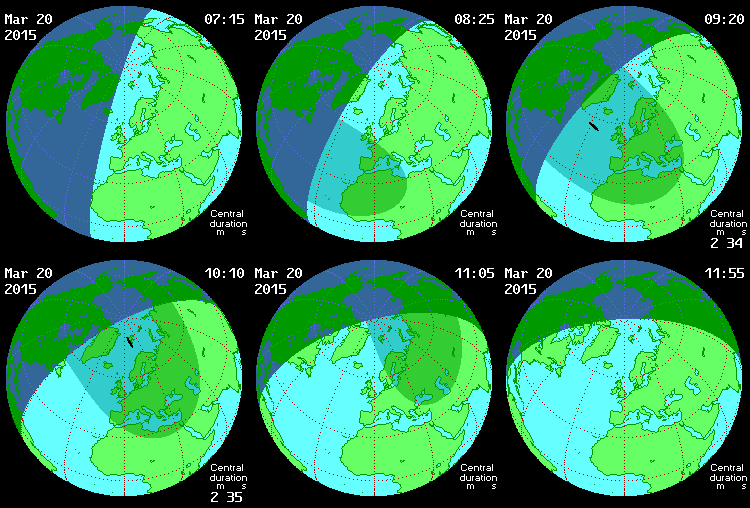
A total solar eclipse occurred at the Moon's descending node of orbit on Friday, March 20, 2015, with a magnitude of 1.0445. A solar eclipse occurs when the Moon passes between Earth and the Sun, thereby totally or partly obscuring the image of the Sun for a viewer on Earth. A total solar eclipse occurs when the Moon's apparent diameter is larger than the Sun's, blocking all direct sunlight, turning day into darkness. Totality occurs in a narrow path across Earth's surface, with a partial solar eclipse visible over a surrounding region thousands of kilometres wide. Occurring about 14 hours after perigee (on March 19, 2015, at 19:40 UTC), the Moon's apparent diameter was larger.
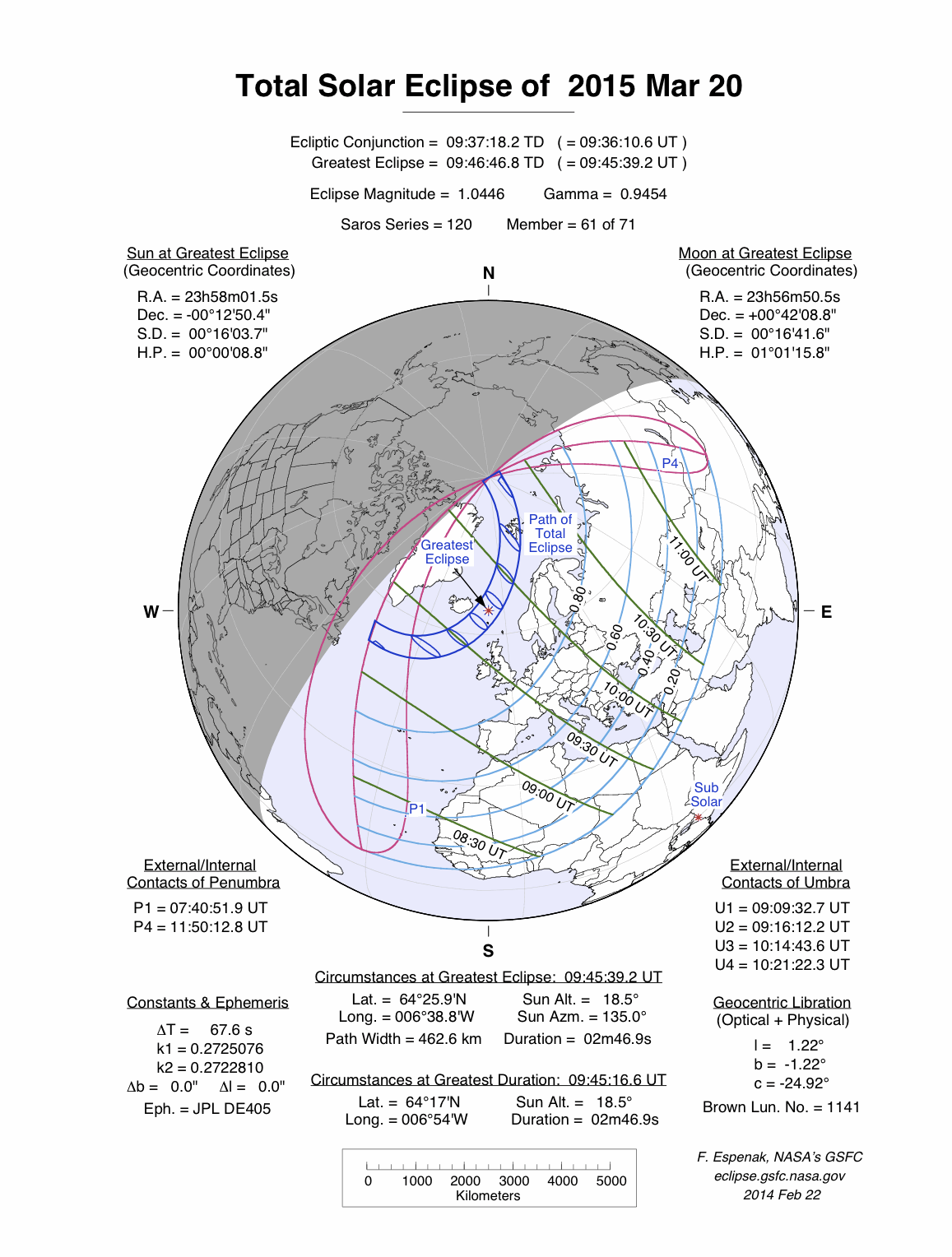
Totality was visible in the Faroe Islands and Svalbard. A partial eclipse was visible for parts of Greenland, Europe, North Africa, Central Asia, and western Russia. This total solar eclipse is notable in that the path of totality passed over the North Pole.
The longest duration of totality was 2 minutes and 47 seconds off the coast of the Faroe Islands. It was the last total solar eclipse visible in Europe until the eclipse of August 12, 2026.
Event
Simulation
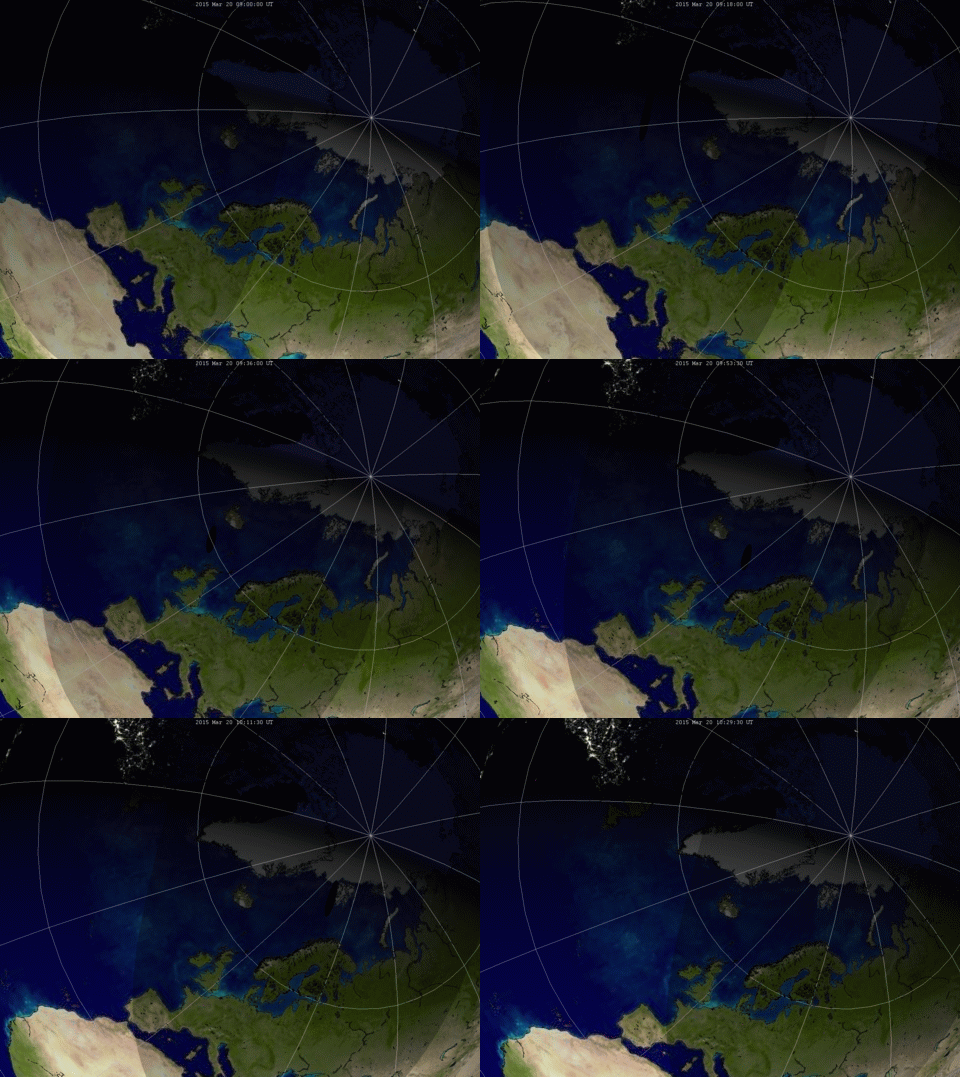
The solar eclipse began at 08:30 GMT in northwest Europe, and moved towards the northeast, but was still in northern Europe. It was most visible from the North Atlantic and Arctic Oceans, Greenland, Iceland, Ireland, the United Kingdom, Faroe Islands, northern Norway and Murmansk Oblast. The shadow began its pass off the south coast of Greenland. It then moved to the northeast, passing between Iceland and the United Kingdom before moving over the Faroe Islands and the northernmost islands of Norway. The shadow of the eclipse was visible in varying degrees all over Europe. For example, London experienced an 86.8% partial solar eclipse while points north of the Faroe Islands in the Norwegian Sea saw a complete solar eclipse. Three chartered airliners flew above the clouds, giving passengers a slightly prolonged view.
The eclipse was observed at radio frequencies at the Metsähovi Radio Observatory, Finland, where a partial eclipse was seen. The eclipse was also observed by meteorological satellite Meteosat-10.
Impact
The European Union has a solar power output of about 90 gigawatts and production could have been temporarily decreased by up to 34 GW of that dependent on the clarity of the sky. In actuality the dip was less than expected, with a 13 GW drop in Germany happening due to overcast skies. This was the first time that an eclipse had a significant impact on the power system, and the electricity sector took measures to mitigate the impact. The power gradient (change in power) may be −400 MW/minute and +700 MW/minute. Places in Netherlands, Belgium and Denmark were 80-85% obscured. The temperature drops varied greatly across Europe, with most areas having an insignificant drop in temperature due to the overcast weather, while others, like Scotland, Wales, and Iceland received a drop of 2-4°C. These areas were not obscured by cloud cover during the eclipse which may have led to the drop in temperature. Wind speed in the UK dropped by ~9%.
Coincidence of events
In addition to the eclipse, 20 March 2015 was also the day of the March equinox (also known as the spring or vernal equinox in the Northern Hemisphere). In addition, six supermoons were expected for 2015. The supermoon on 20 March 2015 was the third of the year; however, it was a new moon (near side facing away from the Sun), and only its shadow was visible.
At greatest eclipse, the Sun was at its zenith less than 24 km south of the Equator. Greatest eclipse occurred at 09:45:39 UTC of Friday, March 20, 2015, while March Equinox occurred at 22:45:09 UTC, just under 13 hours after the greatest eclipse (Greatest eclipse occurred in winter, 13 hours before spring).
Religious significance
Proponents of the Blood Moon Prophecy, such as Bob O'Dell also pointed out that 20 March 2015 was also a significant day on the Jewish and Biblical calendar. That evening was the onset of the Hebrew month of Nisan, the first month in the Biblical calendar year. Furthermore, the path of the total eclipse over the North Pole was a highly symbolic location infusing the day with both great natural significance and profound religious meaning according to O'Dell. Due to the significance of the eclipse, a global prayer event in Jerusalem was organized that day.
Eclipse timing
Places experiencing total eclipse
| Country or territory | City or place | Start of partial eclipse | Start of total eclipse | Maximum eclipse | End of total eclipse | End of partial eclipse | Duration of totality (min:s) | Duration of eclipse (hr:min) | Maximum magnitude | References: |
|---|---|---|---|---|---|---|---|---|---|---|
| Tórshavn | 08:39:02 | 09:41:06 | 09:42:06 | 09:43:05 | 10:47:53 | 1:59 | 2:09 | 1.0068 | ||
| Klaksvík | 08:39:30 | 09:41:30 | 09:42:33 | 09:43:36 | 10:48:17 | 2:06 | 2:09 | 1.0076 | ||
| Ny-Ålesund | 10:11:37 | 11:10:04 | 11:11:15 | 11:12:25 | 12:11:16 | 2:21 | 2:00 | 1.0148 | ||
| Barentsburg | 10:11:26 | 11:10:16 | 11:11:31 | 11:12:46 | 12:11:58 | 2:30 | 2:01 | 1.0205 | ||
| Longyearbyen | 10:12:04 | 11:10:54 | 11:12:08 | 11:13:22 | 12:12:32 | 2:28 | 2:00 | 1.0179 |
Places experiencing partial eclipse
| Country or territory | City or place | Start of partial eclipse | Maximum eclipse | End of partial eclipse | Duration of eclipse (hr:min) | Maximum coverage | References: |
|---|---|---|---|---|---|---|---|
| Lisbon | 07:59:23 | 09:01:03 | 10:08:23 | 2:09 | 66.92% | ||
| Madrid | 09:05:08 | 10:09:00 | 11:18:20 | 2:13 | 66.53% | ||
| Saint Anne | 08:20:35 | 09:26:12 | 10:36:10 | 2:16 | 83.09% | ||
| Dublin | 08:24:09 | 09:28:33 | 10:36:55 | 2:13 | 91.56% | ||
| Paris | 09:22:43 | 10:29:31 | 11:40:28 | 2:18 | 77.89% | ||
| London | 08:25:01 | 09:31:09 | 10:41:13 | 2:16 | 84.44% | ||
| Douglas | 08:26:35 | 09:31:23 | 10:39:58 | 2:13 | 91.53% | ||
| Rome | 09:23:58 | 10:31:30 | 11:42:51 | 2:19 | 53.75% | ||
| Zurich | 09:26:24 | 10:34:27 | 11:46:15 | 2:20 | 69.33% | ||
| Brussels | 09:27:34 | 10:34:47 | 11:45:43 | 2:18 | 79.65% | ||
| Luxembourg | 09:27:16 | 10:34:55 | 11:46:16 | 2:19 | 75.87% | ||
| Nuuk | 06:28:42 (sunrise) | 06:36:06 | 07:27:35 | 0:59 | 88.46% | ||
| Reykjavík | 08:37:49 | 09:37:20 | 10:39:35 | 2:02 | 97.77% | ||
| Amsterdam | 09:30:26 | 10:37:39 | 11:48:20 | 2:18 | 81.77% | ||
| Prague | 09:36:50 | 10:45:45 | 11:57:19 | 2:20 | 68.67% | ||
| Vienna | 09:36:54 | 10:45:56 | 11:57:31 | 2:21 | 62.83% | ||
| Berlin | 09:38:54 | 10:47:32 | 11:58:41 | 2:20 | 74.32% | ||
| Budapest | 09:39:46 | 10:48:48 | 12:00:01 | 2:20 | 58.36% | ||
| Copenhagen | 09:42:27 | 10:50:30 | 12:00:46 | 2:18 | 80.60% | ||
| Oslo | 09:46:48 | 10:53:33 | 12:02:14 | 2:15 | 88.59% | ||
| Warsaw | 09:47:40 | 10:56:49 | 12:07:26 | 2:20 | 66.16% | ||
| Danmarkshavn | 09:01:02 | 09:59:10 | 10:58:29 | 1:57 | 95.68% | ||
| Stockholm | 09:52:34 | 11:00:15 | 12:09:12 | 2:17 | 81.97% | ||
| Riga | 10:56:22 | 12:04:52 | 13:14:04 | 2:18 | 72.49% | ||
| Tallinn | 10:59:29 | 12:07:22 | 13:15:46 | 2:16 | 76.60% | ||
| Helsinki | 11:00:22 | 12:08:03 | 13:16:12 | 2:16 | 77.76% | ||
| Rovaniemi | 11:06:44 | 12:12:12 | 13:17:53 | 2:11 | 87.56% | ||
| Alert | 05:57:40 (sunrise) | 06:13:58 | 06:59:40 | 1:02 | 79.28% | ||
| Moscow | 12:13:10 | 13:20:19 | 14:26:32 | 2:13 | 57.50% | ||
| Belushya Guba | 12:27:46 | 13:29:58 | 14:31:04 | 2:03 | 81.88% |
Eclipse visibility
The event was visible as a partial eclipse all across Europe including: Norway, Sweden, Denmark, the United Kingdom, Ireland, Portugal, France, Germany, Poland, Czech Republic, Slovakia, Hungary, Austria, Italy, Montenegro, Finland, Western Russia, and Ukraine. File:20th March 2015 Solar Eclipse in Sheffield, UK.jpg|Sheffield, United Kingdom. All time local time (GMT) File:Solar eclipse of 2015 March 20 - Lorient 5743.JPG|Lorient, France, 10:20 local time (9:20 GMT) File:15-03-20-Sonnenfinsternis-Berlin-RalfR-N3S 6865-01.jpg|Berlin, Germany, 10:29 local time (9:29 UTC) – unconfirmed source File:15-03-20-Sonnenfinsternis-Markt Schwaben.JPG|Markt Schwaben, Germany File:March 20th Eclipse - Ireland.jpg|Dublin, Ireland, 9:30 GMT File:Eclipse, 2015, Chester-le-Street.jpg|Chester-le-Street, United Kingdom, 9:36 GMT File:EclipseTórshavn.JPG|Tórshavn, Faroe Islands, End of totality, 9:43 local time (GMT) File:Solar eclipse of 20th march 2015 - Wrocław, Poland.png|Wrocław, Poland, 10:44 local time (9:44 UTC) File:Solar Eclipse 2015 - Hjartdal, Norway.JPG|Hjartdal, Norway, 10:47 local time (9:47 UTC) File:Zatmění Slunce 2015-03-20 Praha, Dejvice 10.48.jpg|Prague, Czech Republic, 10:49 local time (9:49 UTC) File:2015 Zaćmienie słońca 20.03.2015.jpg|Kłodzko, Poland, 10:54 local time (9:54 UTC) File:Solar eclipse 2015 Warsaw Poland.jpg|Warsaw, Poland, 10:56 local time (9:56 UTC) File:Solar eclipse 2015 Budapest Hungary.jpg|Budapest, Hungary, 11:00 local time (10:00 UTC) File:Sonnenfinsternis - Solar eclipse of 2015 March 20 in Austria 5.jpg|Bregenz, Austria, 11:06 local time (10:06 UTC) File:Solar eclipse 20th, March 2015, in Milano, Italy.JPG|Milan, Italy, 11:08 (10:08 UTC) – unconfirmed source File:То,чего не может быть.jpg|Petrozavodsk, Russia, 13:25 local time (10:25 UTC) File:Solar eclipse of 2015 March 20 in Kiev.JPG|Kyiv, Ukraine, 12:28 local time (10:28 UTC) File:Ulcinj – Eclipse 2015.JPG|Ulcinj, Montenegro, 11:34 local time (10:34 UTC) File:20 Mar 2015 Moscow 10-35 (UTC), 13-35 (Local).jpg|Moscow, Russia, 13:35 local time (10:35 UTC) File:March 20 Solar Eclipse Leeds England.png|Leeds, United Kingdom, 10:30 UTC/GMT
Eclipse details
Shown below are two tables displaying details about this particular solar eclipse. The first table outlines times at which the Moon's penumbra or umbra attains the specific parameter, and the second table describes various other parameters pertaining to this eclipse.
| Event | Time (UTC) |
|---|---|
| First Penumbral External Contact | 2015 March 20 at 07:41:59.5 UTC |
| First Umbral External Contact | 2015 March 20 at 09:10:40.3 UTC |
| First Central Line | 2015 March 20 at 09:13:50.9 UTC |
| First Umbral Internal Contact | 2015 March 20 at 09:17:19.8 UTC |
| Ecliptic Conjunction | 2015 March 20 at 09:37:18.1 UTC |
| Greatest Duration | 2015 March 20 at 09:46:24.2 UTC |
| Greatest Eclipse | 2015 March 20 at 09:46:46.8 UTC |
| Equatorial Conjunction | 2015 March 20 at 10:18:14.1 UTC |
| Last Umbral Internal Contact | 2015 March 20 at 10:15:51.3 UTC |
| Last Central Line | 2015 March 20 at 10:19:19.7 UTC |
| Last Umbral External Contact | 2015 March 20 at 10:22:29.9 UTC |
| Last Penumbral External Contact | 2015 March 20 at 11:51:20.4 UTC |
| Parameter | Value |
|---|---|
| Eclipse Magnitude | 1.04455 |
| Eclipse Obscuration | 1.09109 |
| Gamma | 0.94536 |
| Sun Right Ascension | 23h58m01.5s |
| Sun Declination | -00°12'50.4" |
| Sun Semi-Diameter | 16'03.7" |
| Sun Equatorial Horizontal Parallax | 08.8" |
| Moon Right Ascension | 23h56m50.5s |
| Moon Declination | +00°42'08.7" |
| Moon Semi-Diameter | 16'41.6" |
| Moon Equatorial Horizontal Parallax | 1°01'15.8" |
| ΔT | 67.7 s |
Eclipse season
This eclipse is part of an eclipse season, a period, roughly every six months, when eclipses occur. Only two (or occasionally three) eclipse seasons occur each year, and each season lasts about 35 days and repeats just short of six months (173 days) later; thus two full eclipse seasons always occur each year. Either two or three eclipses happen each eclipse season. In the sequence below, each eclipse is separated by a fortnight.
| March 20 | |||
|---|---|---|---|
| Descending node (new moon) | |||
| April 4 | |||
| Ascending node (full moon) | |||
| [[File:SE2015Mar20T.png | 200px]] | [[File:Lunar eclipse chart close-2015Apr04.png | 200px]] |
| Total solar eclipse | |||
| Solar Saros 120 | Total lunar eclipse | ||
| Lunar Saros 132 |
References
Bibliography
References
- "March 20, 2015 Total Solar Eclipse". timeanddate.
- "Moon Distances for London, United Kingdom, England". timeanddate.
- F. Espenak. "NASA - Total Solar Eclipse of 2026 August 12".
- (20 March 2015). "Solar eclipse 2015 live: Britain to plunge into morning twilight as Moon blocks out Sun". Daily Telegraph.
- (20 March 2015). "Solar Eclipse: live updates". Guardian.
- Rao, Joe. (20 March 2015). "Flight to Totality: How I Chased the Total Solar Eclipse of 2015 on a Jet". [[space.com]].
- (20 March 2015). "Solar eclipse as seen by a radio telescope".
- (20 March 2015). "EUMETSAT case study".
- (20 March 2015). "Meteosat-10 video of the eclipse".
- Eckert, Vera. (20 March 2015). "European power grids keep lights on through solar eclipse".
- [https://www.entsoe.eu/Documents/Publications/ENTSO-E%20general%20publications/entsoe_spe_pp_solar_eclipse_2015_web.pdf Solar Eclipse March 2015 Policy Brief] ''[[European Network of Transmission System Operators for Electricity]]'', 15 July 2015
- "[https://www.entsoe.eu/Documents/Publications/SOC/150219_Solar_Eclipse_Impact_Analysis_Final.pdf Solar Eclipse 2015 – Impact Analysis]" pp3+6+7+13 . ''[[European Network of Transmission System Operators for Electricity]]'', 19 February 2015. Accessed: 4 March 2015.
- "Curve of potential power loss".
- "Total Solar Eclipse on March 20, 2015: Path Map and Times".
- (2016-09-28). "Meteorological effects of the solar eclipse of 20 March 2015: analysis of UK Met Office automatic weather station data and comparison with automatic weather station data from the Faroes and Iceland". Philosophical Transactions of the Royal Society A: Mathematical, Physical and Engineering Sciences.
- McClure, Bruce. (8 March 2015). "In 2015, first of six supermoons comes on January 20". EarthSky.
- Weisz, Tuly. (12 March 2015). "Passover Blood Moon Preceded by Exceedingly Rare Solar Eclipse".
- Borschel-Dan, Amanda. (19 March 2015). "Solar eclipse Friday has some looking for signs from God". Times of Israel.
- Weisz, Tuly. (22 March 2015). "Blood Moon Enthusiasts Show Total Enthusiasm for Jerusalem's Partial Eclipse".
- (20 March 2015). "'Breathtaking' solar eclipse witnessed by millions". BBC News.
- (20 March 2015). "Solar eclipse 2015: Brief glimpses as clouds hide spectacle". Irish Times.
- (20 March 2015). "Thick cloud hides solar eclipse in France".
- (20 March 2015). "Partial solar eclipse over Germany".
- (20 March 2015). "Solar eclipse over Poland".
- "Total Solar Eclipse of 2015 Mar 20". EclipseWise.com.

This article was imported from Wikipedia and is available under the Creative Commons Attribution-ShareAlike 4.0 License. Content has been adapted to SurfDoc format. Original contributors can be found on the article history page.
Ask Mako anything about Solar eclipse of March 20, 2015 — get instant answers, deeper analysis, and related topics.
Research with MakoFree with your Surf account
Create a free account to save articles, ask Mako questions, and organize your research.
Sign up freeThis content may have been generated or modified by AI. CloudSurf Software LLC is not responsible for the accuracy, completeness, or reliability of AI-generated content. Always verify important information from primary sources.
Report