From Surf Wiki (app.surf) — the open knowledge base
Solar eclipse of June 8, 1918
Total eclipse
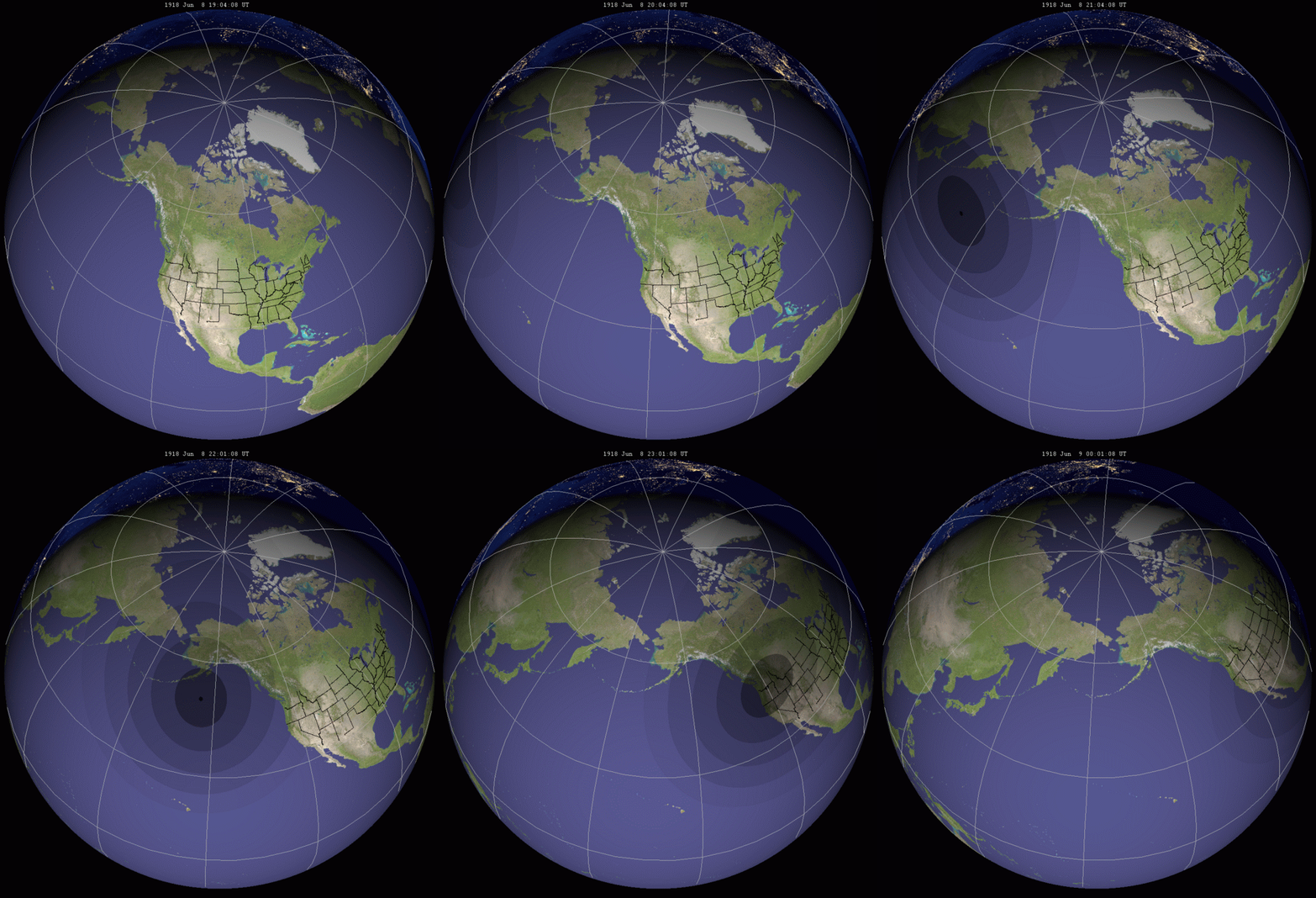
Total eclipse
| Field | Value |
|---|---|
| previous | Solar eclipse of December 14, 1917 |
| next | Solar eclipse of December 3, 1918 |
A total solar eclipse occurred at the Moon's descending node of orbit between Saturday, June 8 and Sunday, June 9, 1918, with a magnitude of 1.0292. A solar eclipse occurs when the Moon passes between Earth and the Sun, thereby totally or partly obscuring the image of the Sun for a viewer on Earth. A total solar eclipse occurs when the Moon's apparent diameter is larger than the Sun's, blocking all direct sunlight, turning day into darkness. Totality occurs in a narrow path across Earth's surface, with the partial solar eclipse visible over a surrounding region thousands of kilometres wide. Occurring 3.7 days after perigee (on June 5, 1918, at 8:40 UTC), the Moon's apparent diameter was larger.
The eclipse was viewable across the entire contiguous United States, an event which would not occur again until the solar eclipse of August 21, 2017.
The Path
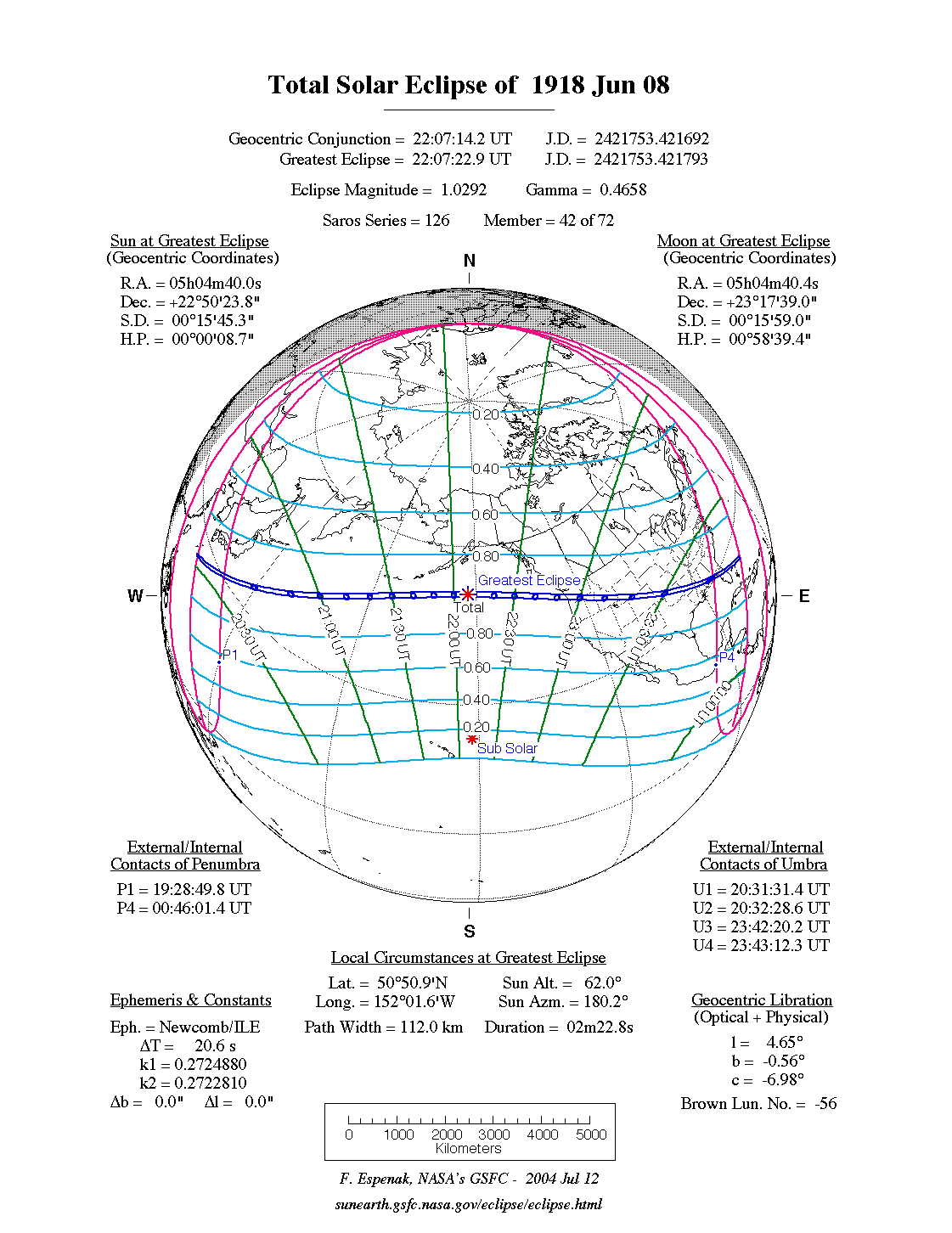
The path of totality started south of Japan, went across the Pacific Ocean, passing northern part of Kitadaitō, Okinawa and the whole Tori-shima in Izu Islands on June 9 (Sunday), and then acrossed the contiguous United States and British Bahamas (today's Bahamas) on June 8 (Saturday). The largest city to see totality was Denver, although many could theoretically see it as the size of the shadow was between 70 and across as it traveled across America. The longest duration of totality was in the Pacific at a point south of Alaska. The path of the eclipse finished near Bermuda.
Besides the path where a total solar eclipse was visible, a partial solar eclipse was visible in the eastern part of East Asia, northern part of Northern Europe, eastern part of Micronesia, Hawaii Islands, northeastern Russian Empire, the entire North America except the Lesser Antilles, and the northwestern tip of South America.
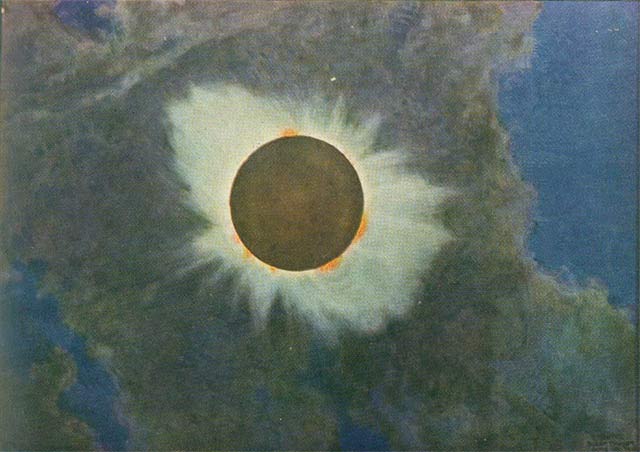
U.S. Observation team
The path of the eclipse clipped Washington state, and then moved across the whole of Oregon through the rest of the country, exiting over Florida. The U.S. Naval Observatory (USNO) obtained a special grant of $3,500 from Congress for a team to observe the eclipse in Baker City, Oregon. The team had been making preparations since the year before, and John C. Hammond led the first members to Baker City on April 11. The location was important, as it influenced the probability of cloud cover and the duration and angle of the sun during the eclipse. The team included Samuel Alfred Mitchell as its expert on eclipses, and Howard Russell Butler, an artist and physicist. In a time before reliable colour photography, Butler's role was to paint the eclipse at totality after observing it for 112.1 seconds. He noted later that he used a system of taking notes of the colours using skills he had learned for transient effects.
Joel Stebbins and Jakob Kunz from the University of Illinois Observatory made the first photoelectric photometric observations of the solar corona from their observing site near Rock Springs, Wyoming
Observation
As the total eclipse approached, the team watched as clouds obscured the Sun. The clouds did clear, but during their most important observations the Sun was covered by a thin cloud; the Sun was completely visible five minutes later. This was not unusual, as cloudy conditions were reported across the country, where the eclipse was also observed from the Yerkes Observatory, Lick Observatory, and Mount Wilson Observatory.
Following the 1915 prediction of Albert Einstein's General theory of relativity that light would be deflected when passing near a massive object such as the Sun, the USNO expedition attempted to validate Einstein's prediction by measuring the position of stars near the Sun. The cloud cover during totality obscured observations of stars, though, preventing this test of the validity of general relativity from being completed until the solar eclipse of May 29, 1919.
Eclipse details
Shown below are two tables displaying details about this particular solar eclipse. The first table outlines times at which the Moon's penumbra or umbra attains the specific parameter, and the second table describes various other parameters pertaining to this eclipse.
| Event | Time (UTC) |
|---|---|
| First Penumbral External Contact | 1918 June 8 at 19:29:10.1 UTC |
| First Umbral External Contact | 1918 June 8 at 20:31:51.8 UTC |
| First Central Line | 1918 June 8 at 20:32:20.5 UTC |
| First Umbral Internal Contact | 1918 June 8 at 20:32:49.1 UTC |
| Ecliptic Conjunction | 1918 June 8 at 22:02:46.3 UTC |
| Greatest Duration | 1918 June 8 at 22:05:43.3 UTC |
| Equatorial Conjunction | 1918 June 8 at 22:07:34.5 UTC |
| Greatest Eclipse | 1918 June 8 at 22:07:43.2 UTC |
| Last Umbral Internal Contact | 1918 June 8 at 23:42:40.5 UTC |
| Last Central Line | 1918 June 8 at 23:43:06.6 UTC |
| Last Umbral External Contact | 1918 June 8 at 23:43:32.6 UTC |
| Last Penumbral External Contact | 1918 June 9 at 00:46:21.9 UTC |
| Parameter | Value |
|---|---|
| Eclipse Magnitude | 1.02920 |
| Eclipse Obscuration | 1.05925 |
| Gamma | 0.46582 |
| Sun Right Ascension | 05h04m40.0s |
| Sun Declination | +22°50'23.8" |
| Sun Semi-Diameter | 15'45.3" |
| Sun Equatorial Horizontal Parallax | 08.7" |
| Moon Right Ascension | 05h04m40.4s |
| Moon Declination | +23°17'39.1" |
| Moon Semi-Diameter | 15'59.0" |
| Moon Equatorial Horizontal Parallax | 0°58'39.4" |
| ΔT | 20.5 s |
Eclipse season
This eclipse is part of an eclipse season, a period, roughly every six months, when eclipses occur. Only two (or occasionally three) eclipse seasons occur each year, and each season lasts about 35 days and repeats just short of six months (173 days) later; thus two full eclipse seasons always occur each year. Either two or three eclipses happen each eclipse season. In the sequence below, each eclipse is separated by a fortnight.
| June 8 | |||
|---|---|---|---|
| Descending node (new moon) | June 24 | ||
| Ascending node (full moon) | |||
| [[File:SE1918Jun08T.png | 200px]] | [[File:Lunar eclipse chart close-1918Jun24.png | 200px]] |
| Total solar eclipse | |||
| Solar Saros 126 | Partial lunar eclipse | ||
| Lunar Saros 138 |
Notes
Other links
References
- "June 8–9, 1918 Total Solar Eclipse". timeanddate.
- "Moon Distances for London, United Kingdom, England". timeanddate.
- Hammond, J.C.. (1919). "The Naval Observatory eclipse expedition, June 8, 1918". Popular Astronomy.
- Lawrence, Jenny. (February 2000). "A Forgotten Cosmic Designer". Natural History.
- Stebbins, Joel. (1918). "The Illinois eclipse expedition to Rock Springs Wyoming". Popular Astronomy.
- (3 October 1918). "Total Solar Eclipse of June 8, 1918". Nature.
- Siegel, Ethan (2007). [https://www.forbes.com/sites/startswithabang/2017/08/04/americas-previous-coast-to-coast-eclipse-almost-proved-einstein-right/ "America's Previous Coast-To-Coast Eclipse Almost Proved Einstein Right"], ''Forbes'', August 4, 2017, retrieved 24 April 2022.
- "Total Solar Eclipse of 1918 Jun 08". EclipseWise.com.
- Motherwell, R.M.. (1918). "The Total Solar Eclipse, June 8, 1918". Journal of the Royal Astronomical Society of Canada.
This article was imported from Wikipedia and is available under the Creative Commons Attribution-ShareAlike 4.0 License. Content has been adapted to SurfDoc format. Original contributors can be found on the article history page.
Ask Mako anything about Solar eclipse of June 8, 1918 — get instant answers, deeper analysis, and related topics.
Research with MakoFree with your Surf account
Create a free account to save articles, ask Mako questions, and organize your research.
Sign up freeThis content may have been generated or modified by AI. CloudSurf Software LLC is not responsible for the accuracy, completeness, or reliability of AI-generated content. Always verify important information from primary sources.
Report