From Surf Wiki (app.surf) — the open knowledge base
Solar eclipse of August 11, 2018
21st-century partial solar eclipse
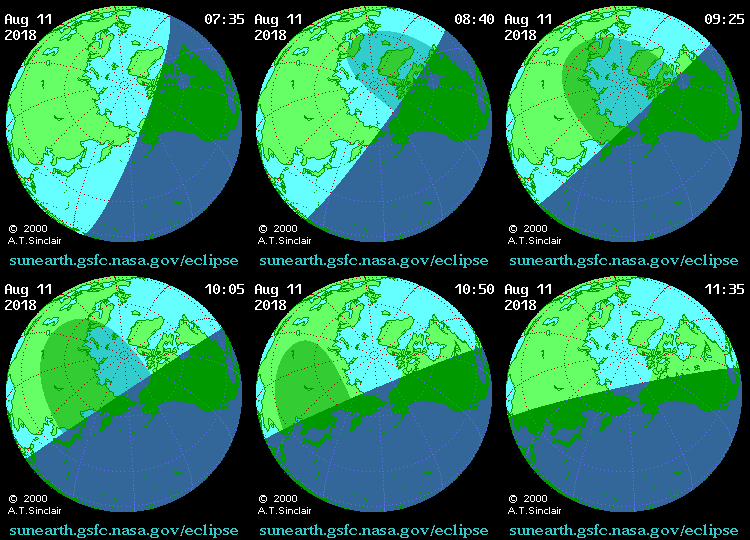
21st-century partial solar eclipse
| Field | Value |
|---|---|
| previous | Solar eclipse of July 13, 2018 |
| next | Solar eclipse of January 6, 2019 |
A partial solar eclipse occurred at the Moon's ascending node of orbit on Saturday, August 11, 2018, with a magnitude of 0.7368. A solar eclipse occurs when the Moon passes between Earth and the Sun, thereby totally or partly obscuring the image of the Sun for a viewer on Earth. A partial solar eclipse occurs in the polar regions of the Earth when the center of the Moon's shadow misses the Earth.
The eclipse was visible in northeastern Canada, Greenland, Northern Europe, and northern Asia.
Visibility
The maximal phase of the partial eclipse was recorded in the East Siberian Sea, near Wrangel Island.
The eclipse was observed in Canada, Greenland, Scotland, most of the Nordic countries (Iceland, Norway, Sweden, Finland), Estonia, Latvia, practically throughout Russia (except for places southwest of the line roughly passing through Pskov, Moscow and Penza, and the most eastern places of the Far East), in Kazakhstan, Kyrgyzstan, Mongolia and China. During sunset, the eclipse was observed in North and South Korea.
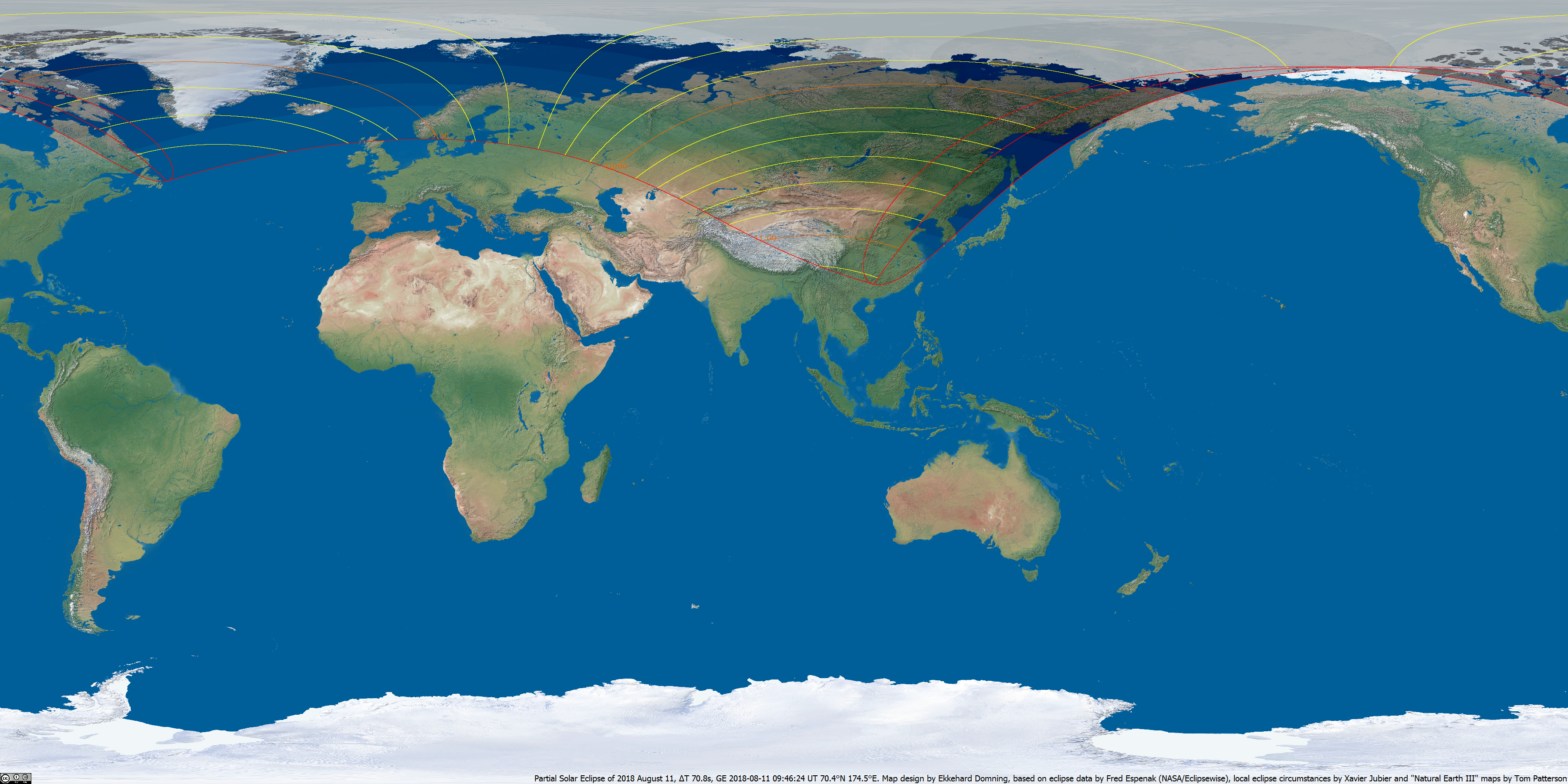
Eclipse timing
Places experiencing partial eclipse
| Country or territory | City or place | Start of partial eclipse | Maximum eclipse | End of partial eclipse | Duration of eclipse (hr:min) | Maximum coverage | References: |
|---|---|---|---|---|---|---|---|
| Mary's Harbour | 05:49:59 (sunrise) | 05:56:30 | 06:19:15 | 0:29 | 4.19% | ||
| Happy Valley-Goose Bay | 05:34:57 (sunrise) | 05:38:54 | 05:55:54 | 0:21 | 5.76% | ||
| Nuuk | 06:04:08 | 06:41:31 | 07:20:02 | 1:16 | 19.99% | ||
| Reykjavík | 08:10:06 | 08:44:23 | 09:19:39 | 1:10 | 10.45% | ||
| Tórshavn | 09:20:26 | 09:48:46 | 10:17:47 | 0:57 | 4.58% | ||
| Pond Inlet | 04:14:57 | 04:59:06 | 05:44:09 | 1:29 | 42.24% | ||
| Oslo | 10:41:08 | 11:01:35 | 11:22:17 | 0:41 | 1.29% | ||
| Pituffik | 05:16:56 | 06:02:44 | 06:49:22 | 1:32 | 43.45% | ||
| Qaanaaq | 06:18:03 | 07:04:15 | 07:51:14 | 1:33 | 44.59% | ||
| Resolute | 03:21:09 | 04:06:26 | 04:52:22 | 1:31 | 49.80% | ||
| Stockholm | 10:49:59 | 11:09:31 | 11:29:13 | 0:39 | 1.04% | ||
| Eureka | 03:23:23 | 04:10:34 | 04:58:19 | 1:35 | 50.80% | ||
| Longyearbyen | 10:28:22 | 11:17:39 | 12:07:20 | 1:39 | 34.99% | ||
| Tallinn | 11:54:04 | 12:17:43 | 12:41:30 | 0:47 | 1.79% | ||
| Coral Harbour | 04:11:37 (sunrise) | 04:17:47 | 04:31:38 | 0:20 | 12.13% | ||
| Helsinki | 11:51:09 | 12:18:00 | 12:45:01 | 0:54 | 2.70% | ||
| Rovaniemi | 11:37:40 | 12:19:25 | 13:01:29 | 1:24 | 13.29% | ||
| Moscow | 12:21:43 | 12:36:23 | 12:51:01 | 0:29 | 0.37% | ||
| Pevek | 21:01:41 | 21:49:06 | 22:08:39 (sunset) | 1:07 | 67.94% | ||
| Magadan | 20:23:41 | 20:54:20 | 21:00:02 (sunset) | 0:36 | 45.56% | ||
| Verkhoyansk | 19:14:19 | 20:04:14 | 20:52:37 | 1:38 | 61.72% | ||
| Yakutsk | 18:24:58 | 19:14:02 | 20:01:19 | 1:36 | 57.62% | ||
| Astana | 15:44:39 | 16:22:56 | 16:59:41 | 1:15 | 9.35% | ||
| Seoul | 19:12:45 | 19:24:07 | 19:30:01 (sunset) | 0:17 | 7.74% | ||
| Pyongyang | 19:10:21 | 19:34:43 | 19:37:37 (sunset) | 0:27 | 19.98% | ||
| Shanghai | 18:30:32 | 18:38:40 | 18:41:16 (sunset) | 0:11 | 3.26% | ||
| Bishkek | 16:18:33 | 16:40:42 | 17:02:12 | 0:44 | 1.76% | ||
| Ulaanbaatar | 17:56:21 | 18:40:55 | 19:23:14 | 1:27 | 29.86% | ||
| Almaty | 16:14:50 | 16:41:33 | 17:07:20 | 0:53 | 3.27% | ||
| Beijing | 18:12:31 | 18:51:18 | 19:16:48 (sunset) | 1:04 | 23.01% |
Gallery
File:Солнечное затмение 11 августа 2018 года в Москве (парк Артёма Боровика) (cropped).jpg|Moscow, Russia, 9:40 UTC File:Solar eclipse of 2018 August 11 in Baley (cropped).jpg|Baley, Russia, 10:24 UTC
Eclipse details
Shown below are two tables displaying details about this particular solar eclipse. The first table outlines times at which the Moon's penumbra or umbra attains the specific parameter, and the second table describes various other parameters pertaining to this eclipse.
| Event | Time (UTC) |
|---|---|
| First Penumbral External Contact | 2018 August 11 at 08:03:16.2 UTC |
| Equatorial Conjunction | 2018 August 11 at 09:21:12.9 UTC |
| Greatest Eclipse | 2018 August 11 at 09:47:28.0 UTC |
| Ecliptic Conjunction | 2018 August 11 at 09:58:53.5 UTC |
| Last Penumbral External Contact | 2018 August 11 at 11:31:53.5 UTC |
| Parameter | Value |
|---|---|
| Eclipse Magnitude | 0.73677 |
| Eclipse Obscuration | 0.67963 |
| Gamma | 1.14758 |
| Sun Right Ascension | 09h24m28.1s |
| Sun Declination | +15°13'19.1" |
| Sun Semi-Diameter | 15'46.8" |
| Sun Equatorial Horizontal Parallax | 08.7" |
| Moon Right Ascension | 09h25m31.3s |
| Moon Declination | +16°21'40.4" |
| Moon Semi-Diameter | 16'40.0" |
| Moon Equatorial Horizontal Parallax | 1°01'10.1" |
| ΔT | 69.2 s |
Eclipse season
This eclipse is part of an eclipse season, a period, roughly every six months, when eclipses occur. Only two (or occasionally three) eclipse seasons occur each year, and each season lasts about 35 days and repeats just short of six months (173 days) later; thus two full eclipse seasons always occur each year. Either two or three eclipses happen each eclipse season. In the sequence below, each eclipse is separated by a fortnight. The first and last eclipse in this sequence is separated by one synodic month.
| July 13 | |||||
|---|---|---|---|---|---|
| Ascending node (new moon) | |||||
| July 27 | |||||
| Descending node (full moon) | |||||
| August 11 | |||||
| Ascending node (new moon) | |||||
| [[File:SE2018Jul13P.png | 200px]] | [[File:Lunar eclipse chart close-2018Jul27.png | 200px]] | [[File:SE2018Aug11P.png | 200px]] |
| Partial solar eclipse | |||||
| Solar Saros 117 | Total lunar eclipse | ||||
| Lunar Saros 129 | Partial solar eclipse | ||||
| Solar Saros 155 |
References
References
- "August 11, 2018 Partial Solar Eclipse". timeanddate.
- "Partial Solar Eclipse of 2018 Aug 11". EclipseWise.com.
This article was imported from Wikipedia and is available under the Creative Commons Attribution-ShareAlike 4.0 License. Content has been adapted to SurfDoc format. Original contributors can be found on the article history page.
Ask Mako anything about Solar eclipse of August 11, 2018 — get instant answers, deeper analysis, and related topics.
Research with MakoFree with your Surf account
Create a free account to save articles, ask Mako questions, and organize your research.
Sign up freeThis content may have been generated or modified by AI. CloudSurf Software LLC is not responsible for the accuracy, completeness, or reliability of AI-generated content. Always verify important information from primary sources.
Report