From Surf Wiki (app.surf) — the open knowledge base
Solanum carolinense
Species of plant

Species of plant
|Solanum carolinense f. albiflorum (Kuntze) Benke |Solanum carolinense var. albiflorum Kuntze |Solanum carolinense var. floridanum (Dunal) Chapm. |Solanum carolinense var. pohlianum Dunal |Solanum floridanum Raf. 1840 |Solanum floridanum Shuttlew. ex Dunal 1852 |Solanum godfreyi Shinners |Solanum pleei Dunal
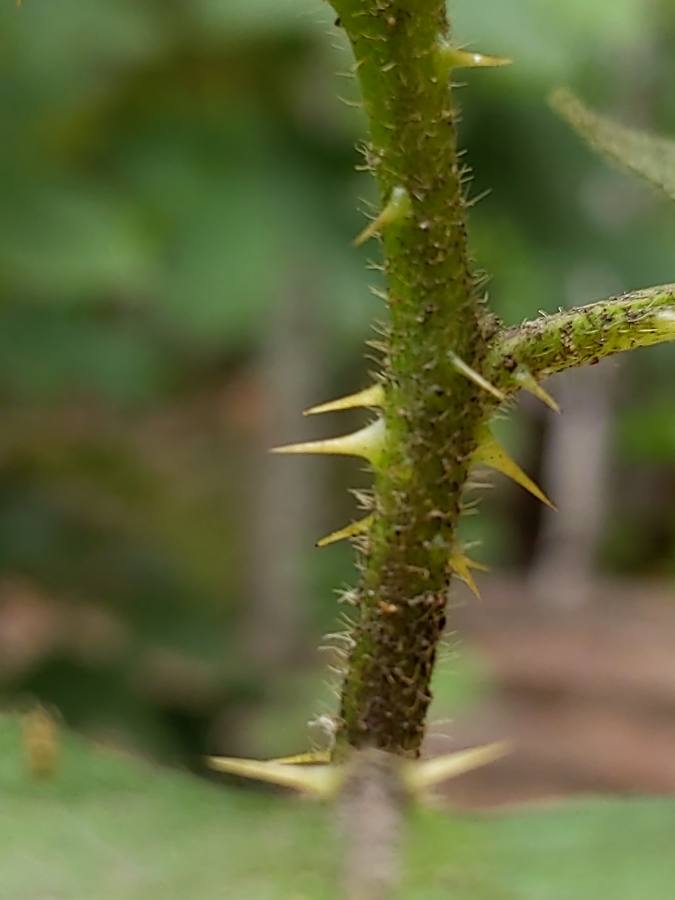
Solanum carolinense, the Carolina horsenettle, is not a true nettle, but a member of the Solanaceae, or nightshade family. It is a perennial herbaceous plant, native to the southeastern United States, though its range has expanded throughout much of temperate North America. The plant is considered to be invasive in parts of Europe, Asia, Africa and Australia. The stem and undersides of larger leaf veins are covered with prickles.
"Horsenettle" is also written "horse nettle" or "horse-nettle", though USDA publications usually use the one-word form. Though there are other horsenettle nightshades, S. carolinense is the species most commonly called "the horsenettle". Other common names include radical weed, sand brier or briar, bull nettle, tread-softly, Solanum mammosum ("apple of Sodom"), devil's tomato and wild tomato.

Description
Leaves are alternate, elliptic-oblong to oval, 2+1/2 to long, and each is irregularly lobed or coarsely toothed. Both surfaces are covered with fine hairs. Leaves smell like potatoes when crushed. The flowers have five petals and are usually white or purple with yellow centers, though there is a blue variant that resembles the tomato flower. The fruits are berries that resemble tomatoes. The immature fruit is dark green with light green stripes, turning yellow and wrinkled as it matures. Each fruit contains around 60 seeds. It flowers throughout the summer, from April to October (on the northern hemisphere). The plant grows to 3 ft tall, is perennial, and spreads by both seeds and underground rhizome. Stems of older plants are woody.
Toxicity
Many parts of the plant have historically been used to create medicines to treat various conditions. It was listed in the United States National Formulary from 1916 to 1936 for use by pharmacists. However all parts of the plant, including its tomato-like fruit, contain toxins in varying degrees due to the presence of solanine glycoalkaloids which is a toxic alkaloid and one of the plant's natural defenses. While ingesting any part of the plant can cause fever, headache, scratchy throat, nausea, vomiting, and diarrhea, ingesting the fruit can cause abdominal pain, circulatory and respiratory depression, or even death.
Ecology
Habitat
These plants can be found growing in pastures, roadsides, railroad margins, and in disturbed areas and waste ground. They grow to about 1 m tall, but are typically shorter, existing as subshrubs. They prefer full sun, but can tolerate both wet or dry conditions. They grow readily in sandy or loamy soils, and may also tolerate a wide range of soil types. They are most vigorous and most likely to become weedy or aggressive on disturbed sites, but can also be found in less disturbed habitats.
Faunal associations and diseases
Bumble bees pollinate the flowers of this species.
At least thirty-two insects, as well as the meadow vole Microtus pennsylvanicus, have been recorded feeding on this species in Virginia alone. The caterpillars of the Synanthedon rileyana moth and the Manduca sexta (tobacco hornworm) moth feed on the plant. Manduca sexta moths prefer inbred plants to outbred plants. The beetle Leptinotarsa juncta specializes on this plant, and the beetle Epitrix fuscula (eggplant flea beetle) eats it as well. These two beetles are its two primary herbivores, and can reduce fruit production by as much as 75% relative to plants protected from all insects. Anthonomus nigrinus feeds on the flowers, and Trichobaris trinotata bores into the stems. This plant is also eaten by Leptinotarsa decemlineata (the Colorado potato beetle) and has been recorded as being eaten at very low rates by pupae of an unidentified species of the family Gelechiidae.
Parasitic nematodes of the genus Pratylenchus have been found on lesions on its roots, however causing little damage. The fungus Rhizoctonia solani was found causing root rot, particularly under wet conditions in plants damaged by trampling. The plant is also affected by powdery mildew species such as Podosphaera solanacearum.
Fruits are eaten by a variety of native animals, including ring-necked pheasant, bobwhite, wild turkey, and striped skunk. Most mammals avoid eating the stems and leaves due to both the spines and toxicity of the plant.
Weed
Carolina horsenettle is considered a noxious weed in one US state (Alaska). It can spread vegetatively by underground rhizomes as well as by seed. It is resistant to many postemergent herbicides and somewhat resistant to broad-spectrum herbicides such as glyphosate and 2,4-D. In fact, herbicide use often selects for horsenettle by removing competing weeds. It is an especially despised weed by gardeners who hand-weed, as the prickles tend to penetrate the skin and then break off when the plant is grasped. The deep root also makes it difficult to remove.


References
References
- "''Solanum carolinense''".
- {{aut
- {{PLANTS
- "USDA Plants Database".
- "EPPO Panel on Invasive Alien Plants".
- "Solanum carolinense [Morella della Carolina] - Flora Italiana".
- "Identification and Control of Horsenettle ''(Solanum carolinense)'' in Virginia".
- "Solanum carolinense (Apple of Sodom, Bull Nettle, Carolina Horse-Nettle, Devil's Potato, Devil's Tomato, Horsenettle, Horse Nettle, Poisonous Potato, Thorn Apple, Wild Tomato) {{!}} North Carolina Extension Gardener Plant Toolbox".
- "URBAN HERBS: Horse Nettle".
- "Solanum carolinense - Useful Temperate Plants".
- "Horse Nettle (Solanum carolinense)".
- Wise, Michael J.. (2007). "The Herbivores of Solanum carolinense (Horsenettle) in Northern Virginia: Natural History and Damage Assessment". Southeastern Naturalist.
- Wise, Michael J.. (1996-10-01). "Impact of two specialist insect herbivores on reproduction of horse nettle, Solanum carolinense". Oecologia.
- Nichols, Robert L.. (1992). "Insects, Nematodes, and Pathogens Associated with Horsenettle (Solanum carolinense) in Bermudagrass (Cynodon dactylon) Pastures". Weed Science.
- Braun, Uwe. (2012). "Taxonomic manual of the Erysiphales (powdery mildews)". CBS-KNAW fungal biodiversity centre.
- "Plants Profile for Solanum carolinense (Carolina horsenettle)".
This article was imported from Wikipedia and is available under the Creative Commons Attribution-ShareAlike 4.0 License. Content has been adapted to SurfDoc format. Original contributors can be found on the article history page.
Ask Mako anything about Solanum carolinense — get instant answers, deeper analysis, and related topics.
Research with MakoFree with your Surf account
Create a free account to save articles, ask Mako questions, and organize your research.
Sign up freeThis content may have been generated or modified by AI. CloudSurf Software LLC is not responsible for the accuracy, completeness, or reliability of AI-generated content. Always verify important information from primary sources.
Report