From Surf Wiki (app.surf) — the open knowledge base
Solanum aethiopicum
Fruiting plant
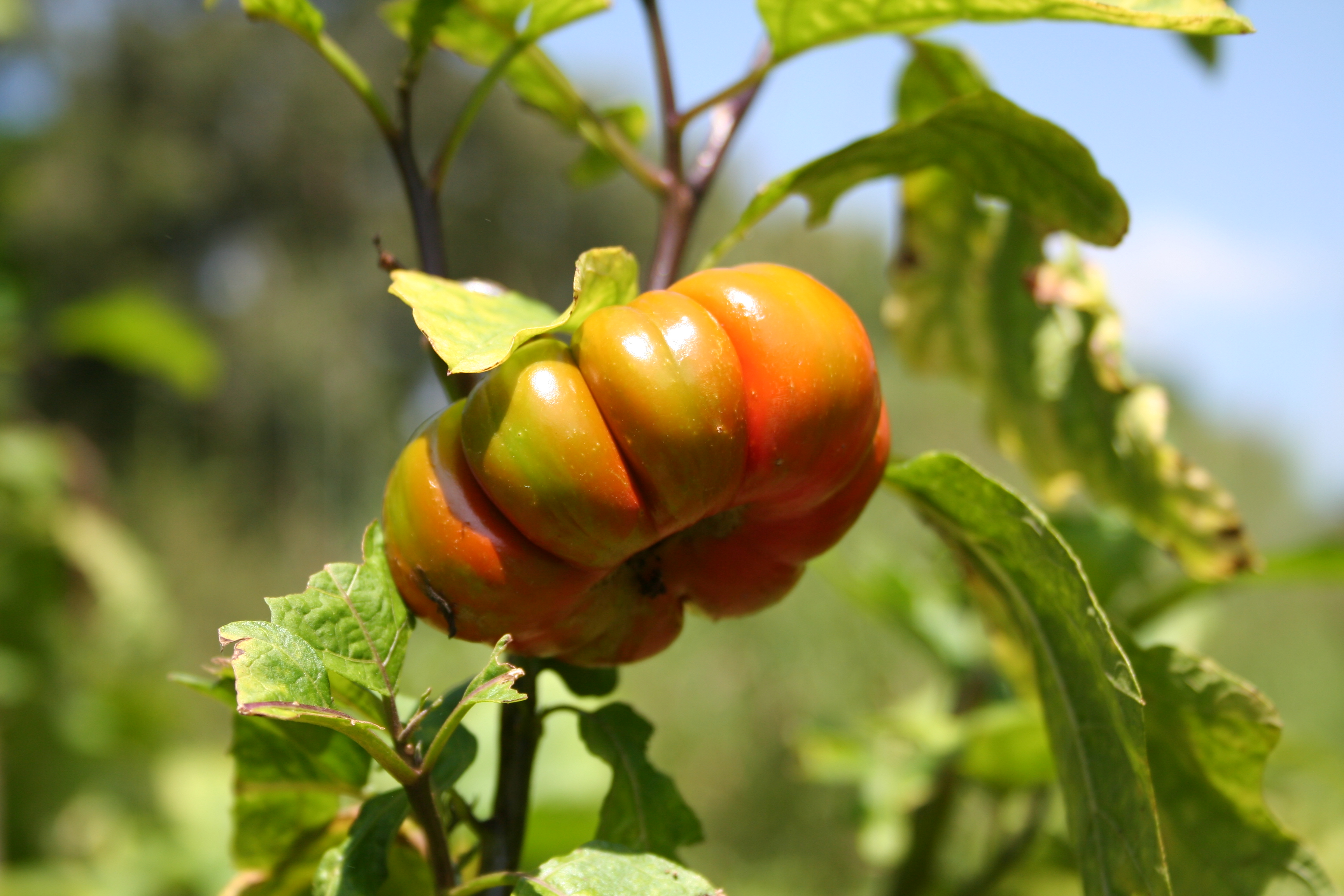
Fruiting plant
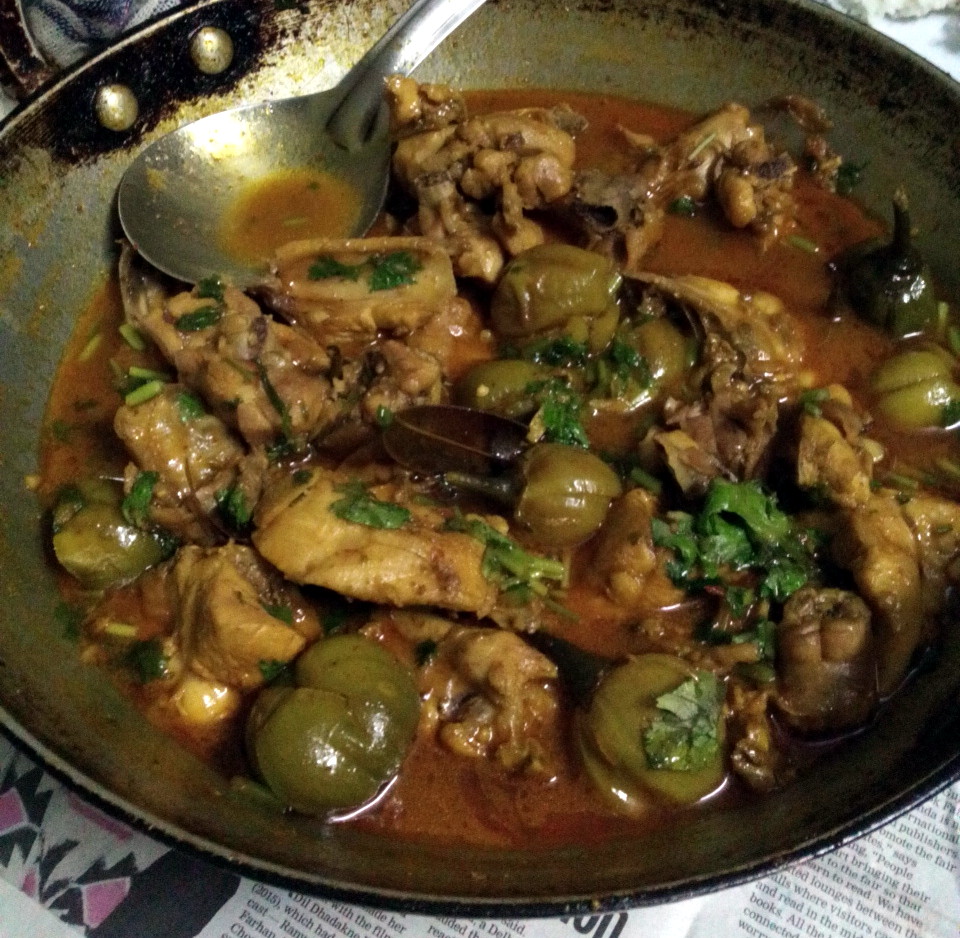
Solanum aethiopicum, the bitter tomato, Ethiopian eggplant, or nakati, is a fruiting plant of the genus Solanum mainly found in Asia and Tropical Africa. It is also known as Ethiopian nightshade, garden eggs, pumpkin-on-a-stick, and mock tomato. It is a popular vegetable in north-east India, and is known as khamen akhaba in Manipuri and samṭawk in Mizo. They are called Titay bii or simply bii in Darjeeling, Sikkim and Nepal, and are relished with meat, particularly pork. These names are a result of its varied morphology, with ripe fruit often looking like a cross between an eggplant and a tomato, which are also from Solanum. In fact, the Ethiopian eggplant was so much confused with the ordinary eggplant that this was considered by some a variety violaceum of S. aethiopicum.
Genetics
Ethiopian eggplant may have originated from the domestication of Solanum anguivi. The scarlet eggplant, also known as Gilo or jiló, was long held to be a distinct species (S. gilo) but is nowadays generally considered to be a cultivar group of S. aethiopicum.
Ethiopian eggplant has been used as a source of disease resistance genes for several commercially grown Solanaceae crops, including Solanum melongena (eggplant). A lack of genomic resources has meant that breeding has lagged behind other vegetables, although a 1.02-Gb draft genome sequenced by BGI, with single-nucleotide polymorphisms identified for use by breeders was released in 2019. A high-quality genomic assembly of S. aethiopicum was released in 2025, enabling the identification of the genetic basis of key agronomic traits.
Uses
The leaves of Solanum aethiopicum are eaten as a leaf vegetable and are actually more nutritious than the fruit.
The highly variable fruit of the plant is eaten both raw and cooked and is becoming more popular as a cultivated crop. These fruits are usually harvested while still green, before the skin becomes thick. Bitterness increases with higher levels of saponin in the fruit, some varieties being sweet and others very bitter. When the berries mature, they turn bright red because of high carotene content.
Solanum aethiopicum is used as an ornamental in Asia.
In Nigeria, Igbo people use it as a substitute for kola nut, especially for those who do not want to chew kola nut, in which case it is used to welcome guests at home or before resumption of a traditional ceremony.
Garden egg, as it is commonly known in Nigeria, is sometimes used to make a tomato-based sauce which can be used to eat yam.
Cultivation
Currently there is a large movement towards increased cultivation of Solanum aethiopicum in West Africa. It grows all year long and can produce high fruit yields. However, low germination rates are an obstacle to wider cultivation.
The only place where S. aethiopicum is grown to a significant extent in Europe lies in South Italy, in Rotonda in the Basilicata, where this plant is of some commercial importance. It was likely introduced by veterans returning from East Africa after the colonial war in the late 19th century.
Cultivars
Cultivars have been allocated into four groups, termed Gilo, Shum, Kumba and Aculeatum. Gilo are grown only for fruit, Shum only for their leaves, Kumba are grown for both their leaves and fruit, Aculateum are ornamental.
- ''''Turkish Orange'''' or ''''Turkish Italian'''' : The fruits of this variety are about 2 inches in diameter and turn bright orange-red when ripe, although they are usually eaten when still green. The sweet taste is often used in Thai curry. It can produce fruit within just 75 days after planting. :
- ''''Sweet Red'''' : These striped fruits, just 1 inch in diameter, have a strong but non-bitter flavor. The plant is thornless and grows up to 3 feet tall. It can produce fruit 125 days after planting. :
- ''''Small Ruffled Red'''', ''''Red Ruffles'''', or ''''Hmong Red'''' : The two-inch berries of the 'Hmong Red' have deep creases and a bitter flavor used in Southeast Asian cooking. It can produce fruit 100 days after planting. :
- '**Gilo'''', ''''Jiló'''', ''''Scarlet eggplant'''' or **garden eggs''' : Grown mainly in Brazil and sub-Saharan Africa. It has a bitter taste and is usually consumed cooked. The plant takes 75 days to reach maturity. Plants vary in size, shape, taste, etc. :
- ''''Liberian eggplant'''' : Landrace from Liberia. Immature fruit are white in color. They are used in soups and stews like Tabughee. The plant takes 85 days to reach maturity.
Synonyms
Always make sure to check for homonyms before placing redirects
these refer to the Ethiopian eggplant in the strict sense: Lycopersicon aethiopicum (L.) Mill. Solanum aethiopicum Jacq.
these must be checked whether they refer to it or to the gilo (and should redirect there): Pseudocapsicum torulosum Moench Solanum aethiopicum var. aculeatum Dunal :Solanum aculeatum (Jacq.) O.E.Schulz in Urb is now Solanum tetramerum Dunal Solanum aethiopicum var. armatum Bitter :Solanum armatum Forssk. is now Solanum virginianum L. :Solanum armatum R.Br. is now Solanum prinophyllum Dunal Solanum aethiopicum var. giorgii (De Wild.) Bitter Solanum aethiopicum var. modicelobatum Bitter Solanum aethiopicum var. inerme Dunal Solanum aethiopicum var. integrifolium (Poir.) O.E.Schulz Solanum aethiopicum var. paaschenianum (H.J.P.Winkl.) Bitter Solanum ambrosiacum Vell. Solanum aurantiacum Sendtn. Solanum brieyi De Wild. Solanum elaeagnifolium Herb. Willd. ex Steud. :Not Solanum elaeagnifolium Cav. :Solanum elaeagnifolium var. ovalifolium Kuntze is now Solanum aridum Morong Solanum elskensii De Wild. Solanum geminifolium Thonn. Solanum giorgii De Wild. Solanum hybridum Jacq. Solanum integrifolium Poir. Solanum kupperi Markgr. Solanum latifolium Poir. :Solanum latifolium Dunal in DC. is now Solanum repandum G.Forst. Solanum lobelii Ten. Solanum lusitanicum Dunal Solanum naumannii Engl. Solanum obtusifolium Willd. :Solanum obtusifolium Hartw. ex Sendtn. in Mart. is now Solanum ferrugineum Jacq. :Solanum obtusifolium Dunal is now Solanum elaeagnifolium Cav. Solanum olivare Pailleux & Bois Solanum ovatifolium De Wild. Solanum paaschenianum H.J.P.Winkl. Solanum poggei Dammer Solanum pseudomelongena Ten. Solanum racemiflorum Dunal Solanum scabrum Kunth Solanum scabrum Zuccagni Solanum scabrum Zuccagni Solanum scabrum Jacq. :Not Solanum scabrum Mill. :Solanum scabrum Vahl is now Solanum volubile Sw. :Solanum scabrum Ruiz & Pav. is now Solanum saponaceum Dunal :Solanum scabrum Lam. is now Solanum muricatum Aiton Solanum schroederi Dammer Solanum sparsespinosum De Wild. Solanum subsessile De Wild. Solanum sudanense Hammerst. Solanum texanum Hort. ex Ten. Solanum texanum Dunal Solanum undatum var. violaceum Dunal :Not Solanum undatum Lam. :Solanum undatum Walsh is now Solanum lycocarpum A.St.-Hil. :Solanum undatum Bouton ex Dunal in DC. is now Solanum linnaeanum Hepper & P.-M.L. Jaeger Solanum violaceum DC. ex Dunal :Not Solanum violaceum Ortega :Solanum aethiopicum var. violaceum is now eggplant :Solanum violaceum Hort. ex Dunal in DC. is now Solanum houstonii Martyn :Solanum violaceum R.Br. is now Solanum brownii Dunal :Solanum violaceum Blume is now Lycianthes sp. :(detailed description of "S. violaceum" situation at Eggplant article) Solanum willdenowii Roem. & Schult. Solanum worsleyi W.Watson Solanum zuccagnianum var. allogonum Dunal Solanum zuccagnianum Dunal
these refer to the gilo: Solanum gilo Raddi Solanum gilo Req. ex Dunal Solanum gilo var. ellipsoideum Bitter Solanum gilo var. erectifructum Bitter Solanum gilo var. pierreanum (Pailleux & Bois) Bitter Solanum gilo subsp. megalacanthum Bitter Solanum gilo var. sparseaculeatum Bitter Solanum gilo subsp. monteiroi (C.H.Wright) Bitter Solanum monteiroi C.H.Wright Solanum pierreanum Paill. & Bois
--
References
References
- "Solanum aethiopicum - Bitter Tomato".
- {{PLANTS
- "Capsicum 'Pumpkin on a Stick'".
- "Pumpkin-on-a-stick".
- (2012-07-01). "Characterization of interspecific hybrids and first backcross generations from crosses between two cultivated eggplants (Solanum melongena and S. aethiopicum Kumba group) and implications for eggplant breeding". Euphytica.
- (2019-10-01). "Draft genome sequence of Solanum aethiopicum provides insights into disease resistance, drought tolerance, and the evolution of the genome". GigaScience.
- (2025-04-03). "Solanum pan-genetics reveals paralogues as contingencies in crop engineering". Nature.
- (July 1986). "Taxonomy of Scarlet Eggplants, Solanum Aethiopicum L". Acta Horticulturae.
- (13 April 2021). "Farmer preferred traits and genotype choices in Solanum aethiopicum L., Shum group". Journal of Ethnobiology and Ethnomedicine.
- "Garden Egg".
This article was imported from Wikipedia and is available under the Creative Commons Attribution-ShareAlike 4.0 License. Content has been adapted to SurfDoc format. Original contributors can be found on the article history page.
Ask Mako anything about Solanum aethiopicum — get instant answers, deeper analysis, and related topics.
Research with MakoFree with your Surf account
Create a free account to save articles, ask Mako questions, and organize your research.
Sign up freeThis content may have been generated or modified by AI. CloudSurf Software LLC is not responsible for the accuracy, completeness, or reliability of AI-generated content. Always verify important information from primary sources.
Report