From Surf Wiki (app.surf) — the open knowledge base
Soil health
A state of soil, meeting ecosystem functions

A state of soil, meeting ecosystem functions
Soil health is a state of a soil meeting its range of ecosystem functions as appropriate to its environment. In more colloquial terms, the health of soil arises from favorable interactions of all soil components (living and non-living) that belong together, as in microbiota, plants and animals. It is possible that a soil can be healthy in terms of ecosystem functioning but not necessarily serve crop production or human nutrition directly, hence the scientific debate on terms and measurements.
Soil health testing is pursued as an assessment of this status but tends to be confined largely to agronomic objectives. Soil health depends on soil biodiversity (with a robust soil biota), and it can be improved via soil management, especially by care to keep protective living covers on the soil and by natural (carbon-containing) soil amendments. Inorganic fertilizers do not necessarily damage soil health if they are not used in excess, and if they bring about a general improvement of overall plant growth which contributes more carbon-containing residues to the soil.
Aspects
The term soil health is used to describe the state of a soil in:
- Sustaining plant and animal productivity (agronomic focus);
- Enhancing biodiversity (Soil biodiversity) (ecological focus);
- Maintaining or enhancing water and air quality (environmental/climate focus);
- Supporting human health and habitation.
- sequestering carbon
The phrase "soil health" has largely replaced the older "soil quality". The primary difference between the two expressions is that soil quality was focused on the ability of the soil serve a particular purpose, as in "quality of soil for maize production" or "quality of soil for roadbed preparation" and so on. The word "health" shifted the perception to be an integrative, holistic, and systematic view of the soil's ability to function as a self-sustaining system. The two expressions still overlap considerably. Soil health as an expression derives from organic or "biological farming" movements in Europe, however, well before soil quality was first applied as a discipline around 1990. In 1978, Swiss soil biologist Dr Otto Buess wrote an essay "The Health of Soil and Plants" which largely defines the field even today.
The underlying principle in the use of the term "soil health" is that soil is not just an inert, lifeless growing medium, which modern intensive farming tends to represent, rather it is a living, dynamic and ever-so-subtly changing whole environment. It turns out that soils highly fertile from the point of view of crop productivity are also lively from a biological point of view. It is now commonly recognized that soil microbial biomass is large: in temperate grassland soil the bacterial and fungal biomass have been documented to be 1–2 t/hectare and 2–5 t/ha, respectively. Some microbiologists now believe that 80% of soil nutrient functions are essentially controlled by microbes.
Using the human health analogy, a healthy soil can be categorized as one:
- In a state of composite well-being in terms of biological, chemical and physical properties;
- Not diseased or infirmed (i.e. not degraded, nor degrading), nor causing negative off-site impacts;
- With each of its qualities cooperatively functioning such that the soil reaches its full potential and resists degradation;
- Providing a full range of functions (especially nutrient, carbon and water cycling) and in such a way that it maintains this capacity into the future.
Conceptualisation
Soil health is the condition of the soil in a defined space and at a defined scale relative to a set of benchmarks that encompass healthy functioning. It would not be appropriate to refer to soil health for soil-roadbed preparation, as in the analogy of soil quality in a functional class. The definition of soil health may vary between users of the term as alternative users may place differing priorities upon the multiple functions of a soil. Therefore, the term soil health can only be understood within the context of the user of the term, and their aspirations of a soil, as well as by the boundary definition of the soil at issue. Finally, intrinsic to the discussion on soil health are many potentially conflicting interpretations, especially ecological landscape assessment vs agronomic objectives, each claiming to have soil health criteria.
Interpretation
Different soils will have different benchmarks of health depending on the "inherited" qualities, and on the geographic circumstance of the soil. The generic aspects defining a healthy soil can be considered as follows:
- "Productive" options are broad;
- Life diversity is broad;
- Absorbency, storing, recycling and processing is high in relation to limits set by climate;
- Water runoff quality is of high standard;
- Low entropy; and
- No damage to or loss of the fundamental components.
This translates to:
- A comprehensive cover of vegetation;
- Carbon levels relatively close to the limits set by soil type and climate;
- Little leakage of nutrients from the ecosystem;
- Biological and agricultural productivity relatively close to the limits set by the soil environment and climate;
- Only geological rates of erosion;
- No accumulation of contaminants; and,
An unhealthy soil thus is the simple converse of the above.
Measurement
On the basis of the above, soil health will be measured in terms of individual ecosystem services provided relative to the benchmark. Specific benchmarks used to evaluate soil health include CO2 release, humus levels, microbial activity, and available calcium.
Soil health testing is spreading in the United States, Australia and South Africa. Cornell University, a land-grant college in NY State, has had a Soil Health Test since 2006. Woods End Laboratories, a private soil lab founded in Maine in 1975, has offered a soil quality package since 1985. Both these services combine physical (aggregate stability), chemical (mineral balance), and biological (CO2 respiration) analyses, which today are considered hallmarks of soil health testing. The approach of other soil labs also entering the soil health field is to add into common chemical nutrient testing a biological set of factors not normally included in routine soil testing. The best example is adding biological soil respiration ("CO2-Burst") as a test procedure; this has already been adapted to modern commercial labs in the period since 2006.
There is however resistance among soil testing labs and university scientists to add new biological tests, primarily because the established metric of soil fertility is largely based on models constructed from "crop response" studies, which match crop yield to specific chemical nutrient concentrations, and no similar models appear to exist for soil health tests. Critics of novel soil health tests argue that they may be insensitive to management changes.
Soil test methods have evolved slowly over the past 40 years. However, in this same time USA soils have also lost up to 75% of their carbon (humus), causing biological fertility and ecosystem functioning to decline; how much is debatable. Many critics of the conventional system say the loss of soil quality is sufficient evidence that the old soil testing models have failed us, and need to be replaced with new approaches. These older models have stressed "maximum yield" and " yield calibration" to such an extent that related factors have been overlooked. Thus, surface and groundwater pollution with excess nutrients (nitrates and phosphates) has grown enormously, and early 2000s measures were reported (in the United States) to be the worst it has been since the 1970s, before the advent of environmental consciousness.
Regenerative Agriculture & Soil Health
Regenerative agriculture (RA) is a holistic approach to farming that emphasizes soil conservation, biodiversity, and sustainable land management. Utilizing various soil health practices, regenerative agriculture "integrates local and indigenous knowledge of landscapes, as well as their management, with established scientific knowledge" while aiming to improve the socioeconomic well-being of a community. Central to RA is the principle that healthy soil is foundational to sustainable agriculture, essentially focusing on feeding the soil rather than feeding each plant. RA serves as an opportunity to directly apply soil health practices to produce crops sustainably. Research highlights that regenerative agriculture enhances nutrient cycling while supporting biodiversity and ecosystem services, which are vital for maintaining soil health. Practices such as cover cropping, crop rotation, no-till farming, integrated pest management, permaculture, and composting support self-sustaining soil ecosystems – further enriching soil fertility while reducing dependence on chemical fertilizers and pesticides, demonstrating that cover crops not only reduce erosion but also improve nutrient cycling.
RA's primary contributions to soil health is the enhancement of organic matter and microbial activity. A myriad of practices can be used to increase soil organic content, like cover cropping, composting, and crop rotation to improve soil fertility, water retention, and ability to resist soil erosion. Research supports that soil microbial diversity is critical for maintaining fertility and resilience against the changing climate, and regenerative practices have been shown to enhance and support this biodiversity. Cover crops act as a protective blanket during the winter months, preventing compaction and erosion, while their roots maintain soil structure and nurture microbial diversity. Crop rotation further enriches soil microbiomes by diversifying nutrient and microbial inputs, disrupting pest cycles, and decreasing reliance on chemical inputs. Similarly, no-till farming minimizes physical disturbances to the soil, preserving its structure and improving water infiltration while conserving organic matter and keeping carbon in the soil, and not in the atmosphere. Permaculture is a design philosophy often incorporated into RA due to its focus on sustainable, ecosystem-based farming practices. Permaculture supports soil health by fostering natural nutrient cycles through techniques like companion planting, mulching, and perennial cropping. It emphasizes the creation of agricultural systems that model and mimic natural ecosystems, promoting biodiversity, more efficient resource use, and long-term soil health. These practices minimize soil erosion, enhance organic matter, and encourage beneficial microbial activity.
Regenerative agriculture offers significant economic and community benefits as well, nurturing resilient farming systems that enhance local economies and promote social well-being. Economically, RA reduces input costs by minimizing reliance on chemical fertilizers and pesticides, leading to lower operational expenses and increased profitability for farmers. Enhanced soil health from practices such as cover cropping and composting improves crop yields and market quality, which can provide greater productivity and financial stability. Although, the lack of heavy machinery increases the amount of necessary labor and steepens dependence on workers. Additionally, RA is designed to support community health by improving access to fresh local produce and working to alleviate food insecurity. Through RA, Community Supported Agriculture (CSA) systems can be established to bridge the divides between farmers and consumers, strengthen community ties, and facilitate a direct-market relationship. These practices not only sustain farmers but benefit surrounding communities by promoting sustainable livelihoods and resilience to environmental changes.
RA also addresses climate challenges by promoting carbon sequestration through practices like composting and no-till farming. These methods not only mitigate climate change by lowering atmospheric CO2 levels but also improve soil health, boosting soil productivity and resilience (Mishra et al. 295-309). Increasing soil organic carbon through RA practices has measurable effects on reducing atmospheric CO2 levels while improving soil functionality. The addition of organic material increases levels of soil organic carbon, thereby reducing atmospheric CO2 levels and enhancing soil fertility and productivity.
These practices collectively cultivate a resilient soil ecosystem that supports plant growth, enhances pest and disease resistance, and mitigates greenhouse gas emissions through carbon storage. However, despite its many benefits, RA faces challenges in assessment and widespread adoption. Biological indicators of soil health are often underrepresented in current evaluations due to their complexity and the context-specific knowledge required, as biological indicators of soil health often require context-specific ecological knowledge and are not universally standardized. Addressing these gaps and advancing research into RA's ecological and socioeconomic impacts will be crucial for its broader implementation and success.
Soil health gap
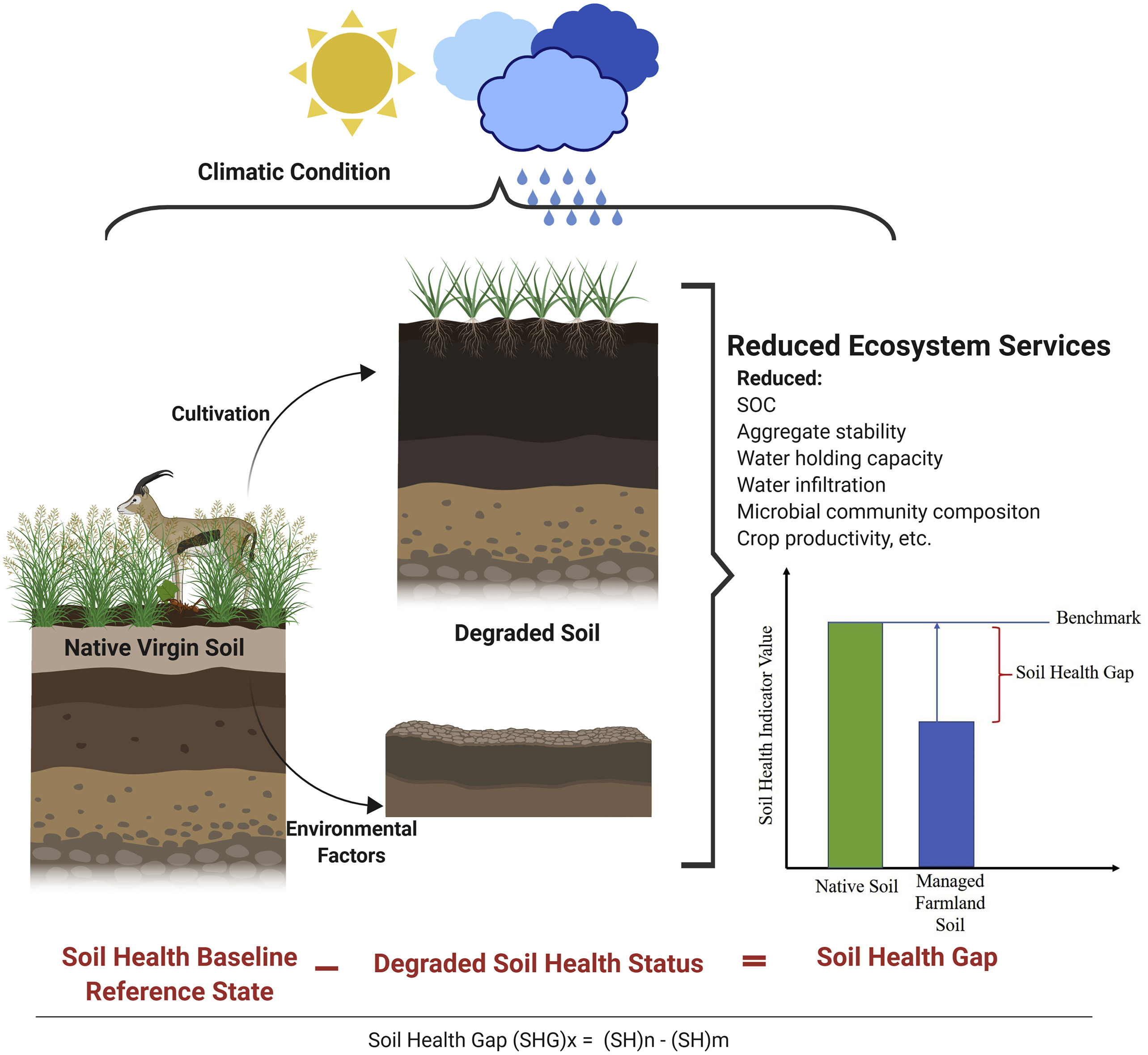
The importance of soil for global food security, agro-ecosystem, environment, and human life has exponentially shifted the research trends toward soil health. However, the lack of a site/region-specific benchmark has limited the research toward understanding the effect of different agronomic managements on soil health. In 2020, Maharjan and his team introduced a new term and concept, "Soil Health Gap" and described how native land in a particular region can help in establishing the benchmark to compare the efficacies of different management practices and at the same time, it can be used in understanding quantitative difference in soil health status.
References
References
- [[Natural Resources Conservation Service. NRCS]] 2013
- "Soil Quality | NRCS Colorado".
- (June 2018). "Managing for soil carbon sequestration: Let's get realistic". Global Change Biology.
- (December 2003). "Microbial diversity and soil functions". European Journal of Soil Science.
- [http://www.conservationwebinars.net/webinars/role-of-soil-biology-in-improving-soil-quality The Role of Soil Biology in Improving Soils] {{webarchive. link. (2014-03-12 [[Webinar]])
- (22 December 2016). "Listing 17 microbes and their effects on the soil and plant health functions". Explogrow, Dr Malherbe, BSc, BSc Hons., MSc, Pr.Sci.Nat..
- "Healthy Soil".
- Kick, Chris. (18 February 2014). "New soil test measures soil health - Farm and Dairy".
- (2023-03-01). "A minimum suite of soil health indicators for North American agriculture". Soil Security.
- (January 2017). "Soil Health Indicators Do Not Differentiate among Agronomic Management Systems in North Carolina Soils". Soil Science Society of America Journal.
- Bernard T. Nolan. (January 1998). "A National Look at Nitrate Contamination of Ground Water". Water Conditioning and Purification.
- Estimating Soil Carbon, Nitrogen, and Phosphorus Mineralization from Short-Term Carbon Dioxide Respiration Communications. in Soil Science and Plant Analysis, 39: 2706–2720, 2008
- Soil CO2 respiration: Comparison of chemical titration, CO2 IRGA analysis and the Solvita gel system. Renewable Agriculture and Food Systems: 23(2); 171–176
- Schreefel, L.. (2020-09-01). "Regenerative agriculture – the soil is the base". Global Food Security.
- (14 November 2023). "Global Application of Regenerative Agriculture: A Review of Definitions and Assessment Approaches". Sustainability.
- Mays, Daniel. (10 November 2020). "The No-Till Organic Vegetable Farm: How to Start and Run a Profitable Market Garden That Builds Health in Soil, Crops, and Communities". Storey Publishing, LLC.
- (2023-01-27). "Regenerative Agriculture—A Literature Review on the Practices and Mechanisms Used to Improve Soil Health". Sustainability.
- (2024-06-21). "Soil health research in the context of regenerative agriculture". AgResearch.
- Spiegal, Bill. (18 March 2016). "Investing In Soil Health Pays".
- (15 June 2020). "Soil Health and Sustainable Agriculture". Sustainability.
- Zhang, Qian Forrest. (6 November 2024). "From Sustainable Agriculture to Sustainable Agrifood Systems: A Comparative Review of Alternative Models". Sustainability.
- (2024-10-10). "Diachronic assessment of soil organic C and N dynamics under long-term no-till cropping systems in the tropical upland of Cambodia". SOIL.
- (2022-09-08). "Towards Sustainable Natural Resources: Monitoring and Managing Ecosystem Biodiversity". Springer Nature.
- (31 May 2023). "What climate and environmental benefits of regenerative agriculture practices? An evidence review". Environmental Research Communications.
- "What are the Benefits of Compost".
- Schreefel, Loekie. (2025-11-05). "Beyond the buzz: analyzing actors promoting regenerative agriculture in Europe". npj Sustainable Agriculture.
- Schreefel, L.. (2024-12-01). "How to monitor the 'success' of agricultural sustainability: A perspective". Global Food Security.
- (2020-09-01). "Soil Health Gap: A concept to establish a benchmark for soil health management". Global Ecology and Conservation.
This article was imported from Wikipedia and is available under the Creative Commons Attribution-ShareAlike 4.0 License. Content has been adapted to SurfDoc format. Original contributors can be found on the article history page.
Ask Mako anything about Soil health — get instant answers, deeper analysis, and related topics.
Research with MakoFree with your Surf account
Create a free account to save articles, ask Mako questions, and organize your research.
Sign up freeThis content may have been generated or modified by AI. CloudSurf Software LLC is not responsible for the accuracy, completeness, or reliability of AI-generated content. Always verify important information from primary sources.
Report