From Surf Wiki (app.surf) — the open knowledge base
SNCB Type 12
Class of steam locomotives
Class of steam locomotives
| Field | Value |
|---|---|
| powertype | Steam |
| name | NMBS/SNCB Type 12 |
| image | Nmbstype12.jpg |
| caption | 12.004 circa 1940 |
| designer | Raoul Notesse |
| builder | Société Anonyme John Cockerill |
| builddate | 1938–1939 |
| totalproduction | 6 |
| whytetype | |
| uicclass | 2′B1′ h2 |
| gauge | |
| leadingdiameter | 900 mm |
| driverdiameter | 2100 mm |
| trailingdiameter | 1262 mm |
| locoweight | 89 t |
| locotenderweight | 116 t |
| fueltype | Coal |
| fuelcap | 8 t |
| watercap | 24000 L |
| boilerpressure | 18 kg/cm2 |
| cylindercount | Two, inside |
| cylindersize | 480 x |
| tractiveeffort | 118.52 kN |
| poweroutput | 2500 hp |
| maxspeed | 140 km/h (service) 165 km/h (record) |
| operator | SNCB/NMBS |
| operatorclass | Type 12 |
| fleetnumbers | 1201 - 1206 |
| withdrawndate | July–September 1962 |
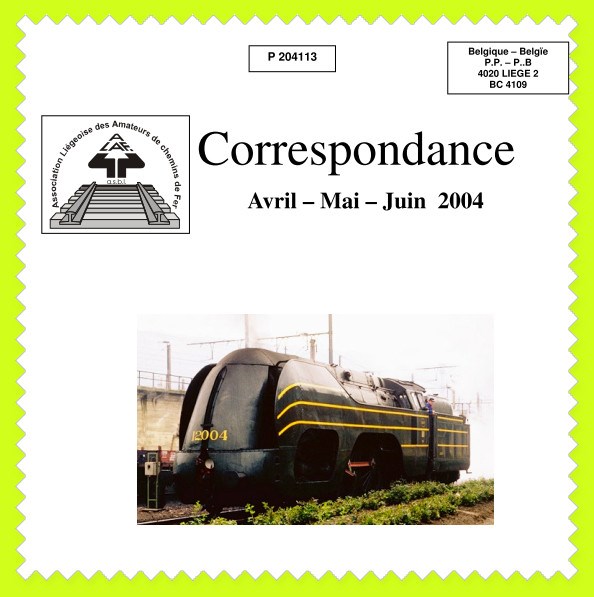
| preservedunits | 12.004 |
| restoredate | 1985 |
| disposition | 1 preserved, 5 scrapped |
12.001 – 12.006
The NMBS/SNCB Type 12 was a class of steam locomotives built in 1938–1939 for the fast lightweight Ostend boat trains operated by the National Railway Company of Belgium.
Design and construction
The class was designed by engineer Raoul Notesse, based on the Canadian Pacific Railway's successful 4-4-4 "Jubilee" semi-streamlined locomotives of 1936/7, but also incorporated the ideas on streamlining of André Huet.
The type 12 locomotives were produced for the Belgian Consortium of Locomotive Construction, by Société anonyme John Cockerill at Seraing, near Liège.
The locomotive bodies were fully streamlined except for openings to provide access to the valve gear and the crankshaft. The design included inside cylinders but outside valve gear to reduce oscillation at speed.
Operation
The class was designed for the fast, relatively lightweight, boat trains on the 124 km journey between Brussels and Ostend to be capable of speeds of 120 -. They were also used on Brussels–Liège expresses. During World War II they were used on Brussels–Ostend, Lontzen/Herbesthal, and Lille trains. For most of their careers, the type 12s were assigned to Schaerbeek, near Brussels.
The class was rated at a maximum speed of 140 km/h. However, on 12 June 1939 one type 12 locomotive completed the 105 km from Brussels to Ostend in 57 minutes at a maximum speed of 165 km/h.
The members of the class ended their careers on the Brussels–Mons and Brussels–Tournai services and were finally withdrawn 27 September 1962. No. 12.004 had been preserved by SNCB and was brought back to running order for the 150th anniversary of railways in Belgium in 1985 but was subsequently left exposed to the elements. Since September 2015 12.004 has been in the "Train World" railway museum at Schaerbeek, so this locomotive is back home.
In fiction
François Schuiten, the Belgian comic book author, made No. 12.004 the central theme of his Graphic novel La Douce, published in 2012.
In Thomas & Friends: The Great Race, a Belgian character named Axel was based on this locomotive.
References
Notes
Bibliography
References
- Notesse, Raoul. (15 May 1939). "La nouvelle locomotive <<Atlantic No. 1201>>". Bulletin Mensuel de la Société Nationale de Chemins de Fer Belges.
- The maker’s plate on the locomotives states “Consortium belge de constructeurs de locomotives COCKERILL – 1939″.
- (1987). "The Great Book of Trains". Portland House.
- "Les Locomotives Vapeur SNCB: Locomotives de type 12". Association Liègeoise des Amateurs de chemins de Fer.
- (April 2004). "La Locomotive type 12 gagne le ruban bleu". Correspondance, Trimestriel de l'ALAF.
- Schuiten, François. (2012). "12 La Douce". Casterman.
- [http://metro.co.uk/2016/04/06/thomas-friends-the-great-race-unveils-diverse-train-line-up-5798197/ ''Thomas & Friends The Great Race unveils diverse train line-up''], retrieved 6 Sep 2016.
This article was imported from Wikipedia and is available under the Creative Commons Attribution-ShareAlike 4.0 License. Content has been adapted to SurfDoc format. Original contributors can be found on the article history page.
Ask Mako anything about SNCB Type 12 — get instant answers, deeper analysis, and related topics.
Research with MakoFree with your Surf account
Create a free account to save articles, ask Mako questions, and organize your research.
Sign up freeThis content may have been generated or modified by AI. CloudSurf Software LLC is not responsible for the accuracy, completeness, or reliability of AI-generated content. Always verify important information from primary sources.
Report