From Surf Wiki (app.surf) — the open knowledge base
SN 1885A
1885 supernova in the Andromeda Galaxy
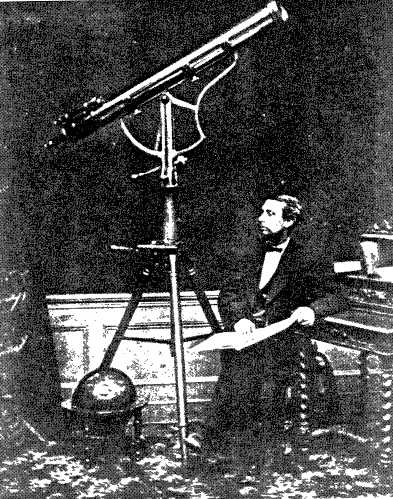
1885 supernova in the Andromeda Galaxy
| Field | Value |
|---|---|
| name | Supernova 1885 |
| image | File:SAndLightCurve.png |
| caption | The visual band light curve of S Andromedae, adapted from Patchett et al. (1985) |
| epoch | J2000.0 |
| type | I pec |
| SNRtype | Unknown |
| host | Andromeda Galaxy |
| constellation | Andromeda |
| ra | 00h 42m 43.11s |
| dec | +41° 16′ 04.2′′ |
| gal | 121.1702 -21.5741 |
| discovery | 20 August 1885 UTC |
| distance | 2.6 Mly |
| mag_v | +6 |
| progenitor | Unknown |
| progenitor_type | Unknown |
| b-v | +1.3 ~ +0.6 |
| notes | First and only supernova observed in Andromeda; |
| first extragalactic supernova observed; | |
| closest type Ia observed | |
| predecessor | SN 1604 (observed), Cassiopeia A (unobserved, ), G1.9+0.3 (unobserved, ) |
| successor | SN 1895B |
| b-v = +1.3 ~ +0.6 first extragalactic supernova observed; closest type Ia observed
SN 1885A (also S Andromedae) was a supernova in the Andromeda Galaxy, the only one seen in that galaxy by astronomers. It was the first supernova ever seen outside the Milky Way, though it was not appreciated at the time due to how far away it was. It is also known as "Supernova 1885".
Discovery
The supernova appears to have been seen first on August 17, 1885, by French astronomer Ludovic Gully during a public stargazing event. Gully thought it was scattered moonlight in his telescope and did not follow up on this observation. Irish amateur astronomer Isaac Ward in Belfast claimed to have seen the object on August 19, 1885, but did not immediately publish its existence.
The independent detection of the supernova by Ernst Hartwig at Dorpat (Tartu) Observatory in Estonia on August 20, 1885, however, was communicated in a telegram on August 31, 1885, once Hartwig had verified in more ideal circumstances that the feature was not caused by reflected moonlight. The telegram prompted widespread observations of the event, and prompted Isaac Ward, Ludovic Gully, and several others to publish their earlier observations (the first reports on S Andromedae appeared before Hartwig's discovery letter which followed his telegram, since the letter was initially lost by Astronomische Nachrichten and only reprinted in a later issue). The history of the discovery is summarized by K.G. Jones and de Vaucouleurs and H. G. Corwin Jr. Both studies doubt that Ward really saw the event since his estimated magnitude is significantly off from the later reconstructed light curve, and conclude that Hartwig should be considered as the discoverer of the supernova.
Features

SN 1885A reached magnitude 5.85 on 21 August 1885, and faded to magnitude 14 six months later. It was reddish in color and declined rapidly in brightness, which is unusual for type Ia supernovae. Some astronomers observed the spectrum of the star visually (no photographic spectral observations were made in that time). These observations were made at the limit of visibility, but they were considered to be in good agreement with each other and with modern data on typical supernovae of type Ia; SN 1885A has thus been assigned to this type.
The supernova occurred at an angular separation of from the relatively bright nucleus of the galaxy. This made detection of its remnant difficult – early attempts were unsuccessful. In 1988, R. A. Fesen and others used the 4-meter Mayall telescope at Kitt Peak to discover the iron-rich remnant of the explosion. Further observations were made with the Hubble Space Telescope in 1999. The spectrum of the remnant shows the presence of iron, calcium and manganese, which were likely created during the explosion. There is some evidence for spherical symmetry in the explosion; this would mean that this type Ia supernova was not triggered by merging.
References
References
- (December 1985). "A revised light curve for the 1885 supernova in M 31". The Observatory.
- "S Andromedae: Supernova 1885 in M31".
- (1885). "Ueber den neuen Stern im grossen Andromeda-Nebel". Astronomische Nachrichten.
- Beesley, D. E.. (September 1985). "Isaac Ward and S Andromedae". [[Irish Astronomical Journal]].
- Ward, Isaac. (1885). "New Star in Andromeda". [[Astronomical Register]].
- Hartwig, Ernst. (1885). "Ueber den neuen Stern im grossen Andromeda-Nebel". Astronomische Nachrichten.
- Copeland, Ralph. (September 1885). "Dun Echt Circulars, No. 97 and No. 98". Dun Echt Circular.
- Vogel, H.C.. (1885). "Ueber den neuen Stern im grossen Andromeda-Nebel". [[Astronomische Nachrichten]].
- Jones, Kenneth Glyn. (1976). "S Andromedae, 1885: An Analysis of Contemporary Reports and a Reconstruction". Journal for the History of Astronomy.
- (1985). "S Andromedae 1885 - A centennial review". Astrophysical Journal.
- Siegel-Itzkovich, Judy. (November 5, 2009). "US-Israeli team's speedily evolving supernova seems to be a new class of exploding star". [[The Jerusalem Post]].
- Pulliam, Christine. (April 26, 2011). "New Type of Exploding Star Discovered". Smithsonian Insider.
- Fesen, Robert A.. (June 1989). "Discovery of the remnant of S Andromedae (SN 1885) in M31". [[The Astrophysical Journal]].
- Hamilton, Andrew J. S.. (2000-10-20). "An Ultraviolet Fe ii Image of SN 1885 in M31". [[The Astrophysical Journal]].
- (October 2017). "Optical and UV Spectra of the Remnant of SN 1885 (S And) in M31". The Astrophysical Journal.
This article was imported from Wikipedia and is available under the Creative Commons Attribution-ShareAlike 4.0 License. Content has been adapted to SurfDoc format. Original contributors can be found on the article history page.
Ask Mako anything about SN 1885A — get instant answers, deeper analysis, and related topics.
Research with MakoFree with your Surf account
Create a free account to save articles, ask Mako questions, and organize your research.
Sign up freeThis content may have been generated or modified by AI. CloudSurf Software LLC is not responsible for the accuracy, completeness, or reliability of AI-generated content. Always verify important information from primary sources.
Report