From Surf Wiki (app.surf) — the open knowledge base
Slipform stonemasonry
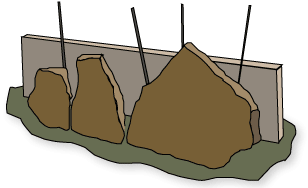
Slipform stonemasonry is a method for making a reinforced concrete wall with stone facing. In slipform stonemasonry stones and mortar are built up in courses within reusable slipforms. It is a cross between traditional mortared stone wall and a veneered stone wall. Short forms, up to 60 cm high, are placed on both sides of the wall to serve as a guide for the stone work. The stones are placed inside the forms with the good faces against the form work. Concrete is poured in behind the rocks. Rebar is added for strength, to make a wall that is approximately half reinforced concrete and half stonework. The wall can be faced with stone on one side or both sides. After the concrete sets enough to hold the wall together, the forms are "slipped" up to pour the next level. With slipforms it is easy for a novice to build free-standing stone walls.
History
Slipform stonemasonry was developed by New York architect Ernest Flagg in 1920. Flagg built a vertical framework as tall as the wall, then inserted 2x6 or 2x8 planks as forms to guide the stonework. When the masonry work reached the top of a plank, Flagg inserted another one, adding more planks until he reached the top of the wall. Helen and Scott Nearing modified the technique in Vermont in the 1930s, using slipforms that were slipped up the wall.
Gallery
File:Oiled slipforms.jpg|Slipforms oiled to prevent concrete from sticking to the wood. File:Placing Stones in Formwork.jpg|Placing stones inside the forms. File:Window Frame in Stonework.jpg|Window frames are placed in the forms. File:Forms are leap-frogged up the wall.jpg|Slipforms are leap-frogged up the wall. File:Finished Slipform Stone House.jpg|A finished slipform stone house.
Notes
The diagram of the slipform wall section is completely misleading without showing the 2nd form.
References
- Elpel, Thomas J. [http://www.dirtcheapbuilder.com/Home_Building/Stone_Masonry.htm "Stone Masonry Construction: A Brief Overview"], Accessed October 10, 2018.
- Elpel, Thomas J. Living Homes: Stone Masonry, Log, and Strawbale Construction. HOPS Press, 2010, p. 85.
This article was imported from Wikipedia and is available under the Creative Commons Attribution-ShareAlike 4.0 License. Content has been adapted to SurfDoc format. Original contributors can be found on the article history page.
Ask Mako anything about Slipform stonemasonry — get instant answers, deeper analysis, and related topics.
Research with MakoFree with your Surf account
Create a free account to save articles, ask Mako questions, and organize your research.
Sign up freeThis content may have been generated or modified by AI. CloudSurf Software LLC is not responsible for the accuracy, completeness, or reliability of AI-generated content. Always verify important information from primary sources.
Report