From Surf Wiki (app.surf) — the open knowledge base
Slip casting
Technique for forming pottery

Technique for forming pottery


Slip casting, or slipcasting, is a ceramic forming technique, and is widely used in industry and by craft potters to make ceramic forms. This technique is typically used to form complicated shapes like figurative ceramics that would be difficult to be reproduced by hand or other forming techniques. The technique involves a clay body slip, usually prepared in a blunger, being poured into plaster moulds and allowed to form a layer, the cast, on the internal walls of the mould.
It is suited for the consistent and precise shaping of complex shapes. It is the standard shaping technique for sanitaryware, such as toilets and basins, and is commonly used for smaller pieces like figurines and teapots.
History
The technique was first developed in China during the Tang dynasty (618–917), but was relatively little-used in China until recent times. It seems to have been reinvented independently in England around 1745 "reputedly by Ralph Daniels of Corbridge", and before long was widely used by European porcelain manufacturers, and then became the main forming technique for sanitaryware by the end of the century.
Technical considerations
Solid casting is used to produce solid articles, such as cup handles; for this the mold frequently includes a reservoir of excess slip. Hollow casting is used to produce articles such as teapots.
The properties of a casting slip depends on multiple factors, including:'Sanitaryware Technology'. Domenico Fortuna. Gruppo Editoriale Faenza Editrice S.p.A. 2000.
- the properties of each raw material in the slip,
- the solids content of the slip,
- the clay:non-plastic ratio in the slip,
- the chemicals in the slip, either deliberately added or introduced from the raw materials and water,
- the type and amount of deflocculant,
- the ambient conditions, especially temperature and humidity, and
- the amount of energy involved in mixing the raw materials to prepare the slip.
Additionally, factors affecting the rate of formation of the cast piece include:
- the viscosity and thixotropy of the slip, which are invariably modified immediately before casting,
- properties of the mold material, such as permeability, and
- moisture content of the mould.
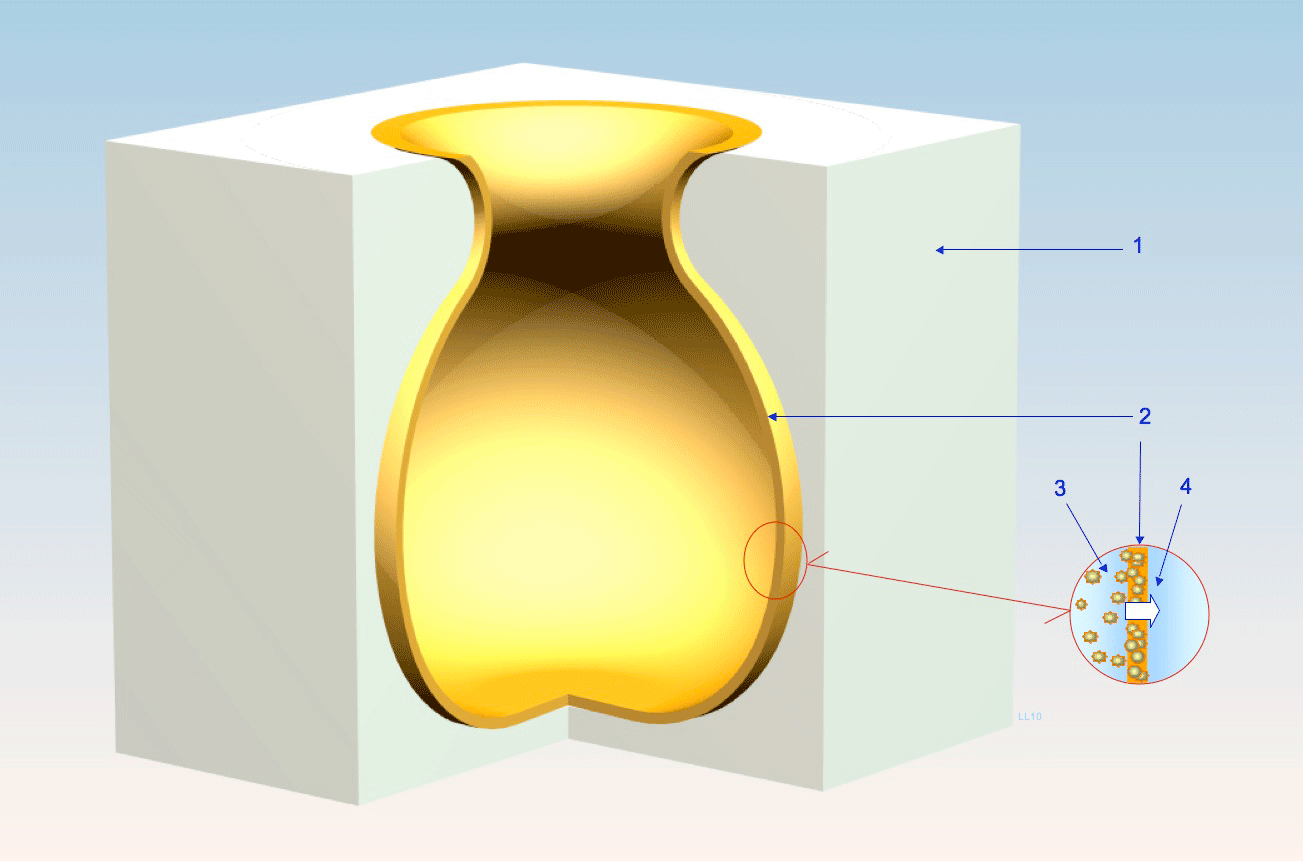
The casting slip is poured into a porous mould. Due to capillary pressure from the mold, a semi-solid particulate layer is formed on the mould through deposition of the solids in the slip. After a period of time, determined in advance by testing, the cast piece is removed from the mold; the cast needs to be sufficiently firm to handle without damage. The cast piece may then be fettled to remove the mold seam, before being dried to remove the remaining water. This typically results in a greenware piece which is then ready for subsequent processing, including glazing and firing.


Casting times
A lavatory closet typically takes around 40 to 60 minutes to cast using the conventional technique, with a Swiss manufacturer noting that "preparing the mould and casting a single piece can take up to 40 minutes." Thinner sections will be quicker, with one source advising 5–10 mm taking 10–15 minutes.with a
https://www.laufen.com/news-stories/earth-water-fire_laufen https://www.materialseducation.org/educators/matedu-modules/docs/Slip_Casting.pdf
Casting times for ceramic tableware have been reported as 35 to 60 minutes for earthenware and 8 to 20 minutes for bone china. Other reports include: 30–50 minutes at a US studio pottery; around 60 minutes at a small Portuguese manufacturer of decorative ceramics; "approximately 15 minutes" from a US distance learning university; 15–20 minutes in an article for studio potters; and 15–45 minutes in a guide for beginners.
Casting times are notably shorter by pressure casting, with 2 minutes reported for tableware bowls and dishes, and 6–8 minutes for sanitaryware. The cycle time per piece of sanitaryware using high pressure at Duravit is reported to be 20 minutes.
Solids content of the slip
To achieve an acceptable rate of cast formation and minimize drying shrinkage, a slip with a high content of solids is needed. The generally accepted solids content of a Vitreous China sanitaryware casting slip ranges between 72 and 75% by weight, which corresponds to slip densities of 1.80–1.85 g/cm3.
Certain chemicals, known as deflocculants, are used to disperse agglomerates in the slip, and so decrease the viscosity and also allow a higher solids content; the latter is important to minimize drying shrinkage. Examples of deflocculants include sodium carbonate and sodium silicate. Typical deflocculant additions used for a Vitreous China casting slip are 0.1-0.65%; the rheological properties of the clay components are the main influencing factors for the dosage.
A mathematical formula developed by Alexandre Brongniart of Sèvres Porcelain is used to determine the dry material content of the slip. This has become to be known as Brongniart's formula.
Pressure casting
Pressure casting is a development of traditional slipcasting which was developed in the 1970s for the production of sanitaryware and more recently has been applied to tableware.
Specially developed polymeric materials allow a mold to be subject to application of external pressures up to 4.0 MPa; much higher than slip casting in plaster molds where the capillary forces correspond to a pressure of around 0.1–0.2 MPa. The high pressure leads to much faster casting rates and, hence, faster production cycles: one study found that by increasing the pressure from 0.25 to 4.0 bar (3.6 to 58 psi) decreased the casting time for a 6-mm cast of a porcelain body from about 45 to 15 min. Using pressure casting, a Geberit factory in Finland casts a toilet in 20 minutes.
Furthermore, the application of high-pressure air through the polymeric molds upon demolding the cast means that a new casting cycle can be started immediately in the same mold, unlike plaster moulds which require lengthy drying times. The polymeric materials have much greater durability than plaster and, therefore, it is possible to achieve products with better dimensional tolerances and much longer mold life.
Advantages of pressure casting over conventional casting have been summarized as higher productivity, higher yield, improved ware quality, lower distortion of the cast piece, reduced surface defects, reduced production space, reduced demand for molds, reduced energy costs, and readily fitting with the automation of demolding and handling.
Ceramic laminates
As a processing technique for ceramic laminates, a ceramic powder is often placed in suspension to form a slip with a high solids content (60 wt%) as well as a very low viscosity value (
Slipware
Slip-cast ware, objects that are formed using slip casting, should not be confused with slipware, pottery that is formed by any technique and then decorated using slip. The French for slip is barbotine (coulée en barbotine means slip casting). As far back as the Roman Empire, potters created what is termed "Barbotine ware" by using clay slip to decorate the surface of pots. "Barbotine pottery" is sometimes used for 19th-century French and American pottery with added slip cast decoration, as well as (confusingly) 17th century English slipware that is decorated with thick blobs of slip.
References
References
- (2008). "The Penland Book of Ceramics: Master Classes in Ceramic Techniques". Lark Books; Sterling Publishing Company, Inc..
- (March 4, 2020). "Slip Casting Molds: What are they, why use them and how to achieve different aesthetics".
- (August 29, 2018). "What Even Is Slipcasting?".
- (2012). "Engineering Materials : polymers, ceramics and composites.". PHI Learning Pvt. Ltd..
- "Casting Your Miniature Doll Molds".
- David W. Richerson, American Ceramic Society, ''The Magic of Ceramics'', p. 41, 2012, Wiley, ISBN 9780470638057, [https://books.google.com/books?id=Rd8O5yvoXloC&pg=PA41 google books]
- Savage, George, and Newman, Harold, ''An Illustrated Dictionary of Ceramics'', p. 265, 1985, Thames & Hudson, ISBN 0500273804
- 'Whitewares: Production, Testing And Quality Control.' W. Ryan, C. Radford. Pergamon Press, 1987.
- "Reference Guide To Making and Adjusting Casting Slip".
- Whitewares: Production, Testing And Quality Control.' W. Ryan, C. Radford. Pergamon Press, 1987.
- (1975). "The Oxford companion to the decorative arts". Clarendon Press.
- 'Materials And Equipment – Whitewares. Volume 13, Issue 1/2. J. B. Wachtman. Wiley & Sons. Pg. 402
- 'Effect Of The Physical Properties Of Slip On The Molding Of Commercial Grade Sanitary Ware' V.V. Mikhalev, V.V. Serov, A.S. Glass and Ceramics, 64(3-4), 129–131, 2007. Pg. 131
- "125 years | Design & Innovation".
- ’The Control Of Casting Slip: A Survey Of Current Casting Practice In The Tableware Industry’ RP.749. Ceram Research, 1987
- (9 October 2019). "You Will be Slip Casting Ceramics with These 5 Easy Steps".
- (7 November 2019). "All you need to know about Slip Casting of Ceramics (We do it everyday!)".
- (13 April 2015). "A Simple Step-by-Step Guide to Slip Casting".
- 'In The Studio: Mixing Casting Slip: Tips and Tricks' D. S. Smith. Pottery Making Illustrated. Nov/Dec 2020
- ‘Ceramics: A Beginner’s Guide To Tools And Techniques’ E. Landberger, M. Lundin. Allworth Press, 2012
- ’A Comparison Of Plaster Casting And Pressure Casting Of Sanitaryware With Particular Reference To Clay Properties’ C. Hogg. Ceramics International. Volume 11, Issue 1, 1985, Pg. 32
- (13 February 2017). "Duravit makes new investments in high-pressure casting".
- 'Ceramics, Glass and Glass-Ceramics – From Early Manufacturing Steps Towards Modern Frontiers' F. Baino, M. Tomalino, D. Tulyaganov. Springer International Publishing, 2021
- (1 January 2014). "Comprehensive Hard Materials". Elsevier.
- "How to Make Casting Slip from Your Clay Body - A Simple Technique".
- (1971). "Industrial Ceramics.". Chapman & Hall.
- 'Ceramics, Glass and Glass-Ceramics - From Early Manufacturing Steps Towards Modern Frontiers' F. Baino, M. Tomalino, D. Tulyaganov. Springer International Publishing, 2021
- (2000-11-21). "Ceramicindustry.com".
- ''Dictionary Of Ceramics''. Arthur Dodd & David Murfin. 3rd edition. The Institute Of Minerals. 1994.
- 'Microstructure-Performance Relation in PMMA-Based Open-Cell Porous Materials for High Pressure Ceramic Sanitaryware Casting. Y. Ergün, C. Dirier, M. Yılmaz, C. Tokman, M. Tanoğlu. Key Engineering Materials. Trans Tech Publications, Ltd., May 2004
- 'Modern Ceramic Engineering' 3rd. edition. D.W.Richerson. CRC Press. 2005. Pg. 436
- "High-pressure ceramic production".
- (August 2017). "DGM-E.pdf".
- ’Clays For Pressure Casting Sanitaryware’ Brian Waters. Ceramic Forum International. Cfi/Ber. 89 (2012) No.1. Pg. E19
- (August 1997). "LAYERED CERAMICS: Processing and Mechanical Behavior". Annual Review of Materials Science.
- (23 June 2004). "The Potter's Dictionary of Materials and Techniques". University of Pennsylvania Press.
- (2000). "Ten Thousand Years of Pottery". University of Pennsylvania Press.
- (25 September 2018). "American Art Pottery: The Robert A. Ellison Jr. Collection". Metropolitan Museum of Art.
- "Pottery - 17th-century slipware".
This article was imported from Wikipedia and is available under the Creative Commons Attribution-ShareAlike 4.0 License. Content has been adapted to SurfDoc format. Original contributors can be found on the article history page.
Ask Mako anything about Slip casting — get instant answers, deeper analysis, and related topics.
Research with MakoFree with your Surf account
Create a free account to save articles, ask Mako questions, and organize your research.
Sign up freeThis content may have been generated or modified by AI. CloudSurf Software LLC is not responsible for the accuracy, completeness, or reliability of AI-generated content. Always verify important information from primary sources.
Report