From Surf Wiki (app.surf) — the open knowledge base
Single crystal
Material with a continuous, unbroken crystal lattice

Material with a continuous, unbroken crystal lattice
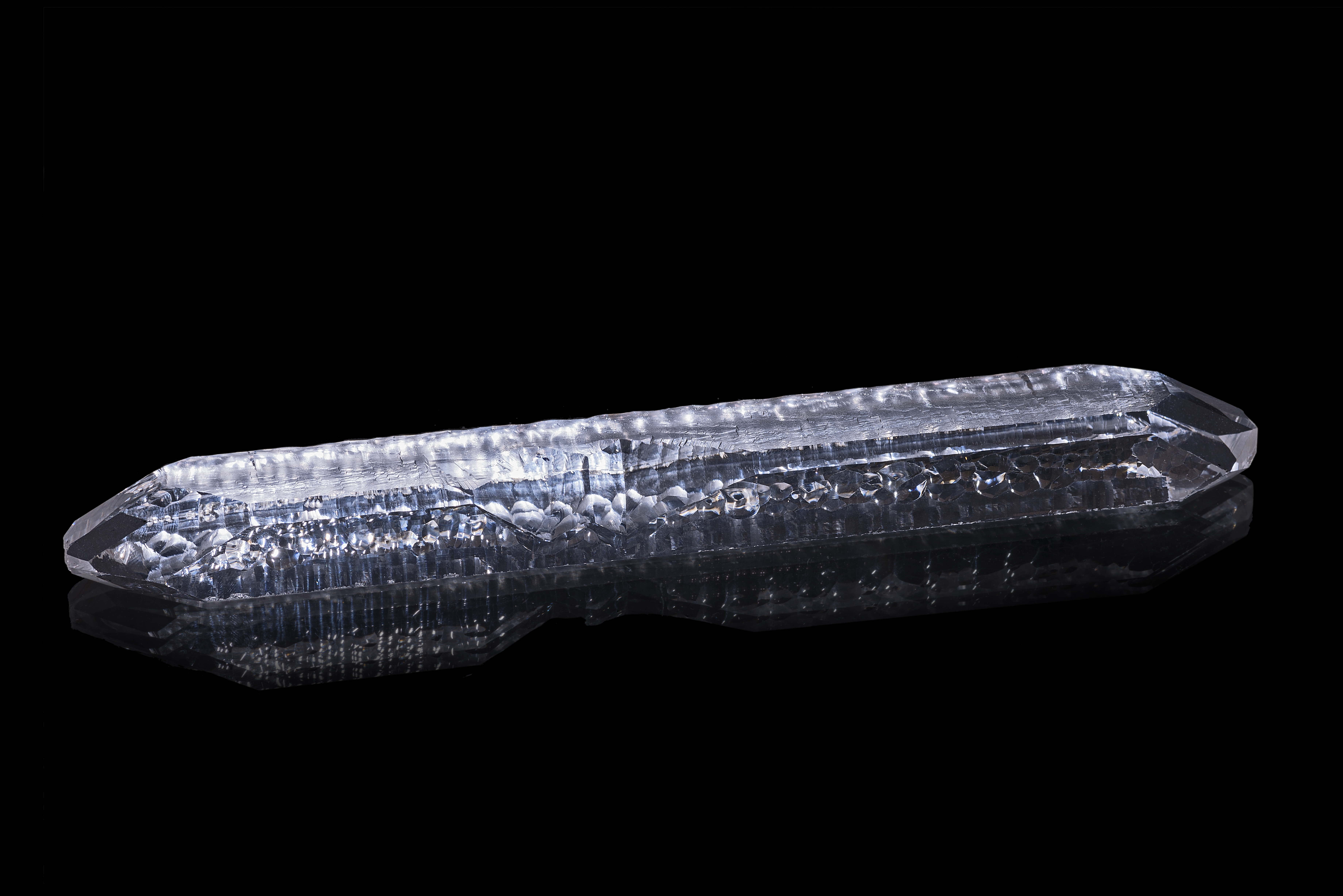
In materials science, a single crystal (or single-crystal solid or monocrystalline solid) is a material in which the crystal lattice of the entire sample is continuous and unbroken to the edges of the sample, with no grain boundaries. The absence of the defects associated with grain boundaries can give monocrystals unique properties, particularly mechanical, optical and electrical, which can also be anisotropic, depending on the type of crystallographic structure. These properties, in addition to making some gems precious, are industrially used in technological applications, especially in optics and electronics.
Because entropic effects favor the presence of some imperfections in the microstructure of solids, such as impurities, inhomogeneous strain and crystallographic defects such as dislocations, perfect single crystals of meaningful size are exceedingly rare in nature. The necessary laboratory conditions often add to the cost of production. On the other hand, imperfect single crystals can reach enormous sizes in nature: several mineral species such as beryl, gypsum and feldspars are known to have produced crystals several meters across.
The opposite of a single crystal is an amorphous structure where the atomic position is limited to short-range order only. In between the two extremes exist polycrystalline, which is made up of a number of smaller crystals known as crystallites, and paracrystalline phases. Single crystals will usually have distinctive plane faces and some symmetry, where the angles between the faces will dictate its ideal shape. Gemstones are often single crystals artificially cut along crystallographic planes to take advantage of refractive and reflective properties.
Production methods
Although current methods are extremely sophisticated with modern technology, the origins of crystal growth can be traced back to salt purification by crystallization in 2500 BCE. A more advanced method using an aqueous solution was started in 1600 CE while the melt and vapor methods began around 1850 CE.
Basic crystal growth methods can be separated into four categories based on what they are artificially grown from: melt, solid, vapor, and solution. Specific techniques to produce large single crystals (aka boules) include the Czochralski process (CZ), floating zone (or zone movement), and the Bridgman technique. Dr. Teal and Dr. Little of Bell Telephone Laboratories were the first to use the Czochralski method to create Ge and Si single crystals. Other methods of crystallization may be used, depending on the physical properties of the substance, including hydrothermal synthesis, sublimation, or simply solvent-based crystallization. For example, a modified Kyropoulos method can be used to grow high quality 300 kg sapphire single crystals. The Verneuil method, also called the flame-fusion method, was used in the early 1900s to make rubies before CZ. The diagram on the right illustrates most of the conventional methods. There have been new breakthroughs such as chemical vapor depositions (CVD) along with different variations and tweaks to the existing methods. These are not shown in the diagram.
In the case of metal single crystals, fabrication techniques also include epitaxy and abnormal grain growth in solids. Epitaxy is used to deposit very thin (micrometer to nanometer scale) layers of the same or different materials on the surface of an existing single crystal. Applications of this technique lie in the areas of semiconductor production, with potential uses in other nanotechnological fields and catalysis.
It is extremely difficult to grow single crystals of the polymers. It is mainly because that the polymer chains are of different length and due to the various entropy reasons. However, topochemical reactions are one of the easy methods to get single crystals of the polymer.https://pubs.rsc.org/en/content/articlelanding/2013/cs/c2cs35343a
Applications
Semiconductor industry
One of the most used single crystals is that of silicon in the semiconductor industry. The four main production methods for semiconductor single crystals are from metallic solutions: liquid phase epitaxy (LPE), liquid phase electroepitaxy (LPEE), the traveling heater method (THM), and liquid phase diffusion (LPD). However, there are many other single crystals besides inorganic single crystals capable semiconducting, including single-crystal organic semiconductors.
Monocrystalline silicon used in the fabrication of semiconductors and photovoltaics is the greatest use of single-crystal technology today. In photovoltaics, the most efficient crystal structure will yield the highest light-to-electricity conversion. On the quantum scale that microprocessors operate on, the presence of grain boundaries would have a significant impact on the functionality of field effect transistors by altering local electrical properties. Therefore, microprocessor fabricators have invested heavily in facilities to produce large single crystals of silicon. The Czochralski method and floating zone are popular methods for the growth of silicon crystals.

Other inorganic semiconducting single crystals include GaAs, GaP, GaSb, Ge, InAs, InP, InSb, CdS, CdSe, CdTe, ZnS, ZnSe, and ZnTe. Most of these can also be tuned with various doping for desired properties. Single-crystal graphene is also highly desired for applications in electronics and optoelectronics with its large carrier mobility and high thermal conductivity, and remains a topic of fervent research. One of the main challenges has been growing uniform single crystals of bilayer or multilayer graphene over large areas; epitaxial growth and the new CVD (mentioned above) are among the new promising methods under investigation.
Organic semiconducting single crystals are different from the inorganic crystals. The weak intermolecular bonds mean lower melting temperatures, and higher vapor pressures and greater solubility. For single crystals to grow, the purity of the material is crucial and the production of organic materials usually require many steps to reach the necessary purity. Extensive research is being done to look for materials that are thermally stable with high charge-carrier mobility. Past discoveries include naphthalene, tetracene, and 9,10-diphenylanthacene (DPA). Triphenylamine derivatives have shown promise, and recently in 2021, the single-crystal structure of α-phenyl-4′-(diphenylamino)stilbene (TPA) grown using the solution method exhibited even greater potential for semiconductor use with its anisotropic hole transport property.
Optical application
Sapphires: also known as the alpha phase of aluminum oxide (Al2O3) to scientists, sapphire single crystals are widely used in hi-tech engineering. It can be grown from gaseous, solid, or solution phases. The diameter of the crystals resulting from the growth method are important when considering electronic uses after. They are used for lasers and nonlinear optics. Some notable uses are as in the window of a biometric fingerprint reader, optical disks for long-term data storage, and X-ray interferometer.
Indium phosphide: these single crystals are particularly appropriate for combining optoelectronics with high-speed electronics in the form of optical fiber with its large-diameter substrates. Other photonic devices include lasers, photodetectors, avalanche photo diodes, optical modulators and amplifiers, signal processing, and both optoelectronic and photonic integrated circuits.
.jpg)
Germanium: this was the material in the first transistor invented by Bardeen, Brattain, and Shockley in 1947. It is used in some gamma-ray detectors and infrared optics. Now it has become the focus of ultrafast electronic devices for its intrinsic carrier mobility.
Arsenide: arsenide III can be combined with various elements such as B, Al, Ga, and In, with the GaAs compound being in high demand for wafers.
Cadmium telluride: CdTe crystals have several applications as substrates for IR imaging, electrooptic devices, and solar cells. By alloying CdTe and ZnTe together room-temperature X-ray and gamma-ray detectors can be made.
Electrical conductors
Metals can be produced in single-crystal form and provide a means to understand the ultimate performance of metallic conductors. It is vital for understanding the basic science such as catalytic chemistry, surface physics, electrons, and monochromators. Production of metallic single crystals have the highest quality requirements and are grown, or pulled, in the form of rods. Certain companies can produce specific geometries, grooves, holes, and reference faces along with varying diameters.
Of all the metallic elements, silver and copper have the best conductivity at room temperature, setting the bar for performance. The size of the market, and vagaries in supply and cost, have provided strong incentives to seek alternatives or find ways to use less of them by improving performance.
The conductivity of commercial conductors is often expressed relative to the International Annealed Copper Standard, according to which the purest copper wire available in 1914 measured around 100%. The purest modern copper wire is a better conductor, measuring over 103% on this scale. The gains are from two sources. First, modern copper is more pure. However, this avenue for improvement seems at an end. Making the copper purer still makes no significant improvement. Second, annealing and other processes have been improved. Annealing reduces the dislocations and other crystal defects which are sources of resistance. But the resulting wires are still polycrystalline. The grain boundaries and remaining crystal defects are responsible for some residual resistance. This can be quantified and better understood by examining single crystals.
Single-crystal copper did prove to have better conductivity than polycrystalline copper.
| Material | ρ (μΩ∙cm) | IACS |
|---|---|---|
| Single-crystal Ag, doped with 3 mol% Cu | 1.35 | 127% |
| Single-crystal Cu, further processed | 1.472 | 117.1% |
| Single-crystal Ag | 1.49 | 115.4% |
| Single-crystal Cu | 1.52 | 113.4% |
| High-purity Ag wire (polycrystalline) | 1.59 | 108% |
| High-purity Cu wire (polycrystalline) | 1.67 | ˃ 103% |
However, the single-crystal copper not only became a better conductor than high purity polycrystalline silver, but with prescribed heat and pressure treatment could surpass even single-crystal silver. Although impurities are usually bad for conductivity, a silver single crystal with a small amount of copper substitutions proved to be the best.
As of 2009, no single-crystal copper is manufactured on a large scale industrially, but methods of producing very large individual crystal sizes for copper conductors are exploited for high performance electrical applications. These can be considered meta-single crystals with only a few crystals per meter of length.

Single-crystal turbine blades
Whilst the absence of grain boundaries decreases yield strength, this is offset by a reduction in thermal creep, making single-crystal solids ideal for high temperature, close tolerance part applications, such as turbine blades. Researcher Barry Piearcey found that a right-angle bend at the casting mold would decrease the number of columnar crystals and later, scientist Giamei used this to start the blade's single-crystal structure.
In research
Single crystals are essential in research especially condensed-matter physics and all aspects of materials science such as surface science. The detailed study of the crystal structure of a material by techniques such as Bragg diffraction and helium atom scattering is easier with single crystals
- If you could find a source to cite, please add! --because it is possible to study directional dependence of various properties and compare with theoretical predictions. Furthermore, macroscopically averaging techniques such as angle-resolved photoemission spectroscopy or low-energy electron diffraction are only possible or meaningful on surfaces of single crystals. Single crystals are further well-suited to investigate material-inherent properties using surface-sensitive techniques, as they are much less affected by preparation methods than thin films. In superconductivity there have been cases of materials where superconductivity is only seen in single-crystalline specimen. They may be grown for this purpose, even when the material is otherwise only needed in polycrystalline form.
As such, numerous new materials are being studied in their single-crystal form. The young field of metal-organic-frameworks (MOFs) is one of many which qualify to have single crystals. In January 2021 Dr. Dong and Dr. Feng demonstrated how polycyclic aromatic ligands can be optimized to produce large 2D MOF single crystals of sizes up to 200 μm. This could mean scientists can fabricate single-crystal devices and determine intrinsic electrical conductivity and charge transport mechanism.
The field of photodriven transformation can also be involved with single crystals with something called single-crystal-to-single-crystal (SCSC) transformations. These provide direct observation of molecular movement and understanding of mechanistic details. This photoswitching behavior has also been observed in cutting-edge research on intrinsically non-photo-responsive mononuclear lanthanide single-molecule-magnets (SMM).
Post-processing of single crystals
Single crystals used in semiconductors, optics, and ceramics must often be machined or sliced into wafers, prisms, or other precision components. Due to their hardness and brittleness, these materials require specialized cutting techniques that minimize subsurface damage and kerf loss.
Inner diameter (ID) sawing is a conventional method, where a thin circular blade embedded with diamond abrasives slices through the crystal. It provides good dimensional accuracy but is limited by blade rigidity and maximum cutting depth.
Multi-wire sawing, which uses long diamond wires moving reciprocally, became the mainstream process for silicon and sapphire wafers. It allows simultaneous slicing of multiple wafers from a single ingot, but the back-and-forth motion can cause vibration and wire wear, leading to surface marks and variable tension.
Endless diamond wire sawing (loop-type) is a more recent approach. The wire forms a continuous closed loop, typically several meters in length, running in a single direction at high linear speeds (around 60–80 m/s). Because the wire tension and motion are steady, the process can achieve smoother surfaces, smaller kerf widths, and longer tool life. It has been applied to slicing hard and brittle single-crystal materials such as silicon, sapphire, and advanced ceramics.
Other techniques, including laser slicing, ultrasonic machining, and ion-beam or chemical-mechanical polishing, are used for finishing or micro-fabrication stages, especially when optical-grade surface quality is required.
References
References
- ""Reade Advanced Materials – Single Crystals"". Reade.
- "Single Crystals – Alfa Chemistry".
- "4.1: Introduction". ''Engineering LibreTexts''. 2019-02-08. Retrieved 2021-02-28.
- "DoITPoMS – TLP Library Atomic Scale Structure of Materials". ''www.doitpoms.ac.uk''. Retrieved 2021-02-28.
- (2007). "Ceramic Materials".
- (2007). "Ceramic Materials".
- (2015). "Handbook of Crystal Growth".
- Zalozhny, Eugene (Jul 13th, 2015). "Monocrystal enables high-volume LED and optical applications with 300-kg KY sapphire crystals". ''LED's Magazine''. Retrieved February 27, 2021.
- (1 October 2019). "Preparation and uses of large area single crystal metal foils". APL Materials.
- (23 January 2018). "Single-crystal metal growth on amorphous insulating substrates". Proceedings of the National Academy of Sciences.
- "Single Crystal Substrates – Alfa Chemistry".
- (2007-01-01). "Chapter 1 – INTRODUCTION". Elsevier.
- Kearns, Joel K.. (2019-01-01). "2 – Silicon single crystals". Woodhead Publishing.
- "CZ-Si Wafers – Nanografi". ''nanografi.com''. Retrieved 2021-02-28.
- (2012-01-01). "Chapter 3 – The Current Situation in Ultra-Precision Technology – Silicon Single Crystals as an Example". William Andrew Publishing.
- (2015). "Handbook of Crystal Growth".
- "Semiconductor Single Crystals".
- (2013). "Edge-controlled growth and kinetics of single-crystal graphene domains by chemical vapor deposition". Proceedings of the National Academy of Sciences of the United States of America.
- (January 2021). "Synthesis of Large-Area Single-Crystal Graphene". Trends in Chemistry.
- (November 2019). "Crystal Engineering of Organic Optoelectronic Materials". Chem.
- (March 2020). "Semiconducting small molecule/polymer blends for organic transistors". Polymer.
- (17 August 2007). "Growth and Electronic Transport in 9,10-Diphenylanthracene Single Crystals—An Organic Semiconductor of High Electron and Hole Mobility". Advanced Materials.
- (February 2021). "Characterization of α-phenyl-4′-(diphenylamino)stilbene single crystal and its anisotropic conductivity". Materials Science and Engineering: B.
- (2018). "Single Crystals of Electronic Materials: Growth and Properties". Elsevier Science & Technology.
- "Indium Phosphide PICs".
- Fornari, Roberto. (18 September 2018). "Single crystals of electronic materials: growth and properties". Woodhead.
- (10 November 1987). "Large Diameter Germanium Single Crystals For IR Optics".
- (14 September 2014). "High temperature optical absorption edge of CdTe single crystal". Journal of Applied Physics.
- "Pure Element Single Crystals – Alfa Chemistry".
- "Scientists blow hot and cold to produce single-crystal metal".
- "TIBTECH innovations: Metal properties comparison: electric conductivity, thermal conductivity, density, melting temperature".
- Cho, Yong Chan. (March 22, 2010). "Copper Better than Silver: Electrical Resistivity of the Grain-Free Single-Crystal Copper Wire". Crystal Growth & Design.
- (June 26, 2014). "Abnormal drop in electrical resistivity with impurity doping of single-crystal Ag". Scientific Reports.
- . (n.d.). ["The International Annealed Copper Standard"](https://www.nde-ed.org/GeneralResources/IACS/IACS.htm). *The Collaboration for NDT Education, Iowa State University*.
- Muhammad Ajmal. (2012). "Fabrication of the best conductor from single-crystal copper and the contribution of grain boundaries to the Debye temperature". CrystEngComm.
- Spittle, Peter. [http://users.encs.concordia.ca/~kadem/Rolls%20Royce.pdf "Gas turbine technology"] ''[[Rolls-Royce plc]]'', 2003. Retrieved: 21 July 2012.
- [http://www.memagazine.org/backissues/membersonly/feb06/features/crjewels/crjewels.html Crown jewels – These crystals are the gems of turbine efficiency] {{webarchive. link. (2010-03-25 Article on single-crystal turbine blades ''memagazine.com'')
- (2017-02-06). "Each Blade a Single Crystal".
- "Silver Single Crystal".
- (September 2020). "Angle-Resolved Photoemission Study on the Band Structure of Organic Single Crystals". Crystals.
- (2015-02-11). "6.2: Low Energy Electron Diffraction (LEED)".
- (30 April 2025). "Investigating charge dynamics at lead halide perovskite single crystal surfaces". Journal of Physics: Energy.
- (30 November 2020). "Unconventional Bulk Superconductivity in YFe 2 Ge 2 Single Crystals". Physical Review Letters.
- (February 2021). "Making large single crystals of 2D MOFs". Nature Materials.
- (September 2017). "Photodriven single-crystal-to-single-crystal transformation". Coordination Chemistry Reviews.
- (15 January 2020). "Hysteresis Photomodulation via Single-Crystal-to-Single-Crystal Isomerization of a Photochromic Chain of Dysprosium Single-Molecule Magnets". Journal of the American Chemical Society.
- Vimfun Optical Sawing. (2023-08-29). "what is id saw".
- (2024-01-29). "3 Types Of Multi Wire Cutting Machines You Need To Know.".
- "Cutting-Edge Innovations: The Endless Diamond Wire Podcast".
This article was imported from Wikipedia and is available under the Creative Commons Attribution-ShareAlike 4.0 License. Content has been adapted to SurfDoc format. Original contributors can be found on the article history page.
Ask Mako anything about Single crystal — get instant answers, deeper analysis, and related topics.
Research with MakoFree with your Surf account
Create a free account to save articles, ask Mako questions, and organize your research.
Sign up freeThis content may have been generated or modified by AI. CloudSurf Software LLC is not responsible for the accuracy, completeness, or reliability of AI-generated content. Always verify important information from primary sources.
Report