From Surf Wiki (app.surf) — the open knowledge base
Simple Lie group
Connected non-abelian Lie group lacking nontrivial connected normal subgroups
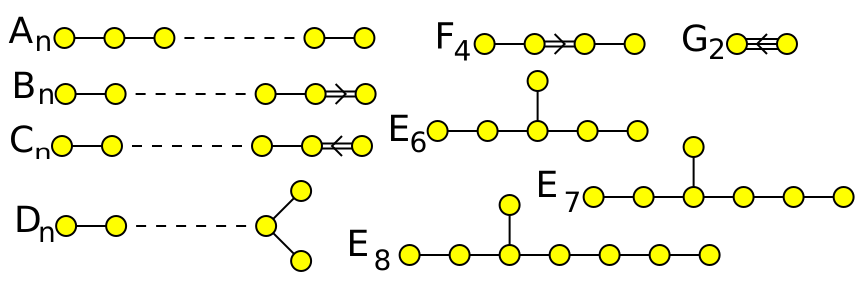
Connected non-abelian Lie group lacking nontrivial connected normal subgroups
the Killing-Cartan classification
In mathematics, a simple Lie group is a connected non-abelian Lie group G which does not have nontrivial connected normal subgroups. The list of simple Lie groups can be used to read off the list of simple Lie algebras and Riemannian symmetric spaces.
Together with the commutative Lie group of the real numbers, \mathbb{R}, and that of the unit-magnitude complex numbers, U(1) (the unit circle), simple Lie groups give the atomic "building blocks" that make up all (finite-dimensional) connected Lie groups via the operation of group extension. Many commonly encountered Lie groups are either simple or 'close' to being simple: for example, the so-called "special linear group" SL(n, \mathbb{R}) of n by n matrices with determinant equal to 1 is simple for all odd n 1, when it is isomorphic to the projective special linear group.
The first classification of simple Lie groups was by Wilhelm Killing, and this work was later perfected by Élie Cartan. The final classification is often referred to as Killing-Cartan classification.
Definition
Unfortunately, there is no universally accepted definition of a simple Lie group. In particular, it is not always defined as a Lie group that is simple as an abstract group. Authors differ on whether a simple Lie group has to be connected, or on whether it is allowed to have a non-trivial center, or on whether \mathbb{R} is a simple Lie group.
The most common definition is that a Lie group is simple if it is connected, non-abelian, and every closed connected normal subgroup is either the identity or the whole group. In particular, simple groups are allowed to have a non-trivial center, but \mathbb{R} is not simple.
In this article the connected simple Lie groups with trivial center are listed. Once these are known, the ones with non-trivial center are easy to list as follows. Any simple Lie group with trivial center has a universal cover whose center is the fundamental group of the simple Lie group. The corresponding simple Lie groups with non-trivial center can be obtained as quotients of this universal cover by a subgroup of the center.
Alternatives
An equivalent definition of a simple Lie group follows from the Lie correspondence: A connected Lie group is simple if its Lie algebra is simple. An important technical point is that a simple Lie group may contain discrete normal subgroups. For this reason, the definition of a simple Lie group is not equivalent to the definition of a Lie group that is simple as an abstract group.
Simple Lie groups include many classical Lie groups, which provide a group-theoretic underpinning for spherical geometry, projective geometry and related geometries in the sense of Felix Klein's Erlangen program. It emerged in the course of classification of simple Lie groups that there exist also several exceptional possibilities not corresponding to any familiar geometry. These exceptional groups account for many special examples and configurations in other branches of mathematics, as well as contemporary theoretical physics. All (locally compact, connected) Lie groups are smooth manifolds. Mathematicians often study complex Lie groups, which are Lie groups with a complex structure on the underlying manifold, which is required to be compatible with the group operations. A complex Lie group is called simple if it is connected as a topological space and its Lie algebra is simple as a complex Lie algebra. Note that the underlying Lie group may not be simple, although it will still be semisimple (see below). --
As a counterexample, the general linear group is neither simple, nor semisimple. This is because multiples of the identity form a nontrivial normal subgroup, thus evading the definition. Equivalently, the corresponding Lie algebra has a degenerate Killing form, because multiples of the identity map to the zero element of the algebra. Thus, the corresponding Lie algebra is also neither simple nor semisimple. Another counter-example are the special orthogonal groups in even dimension. These have the matrix -I in the center, and this element is path-connected to the identity element, and so these groups evade the definition. Both of these are reductive groups.
Full classification
Simple Lie groups are fully classified. The classification is usually stated in several steps, namely:
- Classification of simple complex Lie algebras The classification of simple Lie algebras over the complex numbers by Dynkin diagrams.
- Classification of simple real Lie algebras Each simple complex Lie algebra has several real forms, classified by additional decorations of its Dynkin diagram called Satake diagrams, after Ichirô Satake.
- Classification of centerless simple Lie groups For every (real or complex) simple Lie algebra \mathfrak{g}, there is a unique "centerless" simple Lie group G whose Lie algebra is \mathfrak{g} and which has trivial center.
- Classification of simple Lie groups One can show that the fundamental group of any Lie group is a discrete commutative group. Given a (nontrivial) subgroup K\subset \pi_1(G) of the fundamental group of some Lie group G, one can use the theory of covering spaces to construct a new group \tilde{G}^K with K in its center. Now any (real or complex) Lie group can be obtained by applying this construction to centerless Lie groups. Note that real Lie groups obtained this way might not be real forms of any complex group. A very important example of such a real group is the metaplectic group, which appears in infinite-dimensional representation theory and physics. When one takes for K\subset \pi_1(G) the full fundamental group, the resulting Lie group \tilde{G}^{K = \pi_1(G)} is the universal cover of the centerless Lie group G, and is simply connected. In particular, every (real or complex) Lie algebra also corresponds to a unique connected and simply connected Lie group \tilde{G} with that Lie algebra, called the "simply connected Lie group" associated to \mathfrak{g}.
Compact Lie groups
Main article: root system
Every simple complex Lie algebra has a unique real form whose corresponding centerless Lie group is compact. It turns out that the simply connected Lie group in these cases is also compact. Compact Lie groups have a particularly tractable representation theory because of the Peter–Weyl theorem. Just like simple complex Lie algebras, centerless compact Lie groups are classified by Dynkin diagrams (first classified by Wilhelm Killing and Élie Cartan).
For the infinite (A, B, C, D) series of Dynkin diagrams, a connected compact Lie group associated to each Dynkin diagram can be explicitly described as a matrix group, with the corresponding centerless compact Lie group described as the quotient by a subgroup of scalar matrices. For those of type A and C we can find explicit matrix representations of the corresponding simply connected Lie group as matrix groups.
Overview of the classification
Ar has as its associated simply connected compact group the special unitary group, SU(r + 1) and as its associated centerless compact group the projective unitary group PU(r + 1).
Br has as its associated centerless compact groups the odd special orthogonal groups, SO(2r + 1). This group is not simply connected however: its universal (double) cover is the spin group.
Cr has as its associated simply connected group the group of unitary symplectic matrices, Sp(r) and as its associated centerless group the Lie group of projective unitary symplectic matrices. The symplectic groups have a double-cover by the metaplectic group.
Dr has as its associated compact group the even special orthogonal groups, SO(2r) and as its associated centerless compact group the projective special orthogonal group . As with the B series, SO(2r) is not simply connected; its universal cover is again the spin group, but the latter again has a center (cf. its article).
The diagram D2 is two isolated nodes, the same as A1 ∪ A1, and this coincidence corresponds to the covering map homomorphism from SU(2) × SU(2) to SO(4) given by quaternion multiplication; see quaternions and spatial rotation. Thus SO(4) is not a simple group. Also, the diagram D3 is the same as A3, corresponding to a covering map homomorphism from SU(4) to SO(6).
In addition to the four families A**i, B**i, C**i, and D**i above, there are five so-called exceptional Dynkin diagrams G2, F4, E6, E7, and E8; these exceptional Dynkin diagrams also have associated simply connected and centerless compact groups. However, the groups associated to the exceptional families are more difficult to describe than those associated to the infinite families, largely because their descriptions make use of exceptional objects. For example, the group associated to G2 is the automorphism group of the octonions, and the group associated to F4 is the automorphism group of a certain Albert algebra.
List
Abelian
| Dimension | Outer automorphism group | Dimension of symmetric space | Symmetric space | Remarks | \mathbb{R} (Abelian) |
|---|---|---|---|---|---|
| 1 | \mathbb{R}^* | 1 | \mathbb{R} |
Notes
: The group \mathbb{R} is not 'simple' as an abstract group, and according to most (but not all) definitions this is not a simple Lie group. Further, most authors do not count its Lie algebra as a simple Lie algebra. It is listed here so that the list of "irreducible simply connected symmetric spaces" is complete. Note that \mathbb{R} is the only such non-compact symmetric space without a compact dual (although it has a compact quotient S1).
Compact
| Dimension | Real rank | Fundamental | ||||||||||||
|---|---|---|---|---|---|---|---|---|---|---|---|---|---|---|
| group | Outer automorphism | |||||||||||||
| group | Other names | Remarks | *A*n (n ≥ 1) compact | *B*n (n ≥ 2) compact | *C*n (n ≥ 3) compact | *D*n (n ≥ 4) compact | E6−78 compact | E7−133 compact | E8−248 compact | F4−52 compact | G2−14 compact | |||
| n(n + 2) | 0 | Cyclic, | ||||||||||||
| order n + 1 | 1 if , | |||||||||||||
| 2 if n 1. | projective special unitary group | |||||||||||||
| PSU(n + 1) | A1 is the same as B1 and C1 | |||||||||||||
| n(2n + 1) | 0 | 2 | 1 | special orthogonal group | ||||||||||
| SO2n+1(R) | B1 is the same as A1 and C1. | |||||||||||||
| B2 is the same as C2. | ||||||||||||||
| n(2n + 1) | 0 | 2 | 1 | projective compact symplectic group | ||||||||||
| PSp(n), PSp(2n), PUSp(n), PUSp(2n) | Hermitian. Complex structures of *H*n. Copies of complex projective space in quaternionic projective space. | |||||||||||||
| n(2n − 1) | 0 | Order 4 (cyclic when n is odd). | 2 if n 4, | |||||||||||
| S3 if | projective special orthogonal group | |||||||||||||
| PSO2n(R) | D3 is the same as A3, D2 is the same as A12, and D1 is abelian. | |||||||||||||
| 78 | 0 | 3 | 2 | |||||||||||
| 133 | 0 | 2 | 1 | |||||||||||
| 248 | 0 | 1 | 1 | |||||||||||
| 52 | 0 | 1 | 1 | |||||||||||
| 14 | 0 | 1 | 1 | This is the automorphism group of the Cayley algebra. |
Split
| Dimension | Maximal compact | ||||||
|---|---|---|---|---|---|---|---|
| subgroup | Fundamental | ||||||
| group | Outer auto­morphism | ||||||
| group | Other names | Compact | |||||
| symmetric space | Non-Compact | ||||||
| symmetric space | Remarks | ||||||
| n(n + 2) | n | *D*n/2 or B(n−1)/2 | Infinite cyclic if n = 1 | ||||
| 2 if n ≥ 2 | 1 if n = 1 | ||||||
| 2 if n ≥ 2. | projective special linear group | ||||||
| PSLn+1(R) | Real structures on *C*n+1 or set of RPn in CPn. Hermitian if , in which case it is the 2-sphere. | ||||||
| n(2n + 1) | n | SO(n)SO(n+1) | Non-cyclic, order 4 | 1 | identity component of special orthogonal group | ||
| SO(n,n+1) | n(n + 1) | ||||||
| n(2n + 1) | n | *A*n−1S1 | Infinite cyclic | 1 | projective symplectic group | ||
| PSp2n(R), PSp(2n,R), PSp(2n), PSp(n,R), PSp(n) | n(n + 1) | Hermitian. Complex structures of *H*n. Copies of complex projective space in quaternionic projective space. | |||||
| n(2n − 1) | n | SO(n)SO(n) | Order 4 if n odd, | ||||
| 8 if n even | 2 if n 4, | ||||||
| S3 if | identity component of projective special orthogonal group | ||||||
| PSO(n,n) | n2 | ||||||
| 78 | 6 | C4 | Order 2 | Order 2 | E I | 42 | |
| 133 | 7 | A7 | Cyclic, order 4 | Order 2 | 70 | ||
| 248 | 8 | D8 | 2 | 1 | E VIII | 128 | |
| 52 | 4 | C3 × A1 | Order 2 | 1 | F I | 28 | Quaternionic projective planes in Cayley projective plane. |
| 14 | 2 | A1 × A1 | Order 2 | 1 | G I | 8 | Quaternionic subalgebras of the Cayley algebra. Quaternion-Kähler. |
Complex
| Real dimension | Fundamental | ||||||||||||||
|---|---|---|---|---|---|---|---|---|---|---|---|---|---|---|---|
| group | Outer auto­morphism | ||||||||||||||
| group | Other names | Dimension of | |||||||||||||
| symmetric space | Compact | ||||||||||||||
| symmetric space | Non-Compact | ||||||||||||||
| symmetric space | *A*n | ||||||||||||||
| (n ≥ 1) complex | Bn | ||||||||||||||
| (n ≥ 2) complex | *C*n | ||||||||||||||
| (n ≥ 3) complex | *D*n | ||||||||||||||
| (n ≥ 4) complex | E6 complex | E7 complex | E8 complex | F4 complex | G2 complex | ||||||||||
| 2n(n + 2) | n | *A*n | Cyclic, order n + 1 | 2 if , | |||||||||||
| 4 (noncyclic) if n ≥ 2. | projective complex special linear group | ||||||||||||||
| PSLn+1(C) | n(n + 2) | Compact group *A*n | Hermitian forms on *C*n+1 | ||||||||||||
| 2n(2n + 1) | n | *B*n | 2 | Order 2 (complex conjugation) | complex special orthogonal group | ||||||||||
| SO2n+1(C) | n(2n + 1) | Compact group Bn | |||||||||||||
| 2n(2n + 1) | n | *C*n | 2 | Order 2 (complex conjugation) | projective complex symplectic group | ||||||||||
| PSp2n(C) | n(2n + 1) | Compact group Cn | |||||||||||||
| 2n(2n − 1) | n | *D*n | Order 4 (cyclic when n is odd) | Noncyclic of order 4 for n 4, or the product of a group of order 2 and the symmetric group S3 when . | projective complex special orthogonal group | ||||||||||
| PSO2n(C) | n(2n − 1) | Compact group Dn | |||||||||||||
| 156 | 6 | E6 | 3 | Order 4 (non-cyclic) | 78 | Compact group E6 | |||||||||
| 266 | 7 | E7 | 2 | Order 2 (complex conjugation) | 133 | Compact group E7 | |||||||||
| 496 | 8 | E8 | 1 | Order 2 (complex conjugation) | 248 | Compact group E8 | |||||||||
| 104 | 4 | F4 | 1 | 2 | 52 | Compact group F4 | |||||||||
| 28 | 2 | G2 | 1 | Order 2 (complex conjugation) | 14 | Compact group G2 |
Others
| Dimension | Real rank | Maximal compact | ||||||||||||||||||||
|---|---|---|---|---|---|---|---|---|---|---|---|---|---|---|---|---|---|---|---|---|---|---|
| subgroup | Fundamental | |||||||||||||||||||||
| group | Outer automorphism | |||||||||||||||||||||
| group | Other names | Dimension of | ||||||||||||||||||||
| symmetric space | Compact | |||||||||||||||||||||
| symmetric space | Non-Compact | |||||||||||||||||||||
| symmetric space | Remarks | A2n−1 II | ||||||||||||||||||||
| (n ≥ 2) | *A*n III | |||||||||||||||||||||
| (n ≥ 1) | ||||||||||||||||||||||
| p + q = n + 1 | ||||||||||||||||||||||
| (1 ≤ p ≤ q) | *B*n I | |||||||||||||||||||||
| (n 1) | ||||||||||||||||||||||
| p+q = 2n+1 | *C*n II | |||||||||||||||||||||
| (n 2) | ||||||||||||||||||||||
| n = p+q | ||||||||||||||||||||||
| (1 ≤ p ≤ q) | *D*n I | |||||||||||||||||||||
| (n ≥ 4) | ||||||||||||||||||||||
| p+q = 2n | *D*n III | |||||||||||||||||||||
| (n ≥ 4) | E62 II | |||||||||||||||||||||
| (quasi-split) | E6−14 III | E6−26 IV | E7−5 VI | E7−25 VII | E8−24 IX | F4−20 II | ||||||||||||||||
| (2n − 1)(2n + 1) | n − 1 | *C*n | Order 2 | SLn(H), SU∗(2n) | (n − 1)(2n + 1) | Quaternionic structures on C2n compatible with the Hermitian structure | Copies of quaternionic hyperbolic space (of dimension n − 1) in complex hyperbolic space (of dimension 2n − 1). | |||||||||||||||
| n(n + 2) | p | *Ap−1Aq−1S*1 | SU(p,q), A III | 2pq | Hermitian. | |||||||||||||||||
| Grassmannian of p subspaces of *C*p+q. | ||||||||||||||||||||||
| If p or q is 2; quaternion-Kähler | Hermitian. | |||||||||||||||||||||
| Grassmannian of maximal positive definite | ||||||||||||||||||||||
| subspaces of *C*p,q. | ||||||||||||||||||||||
| If p or q is 2, quaternion-Kähler | If p=q=1, split | |||||||||||||||||||||
| If ≤ 1, quasi-split | ||||||||||||||||||||||
| n(2n + 1) | min(p,q) | SO(p)SO(q) | SO(p,q) | pq | Grassmannian of *Rps in Rp+q*. | |||||||||||||||||
| If p or q is 1, Projective space | ||||||||||||||||||||||
| If p or q is 2; Hermitian | ||||||||||||||||||||||
| If p or q is 4, quaternion-Kähler | Grassmannian of positive definite *Rps in Rp,q*. | |||||||||||||||||||||
| If p or q is 1, Hyperbolic space | ||||||||||||||||||||||
| If p or q is 2, Hermitian | ||||||||||||||||||||||
| If p or q is 4, quaternion-Kähler | If ≤ 1, split. | |||||||||||||||||||||
| n(2n + 1) | min(p,q) | *CpC*q | Order 2 | 1 if p ≠ q, 2 if p = q. | Sp2p,2q(R) | 4pq | Grassmannian of *Hps in Hp+q*. | |||||||||||||||
| If p or q is 1, quaternionic projective space | ||||||||||||||||||||||
| in which case it is quaternion-Kähler. | *Hps in Hp,q*. | |||||||||||||||||||||
| If p or q is 1, quaternionic hyperbolic space | ||||||||||||||||||||||
| in which case it is quaternion-Kähler. | ||||||||||||||||||||||
| n(2n − 1) | min(p,q) | SO(p)SO(q) | If p and q ≥ 3, order 8. | SO(p,q) | pq | Grassmannian of *Rps in Rp+q*. | ||||||||||||||||
| If p or q is 1, Projective space | ||||||||||||||||||||||
| If p or q is 2 ; Hermitian | ||||||||||||||||||||||
| If p or q is 4, quaternion-Kähler | Grassmannian of positive definite *Rps in Rp,q*. | |||||||||||||||||||||
| If p or q is 1, Hyperbolic Space | ||||||||||||||||||||||
| If p or q is 2, Hermitian | ||||||||||||||||||||||
| If p or q is 4, quaternion-Kähler | If , split | |||||||||||||||||||||
| If ≤ 2, quasi-split | ||||||||||||||||||||||
| n(2n − 1) | ⌊n/2⌋ | *A*n−1R1 | Infinite cyclic | Order 2 | *SO**(2n) | n(n − 1) | Hermitian. | |||||||||||||||
| Complex structures on R2n compatible with the Euclidean structure. | Hermitian. | |||||||||||||||||||||
| Quaternionic quadratic forms on R2n. | ||||||||||||||||||||||
| 78 | 4 | A5A1 | Cyclic, order 6 | Order 2 | E II | 40 | Quaternion-Kähler. | Quaternion-Kähler. | Quasi-split but not split. | |||||||||||||
| 78 | 2 | D5S1 | Infinite cyclic | Trivial | E III | 32 | Hermitian. | |||||||||||||||
| Rosenfeld elliptic projective plane over the complexified Cayley numbers. | Hermitian. | |||||||||||||||||||||
| Rosenfeld hyperbolic projective plane over the complexified Cayley numbers. | ||||||||||||||||||||||
| 78 | 2 | F4 | Trivial | Order 2 | E IV | 26 | Set of Cayley projective planes in the projective plane over the complexified Cayley numbers. | Set of Cayley hyperbolic planes in the hyperbolic plane over the complexified Cayley numbers. | ||||||||||||||
| 133 | 4 | D6A1 | Non-cyclic, order 4 | Trivial | E VI | 64 | Quaternion-Kähler. | Quaternion-Kähler. | ||||||||||||||
| 133 | 3 | E6S1 | Infinite cyclic | Order 2 | E VII | 54 | Hermitian. | Hermitian. | ||||||||||||||
| 248 | 4 | E7 × A1 | Order 2 | 1 | E IX | 112 | Quaternion-Kähler. | Quaternion-Kähler. | ||||||||||||||
| 52 | 1 | B4 (Spin9(R)) | Order 2 | 1 | F II | 16 | Cayley projective plane. Quaternion-Kähler. | Hyperbolic Cayley projective plane. Quaternion-Kähler. |
Simple Lie groups of small dimension
The following table lists some Lie groups with simple Lie algebras of small dimension. The groups on a given line all have the same Lie algebra. In the dimension 1 case, the groups are abelian and not simple.
| Dim | Groups | Symmetric space | Compact dual | Rank | Dim |
|---|---|---|---|---|---|
| 1 | , S1 = U(1) = SO2() = Spin(2) | Abelian | Real line | 0 | |
| 3 | R}}) = PSU(2) | Compact | |||
| 3 | SL2() = Sp2(), SO2,1() | Split, Hermitian, hyperbolic | Hyperbolic plane \mathbb{H}^2 | Sphere S2 | 1 |
| 6 | SL2() = Sp2(), SO3,1(), SO3() | Complex | Hyperbolic space \mathbb{H}^3 | Sphere S3 | 1 |
| 8 | SL3() | Split | Euclidean structures on \mathbb{R}^3 | Real structures on \mathbb{C}^3 | 2 |
| 8 | SU(3) | Compact | |||
| 8 | SU(1,2) | Hermitian, quasi-split, quaternionic | Complex hyperbolic plane | Complex projective plane | 1 |
| 10 | R}}) | Compact | |||
| 10 | SO4,1(), Sp2,2() | Hyperbolic, quaternionic | Hyperbolic space \mathbb{H}^4 | Sphere S4 | 1 |
| 10 | SO3,2(), Sp4() | Split, Hermitian | Siegel upper half space | Complex structures on \mathbb{H}^2 | 2 |
| 14 | G2 | Compact | |||
| 14 | G2 | Split, quaternionic | Non-division quaternionic subalgebras of non-division octonions | Quaternionic subalgebras of octonions | 2 |
| 15 | R}}) | Compact | |||
| 15 | SL4(), SO3,3() | Split | 3 in 3,3 | Grassmannian G(3,3) | 3 |
| 15 | SU(3,1), SO*(6) | Hermitian | Complex hyperbolic space | Complex projective space | 1 |
| 15 | SU(2,2), SO4,2() | Hermitian, quasi-split, quaternionic | 2 in 2,4 | Grassmannian G(2,4) | 2 |
| 15 | SL2(), SO5,1() | Hyperbolic | Hyperbolic space \mathbb{H}^5 | Sphere S5 | 1 |
| 16 | SL3() | Complex | SU(3) | 2 | |
| 20 | SO5(), Sp4() | Complex | Spin5() | 2 | |
| 21 | SO7() | Compact | |||
| 21 | SO6,1() | Hyperbolic | Hyperbolic space \mathbb{H}^6 | Sphere S6 | |
| 21 | SO5,2() | Hermitian | |||
| 21 | SO4,3() | Split, quaternionic | |||
| 21 | Sp(3) | Compact | |||
| 21 | Sp6() | Split, hermitian | |||
| 21 | Sp4,2() | Quaternionic | |||
| 24 | SU(5) | Compact | |||
| 24 | SL5() | Split | |||
| 24 | SU4,1 | Hermitian | |||
| 24 | SU3,2 | Hermitian, quaternionic | |||
| 28 | SO8() | Compact | |||
| 28 | SO7,1() | Hyperbolic | Hyperbolic space \mathbb{H}^7 | Sphere S7 | |
| 28 | SO6,2(), SO∗8() | Hermitian | |||
| 28 | SO5,3() | Quasi-split | |||
| 28 | SO4,4() | Split, quaternionic | |||
| 28 | G2() | Complex | |||
| 30 | SL4() | Complex |
Simply laced groups
A simply laced group is a Lie group whose Dynkin diagram only contain simple links, and therefore all the nonzero roots of the corresponding Lie algebra have the same length. The A, D and E series groups are all simply laced, but no group of type B, C, F, or G is simply laced.
References
- {{Cite book | author1-link = Nathan Jacobson
- {{cite book
This article was imported from Wikipedia and is available under the Creative Commons Attribution-ShareAlike 4.0 License. Content has been adapted to SurfDoc format. Original contributors can be found on the article history page.
Ask Mako anything about Simple Lie group — get instant answers, deeper analysis, and related topics.
Research with MakoFree with your Surf account
Create a free account to save articles, ask Mako questions, and organize your research.
Sign up freeThis content may have been generated or modified by AI. CloudSurf Software LLC is not responsible for the accuracy, completeness, or reliability of AI-generated content. Always verify important information from primary sources.
Report