From Surf Wiki (app.surf) — the open knowledge base
Shapour Bakhtiar
Iranian politician (1914–1991)
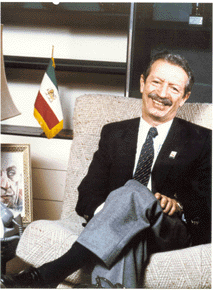
Iranian politician (1914–1991)
| Field | Value | |
|---|---|---|
| name | Shapour Bakhtiar | |
| image | Portrait of Bakhtiar.jpg | |
| order | 40th | |
| office | Prime Minister of Iran | |
| monarch | Mohammad Reza Pahlavi | |
| term_start | 6 January 1979 | |
| term_end | 11 February 1979The office was disputed between him and Mehdi Bazargan from 4 to 11 February 1979. | |
| predecessor | Gholam Reza Azhari | |
| successor | Mehdi Bazargan (Acting) | |
| office1 | Minister of Interior | |
| term_start1 | 16 January 1979 | |
| term_end1 | 11 February 1979 | |
| primeminister1 | *Himself* | |
| predecessor1 | Abbas Gharabaghi | |
| successor1 | Ahmad Sayyed Javadi | |
| order2 | Deputy Minister of Labor | |
| term_start2 | 1 July 1952 | |
| term_end2 | 9 April 1953 | |
| primeminister2 | Mohammad Mossadegh | |
| monarch2 | Mohammad-Reza Pahlavi | |
| order3 | Member of Regency Council | |
| appointer3 | Mohammad Reza Pahlavi | |
| term_start3 | 13 January 1979 | |
| term_end3 | 22 January 1979 | |
| birth_date | ||
| birth_place | Shahrekord, Sublime State of Iran | |
| death_date | ||
| death_place | Suresnes, France | |
| death_cause | Assassination (stab wounds) | |
| resting_place | Montparnasse Cemetery, Paris, France | |
| nationality | Iranian | |
| spouse | Madeleine | |
| Shahintaj | ||
| children | 4 | |
| alma_mater | Faculty of Law of Paris | |
| party | {{plainlist | |
| otherparty | National Front (1949–1979) | |
| signature | Bakhtiar_Signiture.png | |
| footnotes | ||
| allegiance | *France France | |
| branch | *International Brigades | |
| serviceyears | 1940–1941 | |
| unit | 30th Artillerie Regiment | |
| battles | Spanish Civil War | |
| native_name | ||
| native_name_lang | fa |
Shahintaj
- National Resistance Movement of Iran
- (1979–1991)
- Iran Party (1949–1979)
- Spanish Republic Spanish Republic
- French Army World War II
Shapour Bakhtiar (, ; 26 June 19146 August 1991) was an Iranian politician who served as the last Prime Minister of Iran under the rule of Mohammad Reza Pahlavi. In 1991, he and his secretary were murdered in his home in Suresnes, France, by agents of the Islamic Republic of Iran.
Early life
Bakhtiar was born on 26 June 1914 in southwestern Iran into a family of Iranian tribal nobility, the family of the paramount chieftains of the then powerful Bakhtiari tribe. His father, Mohammad Reza Khan (Sardar-e-Fateh), and his mother, Naz-Baygom, were both Lurs and Bakhtiaris. Bakhtiar's maternal grandfather, Najaf-Gholi Khan Samsam ol-Saltaneh, had been appointed prime minister twice, in 1912 and 1918.{{cite book|author=Darioush Bayandor|title=The Shah, the Islamic Revolution and the United States|date=2019|publisher=Palgrave Macmillan|location=Cham, Switzerland
Bakhtiar's mother died when he was seven.{{cite web|author=Cyrus Kadivar
Education
He attended elementary school in Shahr-e Kord and then secondary school, first in Isfahan and later in Beirut, where he received his high school diploma from a French school. He and his cousin, Teymour Bakhtiar, then went to Paris for additional university education at the Faculty of Law. There, he attended the College of Political Science.
Being a firm opponent of totalitarian rule, he was active in the Spanish Civil War for the Second Spanish Republic against General Francisco Franco's fascist Nationalists. In 1940, he volunteered for the French army – rather than the French Foreign Legion – and fought in the 30th Artillerie Regiment of Orléans. Bakhtiar did 18 months' military service. While living in Saint-Nicolas-du-Pélem, he fought with the French Resistance against the German occupation. In 1945, he received his PhD in political science as well as degrees in law from the Faculty of Law of Paris and philosophy from the Sorbonne.
Political career
Bakhtiar returned to Iran in 1946 and joined the social democratic Iran Party in 1949 and led its youth organization. In 1951 he was appointed director of the labor department in the Province of Isfahan by the ministry of labor. He later held the same position in Khuzestan, center of the oil industry. In 1951 Mohammad Mosaddeq had come to power in Iran. Under his premiership Bakhtiar was appointed deputy minister of labor in 1953. After the Shah was reinstated by a British-American sponsored coup d'état, Bakhtiar remained a critic of his rule.
In the mid-1950s he was involved in underground activity against the Shah's regime, calling for the 1954 Majlis elections to be free and fair and attempting to revive the nationalist movement. In 1960, the Second National Front was formed. Bakhtiar played a crucial role in the new organization's activities as the head of the student activist body of the Front. He and his colleagues differed from most other government opponents in that they were very moderate, restricting their activity to peaceful protest and calling only for the restoration of democratic rights within the framework of a constitutional monarchy. The Shah refused to co-operate and outlawed the Front, imprisoning the most prominent liberals. From 1964 to 1977, the imperial regime refused to permit any form of opposition activity, even from moderate liberals like Bakhtiar. In the following years Bakhtiar was imprisoned repeatedly, for a total of six years, for his opposition to the Shah. He was also one of the most prominent members of the central council of the illegal Fourth National Front in late 1977, when the group was reconstituted as the Union of National Front Forces with Bakhtiar as head of the Iran Party (the largest group in the Front).
At the end of 1978, as the Shah's power was crumbling, Bakhtiar was chosen to help in the creation of a civilian government to replace the existing military one. He was appointed to the position of Prime Minister by the Shah, as a concession to his opponents, especially the followers of Ayatollah Ruhollah Khomeini. Although that caused him to be expelled from the National Front, he accepted the appointment, as he feared a revolution in which communists and mullahs would take over the country, which he thought would ruin Iran.
In his 36 days as premier of Iran, Bakhtiar ordered all political prisoners to be freed, lifted censorship of newspapers (whose staff had until then been on strike), relaxed martial law, ordered the dissolution of SAVAK (the regime's secret police) and requested for the opposition to give him three months to hold elections for a constituent assembly that would decide the fate of the monarchy and determine the future form of government for Iran. Despite his conciliatory gestures, Khomeini refused to collaborate with Bakhtiar, denouncing the premier as a traitor for siding with the Shah, labeling his government "illegitimate" and "illegal" and calling for the overthrow of the monarchy. Bakhtiar has been accused of making mistakes during his premiership, such as allowing Khomeini to re-enter Iran. In the end, he failed to rally even his own former colleagues in the National Front.
His government was overwhelmingly rejected by the masses except for a very small number of pro-Shah loyalists and a handful of moderate pro-democratic elements. The opposition was not willing to compromise. The Shah was forced to leave the country in January 1979; Bakhtiar left Iran again for France in April of the same year.
French exile and series of assassination attempts
Shortly after the revolution, Ayatollah Sadegh Khalkhali, a religious judge and later chairman of the Revolutionary Court, announced to the press that the death sentence had been passed on members of the Pahlavi family and former Shah officials, including Bakhtiar.
In July 1979, Bakhtiar emerged in Paris. He was given political asylum there. From his base in Paris, he led the National Movement of Iranian Resistance, which fought the Islamic Republic from within the country. Between 9 and 10 July 1980, Bakhtiar helped organize a coup attempt known as the Nojeh coup plot, prompting the Islamic Republic to issue a death sentence on him.
On 18 July 1980, he escaped an assassination attempt by a group of three attackers in his home in Neuilly-sur-Seine, a suburb of Paris, in which a policeman and a neighbor were killed. The five-man assassination team with ties to the newly formed Islamic republic, led by Anis Naccache, a Lebanese revolutionary, was captured. They were sent to Tehran.
Death

On 6 August 1991, Bakhtiar was murdered along with his secretary, Soroush Katibeh, by three assassins in his home in the Parisian suburb of Suresnes.
Trial
Two of the assassins escaped to Iran. A third, Ali Vakili Rad, was apprehended in Switzerland, along with an alleged accomplice, Zeynalabedin Sarhadi, a great-nephew of Hashemi Rafsanjani, the president of Iran at the time. Both were extradited to France for trial. Vakili Rad was sentenced to life in prison in December 1994, but Sarhadi was acquitted. Rad was paroled on 19 May 2010, after serving 16 years of his sentence. He was received as a hero by Islamic Republic officials.
Aftermath
The release of Rad had happened only two days after Tehran freed Clotilde Reiss, a French student accused of spying by the Islamic regime. Both the French and Iranian governments deny the two affairs were linked.
Hours after Bakhtiar's assassination, a British hostage was released from Lebanon, presumably held by Hezbollah, but a French hostage was taken. Although many in the Iranian exile community speculated about official French complicity in Bakhtiar's death, the second kidnapping casts doubt on such theories. The French would seem unlikely to support an operation that included the kidnapping of another French hostage in Lebanon, and there is no apparent connection between the two events.
Published works
Bakhtiar published a memoir in addition to many articles. His books include Ma Fidélité (in French) and 37 Days after 37 Years (in Persian), his biography (highlighting his political career and his beliefs, up to the Iranian Revolution). His writings are of special interest regarding society and politics in the Pahlavi era and the period of riots and turbulence just before the fall of Mohammad Reza Shah Pahlavi.
Personal life
Bakhtiar was first married to a French woman with whom he had four children: sons Guy and Patrick, and two daughters, Viviane and France. Viviane died of a heart attack at the age of 49 in Cannes in August 1991. Guy is a French police intelligence unit officer.
Shortly before his death, Bakhtiar divorced his wife and married a young Iranian woman. His second wife was Shahintaj, and they had a son, Goudarz. He also had a stepdaughter named Manijeh Assad. As of 2001, all three were United States citizens.
Bakhtiar is buried in Montparnasse Cemetery in Paris.
Notes
References
- ""Interview with Bakhtiar, Shapour : Tape 01. The Iranian Oral History Project is a unique resource for the study of modern Iranian history".".
- (2010-05-18). "L’assassinat de Chapour Bakthiar était presque parfait...".
- Nehmé, Lina Murr. (2018-08-06). "Il y a vingt-sept ans, le régime des mollahs tuait Chapour Bakhtiar en France".
- (2018-08-11). "A Life in Focus: Shapour Bakhtiar, the last prime minister of Iran’s Pahlavi era".
- "Bakhtiari, Teymour". Bakhtiari Family.
- Elizabeth Collard. (1979). "IRAN". Economic East Economic Digest Ltd.
- Wolfgang Saxon (9 August 1991) "[https://www.nytimes.com/1991/08/09/obituaries/shahpur-bakhtiar-foe-of-shah-hunted-by-khomeini-s-followers.html Shahpur Bakhtiar: Foe of Shah Hunted by Khomeini's Followers]" [[New York Times]], retrieved 6 July 2015
- (2008). "No Safe Haven: Iran's Global Assassination Campaign". Iran Human Rights.
- Kaveh Basmenji. (25 January 2013). "Tehran Blues: Youth Culture in Iran". Saqi.
- (18 July 1980). "Police thwart attempt to assassinate Bakhtiar". [[The Pittsburgh Press]].
- Hooman Bakhtiar. (9 August 2015). "Obama's Sanctions Gift to an Assassin for Iran". The Wall Street Journal.
- Both men were killed with kitchen knives. Their bodies were not found until at least 36 hours after death, even though Bakhtiar had heavy police protection and his killers had left identity documents with a guard at his house.Riding, Alan. [https://www.nytimes.com/1991/08/10/world/france-vows-to-press-for-release-of-newly-taken-hostage.html "France Vows to Press for Release of Newly Taken Hostage"], ''New York Times'', 10 August 1991. Retrieved 5 November 2007.
- Rempel, William C. [https://www.latimes.com/archives/la-xpm-1994-11-03-mn-58301-story.html "Tale of Deadly Iranian Network Woven in Paris"] {{webarchive. link. (27 December 2007, ''[[Los Angeles Times]]'', 3 November 1994. Retrieved 5 November 2007.)
- Kenneth Pollack. (2 November 2004). "The Persian Puzzle: Deciphering the Twenty-five-Year Conflict Between the United States and Iran". Random House Publishing Group.
- Greenhouse, Stephen. [https://www.nytimes.com/1991/12/28/world/french-ask-swiss-on-jailed-iranian.html "French Ask Swiss on Jailed Iranian"], ''New York Times'', 28 December 1991. Retrieved 5 November 2007.
- Riding, Alan; [https://www.nytimes.com/1994/11/03/world/3-iranians-go-on-trial-in-france-in-slaying-of-exiled-ex-premier.html ''3 Iranians Go on Trial in France in Slaying of Exiled Ex-Premier''], New York Times; 3 November 1994; retrieved 5 November 2007.
- U.S. State Department, [http://dosfan.lib.uic.edu/ERC/democracy/1994_hrp_report/94hrp_report_nea/Iran.html 1994 Human Rights Report: Iran] {{Webarchive. link. (7 February 2012 . Retrieved 5 November 2007)
- (19 May 2010). "Ali Vakili Rad: The Perfect Murder and An Imperfect Getaway". France 24.
- (18 May 2010). "Iran Gives Hero's Welcome to Killer of Former Prime Minister Shapour Bakhtiar". Voice of America.
- (20 May 2010). "Bakhtiar's Murderer Turned into a Hero and Role Model". Rooz Online.
- Lisa Bryant. (17 May 2010). "France Sends Iranian Assassin Home". Voice of America.
- Schmidt, William E. [https://www.nytimes.com/1991/08/10/world/pressure-mounts-on-israel-to-free-its-arab-captives.html "Pressure Mounts on Israel to Free Its Arab Hostages"], ''New York Times'', 10 August 1991. Retrieved 5 November 2007.
- Habib Lajevardi, editor, ''Memoirs of Shapour Bakhtiar'', in [[Persian language. Persian]] ([[Harvard University Press]], 1996). {{ISBN. 0-932885-14-4
- Chapour Bachtiar, ''Ma Fidélité'', Edition Albin Michel, Paris 1985 {{ISBN. 2-226-01561-2, {{ISBN. 978-2-226-01561-7
- ''37 Days after 37 Years'', in [[Persian language. Persian]], Radio Iran Publications, Paris, 1982 {{ISBN needed
- (7 August 2010). "An interview of Shapour Bakhtiar's Only Living Daughter". Iranian.
- (24 August 1991). "Bakhtiar's daughter dies of heart attack". UPI.
- "Autopsy shows Bakhtiar likely killed Tuesday".
- Kadivar, Cyrus. (2017). "Farewell Shiraz: An Iranian Memoir of Revolution and Exile". American University in Cairo Press.
- David Rosenzweig. (8 August 2001). "Family of Slain Prime Minister Files Suit Against Iranian Government". Los Angeles Times.
This article was imported from Wikipedia and is available under the Creative Commons Attribution-ShareAlike 4.0 License. Content has been adapted to SurfDoc format. Original contributors can be found on the article history page.
Ask Mako anything about Shapour Bakhtiar — get instant answers, deeper analysis, and related topics.
Research with MakoFree with your Surf account
Create a free account to save articles, ask Mako questions, and organize your research.
Sign up freeThis content may have been generated or modified by AI. CloudSurf Software LLC is not responsible for the accuracy, completeness, or reliability of AI-generated content. Always verify important information from primary sources.
Report