From Surf Wiki (app.surf) — the open knowledge base
Shalwar kameez
Trousers and tunic worn in South Asia
Trousers and tunic worn in South Asia

Shalwar kameez (also salwar kameez and less commonly shalwar qameez) is a traditional combination dress worn by men and women in South Asia, and Central Asia.
Shalwars are trousers which are atypically wide at the waist and narrow to a cuffed bottom. They are held up by a drawstring or elastic belt, which causes them to become pleated around the waist. The trousers can be wide and baggy, or they can be cut quite narrow, on the bias. Shalwars have been traditionally worn in a wide region which includes Eastern Europe, West Asia, Central Asia, and South Asia. The kameez is a long shirt or tunic. The side seams are left open below the waist-line (the opening known as the chaak), which gives the wearer greater freedom of movement. The kameez is usually cut straight and flat; older kameez use traditional cuts; modern kameez are more likely to have European-inspired set-in sleeves. The kameez may have a European-style collar, a Mandarin collar, or it may be collarless; in the latter case, its design as a women's garment is similar to a kurta. The combination garment is sometimes called salwar kurta, salwar suit, Punjabi suit, and Punjabi dress.
The shalwar and kameez were introduced into South Asia by arriving Muslims in the north in the 13th century: at first worn by Muslim women, their use gradually spread, making them a regional style, especially in the historical Punjab region. The shalwar-kameez is widely-worn by men and women in Pakistan, and is the country's national dress. It is also widely worn by men and women in Afghanistan, and some men in the Punjab region of India, and which it has been adopted since medieval times by women throughout India, and more generally in South Asia.
When women wear the shalwar-kameez in some regions, they usually wear a long scarf or shawl called a dupatta around the head or neck. In South Asia, the dupatta is also employed as a form of modesty—although it is made of delicate material, it obscures the upper body's contours by passing over the shoulders. For Muslim women, the dupatta is a less stringent alternative to the chador or burqa (see hijab and purdah); for Sikh and Hindu women, the dupatta is useful when the head must be covered, as in a temple or the presence of elders. Everywhere in South Asia, modern versions of the attire have evolved; the shalwars are worn lower down on the waist, the kameez have shorter lengths, higher splits, lower necklines and backlines, and with cropped sleeves or without sleeves.
Description
The shalwar are loose pyjama-like trousers. The legs are wide at the top, and narrow at the ankle. The kameez is a long shirt or tunic, often seen with a Western-style collar; however, for female apparel, the term is now loosely applied to collarless or mandarin-collared kurtas. The kameez might be worn with pyjamas as well, either for fashion or comfort. Some kameez styles have side seams (known as the chaak), left open below the waist-line, giving the wearer greater freedom of movement.
Styles
The kameez can be sewn straight and flat, in an "A" shape design or flowing like a dress; there are a variety of styles. Modern kameez styles are more likely to have European-inspired set-in sleeves. If the tailor's taste or skill is displayed, this will be seen in the shape of the neckline and the decoration of the kameez. The kameez may be cut with a deep neckline, sewn in diaphanous fabrics, or styled in cap-sleeve or sleeveless designs.
There are many styles of shalwar: the Peshawari shalwar, Balochi shalwar, Sindhi Chareno, Sindhi Kancha, Sindhi Suthan/Salwar, Sindhi Pajamo/Sorhi Suthan and Punjabi shalwar.
Although various regions of the Indian subcontinent now wear the outfit in its various forms, the outfit was originally only popular on a wide scale in Afghanistan, Khyber Pakhtunkhwa, Sindh, Balochistan and the Punjab region of the Indian subcontinent. However, the shalwar kameez has now become popular across the Indian subcontinent.
Different forms
The following are some of the styles of shalwar kameez.
Anarkali suit
The shalwar kameez known as the Anarkali suit is named after the court dancer from Lahore, Pakistan. This suit has a timeless style which has become very popular. It is made up of a long, frock-style top and features a slim fitted bottom. This style of suit links the Indian subcontinent with the women's firaq partug (frock and shalwar) of northwestern Pakistan and Afghanistan and to the traditional women's clothing of parts of Central Asia. It also links to the Punjab region, where the Anarkali suit is similar to the anga and the Peshwaz worn in Jammu.
Afghanistan suits
The styles of shalwar kameez worn in Afghanistan include various styles of khet partug, perahan tunban and Firaq partug worn by Pashtuns, Tajiks, and Hazaras. The shalwar tends to be loose and rests above the ankles.
File:Clothing worn by most Pashtun males.jpg|Perahan tunban worn by most Pashtun males in Afghanistan and Pakistan File:Afghan Uniformed Police officer Noor Haya talks with an elder outside the district center in Spin Boldak, Kandahar province, Afghanistan, Sept 110918-A-VB845-368.jpg|Man in Afghan clothing: perahan tunban File:Afghan children wearing traditional clothes in Kabul.jpg|Afghan children wearing traditional clothes in Kabul File:Inside The Old Terminal Of Kabul International Airport.jpg|Men wearing perahan tunban, a form of shalwar kameez at Kabul Airport in Afghanistan
Peshawari shalwar suit
The traditional dress of Peshawar and other parts of Khyber Pakhtunkhwa, Pakistan, is the khalqa (gown) which opens at the front, or shirt which does not open at the front, and the Peshawari shalwar which is very loose down to the ankles. The Peshawari shalwar can be used with a number of upper garments and is part of the clothing of Khyber Pakhtunkhwa.
Balochi suits
The clothing of Balochistan, Pakistan includes the shalwar kameez which when worn by males consists of a very baggy shalwar using large lengths of cloth. The kameez is also loose, and traditionally is long, with long sleeves. The present Balochi shalwar kameez replaced the earlier version which consisted of a robe to the ankles and a shalwar using cloth of up to 40 yards. The Pashtuns in northern Balochistan wear clothes similar to the styles worn in Afghanistan.
File:Quetta.1867.JPG|Balochi male shalwar kameez, Quetta, 1867 File:Baluchistan01.jpg|Traditional Balochi suits File:Tribal Elders, April 1896.jpg|Tribal elders, April 1896
The female Balochi suit consists of the head scarf, long dress and a shalwar.
File:Balochi traditional dress.jpg|Balochi traditional dress File:Baluchi dress (UBC 2013).jpg|Baluchi dress File:Balochi embroidery.png|Balochi embroidery File:Traditional Balouchi Dresses.JPG|Traditional Balochi dresses
Phiran, poots and shalwar
In Kashmir, the outfit consists of the phiran, poots and shalwar.
File:A lady at srinagar.JPG|Left and right: phiran shalwar; centre: Punjabi suits File:Bihar girl in Kashmiri dress.jpg|Kashmiri phiran File:Traditional winter dress of kashmir.jpg|A man from Srinagar wearing phiran File:Kashmiri Muslim women in traditional long Phiran 1870.jpg|Kashmiri women in traditional long phiran 1870 File:KashmirPundit1895BritishLibrary.jpg|Kashmiri Pandits in phiran and pyjama File:Men in Kashmiri Phiran and Poots 1875.jpg|Men in Kashmiri phiran and poots, 1875
Punjabi suits
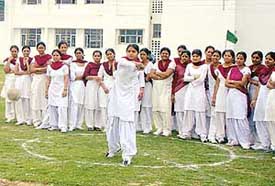
The traditional shalwar kameez worn in the Punjab region is cut differently to the styles worn in Balochistan and Afghanistan and is known as a "Punjabi suit" with the kameez being cut straight and flat with side slits (which is a local development as earlier forms of kameez did not have side slits). The shalwar is wide at the top but fits closely to the legs and is gathered at the ankles. The Punjabi shalwar is also cut straight and gathered at the ankles with a loose band reinforced with coarse material. In rural Punjab, the shalwar is still called the suthan, which is a different garment that was popular in previous centuries, alongside the churidar and kameez combination (which is still popular). In Britain, British Asian women from the Punjab region of the Indian subcontinent have brought the dress to the mainstream, and even high-fashion, appeal. The Punjabi suit is popular in other regions of the Indian subcontinent, such as Mumbai and Sindh. The popularity of Punjabi suits in India was extentuated during the 1960s through Hindi cinema. Punjabi suits are also popular among young women in Bangladesh and are especially popular amongst school girls in India. The outfit is also popular in Afghanistan, where it is called the Punjabi.
File:Jaipur-India n001.jpg|Punjabi Shalwar kameez File:Women of Puducherry.jpg|Women in Punjabi suits File:MissPooja2.jpg|Miss Pooja of the Punjab region in a Punjabi suit File:Shalvaar qamiz.JPG|Men's Punjabi Shalwaar qamiz File:Christian Girls Arriving at School, Jammu, ca.1875-ca.1940 (imp-cswc-GB-237-CSWC47-LS10-047).jpg|Girls arriving at school, Jammu, File:Picket_Line_in_Pakistan.jpg|Women in ornate shalwars File:Rohi's Women Dress - Bahawalpur Museum.jpg|Rohi (Cholistan) woman's bandhani dress (Punjab, Pakistan) File:1st Punjabi Wikipedia Workshop-9.jpg|First Punjabi Wikipedia Workshop: women in Punjabi suits File:A-punjabi-kitchen.jpg|Women wearing traditional clothes in a Punjabi kitchen: 1899
Another common type of Punjabi shalwar kameez is the Patiala salwar which has many folds and originates in the city of Patiala.
Another style of the Punjabi suit is the use of the shalwar which hails from the Pothohar region of Punjab, Pakistan, and is known as the Pothohari shalwar. The Pothohari shalwar retains the wideness of the older Punjabi suthan and also has some folds. The kameez is also wide. The head scarf is traditionally large, similar to the chador or phulkari that was used throughout the plains of the Punjab region.
Saraiki shalwar suits are Punjabi outfits which include the Bahawalpuri shalwar suit and the Multani shalwar suit.
The Bahawalpuri shalwar originates from the Bahawalpur region of Punjab, Pakistan. The Bahawalpuri shalwar is very wide and baggy with many voluminous folds. The material traditionally used for the Bahawalpuri shalwar and suthan is known as Sufi which is a mixture of cotton warp mixed with silk weft and gold threads running down the material. The other name for these types of mixed cloth is shuja khani. The Bahawalpuri shalwar is worn with the Bahawalpur style kameez, the Punjabi kurta or chola.
File:Nawab Muhammad Of Bawalpur 1868-1900.JPG|Nawab Muhammad of Bahawalpur (1868–1900) wearing a loose Bahawalpuri shalwar File:Prince Suba Sadiq Abbasi.JPG|Prince Suba Sadiq Abbasi, Bahawalpur File:Bed Sheets - Bahawalpur Museum.jpg|Bahawalpur kameez File:Nawab Sadiq Khan Fifth.JPG|Nawab Sadiq Khan Fifth (died 1966) in the Bahawalpuri shalwar
The Multani shalwar, also known as the 'ghaire wali' or 'Saraiki ghaire wali' shalwar as it is very wide around the waist, originates from the Multan area of the Punjab region. The style is similar to the Sindhi kancha shalwar as both are derivatives of the pantaloon shalwar worn in Iraq and adopted in these locations during the 7th century AD. The Multani shalwar is very wide, baggy, and full, and has folds like the Punjabi suthan. The upper garments include the Punjabi kameez and the chola of the Punjab region.
An older variety of shalwar kameez of the Punjab region is the Punjabi suthan and kurta suit. The Punjabi suthan is a local variation of the ancient svasthana tight fitting trousers which have been used in the Punjab region since the ancient period and were worn with the tunic called varbana which was tight fitting.
The Punjabi suthan is arranged in plaits and uses large amounts of material (traditionally coloured cotton with vertical silk lines, called sussi) of up to 20 yards hanging in many folds. The suthan ends at the ankles with a tight band which distinguishes the suthan from a shalwar. The modern equivalent of the loose Punjabi suthan are the cowl pants and dhoti shalwars which have many folds.
Some versions of the Punjabi suthan tighten from the knees down to the ankles (a remnant of the svasthana). If a tight band is not used, the ends of the suthan fit closely around the ankles. The Jodhpuri breeches devised during the 1870s by Sir Pratap Singh of Jodhpur offer a striking slim line resemblance to the centuries-old tight Punjabi suthan, although the churidar is cited as its source. The tight pantaloon style suthan was popular with the Indian Cavalry during the 19th and early 20th centurie; they were dyed in Multani mutti or mitti (clay/fuller's earth), which gave the garments a yellow colour.
The kurta is a remnant of the 11th-century female kurtaka which was a shirt extending to the middle of the body with side slits worn in parts of north India which has remained a traditional garment for women in Punjab, albeit longer than the kurtaka. The suthan was traditionally worn with a long kurta but can also be worn with a short kurti or frocks. Modern versions of the kurta can be knee length. The head scarf is also traditionally long but again, modern versions are shorter.
File:Nihang Singh and Nihang Singhani.jpg|19th-century Punjabi suthan suit worn by the lady on the right File:Pahari women kashmir3.jpg|Women in Punjabi suthan 1890 File:Market Place, Bikanir 1896. Woman on left in loose Punjabi suthan suit.jpg|Woman on left in loose Punjabi suthan suit File:Punjabi Sikh woman in Amritsar Punjabi suthan and short kurta 1874.jpg|Punjabi woman in Punjabi suthan and short kurta, 1874 File:GuptaDanceMusic02.jpg|Ancient svasthana and varbana outfit worn during the Gupta Empire, the basis of the Punjabi suthan suit File:Sepoys of 20th Punjab Infantry and Hunza Gun. 1893. Men in Punjabi tight from knees suthan.jpg|Men in tight Punjabi suthan, 1893 File:Bharatpore maharajah.jpg|The Nawab Muhammad Bahawal Khan Abbasi V Bahadur (1883–1907) of Bahawalpur State in suthan File:Bertrand Blanchard Acosta in jodhpurs and goggles.tif|Bertrand Blanchard Acosta in jodhpurs and goggles
The outfit in Jammu is the Dogri kurta and suthan. When the tight part of the suthan, up to the knees, has multiple close fitting folds, the suthan is referred to as Dogri pants or suthan, in Jammu, and churidar suthan in the Punjab region and some parts of Himachal Pradesh.
File:Dogri play Bawa Jitto directed by Balwant Thakur Produced in 1986 and still going strong.jpg|Men and boys wearing a knee length variation of the Punjabi ghuttana and Dogri kurta. The full suthan is tight from the knees to the ankles, associated with the Punjab region. File:Punjab Hills 1895. Kulu woman in churidar suthan. Himachal Pradesh.jpg|Punjab Hills 1895, Kulu woman in churidar suthan, Himachal Pradesh
Sindhi suits
The traditional Sindhi Shalwar Kameez or (Suthan ain Khamis) in Sindhi are of different styles, The Sindhi Shalwar worn by men are of three types, one is called Suthan/Salwar which is wide at waist and gets narrow below the knees till ankles where there are loosely fitted (Pācha) cuffs, it is worn mostly in upper/north of Sindh. The second type of Shalwar is (Kancha) which used to be worn usually in lower/south of Sindh and was wide down the knees till ankles where there are wider ankles (Pācha), Kancha is mostly not worn anymore or if ever worn then it does not have the that much wide ankles as the original one. The Sindhi Suthan and Kancha usually have less pleats, The third style of Shalwar is modern Sindhi suthan/salwar which do not have any pleats but is loose like pyjamas, while some men wear Gairwari Salwar, which has many pleats and is voluminous. All the shalwars are tied at waist by Agath (drawstring) which is made of different bright colours heavily ornated and embellished with shiny metallic threads, beads, mirrors etc. The Salwar and Kancha's pleats are created by bringing the folds together on opposite sides. The Khamis is also made of different styles, originally Sindhi men used to wear either short or long Angrakho which was tied at either side or in middle, the shorter one was called Angelo, and was worn by common people, the longer ones were worn by Soldiers, government officials and noblemen, other style was called Kiriyo/Puthiyo, then the short Kurtas (tunics) called (Pehrān/Pehriyān) were commonly worn, which used to be collarless like Angrakho and was tied at either side or in middle, and had half way slit opening in front unlike angrakhas which used to be completely slit in front. The Angrakho and Pehrān/Pehriyān were also used to be embroidered with Sindhi bhart and mirrorwork. Above Angelo and Pehrān some men also wore (Koti, Sadri, Gidi, Kaba) which can also be sometimes embroidered with mirrors usually borders and a heart shape design on back having initials of first and last name of wearer. while underneath the Angelo, Pehran and Khamis men wear Ganji (vest) which is also heavily embroidered with Sindhi stitches and mirrors. During British Raj, the colllars were introduced in Sindh, the Sindhi men started wearing Pehran with collars and buttons, also during that time the english long coats and jackets were introduced which were worn over local clothing. The upper garment of Sindhi men was mostly short either till hips or till midway to thighs, except for some rich men, but the modern Khamis reaches at least till knees, the modern Khamis can have (Gol daman) round cut at end corners or (Chokor Daman) square cut, this is now a everydays clothing of Sindhi men. The clothes are adorned with Ajrak and topi or Patko (Turbans), but usually on everyday life, a various coloured floral, checkered or plain piece of cloth with Sindhi embroideries and mirrors is carried over shoulders or as turban, also used as a (rumal) handkerchief, and for the protection from the heat of sun, while during winters locally wool made shawls of different styles like Loi, Katho, Khes etc are used for warming.
Sindhi women of Sindh wear Salwar/Suthan which is almost similar those worn by men, but back in time some women of lower Sindh used to wear a very baggy Salwars called "Chareno" but these are not normally worn anymore. Many Sindhi women also wore churidar pajamo (Sohri Suthan). Traditional Sindhi women Suthan and Pajamo are made of bright colours and rich fabrics like soosi, silk, satin, velvets and brocades which are heavily embroidered at ankles (Pācha). The Salwars are worn with the Cholo (tunics) or Ghagho, Abho (different frocks) which are also heavily intricately embroidered with Sindhi bhart and other embellishments called Gaj, Aggoti, Gichi, back in time the Salwars were used to be hidden under a wide Paro/Peshgeer (Skirt), specially when a woman went outside and over the head women wore a wide and long veils called Rawo/Gandhi/Pothi/Chuni/Salur. File:Group of Sindhi girls in traditional clothes.jpg|Sindhi girls wearing traditional Sindhi dress, worn by Soomra tribe File:Sindhi Gaj Shirts.jpg|Traditional Sindhi Cholo with heavy embroidered Gaj worn by Sammat group of Sindhi women File:Muslim girl karachi1870.jpg|Girl from Karachi, Sindh, in a shalwar and Choli. c. 1870. Oriental and India Office Collection, British Library. File:Baloch Man in Sindhi traditional pantaloon style 1845.jpg|Man in Sindhi traditional Suthan Shalwar File:Man in Sindhi angerkho top (1845).jpg|Man in Sindhi long angrakho (1845) File:Hyderabad, Sindh (8091058973).jpg|Two Sindhi men and a boy in Sindhi Suthan/Salwar, Pehran, Patka, Loi (Sindhi shawl), and cap and jacket File:Portret van twee onbekende mannen van een Sindhi-stam Two Sindees. Soonnee Mussulmans. Sind (titel op object), RP-F-2001-7-1122F-41.jpg|Portrait of two Sindhi men wearing Sindhi Kancha, Pehran, Ajrak and turbans on head File:PK Karachi asv2020-02 img11 Clifton Beach.jpg|A Sindhi camel driver in Clifton Beach, wearing modern style Sindhi Kancha and Khamis and a rumal (handkerchief) on shoulder File:Muslim girl sind1870.jpg|Woman, in Sind, British India, in Sindhi slim pajamo shalwar File:Hindu girl karachi.jpg|Sindhi girl from Karachi, Sind, in Sindhi ghagho like cholo and narrow suthan, c. 1870 File:Portret van een onbekende vrouw van de Mohana-stam Mohana woman. Soonnee Mussulman. Sind (titel op object), RP-F-2001-7-1122F-69.jpg|Portrait of a Mohana girl in Sindhi Salwar
Notes
Explanatory notes
Citations
General and cited references
- .
References
- (2013). "Derailing Democracy in Afghanistan: Elections in an Unstable Political Landscape". Columbia University Press.
- {{Cite OED. shalwar. 177379
- {{Cite OED. kameez
- Donnan, Hastings. (1991). "Economy and Culture in Pakistan: Migrants and Cities in a Muslim Society". Palgrave Macmillan UK.
- (2003). "The SAGE Encyclopedia of Social Science Research Methods". SAGE Publications.
- (2011). "Concise Oxford English Dictionary: Book & CD-ROM Set". Oxford University Press.
- "shalwar kameez".
- Anesa, Patrizia. (2018). "Lexical Innovation in World Englishes: Cross-fertilization and Evolving Paradigms". Taylor & Francis.
- (2012). "Islam in the West: Key Issues in Multiculturalism". Palgrave Macmillan UK.
- (1999). "Bulgarian Urban Culture in the Eighteenth and Nineteenth Centuries". Susquehanna University Press.
- Cole, Jeffrey E.. (2011). "Ethnic Groups of Europe: An Encyclopedia: An Encyclopedia". ABC-CLIO.
- Scarce, Jennifer M.. (2014). "Women's Costume of the Near and Middle East". Routledge.
- (1996). "The Forbidden Modern: Civilization and Veiling". University of Michigan Press.
- (2011). "Concise Oxford English Dictionary: Book & CD-ROM Set". Oxford University Press.
- Platts, John Thompson. (February 2015). "A dictionary of Urdu, classical Hindi, and English". W. H. Allen & Co..
- Shukla, Pravina. (2015). "The Grace of Four Moons: Dress, Adornment, and the Art of the Body in Modern India". Indiana University Press.
- Mooney, Nicola. (2011). "Rural Nostalgias and Transnational Dreams: Identity and Modernity Among Jat Sikhs". University of Toronto Press.
- (17 April 2022). "The Punjab and Bengal". Anuradha Prakashan.
- (4 January 2002). "Television, Ethnicity and Cultural Change". Routledge.
- (31 October 2013). "Gender, Religion, and the Heathen Lands: American Missionary Women in South Asia, 1860s-1940s". Routledge.
- Tarlo, Emma. (1996). "Clothing Matters: Dress and Identity in India". University of Chicago Press.
- Tarlo, Emma. (1996). "Clothing Matters: Dress and Identity in India". University of Chicago Press.
- Sun, Ming-Ju. (2001). "Traditional Fashions from India Paper Dolls". Courier Corporation.
- Fraile, Sandra Santos. (11 July 2013). "Sites and Politics of Religious Diversity in Southern Europe: The Best of All Gods". BRILL.
- Shome, Raka. (2014). "Diana and Beyond: White Femininity, National Identity, and Contemporary Media Culture". University of Illinois Press.
- Marsden, Magnus. (2005). "Living Islam: Muslim Religious Experience in Pakistan's North-West Frontier". Cambridge University Press.
- Haines, Chad. (2013). "Nation, Territory, and Globalization in Pakistan: Traversing the Margins". Routledge.
- Ozyegin, Gul. (2016). "Gender and Sexuality in Muslim Cultures". Routledge.
- Johnson, Thomas H.. (2018). "Taliban Narratives: The Use and Power of Stories in the Afghanistan Conflict". Oxford University Press.
- Kumar, Walia, Monish, Amita. "Elucidation of the Indian Salwar Kameez". Proceedings of ADVED 2016 2nd International Conference on Advances in Education and Social Sciences 10-12 October 2016- Istanbul, Turkey.
- Khandelwal, Madhulika Shankar. (2002). "Becoming American, Being Indian: An Immigrant Community in New York City". Cornell University Press.
- (2013). "Encyclopedia of National Dress: Traditional Clothing around the World". [[ABC-CLIO]].
- (2012). "Islam in the West: Key Issues in Multiculturalism". Palgrave Macmillan UK.
- Ozyegin, Gul. (2016). "Gender and Sexuality in Muslim Cultures". Routledge.
- Shukla, Pravina. (2015). "The Grace of Four Moons: Dress, Adornment, and the Art of the Body in Modern India". Indiana University Press.
- Koerner, Stephanie. (2016). "Unquiet Pasts: Risk Society, Lived Cultural Heritage, Re-designing Reflexivity". Taylor & Francis.
- (2010-08-16). "Unquiet Pasts: Risk Society, Lived Cultural Heritage, Re-Designing Reflexivity – Stephanie Koerner, Ian Russell – Google Books". Ashgate Publishing.
- Padmavati, B (2009) Techniques Of Drafting And Pattern Making Garments For Kids And Adolescents [https://books.google.com/books?id=-OU2BTkLQqUC&q=salwar&pg=PP4]
- Jānmahmad. (1 January 1982). "The Baloch cultural heritage". Royal Book Co..
- Condra, Jill (2013). ''Encyclopedia of National Dress: Traditional Clothing Around the World''. [https://books.google.com/books?id=lazWAQAAQBAJ&dq=shalwar+kameez+styles&pg=PA570]
- "Social Science a Textbook in History for Class IX as per New Syllabus". FK Publications.
- Sumathi, G. J.. (1 January 2007). "Elements of Fashion and Apparel Design". New Age International.
- Rutnagur, Sorabji. M (1996) ''The Indian Textile Journal'', Volume 106, Issues 9-12 [https://books.google.com/books?id=EyxNAAAAYAAJ&q=punjabi+salwar+kameez]
- Condra, Jill (2013) Encyclopedia of National Dress: Traditional Clothing Around the World [https://books.google.com/books?id=lazWAQAAQBAJ&dq=kurta+mens+punjab+side+slits&pg=PA570]
- Condra, Jill (2013) ''Encyclopedia of National Dress: Traditional Clothing Around the World'' [https://books.google.com/books?id=lazWAQAAQBAJ&dq=uzbek+womens+traditional+dress&pg=PA9]
- B. N. Goswamy, Kalyan Krishna, Tarla P. Dundh (1993) Indian Costumes in the Collection of the Calico Museum of Textiles, Volume 5 [https://books.google.com/books?id=1IHWAAAAMAAJ&q=west+india+peshwaj+is+known+as+anga]
- Punjab District Gazetteers – District Attock Year Published 1930 BK-000211-0160 [https://books.google.com/books?id=3MNFAQAAIAAJ&q=+anga]
- Kumar, Raj (2006) Paintings and Lifestyles of Jammu Region: From 17th to 19th century A.D.[https://books.google.com/books?id=f-1XyQ2eIG8C&q=peshwaj&pg=PA7]
- R. T. I. (Richard Thomas Incledon) Ridgway (1997) Pashtoons: History, Culture & Traditions [https://books.google.com/books?id=CsS2AAAAIAAJ&q=khat+partug]
- (1 August 2004). "CultureGrams".
- "Gurmukhi e-Book : Shayed Rammi Mann Jaye Te Hor Kahanian; Pure".
- North-West Frontier Province (Pakistan). Information Dept Yearbook (1955) [https://books.google.com/books?id=rqQ0AQAAIAAJ&q=+front]
- Peshawar, University of. (1 January 1952). "Journal of the University of Peshawar".
- Captain Hastings, E. G. G. (1878) Report of the regular settlement of the peshawar district of the punjab [https://archive.org/details/reportregularse00hastgoog ]
- Postans, Thomas (1843) Personal Observations on Sindh: The Manners and Customs of Its Inhabitants; and Its Productive Capabilities [https://archive.org/details/in.ernet.dli.2015.529163/page/n74 ]
- (12 March 2013). "Balochi dress – Male". Baloch Culture.
- Nadiem, Ihsan H.. (December 18, 2007). "Balochistan: Land, History, People". Sang-e-Meel Publications.
- DostPakistan.pk [http://www.dostpakistan.pk/balochi-dress/] but now can also be knee length.
- Malik, S. And Sahgal. "Gettingahead In Social Studies". Orient Blackswan.
- Irani, Tannaaz. (10 December 2014). "THE ARMCHAIR CRITIC: Chafes and Chuckles". Cresco Books.
- Marwaha, Pritpal (2012) Shakahaari: The Vegetarian Gourmet Fine, Authentic Indian Vegetarian Cuisine [https://books.google.com/books?id=uLFM9payskcC&dq=salwar+kameez+punjabi&pg=PA19]
- Cooke, David Coxe. (1 January 1967). "Dera, a village in India". W.W. Norton.
- Madani, Mohsen Saeidi. (1 January 1993). "Impact of Hindu Culture on Muslims". M.D. Publications Pvt. Ltd..
- Kumar, Raj (2006) Paintings and Lifestyles of Jammu Region: From 17th to 19th century A.D [https://books.google.com/books?id=f-1XyQ2eIG8C&dq=punjabi+salwar&pg=PA201]
- ''Panjab University Research Bulletin: Arts'', Volume 13, Issue 1 – Volume 14, Issue (1982) [https://books.google.com/books?id=nvE7AQAAIAAJ&q=++suthan]
- Mohinder Singh Randhawa. (1960) Punjab: Itihas, Kala, Sahit, te Sabiachar aad.Bhasha Vibhag, Punjab, Patiala.
- {{Harvnb. Breidenbach. Pál. Zcaronupanov. 2004 Quote: "And in Bubby Mahil’s fashion store in London, white socialites and young British Asians shop for the Punjabi suits".
- {{Harvnb. Walton-Roberts. Pratt. 2005. Quote: "Meena owns a successful textile design and fashion business in the Punjab, designing and selling high-end salwar kameez (Punjabi suits) ..."{{Context inline. (October 2014)
- Sheikh, Ibriz (27.05.2015) 'Dress over pants': Rest of the world finally catches on to Shalwar kameez trend [http://tribune.com.pk/story/893061/dress-over-pants-rest-of-the-world-finally-catches-on-to-shalwar-kameez-trend/]
- {{Harvnb. Bachu. 2004
- Sorabji M. Rutnagur (1996) The Indian Textile Journal, Volume 106, Issues 9-12 [https://books.google.com/books?id=EyxNAAAAYAAJ&q=punjabi+dress]
- McGilvray, Dennis B. (2008)Crucible of Conflict: Tamil and Muslim Society on the East Coast of Sri Lanka [https://books.google.com/books?id=MTh4pixlifYC&dq=punjabi+salwar+south+india&pg=PA322]
- Saikia, Yasmin. (2011). "Women, War, and the Making of Bangladesh: Remembering 1971". Duke University Press.
- Bakshi, SHri Ram (1992) Struggle for Independence: Vijaya Lakshmi Pandit [https://books.google.com/books?id=jYBDAAAAYAAJ&q=punjabi+salwar]
- Ṿai, Shalṿah (2002) India's Jewish heritage: ritual, art & life-cycle. Marg Publications [https://books.google.com/books?id=VaVtAAAAMAAJ&q=punjabi+]
- Alex Newton, Betsy Wagenhauser, Jon Murray (1996) Bangladesh: A Lonely Planet Travel Survival Kit [https://books.google.com/books?id=NQswAQAAIAAJ&q=punjabi+]
- (India), Madhya Pradesh. (1 January 1965). "Madhya Pradesh district gazetteers". Govt. Central Press.
- Emadi, Hafizullah. (1 January 2005). "Culture and Customs of Afghanistan". Greenwood Publishing Group.
- "Afghanistan Clothing, Afghan or Afghani Traditional Clothes".
- Staples, Suzanne Fisher (2008) Under the Persimmon Tre. Farrar, Straus and Giroux (BYR [https://books.google.com/books?id=Uf7TYT-OwPoC&dq=punjabi+kameez+in+afghanistan&pg=PT213]
- Pia Karlsson, Amir Mansory (2007) An Afghan dilemma: education, gender and globalisation in an Islamic context. Institute of International Education, Department of Education, Stockholm University [https://books.google.com/books?id=RGElAQAAIAAJ&q=punjab+]
- "Culture and Traditions of Kashmir".
- (Firm), Cosmo Publications. (1 January 2000). "The Pakistan gazetteer". Cosmo Publications.
- (1 January 1899). "Current Opinion". Current Literature Publishing Company.
- (1 January 2001). "Maharajas' Jewels". Mapin Pub..
- Extracts from the District & States Gazetteers of the Punjab, Pakistan, Volume 2 (1976) [https://books.google.com/books?id=2RluAAAAMAAJ&q=sufi]
- (Firm), Cosmo Publications. (1 January 2000). "The Pakistan gazetteer". Cosmo Publications.
- 1998 District Census Report of [name of District].: Lodhran (1999) [https://books.google.com/books?id=mT-FAAAAIAAJ&q=+chola]
- (1 January 1984). "The All-Pakistan Legal Decisions". All-Pakistan Legal Decisions.
- (1 January 1979). "Islamic Culture: The Hyderabad Quarterly Review". Deccan..
- Kumar, Raj (2008) Encyclopaedia of Untouchables Ancient, Medieval and Modern [https://books.google.com/books?id=e8o5HyC0-FUC&dq=multan+salwar+raj+kumar&pg=PA240]
- [https://books.google.com/books?id=adZHAAAAMAAJ&q=multan+iraq+salwar] Sawindara Siṅgha Uppala (1966) Panjabi short story: its origin and development
- Chandra, Moti (1973) Costumes, Textiles, Cosmetics & Coiffure in Ancient and Mediaeval India [https://books.google.com/books?id=TaHpAAAAMAAJ&q=multan+iraq+salwar]
- Chaudhry, Nazir Ahmad (2002) Multan Glimpses: With an Account of Siege and Surrender [https://books.google.com/books?id=_fxtAAAAMAAJ&q=multan++baggy+shalwar]
- (1 January 1903). "Glossary of the Multani Language, Or, Southwestern Panjabi". Printed at the Punjab Government Press.
- O'Brien, Edward (1881) Glossary of the Multani Language Compared with Punjábi and Sindhi [https://books.google.com/books?id=u10IAAAAQAAJ&q=chola+]
- (India), Haryana. (1 January 1988). "Haryana District Gazetteers: Sirsa". Haryana Gazetteers Organization.
- Aniruddha Ray, Kuzhippalli Skaria Mathew (2002) Studies in history of the Deccan: medieval and modern : Professor A.R. Kulkarni felicitation volume [https://books.google.com/books?id=OT9uAAAAMAAJ&q=punjab+]
- A. V. Narasimha Murthy, K. V. Ramesh (1987) Giridharaśrī: essays on Indology : Dr. G.S. Dikshit felicitation volume [https://books.google.com/books?id=Q_-1AAAAIAAJ&q=svasthana+harsha]
- (1 January 1969). "Mārg̲". J. J. Bhabha for Marg Publications..
- Punjab District Gazetteer: Reprint of Ludhiana District and Malerkotla State Gazetteer, 1904 [https://books.google.com/books?id=E-c2AQAAMAAJ&q=punjabi+suthan]
- Punjab District Gazetteers (1932)[https://books.google.com/books?id=s-Y2AQAAMAAJ&q=punjab++suthan Punjab District Gazetteers (1932)]
- dept, Punjab revenue. (1 January 1876). "Land revenue settlement reports".
- General, India Office of the Registrar. (1 January 1961). "Census of India, 1961". Manager of Publications.
- Singh, Jaisal. (1 January 2007). "Polo in India". New Holland Publishers.
- (1 January 1985). "Indian Costumes". Publ. Division, Ministry of Information and Broadcasting.
- (1 January 2001). "Country Life". Country Life, Limited.
- Carman, W. Y. (1961) Indian Army Uniforms Under the British: From the 18th century to 1947 [https://archive.org/details/indianarmyunifor00carm ]
- Ghurye, Govind Sadashiv. (1 January 1966). "Indian Costume". Popular Prakashan.
- Yadava, Ganga Prasad (1982) ''Dhanapāla and His Times: A Socio-cultural Study Based Upon His Works'' [https://books.google.com/books?id=aY_I3zgxfpsC&dq=kurtaka+dress&pg=PA107]
- Sharma, Brij Narain (1966) Social life in Northern India, A.D. 600-1000 [https://books.google.com/books?id=G0oiAAAAMAAJ&q=kurtaka+punjab]
- D. N. Saraf (1987) Arts and Crafts, Jammu and Kashmir: Land, People, Culture [https://books.google.com/books?id=r72ywi3YYMAC&dq=jammu+suthan&pg=PA37]
- (14 February 2010). "Indian Ethnic Wear". Ethnic Code.
- Baden Henry Baden-Powell (1872) Hand-book of the Manufactures & Arts of the Punjab: With a Combined Glossary & Index of Vernacular Trades & Technical Terms ... Forming Vol. Ii to the "Hand-book of the Economic Products of the Punjab" Prepared Under the Orders of Government [http://access.bl.uk/item/pdf/lsidyv39189ee9]
- Kumar, Ritu. (14 July 2006). "Costumes and textiles of royal India". Antique Collectors' Club.
- Pathan, Mumtaz Husain. (1 January 1974). "Arab kingdom of al-Mansurah in Sind". Institute of Sindhology, University of Sind.
- "Nani and her Hand-Knit Sindhi Nada".
- Burton, Richard (1996) Sindh and the Races that Inhabit the Valley of the Indus: With Notices of the Topography and History of [the] Province [https://books.google.com/books?id=gO6pPmYjF5MC&q=kaba&pg=PA285]
- Kumar, Raj. (1 January 2008). "Encyclopaedia of Untouchables Ancient, Medieval and Modern". Gyan Publishing House.
- Reginald Edward Enthoven, [[Stephen Meredyth Edwardes]] (1909) Provincial series: Bombay presidency ... [https://books.google.com/books?id=CltuAAAAMAAJ&q=suthan]
- "Sindhi Clothing – Sindhi Khazana".
- (Pakistan), Population Census Organisation. (1 January 2000). "1998 provincial census report of [name of province].". Population Census Organization, Statistics Division, Govt. of Pakistan.
This article was imported from Wikipedia and is available under the Creative Commons Attribution-ShareAlike 4.0 License. Content has been adapted to SurfDoc format. Original contributors can be found on the article history page.
Ask Mako anything about Shalwar kameez — get instant answers, deeper analysis, and related topics.
Research with MakoFree with your Surf account
Create a free account to save articles, ask Mako questions, and organize your research.
Sign up freeThis content may have been generated or modified by AI. CloudSurf Software LLC is not responsible for the accuracy, completeness, or reliability of AI-generated content. Always verify important information from primary sources.
Report