From Surf Wiki (app.surf) — the open knowledge base
Set square
Object used in engineering and technical drawing
Object used in engineering and technical drawing
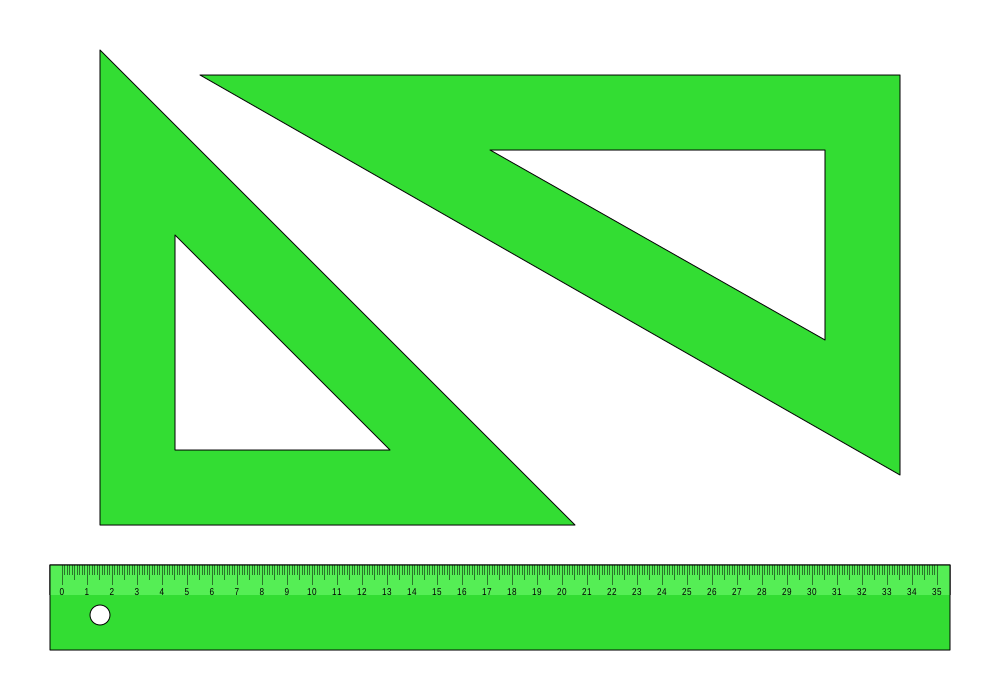
A set square or triangle (American English) is an object used in engineering and technical drawing, with the aim of providing a straightedge at a right angle or other particular planar angle to a baseline.
Types
The simplest form of set square is a triangular piece of transparent plastic (or formerly of polished wood) with the centre removed. More commonly the set square bears the markings of a ruler and a half circle protractor. The outer edges are typically bevelled. These set squares come in two usual forms, both right triangles: one with 90-45-45 degree angles, the other with 30-60-90 degree angles. Combining the two forms by placing the hypotenuses together will also yield 15° and 75° angles. They are often purchased in packs with protractors and compasses.
Less commonly found is the adjustable set square. Here, the body of the object is cut in half and rejoined with a hinge marked with angles. Adjustment to the marked angle will produce any desired angle up to a maximum of 180°.
{{lang|de|Geodreieck}}
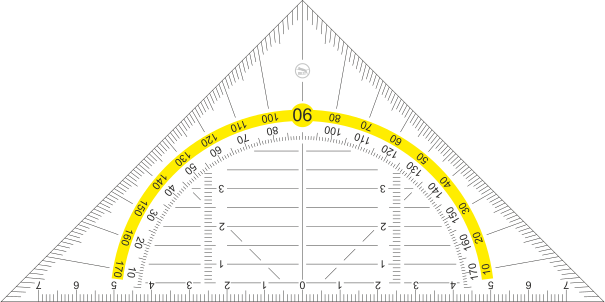

In some European countries a common form of set square combines a 90-45-45 triangle, a ruler and a protractor into a single tool made of stiff or slightly flexible transparent plastic. Being a mandatory tool used by pupils in middle school and higher in German-speaking and neighbouring countries, this specific design is named "Geodreieck" (short form of "Geometrie-Dreieck", meaning "geometry triangle") or similar. It was originally developed in 1964 by the German manufacturer (after several refirmations now Geotec Schul- und Bürowaren GmbH). Relatively uncommon in English-speaking countries, this is sometimes called a "protractor triangle", a term, however, also used for other similar designs. The original design has a hypotenuse length of 15.8 cm and features a 2×7 cm symmetry scale in millimeter and degree raster. Variants in larger sizes, with fixed or detachable handles, with or without bevelled edges (facets), and with or without ink nodules or embossed labels exist as well. Some variants have extra markings at angles of 7° and 42° (138° and 173°) in addition to the normal 45° and 90° markings to ease dimetric axonometry per ISO 5456-3, others feature angle scales in gons instead of degrees. Several other somewhat similar designs named "TZ-Dreieck" ("TZ triangle") exist for (larger) technical drawings (TZ from German: Technisches Zeichnen). The scale reaches from 10 to 10 cm, or even 11 to 11 cm.
Navigation protractor triangles

Similar to the Geodreieck, a number of other protractor triangle types exist for navigation purposes. Various designs are named navigation (protractor) triangle, nautical navigational triangle, nautical set square, Portland (navigational) triangle or Portland protractor triangle, Kent-type triangle, Inoue-type A/B nautical triangle or plotting triangle, course triangle, yachtsmen triangle, and supporting triangle.
However, some widely used navigational protractors, such as the Cras protractor, are not triangles.
References
References
- (2013). "Unternehmen / Geschichte". GEOtec Zeichen- und Kunststofftechnik GmbH.
- (2019-09-11). "Das Geodreieck kommt aus Tirol". [[Der Standard]].
- (1999). "80. Historische Winkelmeßgeräte in Projekten des Mathematikunterrichts".
- (2006). "Das Geometrie-Dreieck". Institut für Mathematik, [[Universität Würzburg]].
- (2017). "Lexikon der Mathematik". [[Springer Spektrum]] / [[Springer Verlag GmbH]].
- (2019-09-09). "Das Geodreieck – das Original aus Wörgl". [[Österreichischer Rundfunk]] (ORF).
- (2021-03-14). "Mittelständler Aristo: Dieses Unternehmen hat das Geodreieck erfunden". [[Frankfurter Allgemeine Zeitung]] (FAZ).
- (2021-04-04). "Firma Geotec plant Neustart". Target Group Publishing GmbH.
This article was imported from Wikipedia and is available under the Creative Commons Attribution-ShareAlike 4.0 License. Content has been adapted to SurfDoc format. Original contributors can be found on the article history page.
Ask Mako anything about Set square — get instant answers, deeper analysis, and related topics.
Research with MakoFree with your Surf account
Create a free account to save articles, ask Mako questions, and organize your research.
Sign up freeThis content may have been generated or modified by AI. CloudSurf Software LLC is not responsible for the accuracy, completeness, or reliability of AI-generated content. Always verify important information from primary sources.
Report