From Surf Wiki (app.surf) — the open knowledge base
Senkaku Islands
Island within Ryukyu Islands disputed between Japan, China and Taiwan
Island within Ryukyu Islands disputed between Japan, China and Taiwan
| Field | Value | |
|---|---|---|
| disputed | yes | |
| name | Senkaku Islands | |
| plural | yes | |
| other_names | Diaoyu Islands / Diaoyutai Islands / Pinnacle Islands | |
| image_name | Diaoyutai senkaku.png | |
| image_size | 320px | |
| image_caption | Location of the islands (yellow rectangle and inset) | |
| image_map | Senkaku Diaoyu Tiaoyu Islands.png | |
| location | Pacific Ocean | |
| coordinates | ||
| total_islands | 5 + 3 rocks (reefs) | |
| major_islands | {{Plainlist | |
| area_km2 | 7 | |
| elevation_m | 383 | |
| country | ||
| country_admin_divisions_title | City | |
| country_admin_divisions | Ishigaki, Okinawa | |
| country1 | ||
| country1_admin_divisions_title | Township | |
| country1_admin_divisions | Toucheng Township, Yilan County, Taiwan | |
| country2 | ||
| country2_admin_divisions_title | County | |
| country2_admin_divisions | Yilan County, Taiwan |
- Uotsuri-shima / Diaoyu Dao
- Taishō-tō / Chiwei Yu
- Kuba-shima / Huangwei Yu
- Kita-Kojima / Bei Xiaodao
- Minami-Kojima / Nan Xiaodao
The Senkaku Islands, known as the Diaoyu Islands in China and the Diaoyutai Islands in Taiwan, are a group of uninhabited islands in the East China Sea, administered by Japan. They were historically known in the Western world as the Pinnacle Islands. The islands are located northeast of Taiwan, east of China, west of Okinawa Island, and north of the southwestern end of the Ryukyu Islands.
The islands are the focus of a territorial dispute between Japan, China and Taiwan. China claims the discovery and ownership of the islands from the 14th century, while Japan maintained ownership of the islands from 1895 until its surrender at the end of World War II. The United States received administrative rights of the islands from Japan under the Treaty of San Francisco and administered the islands as part of the United States Civil Administration of the Ryukyu Islands from 1945 until 1972, before returning them to Japanese control under the Okinawa Reversion Agreement. The discovery of potential undersea oil reserves in 1968 in the area was a catalyst for further interest in the disputed islands. Despite the diplomatic stalemate between China and Taiwan, both governments agree that the islands are part of Taiwan as part of Toucheng Township in Yilan County. Japan administers the Senkaku islands as part of the city of Ishigaki in Okinawa Prefecture. It does not acknowledge the claims of China nor Taiwan, but it has not allowed the Ishigaki administration to develop the islands.
As a result of the dispute, public access to the uninhabited islands is restricted; Japan’s central government has denied landing requests even from local authorities. Although the islands are administered by Japan since 1895, a continuity interrupted only by US administration from 1945 to 1972, this long-standing status quo has been increasingly challenged by China since 2010s; Since the early 2010s, China Coast Guard have frequently entered the surrounding waters of the islands, prompting responses and exchanges of warnings with the Japan Coast Guard. China has also announced territorial-sea baselines (2012) and established an East China Sea ADIZ (2013), all of which are contested by Japan. The United States, which returned administrative right of the islands to Japan in 1972, takes no position on the ultimate sovereignty but acknowledges that the islands are under Japanese administration and are covered by the US–Japan security treaty. Recent US–Japan statements also refer to Japan’s longstanding administration and oppose any unilateral actions that seek to undermine it .
The Senkaku Islands are important nesting sites for seabirds, and are one of two remaining nesting sites in the world for the short-tailed albatross, alongside Tori-shima, Izu Islands.
Names
The islands are referred to as the Senkaku Islands in Japanese. In mainland China, they are known as the Diaoyu Islands () or more fully "Diaoyu Dao and its affiliated islands" (), while in Taiwan they are called the Diaoyutai Islands, or previously spelled as Tiaoyutai Islands (). In Western sources, the historical English name Pinnacle Islands is occasionally still used when neutrality among the competing national claims is desirable.
In Okinawan (northern Ryukyu), the islands are known as **, while their Yaeyama (southern Ryukyu) name is iigunkubajima.
Chinese records of these islands date back to as early as the 15th century when they were referred as Diaoyu in books such as Voyage with a Tail Wind () (1403) and Record of the Imperial Envoy's Visit to Ryūkyū () (1534). Adopted by the Chinese Imperial Map of the Ming Dynasty, the Chinese name for the island group (Diaoyu) and the Japanese name for the main island (Uotsuri) both mean "fishing".
History
Early history
Historically, the Chinese had used the uninhabited islands as navigational markers in making the voyage to the Ryukyu Kingdom upon commencement of diplomatic missions to the kingdom, "resetting the compass at a particular isle in order to reach the next one".
The first published description of the islands in Europe appears in a book imported by Isaac Titsingh in 1796. His small library of Japanese books included Sangoku Tsūran Zusetsu by Hayashi Shihei. This text, which was published in Japan in 1785, described the Ryūkyū Kingdom. Hayashi followed convention in giving the islands their Chinese names in his map in the text, where he coloured them in the same pink as China.
In 1832, the Oriental Translation Fund of Great Britain and Ireland supported the posthumous abridged publication of Titsingh's French translation.
The name, "Pinnacle Isles" was first used by James Colnett, who charted them during his 1789–1791 voyage in the Argonaut. William Robert Broughton sailed past them in November 1797 during his voyage of discovery to the North Pacific in HMS Providence, and referred to Diaoyu Island/Uotsuri Island as "Peaks Island". Reference was made to the islands in Edward Belcher's 1848 account of the voyages of HMS Sammarang. Captain Belcher remarked that "the names assigned in this region have been too hastily admitted." Belcher reported anchoring off Pinnacle Island in March 1845.
In the 1870s and 1880s, the English name Pinnacle Islands was used by the British navy for the rocks adjacent to the largest island Uotsuri-shima / Diaoyu Dao (then called ); Kuba-shima / Huangwei Yu (then called Ti-a-usu); and Taishō-tō / Chiwei Yu.
A Japanese navy record issued in 1886 first started to identify the islets using equivalents of the Chinese and English terms employed by the British. The name "Senkaku Retto" is not found in any Japanese historical document before 1900 (the term "Senkaku Gunto" began being used in the late 19th century), and first appeared in print in a geography journal published in 1900. It was derived from a translation of the English name Pinnacle Islands into a Sinicized Japanese term "Sento Shoto" (as opposed to "Senkaku Retto", i.e., the term used by the Japanese today), which has the same meaning.
The collective use of the name "Diaoyutai" to denote the entire group began with the advent of the controversy in the 1970s.
Control of the islands by Japan and the US


As the uninhabited islets were historically used as maritime navigational markers, they were never subjected to administrative control other than the recording of the geographical positions on maps, descriptions in official records of Chinese missions to the Ryukyu Kingdom, etc.
The Japanese central government incorporated the islands into Okinawa Prefecture in January 1895 while still fighting China in the First Sino-Japanese War. Around 1900, Japanese entrepreneur Koga Tatsushirō constructed a bonito fish processing plant on the islands, employing over 200 workers. The business failed around 1940 and the islands have remained deserted ever since. In the 1970s, Koga Tatsushirō's son Zenji Koga and Zenji's wife Hanako sold four islets to the Kurihara family of Saitama Prefecture. Kunioki Kurihara owned Uotsuri, Kita-Kojima, and Minami-Kojima. Kunioki's sister owned Kuba.
The islands came under US government occupation in 1945 after the surrender of Japan ended World War II. In 1969, the United Nations Economic Commission for Asia and the Far East (ECAFE) identified potential oil and gas reserves in the vicinity of the Senkaku Islands. In 1971, the Okinawa Reversion Treaty passed the United States Senate, returning the islands to Japanese control in 1972. Also in 1972, the Republic of China government and People's Republic of China government officially began to declare ownership of the islands.
Since 1972, when the islands reverted to Japanese government control, the government of Ishigaki has been given civic authority over the territory. The Japanese central government, however, has prohibited Ishigaki from surveying or developing the islands.
In 1978, a Japanese political group constructed the first lighthouse on Uotsuri island and grazed two goats. Goats have since proliferated and affected the island's vegetation.
In 1979 an official delegation from the Japanese government composed of 50 academics, government officials from the Foreign and Transport ministries, officials from the now-defunct Okinawa Development Agency, and Hiroyuki Kurihara, visited the islands and camped on Uotsuri for about four weeks. The delegation surveyed the local ecosystem, finding moles and sheep, studied the local marine life, and examined whether the islands would support human habitation.
In 1988, a Japanese political group reconstructed a lighthouse on Uotsuri Island.
In 2005, a Japanese fisherman who owned a lighthouse at Uotsuri Island expressed his intention to relinquish the ownership of the lighthouse, and the lighthouse became a national property pursuant to the provisions of the Civil Code of Japan. Since then, the Japan Coast Guard has maintained and managed the Uotsuri lighthouse.
From 2002 to 2012, the Ministry of Internal Affairs and Communications paid the Kurihara family ¥25 million a year to rent Uotsuri, Minami-Kojima and Kita-Kojima. Japan's Ministry of Defense rents Kuba island for an undisclosed amount. Kuba is used by the US military as a practice aircraft bombing range. Japan's central government completely owns Taisho island.
The reaction of the Kan Cabinet to the September 2010 Senkaku boat collision incident was seen by former Prime Minister Shinzo Abe as "a very foolish move" and "frighteningly naive".
On December 17, 2010, the city of Ishigaki designated January 14 as "Pioneering Day" to commemorate Japan's 1895 incorporation of the Senkaku Islands. China condemned Ishigaki's actions.
In May 2012, both the Tokyo Metropolitan and Japanese central governments announced plans to negotiate purchase of Uotsuri, Kita-Kojima, and Minami-Kojima from the Kurihara family, and on September 11, 2012, the Japanese government nationalized its control over Minami-kojima, Kita-kojima, and Uotsuri islands by purchasing them from the Kurihara family for ¥2.05 billion. China's Foreign Ministry objected saying Beijing would not "sit back and watch its territorial sovereignty violated."
In 2014, Japan constructed a lighthouse and wharf featuring Japanese flag insignia on the islets.
Geography
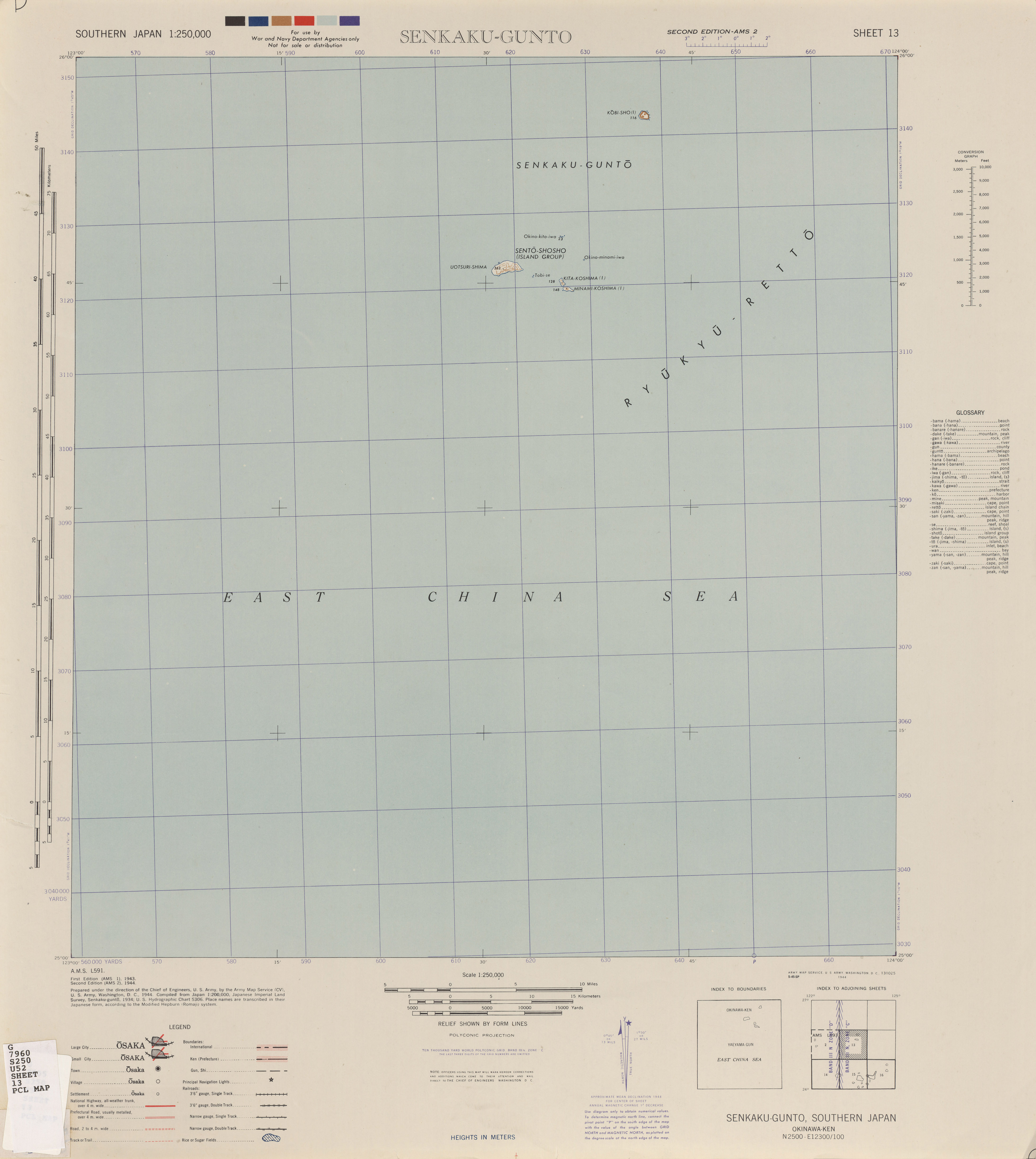
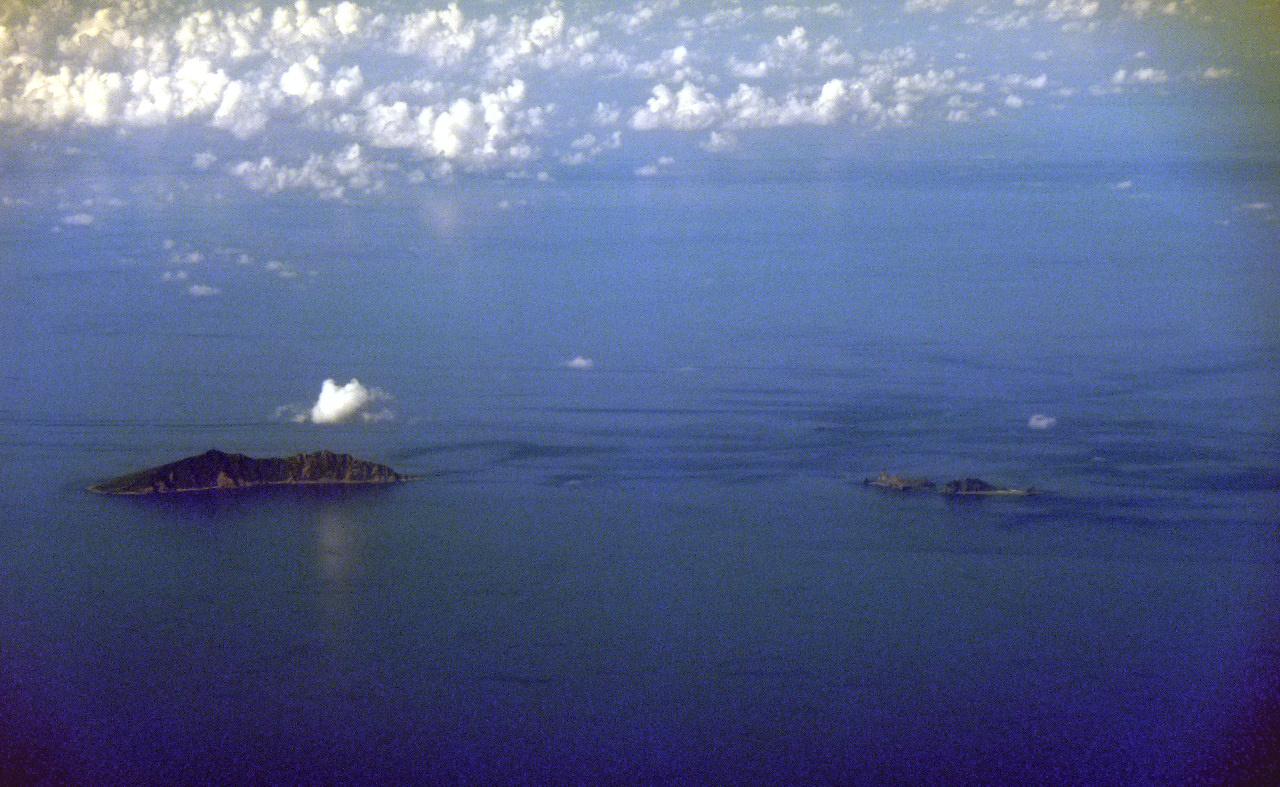
The island group are known to consist of five uninhabited islets and three barren rocks. China has identified and named as many as 71 islets that belong to this group after the Japanese Cabinet released names for 39 uninhabited islands.
These minor features in the East China Sea are located approximately 120 nautical miles northeast of Taiwan, 200 nautical miles east of the Chinese mainland and 200 nautical miles southwest of the Japanese island of Okinawa.
According to one visitor, Uotsuri-shima, the largest of the islands, consists of a pair of rocky gray mountains with steep, boulder-strewn slopes rising almost straight from the water's edge. Other, nearby islands were described as large rocks covered by low vegetation.
In ascending order of distances, the island cluster is located:
- 140 km east of Pengjia Islet, Republic of China (Taiwan)
- 170 km north of Ishigaki Island, Japan
- 186 km northeast of Keelung, Republic of China (Taiwan)
- 410 km west of Okinawa Island, Japan
| No. | Japanese name | Republic of China name | China (PRC) name | Coordinates | Area (km2) | Highest elevation (m) | Images | ||||
|---|---|---|---|---|---|---|---|---|---|---|---|
| 1 | Uotsuri Island (魚釣島) | 釣魚臺 / 釣魚台 Diaoyutai | |||||||||
| POJ: Tiò-hî-tâi | Diaoyu Dao (钓鱼岛/釣魚島) | 4.32 | 383 | [[File:Senkaku-uotsuri.jpg | center | frameless | alt= | 330x330px]] | |||
| 2 | Taisho Island (大正島) | 赤尾嶼 Chiwei Isle | Chiwei Yu (赤尾屿/赤尾嶼) | 0.0609 | 75 | [[File:Taisyoujima of Senkaku Islands.jpg | center | frameless]] | |||
| 3 | Kuba Island (久場島) | 黃尾嶼 Huangwei Isle | Huangwei Yu (黄尾屿/黄尾嶼) | 1.08 | 117 | [[File:Senkaku kubajima COK20082-C2-3+4.jpg | center | frameless]] | |||
| 4 | Kitakojima Island (北小島) | 北小島 Beixiao Island | Beixiao Dao (北小岛/北小島) | 0.3267 | 135 | [[File:Kitakojima and Minamikojima of Senkaku Islands.jpg | thumb | Kita-Kojima (left) and Minami-Kojima (right) | alt= | center]] | |
| 5 | Minamikojima Island (南小島) | 南小島 Nanxiao Island | Nanxiao Dao (南小岛/南小島) | 0.4592 | 149 | ||||||
| 6 | Okinokitaiwa Island (沖ノ北岩) | 沖北岩 Chongbeiyan | Bei Yu (北屿/大北小岛/大北小島) | 0.0183 | nominal | [[File:Okinokitaiwa of Senkaku Islands.jpg | center | frameless]] | |||
| 7 | Okinominamiiwa Island (沖ノ南岩) | 沖南岩 Chongnanyan | Nan Yu (南屿/大南小岛/大南小島/南岩) | 0.0048 | nominal | [[File:Okinominamiiwa of Senkaku Islands.jpg | center | frameless]] | |||
| 8 | Tobise Island (飛瀬) | 飛瀨 Feilai | Fei Yu (飞屿/飞礁岩/飛礁岩) | 0.0008 | nominal | [[File:Tobise of Senkaku Islands.jpg | center | thumb | Tobise rocks (bottom right)]] |

The depth of the surrounding waters of the continental shelf is approximately 100 - except for the Okinawa Trough on the south. The shelf is shallow enough that the western islands were likely connected to the mainland during the Last Glacial Period.
Geology
Uotsuri, Kitakojima, Minamikojima and surrounding islets are sedimentary in origin, predominantly consisting of probably Miocene aged sandstone and sandstone-conglomerate, with subordinate conglomerate, coal seams up to 10 cm thick, and rare siltstone beds. The sedimentary strata have around 300 m of exposed thickness at Uotsuri, and have SW-NE, EW and NW-SE strikes, with a general inclination of a dip of less than 20 degrees towards the North. These strata are intruded by sheets of Mio-Pliocene porphyritic hornblende diorite, and are fringed by recent coral outcrops and surface talus deposits. Kuba and Taisho are volcanic in origin, with Kuba comprising "pyroxene andesite, lava, volcanic bombs, pumice, limestone, and other rocky material" and Taisho is thought to be consist of "andesite, tuff breccia, and tuffaceous sandstone".
Wildlife
Plants
Permission for collecting herbs on three of the islands was recorded in an Imperial Chinese edict of 1893.
Several floral surveys have been conducted on the Senkaku islands, with a 1980 survey finding that Uotsuri had 339 species of plants. These ecological communities varied based on altitude, with the communities being divided into windswept mountaintop vegetation with Podocarpus macrophyllus trees, with the understory including Liriope muscari and Rhaphiolepis umbellata, inclined high forest including the palms Livistona chinensis and Arenga engleri, lowland windswept shrub forest including Ficus microcarpa and Planchonella obovata, and seashore plants. Minamikojima was much less diverse, and dominated by grasses, while Kitakojima only had sparse plant life. Kuba has a forest near the crater, which includes a variety of flora including Ceodes umbellifera, Macaranga tanarius, Ficus benjamina, Diospyros maritima, Trema orientalis, Machilus thunbergii, and Livistona subglobosa, with forest floor plants being sparse.
Animals
In an account by in 1900, it was noted the large number of birds present on the islands, tens of thousands of short-tailed and black-footed albatross would flock on Uotsuri-shima, in the colder months, while hundreds of thousands of sooty tern and brown noddy would descend on Kitakojima and Minamikojima in the warmer months. He also described the air of Uotsuri as swarming with bluebottle flies and mosquitoes. In the same year, an account by , surveying Kuba Island, noted the presence of whimbrel, Von Schrenck's bittern, the streaked shearwater, and the brown booby. Mikinosuke also noted the large number of chickens and feral cats on the island, with dozens of cats descending on the seabirds at night. Kitakojima and Minamikojima are one of only two significant breeding places of the rare short-tailed albatross (Phoebastria albatrus). The islands have been recognised as an Important Bird Area (IBA) by BirdLife International.
Uotsuri-shima, the largest island, has a number of endemic species such as the Senkaku mole (Mogera uchidai) and Okinawa-kuro-oo-ari ant. Due to the introduction of domestic goats to the island in 1978, the Senkaku mole is now an endangered species. The striped field mouse (Apodemus agrarius) has also been noted to be present on Uotsuri. Surveys from 1900 to 1953 and noted the presence of the Asian house shrew, black rats and fruit bats but these were not noted in more recent surveys.
Six species of reptile have been recorded from the islands, including Gekko hokouensis (Uotsuri, Minami) Eumeces elegans (Uotsuri, Minami), an indeterminate species of Scincella (Uotsuri) Ramphotyphlops braminus (Uotsuri) Elaphe carinata (Uotsuri) and Dinodon rufozonatus (Uotsuri).
Rich marine biodiversity adjacent to the islands has been recognized but poorly studied. Seemingly, varieties of larger fish and animals inhabit or migrate through the area, including tunas, sharks, marlins, critically endangered hawksbill sea turtles, dolphins, pilot whales, sperm whales, and humpback whales.
Sovereignty dispute
Main article: Senkaku Islands dispute
Territorial sovereignty over the islands and the maritime boundaries around them are disputed between the People's Republic of China, the Republic of China, and Japan.
The People's Republic and Republic of China claim that the islands have been a part of Chinese territory since at least 1534. China acknowledges that Japan took control of the islands in 1894–1895 during the first Sino-Japanese War, through the signature of the Treaty of Shimonoseki. China asserts that the Potsdam Declaration required that Japan relinquish control of all islands except for "the islands of Honshū, Hokkaidō, Kyūshū, Shikoku and such minor islands as we determine", and China states that this means control of the islands should pass to Republic of China, which was part of China at the time of the first Sino-Japanese War as well as of the San Francisco Peace Treaty. Both the People's Republic of China (PRC) and the Republic of China (ROC) respectively separately claim sovereignty based on arguments that include the following points:
- Discovery and early recordings in maps and travelogues.
- The islands being China's frontier off-shore defence against wokou (Japanese pirates) during the Ming and Qing dynasties (1368–1911).
- A Chinese map of Asia, as well as the Sangoku Tsūran Zusetsu map compiled by Japanese cartographer Hayashi Shihei in the 18th century, showing the islands as a part of China.
- Japan taking control of the islands in 1895 at the same time as the First Sino-Japanese War was happening. Furthermore, correspondence between Foreign Minister Inoue and Interior Minister Yamagata in 1885, warned against the erection of national markers and developing their land to avoid Qing Dynasty suspicions.
- The Potsdam Declaration stating that "Japanese sovereignty shall be limited to the islands of Honshū, Hokkaidō, Kyūshū, Shikoku and such minor islands as we determine", and "we" referred to the victors of the Second World War who met at Potsdam and Japan's acceptance of the terms of the Declaration when it surrendered.
- China's formal protest of the 1971 US transfer of control to Japan.
Japan does not accept that there is a dispute, asserting that the islands are an integral part of Japan. Japan has rejected claims that the islands were under China's control prior to 1895, and that these islands were contemplated by the Potsdam Declaration or affected by the San Francisco Peace Treaty.
The stance given by the Japanese Ministry of Foreign Affairs is that the Senkaku Islands are clearly an inherent territory of Japan, in light of historical facts and based upon international law, and the Senkaku Islands are under the valid control of Japan. They also state "there exists no issue of territorial sovereignty to be resolved concerning the Senkaku Islands." The following points are given:
- The islands had been uninhabited and showed no trace of having been under the control of China prior to 1895.
- The purposes of maps and the intentions behind their creators can vary significantly, and the mere existence of an ancient map does not substantiate claims of territorial sovereignty. The map (1785) cited by China from Hayashi Shihei does not provide evidence that the creator's coloring was intended to indicate territorial sovereignty. This map also depicts Taiwan as only about one-third the size of Okinawa's main island, and it is colored differently from mainland China, which controlled Taiwan at the time. This suggests that the creator did not possess accurate knowledge.
- The islands were neither part of Taiwan nor part of the Pescadores Islands, which were ceded to Japan by the Qing Dynasty of China in Article II of the May 1895 Treaty of Shimonoseki, thus were not renounced by Japan under Article II of the San Francisco Peace Treaty, which serves as the international law addressing the aftermath of WW2.
- A resident of Okinawa Prefecture who had been engaging in activities such as fishery around the Senkaku Islands since around 1884 made an application for the lease of the islands, and approval was granted by the Meiji Government in 1896. After this approval, he sent a total of 248 workers to those islands and ran the following businesses: constructing piers, collecting bird feathers, manufacturing dried bonito, collecting coral, raising cattle, manufacturing canned goods and collecting mineral phosphate guano (bird manure for fuel use). The fact that the Meiji Government gave approval concerning the use of the Senkaku Islands to an individual, who in turn was able to openly run these businesses mentioned above based on the approval, demonstrates Japan's valid control over the Islands.
- In May 1920, a thank-you letter from the Republic of China's consulate in Nagasaki regarding the rescue of Chinese fishermen in distress near the Senkaku Islands by Japanese fishermen included the notation "Senkaku Islands, Yaeyama District, Okinawa Prefecture, Empire of Japan."
- Though the islands were controlled by the United States as an occupying power between 1945 and 1972, Japan has since 1972 exercised administration over the islands.
- In 1953, the official Chinese newspaper People's Daily published an article that explicitly stated that the Ryukyu Islands consist of seven island groups, including the Senkaku Islands. Additionally, in the world atlas published by the China Map Press in 1958 (reprinted in 1960), these islands were clearly referred to as the "Senkaku Islands" and considered part of Okinawa.
- The Republic of China and the People's Republic of China only started claiming ownership of the islands in 1971, following a May 1969 United Nations report that a large oil and gas reserve may exist under the seabed near the islands.
In 2012 the Japanese Ministry of Foreign Affairs created a webpage in support of its claims. Separately, in a 2012 government statement Beijing declaring the territorial-sea baselines for Diaoyu Islands and its affiliated islets, framing the claimed 12-nautical-mile waters around the group. In late 2014 the National Marine Data and Information Service, a department under the State Oceanic Administration of China created a website of its own to support its claims.
On 22 June 2020, the Ishigaki City Council voted to change the name of the area containing the Senkaku Islands from "Tonoshiro" to "Tonoshiro Senkaku". Republic of China's Ministry of Foreign Affairs responded that the islands belong to Republic of China, and any moves to deny this fact are invalid. The Taiwanese government and the opposition KMT party also condemned the council's move, saying the Islands are ROC territory and the nation would not give up even "an inch" of its sovereignty.
United States' position
The official and successive US position takes no stance on the ultimate sovereignty. The US previously recognized Japan's sovereignty over the Senkaku Islands from 1895 to 1972. However, during the 1971–72 reversion debate, the US adopted an ambiguous policy, and stated that it could only return to Japan what it had originally received, namely, administrative rights, not sovereignty. Accordingly, the Okinawa Reversion Agreement was structured to transfer administrative rights only and “does not affect the legal status” of the islands' sovereignty; successive US administrations have taken no position on ultimate sovereignty, while treating the controversy as a matter for the parties to resolve.
"The United States believes that a return of administrative rights over those islands to Japan, from which the rights were received, can in no way prejudice any underlying claims. The United States cannot add to the legal rights Japan possessed before it transferred administration of the islands to us, nor can the United States, by giving back what it received, diminish the rights of other claimants. The United States has made no claim to the Senkaku Islands and considers that any conflicting claims to the islands are a matter for resolution by the parties concerned."
Both the Republic of China (Taiwan) and the People’s Republic of China protested the inclusion of the islets in the reversion arrangements and asserted their own claims: on 15 March 1971 the ROC submitted a note verbale in Washington asserting that Diaoyutai is ROC territory, to which the US replied that returning administrative rights to Japan would not affect ROC's sovereignty claims; PRC statements likewise rejected the reversion and asserted that Diaoyu Dao is China’s territory.
Post-2012 escalation
Since the 2012 flare-up, China has significantly increased its maritime and air activities surrounding the islands aimed at undermining Japan's long-standing physical control, prompting reciprocal responses from Japan. Chinese vessels have increasingly entered the contiguous zone adjacent to the territorial waters around the Senkaku Islands, with near-daily frequency, prompting the Japan Coast Guard to respond by consistently shadowing and issuing warnings. In 2013, China also established an East China Sea ADIZ that includes the airspace over the Senkaku islands, which drew protests from Japan and was widely analyzed by international security sources.
In August 2016 the Japanese foreign minister Fumio Kishida told China's foreign minister Wang Yi "that the activity represented an escalation of tensions". It was the first meeting of the top diplomats since the Permanent Court of Arbitration ruling against China's South China Sea claims and was coincident with a three-party meeting (including South Korea) relative to a North Korean submarine-launched missile in the Sea of Japan.
The maritime campaign of China has intensified since 2019, with its vessels attempting to harass Japanese fishing boats and China Coast Guard gaining legal authority in 2021 to fire on foreign ships.
In 2024, media reporting based on Japan Coast Guard statistics described a near year-round presence of Chinese government vessels in the contiguous zone (355 days) and dozens of territorial-sea entries; The Diplomat reported 42 such days, while Stars and Stripes cited Japan Coast Guard figures of 39 incursions within 12 nautical miles that year. On 21–24 March 2025, four China Coast Guard vessels remained inside waters claimed by Japan for a record 92 hours and 8 minutes, according to contemporary reports citing Japan Coast Guard releases. In May 2025, Japan and China exchanged accusations of an airspace violation near the islands following a China Coast Guard helicopter flight; both sides lodged protests. Short-duration entries into waters claimed by Japan continued later in 2025, according to Jiji Press bulletins. More generally, wire-service reporting has chronicled routine instances in which the China Coast Guard announces patrols around Diaoyu Islands while the Japan Coast Guard issues warnings for Chinese vessels to leave waters claimed by Japan. On 27 January 2026, Reuters reported that since late 2025, the Japanese government had been advising fishers to avoid the Senkaku Islands in order to not escalate relations with China.
Notes
Footnotes
References
- Belcher, Edward and Arthur Adams. (1848). Narrative of the Voyage of H.M.S. Samarang, During the Years 1843–46: Employed Surveying the Islands of the Eastern Archipelago. London : Reeve, Benham, and Reeve. OCLC 192154
- Charney, Jonathan I., David A. Colson, Robert W. Smith. (2005). International Maritime Boundaries, 5 vols. Hotei Publishing: Leiden. ; ; ; ; ; OCLC 23254092
- Findlay, Alexander George. (1889). A Directory for the Navigation of the Indian Archipelago and the Coast of China. London: R. H. Laurie. OCLC 55548028
- Hagström, Linus. (2005). Japan's China Policy: A Relational Power Analysis. London: Routledge. ; OCLC 475020946
- Inoue, Kiyoshi. (1972) Senkaku Letto /Diaoyu Islands The Historical Treatise. Kyoto: Daisan Publisher (出版社: 第三書館) (1996/10) 「尖閣」列島―釣魚諸島の史的解明 [単行本] . ; also hosted in here for online reading (set to Shift-JIS character code), with English synopsis here . Chinese translation by Ying Hui, Published by Commercial Press Hong Kong (1973) 釣魚列島的歷史和主權問題 / 井上清著 ; 英慧譯 , .
- Jarrad, Frederick W. (1873). The China Sea Directory, Vol. IV. Comprising the Coasts of Korea, Russian Tartary, the Japan Islands, Gulfs of Tartary and Amúr, and the Sea of Okhotsk. London: Hydrographic Office, Admiralty. OCLC 557221949
- Lee, Seokwoo, Shelagh Furness and Clive Schofield. (2002). Territorial disputes among Japan, China and Republic of China concerning the Senkaku Islands. Durham: University of Durham, International Boundaries Research Unit (IBRU) . ; of China-concerning-the-senkaku-islands/oclc/249501645?referer=di&ht=edition OCLC 249501645
- Suganuma, Unryu. (2000). Sovereign Rights and Territorial Space in Sino-Japanese Relations. Honolulu: University of Hawaii Press. ; OCLC 170955369
- Valencia, Mark J. (2001). Maritime Regime Building: Lessons Learned and Their Relevance for Northeast Asia. The Hague: Martinus Nijhoff. ; OCLC 174100966
External link
References
- The Guardian. (November 23, 2013). "China imposes airspace restrictions over Japan-controlled Senkaku islands".
- France24. (November 27, 2013). "US defies China to fly over disputed Senkaku islands".
- link. [[Ministry of Foreign Affairs (Taiwan)]]
- link. zh-tw. 宜蘭縣頭城鎮公所 Toucheng Township Office. zh-tw. 另轄兩小島(龜山島及龜卵嶼)及一群島(釣魚臺列嶼)。
- link. [[Central News Agency (Republic of China)]]
- 中华人民共和国国务院新闻办公室. link. 新华社. (2012-09-25)
- link. (June 30, 2017 , retrieved September 20, 2010.)
- link. (April 9, 2023 , retrieved September 20, 2010.)
- McDorman, Ted L. (2005). "Central Pacific and East Asian Maritime Boundaries" in {{Google books. RN0GnOcw0McC. ''International Maritime Boundaries'', Vol. 5, pp. 3441.
- Lee, Seokwoo. (2002). {{Google books. MZGsi1ptLvoC. ''Territorial Disputes Among Japan, China and Taiwan Concerning the Senkaku Islands'', pp. 10–13.
- Lee, Seokwoo. (2002). "Territorial Disputes among Japan, China and Taiwan concerning the Senkaku Islands (Boundary & Territory Briefing Vol.3 No.7)". IBRU.
- Pan, Junwu. (2009). "Toward a New Framework for Peaceful Settlement of China's Territorial and Boundary Disputes". Martinus Nijhoff Publishers.
- Takamine, Tsukasa. (2012). "Japan's Development Aid to China, Volume 200: The Long-running Foreign Policy of Engagement". Routledge.
- Drifte, Reinhard. (2012). "Japan's Security Relations with China Since 1989: From Balancing to Bandwagoning?". Routledge.
- Lee, Seokwoo. (2002). "Territorial Disputes among Japan, China and Taiwan concerning the Senkaku Islands (Boundary & Territory Briefing Vol.3 No.7)". IBRU.
- (2021-10-05). "Ishigaki city denied permit to land on Senkaku Islands". The Asahi Shimbun.
- (2013). "A Sino–Japanese Clash in the East China Sea".
- (2021-07-30). "Sino-Japanese controversy over the Senkaku/Diaoyu/Diaoyutai Islands". European Parliamentary Research Service.
- (2022-11-30). "The Senkaku Islands". Cabinet Secretariat, Government of Japan.
- (2024-04-12). "China, Japan coast guards patrol disputed East China Sea waters". Reuters.
- Takahashi, Kosuke. (2025-01-02). "China Sets Record for Activity Near Senkaku/Diaoyu Islands in 2024". The Diplomat.
- (2024-04-12). "China, Japan coast guards patrol disputed East China Sea waters". Reuters.
- (2012-09-10). "Statement of the Government of the People’s Republic of China on the Baselines of the Territorial Sea of Diaoyu Dao and Its Affiliated Islands". Ministry of Foreign Affairs of the PRC.
- (2015-01-30). "China’s Air Defense Identification Zone (ADIZ)". Congressional Research Service.
- (2021-03-01). "The Senkakus (Diaoyu/Diaoyutai) Dispute: U.S. Treaty Obligations". Congressional Research Service.
- (2017-02-10). "The Senkakus (Diaoyu/Diaoyutai) Dispute: U.S. Treaty Obligations". Congressional Research Service.
- (2025-02-07). "United States–Japan Joint Leaders’ Statement".
- "Albatrosses Residing on the Senkaku Islands (1979: Former Okinawa Development Agency)".
- (2015-08-28). "Foreign Ministry Spokesperson Hua Chunying's Remarks on the Japanese Government Opening a Link about Diaoyu Dao on the Official Cabinet Website". Ministry of Foreign Affairs, the People's Republic of China.
- "The ROC government reiterates its sovereignty over the Tiaoyutai Islands".
- Jesse Johnson. (27 July 2020). "China's 100-day push near Senkaku Islands comes at unsettling time for Sino-Japanese ties".
- [[Harold C. Hinton]]. (1980). "The China Sea: The American Stake in its Future". National Strategy Information Center.
- (2008). "Media Reaction: Cross-Strait Talks, Taiwan-Japan Dispute, U.S. Global Influence". [[United States Department of State]].
- Ministry of Foreign Affairs Taiwan. "the Republic of China's Sovereignty Claims over the Diaoyutai Islands and the East China Sea Peace Initiative". www.mofa.gov.tw.
- (August 17, 2013). "Diaoyutai tensions stoked by arrival of China coast guard". www.taipeitimes.com.
- (November 24, 2013). "China preparing for Diaoyutai conflict: expert". www.chinapost.com.tw.
- (2013-09-05). "The Republic of China's Sovereignty Claims over the Diaoyutai Islands and the East China Sea Peace Initiative". Ministry of Foreign Affairs, Taiwan (Taiwan).
- {{harvnb. Lai. 2013
- link. (June 24, 2023 , ''Occasional Papers/Reprints Series in Contemporary Asian Studies'', Nr 3 – 1999 (152), p.13)
- [https://businessmirror.com.ph/2018/02/19/whats-in-a-name-4/ What's in a name?] {{Webarchive. link. (July 8, 2023 , ''[[BusinessMirror]]'': "The disputed islands East China Sea are called the Senkaku Islands by Japan, Diaoyu Islands in China and the Diaoyutai Islands by the government of Taiwan. In the West, these rocks are called the Pinnacle Islands as a loose translation of the Japanese name.")
- [http://americandiplomacy.web.unc.edu/2007/09/japans-territorial-disputes/ Japan's Territorial Disputes] {{Webarchive. link. (July 8, 2023 , ''American Diplomacy'': "The Chinese call them the Diaoyu Islands, and on foreign maps in the past they have been called the Pinnacle Islands.")
- (2001-03-30). "Okinawago jiten". Zaimushō Insatsukyoku.
- Title: Liang zhong hai dao zhen jing / [Xiang Da jiao zhu].Imprint: Beijing : Zhonghua shu ju : Xin hua shu dian Beijing fa xing suo fa xing, 2000 reprint edition. Contents: Shun feng xiang song—Zhi nan zheng fa. (順風相送--指南正法). {{ISBN. 7-101-02025-9. pp96 and [http://bbs.home.news.cn/upfiles/04B5B77C.002C pp253] {{webarchive. link. (July 7, 2011 . The full text is available at [http://zh.wikisource.org/wiki/%E4%B8%A4%E7%A7%8D%E6%B5%B7%E9%81%93%E9%92%88%E7%BB%8F wikisource] {{Webarchive). link. (June 15, 2011 .)
- Suganuma, {{Google books. vDpEiKR2osoC. p. 49.
- link. (February 4, 2016 ; alternate [[romaji]] [http://www.worldcat.org/search?q=Sankoku+Ts%C5%ABran+Zusetsu&qt=results_page ''Sankoku Tsūran Zusetsu''] {{Webarchive). link. (October 6, 2018)
- Cullen, Louis M. (2003). {{Google books. ycY_85OInSoC. ''A History of Japan, 1582–1941: Internal and External Worlds'', p. 137.
- . (December 22, 2012). ["The Senkaku or Diaoyu Islands: Narrative of an empty space"](https://www.economist.com/news/christmas/21568696-behind-row-over-bunch-pacific-rocks-lies-sad-magical-history-okinawa-narrative). *[[Economist Group]]*.
- [[Julius Klaproth. Klaproth, Julius]]. (1832). {{Google books. lsoNAAAAIAAJ. ''San kokf tsou ran to sets, ou Aperçu général des trois royaumes'', pp. 169–180.
- "Pinnacle Rock in Latitude 29°40{{prime and Longitude 132° E. of London... This Navigation is no ways dangereous were you sure of your Latitude and to make Pinnicle Isle". James Colnett, ''The Journal ... aboard the Argonaut from April 26, 1789 to Nov. 3, 1791'', ed. with introd. and notes by F. W. Howay, Toronto, Champlain Society Vol. 26, 1940, p. 47.
- William Robert Broughton, ''William Robert Broughton's Voyage of Discovery to the North Pacific, 1795–1798'', edited by Andrew David; with an introduction by Barry Gough, Ashgate for the Hakluyt Society, Farnham, England; Burlington, VT, 2010, p. 202.
- Suganuma, Unryu. (2001). {{Google books. vDpEiKR2osoC. ''Sovereign Rights and Territorial Space in Sino-Japanese Relations'',
- Belcher, Edward. (1848). {{Google books. jotKAAAAYAAJ. ''Narrative of the Voyage of'' H.M.S. ''Samarang'', Vol. I, pp. 315.. PiAEAAAAQAAJ. Vol. II, pp. 572–574.
- Belcher, {{Google books. jotKAAAAYAAJ. Vol. I,
- Suganuma, {{Google books. vDpEiKR2osoC. p. 90.. LvoGAAAAQAAJ. ''The China Sea Directory'', Vol. IV, pp. 141–142.
- Suganuma, {{Google books. vDpEiKR2osoC. p. 91.
- link. (July 8, 2023 citing Park (1973) "Oil under Troubled Waters: The Northeast Asia Seabed Controversy", 14 HILJ (''[[Harvard International Law Journal]]'') 212, 248–249; also Park, Choon-Ho (1972). ''Continental Shelf Issues in the Yellow Sea and the East China Sea''. Kingston, Rhode Island: Law of the Sea Institute, pp. 1–64.)
- (2012). "BBC News – Japan confirms disputed islands purchase plan". bbc.co.uk.
- Ito, Masami, "[http://www.japantimes.co.jp/text/nn20120517x2.html Owner OK with metro bid to buy disputed Senkaku Islands]", ''[[Japan Times]]'', May 18, 2012, pp. 1–2
- Kaneko, Maya, ([[Kyodo News]]) "[http://search.japantimes.co.jp/cgi-bin/nn20101208f2.html Ishigaki fishermen fret over Senkaku encroachment] {{Webarchive. link. (December 27, 2012 ", ''[[Japan Times]]'', December 8, 2010, p. 3.)
- Finney, John W. [https://www.nytimes.com/1971/11/11/archives/senate-endorses-okinawa-treaty-votes-84-to-6-for-islands-return-to.html "Senate Endorses Okinawa Treaty; Votes 84 to 6 for Island's Return to Japan"] {{Webarchive. link. (October 27, 2018 , ''The New York Times''. November 11, 1971.)
- [[Kyodo News]], "[http://www.japantimes.co.jp/text/nn20120911a3.html Senkaku purchase bid made official] {{Webarchive. link. (September 18, 2012 ", ''[[Japan Times]]'', September 11, 2012, p. 2)
- Ito, Masami, "[http://www.japantimes.co.jp/text/nn20120518f1.html Jurisdiction over remote Senkakus comes with hot-button dangers] {{Webarchive. link. (May 19, 2012 ", ''[[Japan Times]]'', May 18, 2012, p. 1)
- [https://megalodon.jp/2020-0705-1315-16/https://www.jstage.jst.go.jp:443/article/hozen/8/1/8_KJ00003259290/_pdf The Problem of Feral Goats on Uotsuri-jima in the Senkuku Islands and Appeals for Countermeasures to Resolve the Problem.] {{Webarchive. link. (July 5, 2020 , ''Japanese Journal of Conservation Ecology 8'', p.90. Yasushi Yokohata, Laboratory of Environmental Biology, Faculty of Education, Toyama University. 2003.)
- [https://web.archive.org/web/20200604024659/https://www.kaiho.mlit.go.jp/info/books/report2005/topics/p005-1.html 4. Start managing the "Uotsuri Island Lighthouse" of the Senkaku Islands] Japan Coast Guard Annual Report 2005
- Hongo, Jun, "[http://www.japantimes.co.jp/text/nn20120419a4.html Tokyo's intentions for Senkaku islets] {{Webarchive. link. (November 1, 2012 ", ''[[Japan Times]]'', April 19, 2012, p. 2.)
- (15 October 2010). "Former Japanese Prime Minister Shinzō Abe on U.S.-Japanese Relations". Hudson Institute.
- (15 October 2010). "U.S.-Japan Relations". National Cable Satellite Corporation.
- [[Agence France-Presse]], "[http://search.japantimes.co.jp/cgi-bin/nn20101218x1.html Senkaku memorial day riles China] {{Webarchive. link. (July 20, 2012 ", ''[[Japan Times]]'', December 19, 2010, p. 1. Retrieved January 29, 2011.)
- (September 6, 2012). "Japan Said to Have Tentative Deal to Buy 3 Disputed Islands from Private Owners". The New York Times.
- (September 10, 2012). "Japan says it will purchase disputed islands from private owner, angering China". Washington Post.
- [[Kyodo News]], "[http://www.japantimes.co.jp/news/2015/03/02/national/politics-diplomacy/taiwan-activists-threaten-to-land-on-senkakus-if-japan-doesnt-remove-facilities/#.VPWSFY0cQ5s Taiwan activists threaten to land on Senkakus if Japan doesn't remove facilities] {{Webarchive. link. (November 16, 2022 ", ''[[Japan Times]]'', 2 March 2015)
- (September 17, 2010). "How uninhabited islands soured China-Japan ties". BBC News.
- "China announces geographic codes for Diaoyu Islands". [[Xinhua]].
- "China releases official names of disputed islands".
- UC Berkeley: [[UC Institute on Global Conflict and Cooperation]]; retrieved November 15, 2010.
- Fackler, Martin. (2012-09-22). "In Shark-Infested Waters, Resolve of Two Giants is Tested". [[The New York Times]].
- [http://www.acap.aq/ Agreement on the Conservation of Albatrosses and Petrals (ACAP)] {{Webarchive. link. (April 6, 2011 , [http://data.acap.aq/breeding_site.cfm?bs_id=2499 Breeding site details: Agincourt/P'eng-chia-Hsu] {{Webarchive). link. (July 6, 2011)
- (March 2014). "The Senkaku Islands".
- link. [[:zh:內政部地政司. Department of Land Administration]]. (31 October 2017). zh-tw. 地政事務所名稱(代碼) 宜蘭(GB) 鄉鎮市區名稱(代碼) 頭城鎮(02){...}段 小段 代碼 備註{...}釣魚台 0568 赤尾嶼 0569 黃尾嶼 0570 北小島 0571{...}南小島 0572
- link. Ministry of the Interior]]
- "Geographic Location".
- link. zh-hans. 钓鱼岛是中国的固有领土
- link. (November 13, 2012 .)
- (February 2018). [[National Museum of Taiwan History]]. zh-tw. 臺海軍事危機地圖1949-1958年{...}釣魚臺{...}地圖繪製:黃清琦 (In the map labeled 臺海軍事危機地圖1949-1958年, the [[Free area of the Republic of China]] is colored light green, the PRC (China) is colored red and the Ryukyu Islands are colored pink. The area labeled 釣魚臺 is colored light green. The map was created by Ching-Chi Huang.)
- link
- link. (November 13, 2012 .)
- link. (November 14, 2012 .)
- link. (August 27, 2024 ; GSI, [http://watchizu.gsi.go.jp/watchizu.html?latitude=25.7333333333333&longitude=123.539583333333 北小島 (Kita kojima)] {{Webarchive). link. (November 14, 2012 .)
- link. (August 27, 2024)
- link. (November 14, 2012 .)
- GSI, [http://watchizu.gsi.go.jp/cgi-bin/watchizu.cgi?id=38235400&slidex=1200&slidey=200 map 5]
- link. (November 13, 2012 .)
- GSI, [http://watchizu.gsi.go.jp/cgi-bin/watchizu.cgi?id=38235405&slidex=0&slidey=2000 map 7]
- link. (November 14, 2012 .)
- Ji, Guoxing. (1995). [http://escholarship.org/uc/item/7rq2b069 "Maritime Jurisdiction in the Three China Seas", p. 11] {{Webarchive. link. (August 6, 2012 ; Sibuet, Jean-Claude et al. [http://adsabs.harvard.edu/abs/1987JGR....9214041S "Back arc extension in the Okinawa Trough"] {{Webarchive). link. (June 13, 2015 , ''Journal of Geophysical Research'', Vol. 92, Issue B13, pp. 14041-14063.)
- (2008-06-18). "The Herpetofauna of the Senkaku Group, Ryukyu Archipelago". University of Hawaii Press.
- Matsumoto, Y., and Tsuji, K. (1973) : [http://naosite.lb.nagasaki-u.ac.jp/dspace/bitstream/10069/16488/1/kyoyoS14_00_05_t.pdf Geology of Uotsuri-jima, Kita-kojima and Minami-kojima] {{Webarchive. link. (April 7, 2016 . Bull. Fac. Liberal Arts, Nagasaki Univ. (Nat. Sci.), 14, 43–57 (in Japanese with English abstract).)
- "Geology of the Senkaku Islands {{!}} Info Library".
- Ji, [http://escholarship.org/uc/item/7rq2b069 p. 11; excerpt, "In 1893, Empress Dowager Tsu Shih of the Qing Dynasty issued an imperial edict .... China argues that discovery accompanied by some formal act of usage is sufficient to establish sovereignty over the islands."] {{Webarchive. link. (August 6, 2012)
- "Surveys Between the end of World War II and 1970, Part 1 (1950, 1952, 1953, 1964: University of the Ryukyus)".
- "Surveys Between the end of World War II and 1970, Part 2 (1970, 1971: University of the Ryukyus)".
- "Surveys following Okinawa's reversion to Japan (1979: Okinawa Development Agency)".
- "Meiji Era surveys (1900: Kuroiwa and Miyajima)".
- . (2021). ["Senkaku Islands"](http://datazone.birdlife.org/site/factsheet/senkaku-islands-iba-japan). *BirdLife International*.
- Zoological Society of London, [https://web.archive.org/web/20100922150619/http://edgeofexistence.org/mammals/species_info.php?id=68 EDGE (Evolutionary Distinct & Globally Endangered) Senkaku mole], 2006; retrieved November 15, 2010.
- "尖閣諸島の自然 – 尖閣諸島の魚たち".
- (September 2009). 上海辞书出版社. [[Shanghai Lexicographical Publishing House]].. zh-hans. '''台湾省'''{...}包括台湾岛、澎湖列岛和赤尾屿、绿岛、兰屿、彭佳屿、钓鱼岛等岛屿。{...}钓鱼岛 黃尾屿 赤尾屿
- link
- link. (February 29, 2012 (论钓鱼岛主权的归属), Fujian Education Department {{verify source). (August 2019)
- "[https://www.worldcat.org/oclc/44014900] {{Webarchive. link. (April 30, 2019" {{verify source). (August 2019)
- [http://english.people.com.cn/200305/25/eng20030525_117192.shtml "China's Diaoyu Islands Sovereignty is Undeniable"] {{Webarchive. link. (September 20, 2010 , ''People's Daily'', 25 May 2003. Retrieved 24 February 2007. {{verify source). (August 2019)
- (August 2019). "Q&A on the Senkaku Islands". Ministry of Foreign Affairs of Japan.
- (July 2, 2008). "Koji Taira". Japan Focus.
- (August 2019). "Potsdam Declaration (full text)".
- ''[[People's Daily]]'', Beijing, China, 31 December 1971, Page 1, "An Declaration of The Ministry of Foreign Affairs of the People's Republic of China, 1971–12-30" {{verify source. (August 2019)
- Netherlands Institute for the Law of the Sea (NILOS). (2000). {{Google books. 6GOVS_0Zm6oC. ''International Organizations and the Law of the Sea'', p. 108.
- Ji, [http://escholarship.org/uc/item/7rq2b069 pp. 11–12, 19.] {{Webarchive. link. (August 6, 2012)
- (August 2019). "Q&A on the Senkaku Islands". Ministry of Foreign Affairs of Japan.
- (25 September 2010). "Japan refuses China demand for apology in boat row". Reuter.
- (August 2019). "The Basic View on the Sovereignty over the Senkaku Islands".
- Satoru Sato, Press Secretary, Japanese Ministry of Foreign Affairs [https://www.wsj.com/articles/SB10001424052748704129204575505141368553952 Letter to the Editor: Clarifying the Senkaku Islands Dispute] {{Webarchive. link. (November 14, 2017 ''[[The Wall Street Journal]]'', 21 September 2010 {{verify source). (August 2019)
- (August 2019). "[[:ja:池上彰スペシャル".
- link. (August 2019)
- (August 2019). "The Basic View on the Sovereignty over the Senkaku Islands". Ministry of Foreign Affairs of Japan}} {{verify source.
- Ito, Masami. (18 May 2012). "Jurisdiction over remote Senkakus comes with hot-button dangers". [[Japan Times]].
- (August 2019). "The Basic View on the Sovereignty over the Senkaku Islands". Ministry of Foreign Affairs of Japan.
- "Senkaku Islands".
- "钓鱼岛_钓鱼岛是中国的固有领 (Diaoyu Islands".
- (January 1, 2015). "China-Japan Dispute Over Islands Spreads to Cyberspace". The New York Times.
- (2020-06-22). "Ishigaki renames area containing Senkaku Islands, prompting backlash fears". The Japan Times.
- (2020-06-22). "Japan: Ishigaki City Council Votes to Inscribe 'Senkaku' Into Administrative Name of Disputed Islands". The News Lens.
- (2020-06-23). "Nation protests Japan's Diaoyutai move". The Taipei Times.
- Robert D. Eldridge. "U.S. Senkakus Policy and its Contradictions".
- Robert D. Eldridge. (2014). "The Origins of U.S. Policy in the East China Sea Islands Dispute: Okinawa's Reversion and the Senkaku Islands". [[Routledge]].
- (2021-03-01). "The Senkakus (Diaoyu/Diaoyutai) Dispute: U.S. Treaty Obligations". Congressional Research Service.
- (2017-02-10). "The Senkakus (Diaoyu/Diaoyutai) Dispute: U.S. Treaty Obligations". Congressional Research Service.
- (2013-06-05). "ROC Government Response to the Diaoyutai Islands (Q&A)". Ministry of Foreign Affairs (Taiwan).
- (2012-10-11). "Japanese “sovereignty” claim over Diaoyu Islands never valid: facts and figures". Embassy of the People’s Republic of China in the United States.
- (2015-01-30). "China’s Air Defense Identification Zone (ADIZ)". Congressional Research Service.
- Page, Jeremy, [https://www.wsj.com/articles/chinas-claim-to-most-of-south-china-sea-has-no-legal-basis-court-says-1468315137 "Tribunal Rejects Beijing's Claims to South China Sea"] {{Webarchive. link. (February 28, 2017, Wall Street ''Journal'', July 12, 2016. Retrieved 2016-08-24.)
- link. (February 10, 2017, ''Financial Times'', July 15, 2016. With high-resolution aerial image of [[Fiery Cross Reef]]. Retrieved 2016-08-24.)
- Obe, Mitsuru, [https://www.wsj.com/articles/japan-presses-china-on-vessels-sailing-near-disputed-islands-1472039715 "Japan Presses China on Vessels Sailing Near Disputed Islands"] {{Webarchive. link. (February 5, 2017, Wall Street ''Journal'', August 24, 2016. Retrieved 2016-08-24.)
- (2025-01-07). "China sets record for coast guard vessels spotted near Japan’s Senkakus in 2024". Stars and Stripes.
- Takahashi, Kosuke. (2025-03-25). "China Coast Guard Makes Its Longest Intrusion Into Disputed East China Sea Waters". The Diplomat.
- (2025-03-24). "Tensions rise as Chinese ships break record for presence in waters around Senkakus". Stars and Stripes.
- (2025-05-04). "Japan and China trade accusations of airspace violation near disputed islands". Associated Press.
- (2025-09-12). "4 Chinese Ships Sail in Japanese Waters off Senkakus".
- (2025-09-14). "2 Chinese Ships Enter Japanese Waters off Senkakus".
- Katsumura, Mariko. (27 January 2026). "Fearing China clash, Japan asks fishermen to avoid flashpoint islands". [[Reuters]].
This article was imported from Wikipedia and is available under the Creative Commons Attribution-ShareAlike 4.0 License. Content has been adapted to SurfDoc format. Original contributors can be found on the article history page.
Ask Mako anything about Senkaku Islands — get instant answers, deeper analysis, and related topics.
Research with MakoFree with your Surf account
Create a free account to save articles, ask Mako questions, and organize your research.
Sign up freeThis content may have been generated or modified by AI. CloudSurf Software LLC is not responsible for the accuracy, completeness, or reliability of AI-generated content. Always verify important information from primary sources.
Report