From Surf Wiki (app.surf) — the open knowledge base
Sengkang LRT line
Light rail line in Singapore

Light rail line in Singapore
| Field | Value | |||||||
|---|---|---|---|---|---|---|---|---|
| name | Sengkang LRT | |||||||
| native_name | ||||||||
| 盛港轻轨线 | ||||||||
| color | ||||||||
| logo | SKLRT logo.svg | |||||||
| logo_width | 250px | |||||||
| logo_alt | Logo of Sengkang LRT line | |||||||
| image | Singapore Crystal Mover.jpg | |||||||
| image_width | 250px | |||||||
| image_alt | A one-car Mitsubishi Crystal Mover train, numbered 38, on elevated tracks of the Sengkang LRT Line. The train is moving along a curve with multi-story residential buildings in the background. | |||||||
| caption | A Mitsubishi Crystal Mover Automated People Mover on the Sengkang LRT Line | |||||||
| type | Automated guideway transit/People mover | |||||||
| system | Light Rail Transit (Singapore) | |||||||
| status | Operational | |||||||
| locale | Sengkang, North-East Region, Singapore | |||||||
| start | Sengkang | |||||||
| end | ||||||||
| stations | 14 | |||||||
| routes | 4 | |||||||
| daily_ridership | 27,541 (July 2020) | |||||||
| open | (East Loop) | |||||||
| (West Loop) | ||||||||
| (Farmway station) | ||||||||
| (Cheng Lim station) | ||||||||
| (Kupang station) | ||||||||
| owner | Land Transport Authority | |||||||
| operator | SBS Transit Ltd | |||||||
| character | Fully-elevated | |||||||
| depot | Sengkang | |||||||
| stock | Mitsubishi Heavy Industries Crystal Mover (C810, C810A, C810D) | |||||||
| linelength | 10.7 km | |||||||
| gauge | ||||||||
| Guideway span: 3.2 m | ||||||||
| electrification | 750 V DC Third rail | |||||||
| speed | 70 km/h | |||||||
| signalling | Kyosan Electric APM fixed block system | |||||||
| map | {{switcher | |||||||
| [[File:Singapore Sengkang LRT System Map.png | 275px | alt | A map of the Sengkang LRT Line in Singapore. It displays two loops: the East Loop and the West Loop, both originating from the Sengkang station (STC NE16). The map also indicates connections to the North East Line (NEL) (coloured purple) at Sengkang, leading to Punggol to the north and HarbourFront to the south.]] | |||||
| {{Sengkang LRT line | inline | 1}} | ||||||
| {{Maplink | frame | yes | plain=yes | type=line | stroke-colour=# | text=Interactive Map | frame-align=center | zoom=13}} |
| map_state | collapsed |
the LRT line
盛港轻轨线
(West Loop) (Farmway station) (Cheng Lim station) (Kupang station) Guideway span: 3.2 m | [[File:Singapore Sengkang LRT System Map.png|275px|alt= A map of the Sengkang LRT Line in Singapore. It displays two loops: the East Loop and the West Loop, both originating from the Sengkang station (STC NE16). The map also indicates connections to the North East Line (NEL) (coloured purple) at Sengkang, leading to Punggol to the north and HarbourFront to the south.]] | Show system map | | Show diagram map | | Show interactive map
The Sengkang LRT line (SKLRT) is a 10.7 km elevated automated guideway transit line in Sengkang, Singapore. The driverless line consists of 14 stations on two loops, with Sengkang station serving as the interchange for both loops and linking the line to the North East MRT line. It is the second Light Rail Transit (LRT) line in Singapore after the Bukit Panjang LRT line, and the first LRT line operated by SBS Transit.
The SKLRT was planned in tandem with the development of the Sengkang estate in the 1990s. Construction of the LRT stations and viaducts was completed in 2001, and the Land Transport Authority transferred operations to SBS Transit in September 2002. The east loop began operations on 18 January 2003, followed by the west loop on 29 January 2005, with Kupang station being the last to open on 27 June 2015.
The line operates using Kyosan Electric's Automated People Mover (APM) fixed block signalling system and Mitsubishi Heavy Industries' Crystal Mover APM cars. The SKLRT initially ran single-car operations until it was upgraded for two-car operations in December 2015 to accommodate increased ridership. Between 2018 and 2022, the SKLRT underwent further renewal works to improve its reliability. A new fleet of 25 two-car APMs is expected to progressively enter service from 2025 until 2028, replacing 25 one-car trains and half of the 16 two-car trains in the existing fleet.
History
Planning and construction
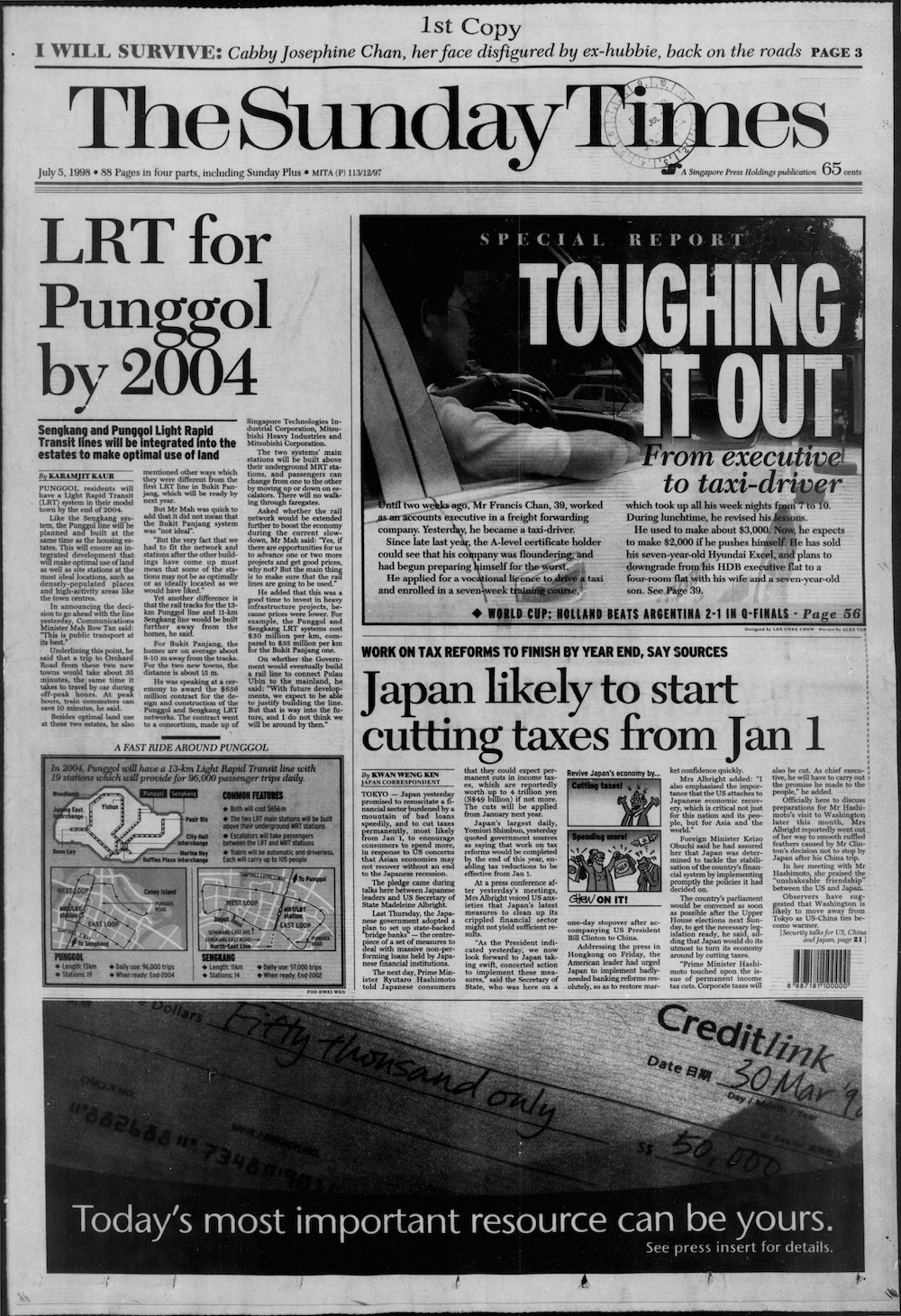
The Sengkang estate was first earmarked for development in the Urban Redevelopment Authority's 1991 Concept Plan. At the groundbreaking ceremony of the Bukit Panjang LRT line on 27 September 1996, deputy prime minister Tony Tan announced the government's decision to construct the Sengkang LRT (SKLRT). The line would be developed alongside the Sengkang estate and integrated with future developments, intended to improve accessibility and convenience for residents. An exhibition for the SKLRT opened on 7 December 1996 in Ngee Ann City. At the time, according to communications minister Mah Bow Tan, the SKLRT was planned to be completed in 2002.
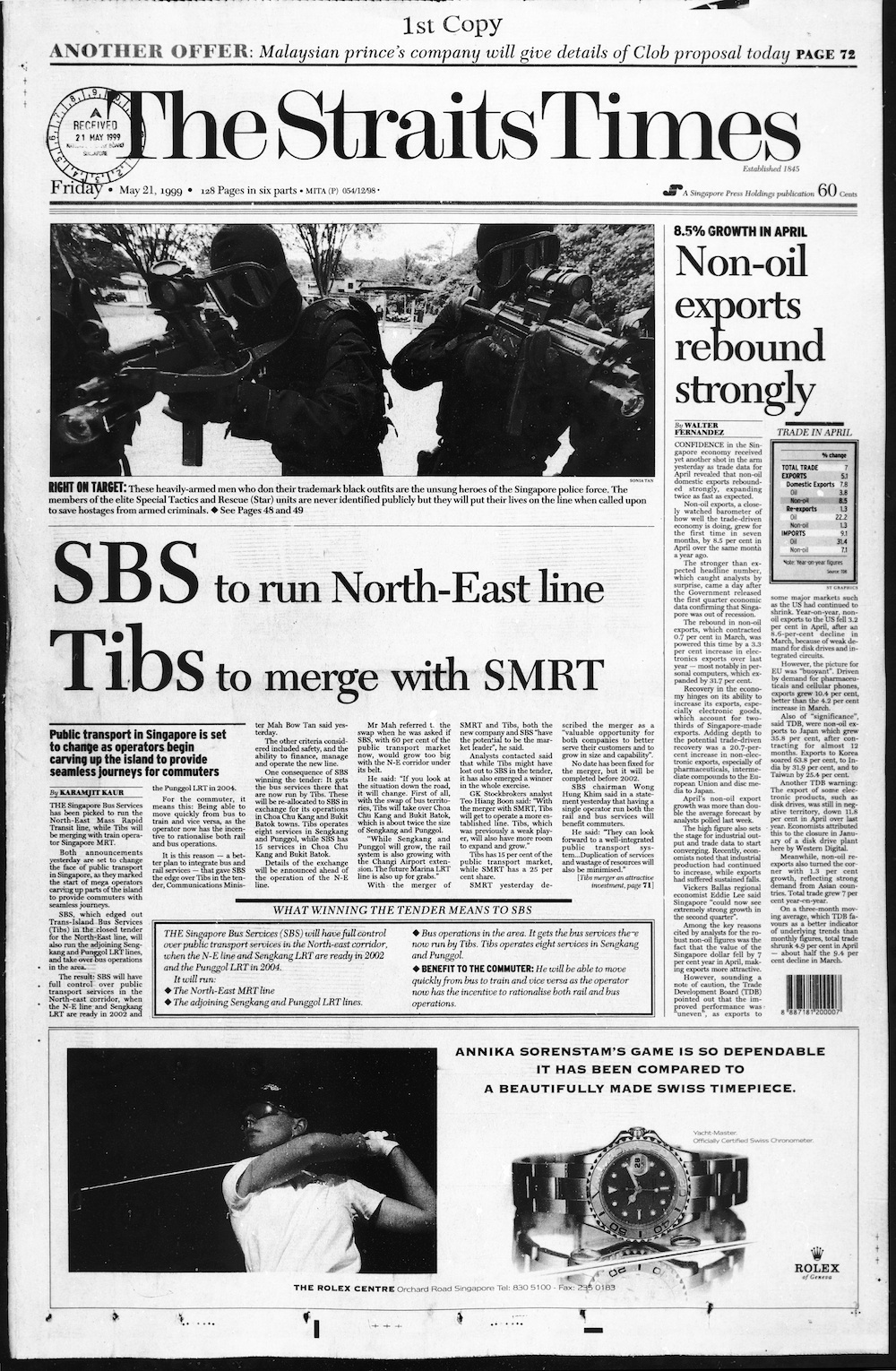
The contract for the design and construction of the Sengkang and Punggol LRT lines was awarded to a joint venture on 4 July 1998 for S$656 million (US$ million). The joint venture comprised Singapore Technologies Industrial Corporation (predecessor of Sembcorp), Mitsubishi Heavy Industries and Mitsubishi Corporation. On 20 May 1999, Singapore Bus Service (later renamed SBS Transit) was appointed to operate the SKLRT along with the North East MRT line and the Punggol LRT line.
Construction of the SKLRT stations and viaducts was completed in 2001. In December of that year, subcontractor BRR Holdings withdrew from the LRT project due to financial difficulties, and handed over its responsibilities to SembCorp Engineers and Constructors. According to Singapore's transport agency – the Land Transport Authority (LTA), the withdrawal had minimal impact on the construction schedule.
On 1 September 2002, the LTA transferred operations of the SKLRT to SBS Transit, which conducted extensive test runs and trials on the line. This came in light of frequent delays and breakdowns experienced on the Bukit Panjang LRT. In December 2002, transport minister Yeo Cheow Tong said the opening of the SKLRT would be delayed due to modifications required for the communication and radio systems. Due to limited funding from the 1997 financial crisis and low projected ridership, the Sengkang LRT line was initially constructed for single-car operations, even though it had been designed for two. Nevertheless, provisions were made for future upgrades to two-car operations during the expected equipment replacement cycle within 15 to 20 years.
Opening
| Date | Project | Description | |||||||
|---|---|---|---|---|---|---|---|---|---|
| 18 January 2003 | East Loop | Opening of the East Loop | |||||||
| 29 January 2005 | West Loop | date=10 January 2005 | title=Punggol LRT and Sengkang LRT West Loop to Commence Revenue Service on 29 January 2005 | url=https://www.sbstransit.com.sg/press/2005jan_10-3.aspx | url-status=dead | archive-url=https://web.archive.org/web/20190830050757/https://www.sbstransit.com.sg/press/2005jan_10-3.aspx | archive-date=30 August 2019 | access-date=30 August 2019 | publisher=SBS Transit}} |
| 15 November 2007 | date=14 November 2007 | title=Farmway LRT Station to Open on 15 November 2007 | url=http://www.sbstransit.com.sg/press/2007-11-14-01-S.aspx | url-status=dead | archive-url=https://web.archive.org/web/20170907075334/http://www.sbstransit.com.sg/press/2007-11-14-01-S.aspx | archive-date=7 September 2017 | access-date=7 September 2017 | publisher=SBS Transit}} | |
| 4 January 2010 | date=16 December 2009 | title=SK West Loop Peak Hours | url=https://www.sbstransit.com.sg/download/SK_West_Loop_Peak_Hours.pdf | url-status=dead | archive-url=https://web.archive.org/web/20160219235824/http://www.sbstransit.com.sg/download/SK_West_Loop_Peak_Hours.pdf | archive-date=19 February 2016 | access-date=30 August 2019 | publisher=SBS Transit}} | |
| 1 January 2013 | date=21 December 2012 | title=Cheng Lim LRT Station To Open And Sengkang West LRT to Run in Both Directions | url=http://www.sbstransit.com.sg/press/2012-12-21-01.aspx | url-status=dead | archive-url=https://web.archive.org/web/20121224110914/http://www.sbstransit.com.sg/press/2012-12-21-01.aspx | archive-date=24 December 2012 | access-date=21 December 2012 | publisher=SBS Transit}} | |
| 27 June 2015 | date=15 June 2015 | title=Kupang LRT Station to Open on Saturday, 27 June 2015 | url=http://www.sbstransit.com.sg/download/kupang_lrt_station.pdf | url-status=dead | archive-url=https://web.archive.org/web/20151124090502/https://www.sbstransit.com.sg/download/kupang_lrt_station.pdf | archive-date=24 November 2015 | access-date=15 June 2015 | publisher=SBS Transit}} |
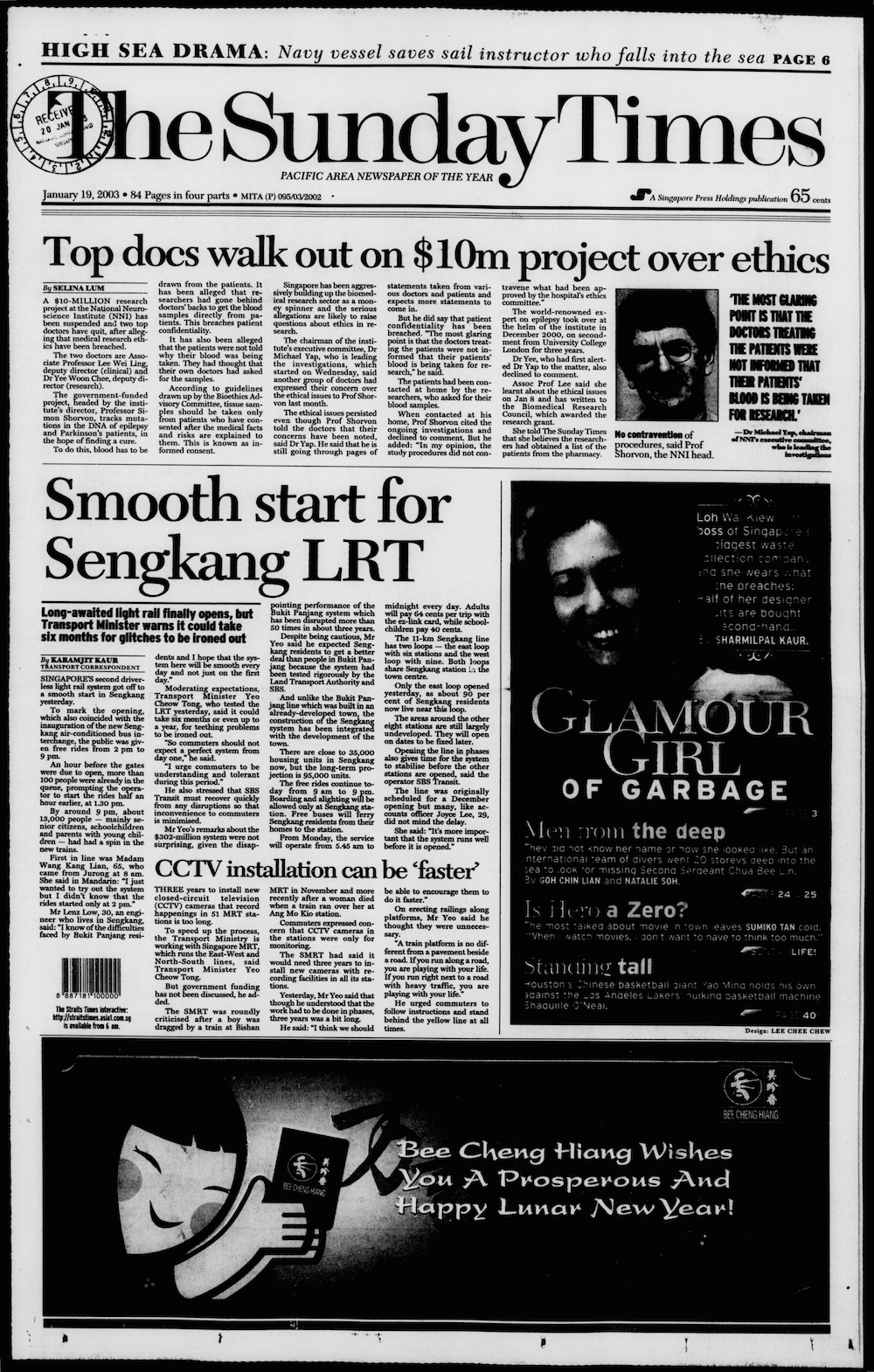
The east loop commenced operations on 18 January 2003, offering free rides during its first two days. At the time, 90% of Sengkang residents lived along the east loop, while the west remained largely undeveloped. Operations began at 1:30 pm to accommodate the queue of the 100 waiting commuters. The initial fare on the SKLRT was S$0.64 per trip (US$). The system experienced its first breakdown on 5 September that year because of a computer failure. In October 2004, Today reported that the SKLRT was operating at a loss due to low ridership, as only 37,000 of the projected 95,000 public flats had been completed.
With the exception of the Farmway, Cheng Lim, and Kupang stations, the west loop commenced operations on 29 January 2005. To mark the commencement of the west loop, Wee Siew Kim, Adviser to Jalan Kayu Grassroots Organisations, officiated the opening of the bridge linking Thanggam Station to Jalan Kayu via Lorong Samak. The west loop initially operated unidirectional services in the peak flow direction. Morning services from 5:20am to 3:00pm ran anti-clockwise from Thanggam to Renjong, while evening services from 3:00pm to 12:35am ran clockwise from Renjong to Thanggam.
Farmway station opened on 15 November 2007 to serve the Anchorvale Community Club and surrounding housing developments. On 4 January 2010, the west loop commenced bidirectional services only on weekday peak hours from 6:45am to 9:00am and from 6:15pm to 8:30pm. Full-day bidirectional services on the west loop began on 1 January 2013 with the opening of Cheng Lim station. Kupang station opened on 27 June 2015 to cater to new residential developments in its vicinity. Daily ridership on the SKLRT at the time had reached 60,000.
A power trip caused a two-hour disruption on the evening of 1 June 2016. On 16 February 2018, a dislodged power collector shoe caused a train to stall near Sengkang station. On 9 June 2024, the signalling system's power supply failed during upgrading works. As a result, no trains could be launched on that morning, with services only resuming at 10:12am.
Upgrades
On 31 October 2012, the LTA announced plans to increase passenger capacity of the Sengkang and Punggol LRT lines (SPLRT) to cater to increased ridership on the SPLRT. According to SBS Transit, daily ridership had reached 73,000. The Straits Times reported in September that the LTA had completed engineering studies for upgrading the system from one-car to two-car operations. The upgrading works involved retrofitting 16 of the 41 one-car trains for two-car operations while purchasing 16 additional cars. Two-car operations on the SKLRT began on 22 December 2015, with an official ceremony held on 5 January 2016. However, in October 2024, Sengkang GRC Member of Parliament (MP) Jamus Lim highlighted commuter concerns about inconsistent train frequencies and the irregular use of two-car trains during peak hours.
On 15 December 2017, the LTA outlined a renewal programme to improve operational reliability on the SPLRT. These works included power rail and signalling maintenance, along with reinforcing viaduct crossheads and replacing bearings after cracks were found during inspections. The maintenance works took place on selected Sunday mornings from 14 January to 25 February 2018, during which the affected loops operated unidirectional services. Unidirectional services continued on Sunday mornings from 4 March to 29 April due to extended maintenance works involving power rail replacements and preventive maintenance on signalling cables. Rectification works on the concrete plinths and elevated slabs were conducted on Sunday evenings between May 27 and October 7. Maintenance works during service hours continued in 2020, 2021, and 2022. Although these works were originally scheduled for completion in 2022, the LTA announced in 2021 that the renewal had been delayed due to the impact of the COVID-19 pandemic.
Plans to refurbish Sengkang station was announced in May 2018. The upgrades included expanding the LRT platform and installing new dual-speed escalators and a new lift to connect the platforms, concourse and mezzanine levels of the station. New signs and queue markings were introduced on the platform to indicate new stopping points for each of the four LRT routes plying the station. The refurbished LRT platforms began operations at the end of September 2024.
On 5 February 2021, the LTA said they would purchase 17 two-car trains for the SPLRT, which were expected to be delivered from 2024 to 2027. The 3.5 ha Sengkang Depot would also be expanded to 11.1 ha to increase capacity and maintenance space for the new trains. The depot expansion also included two new reception tracks to reduce train launching time. In February 2022, the contract for the depot expansion was awarded to Sato Kogyo (S) Pte Ltd for S$157 million (US$ million), and the contract for the new fleet of trains was awarded to Mitsubishi Corporation for S$439 million (US$ million). The new trains entered service on 15 July 2025.
Network and operations
Route and service

The Sengkang LRT (SKLRT) is a fully elevated automated guideway transit line, with a route length of 10.7 km. It is coloured grey on official maps. On dynamic passenger information displays and static signs on the platforms, yellow indicates the east loop, and red indicates the west loop. The SKLRT has four routes operating on two bi-directional loops that converge at Sengkang station. The line generally runs along road medians, with an average viaduct height of 15 m.
On the east loop, the line heads north after Sengkang station before curving eastward and running along the medians of Compassvale Street and Rivervale Drive. After passing Rumbia station, it turns south along Rivervale Drive, then west along Sengkang East Avenue, completing the loop by heading north back to Sengkang station. On the west loop, the line from Sengkang station diverges west toward Cheng Lim station. A spur connects the SKLRT to the Punggol LRT line across the Tampines Expressway. The SKLRT continues along Anchorvale Street and Fernvale Street. Between the Farmway and Kupang stations, the line crosses Sungei Punggol. After Kupang station, the line turns south along Fernvale Road, and turns east along Sengkang West Avenue. It crosses Sungei Punggol again between Layar and Tongkang stations, with reception tracks connecting the line to Sengkang Depot. Following Renjong station, the line completes the loop by heading north back to Sengkang station.
The line operates between 5:18am (5:38am on Sundays and public holidays) and 12:37am daily. The SKLRT is operated by SBS Transit. Since 2018, the SKLRT has been part of the New Rail Financing Framework (NRFF). Previously, the operator (the owner of the rail assets) had to bear the cost of maintaining and upgrading trains and signalling. Under the NRFF, the LTA and SBS Transit share the profits and financial risks in operating the line and the LTA will take control of its operating assets on 1 April 2033. SBS Transit operates the line under a 15-year licence which will expire on 31 March 2033.
Stations
The east loop has five stations, while the west loop has eight stations. The average distance between stations are 300 m, with each station positioned to serve residents within a 400 m radius.
| Singapore LRT | Sengkang}}" | Station code | Singapore LRT | Sengkang}}" | Station name | Singapore LRT | Sengkang}}" | Images | Singapore LRT | Sengkang}}" | Opening | Singapore LRT | Sengkang}}" | Further information | Singapore LRT | Sengkang}}" | Location(s) | East Loop | West Loop |
|---|---|---|---|---|---|---|---|---|---|---|---|---|---|---|---|---|---|---|---|
| {{SMRT code | STC | NE | 16}} | Sengkang | [[File:STC Sengkang LRT Platform.jpg | 100px | alt=View of Sengkang LRT platform]] | 18 January 2003; | |||||||||||
| Interchange with the . | |||||||||||||||||||
| Close to the [[File:Bus-logo.svg | 15px | link=]] Sengkang Bus Interchange. | |||||||||||||||||
| Compassvale | [[File:SE1 Compassvale LRT platforms 20250126 141509.jpg | 100px | alt=View of Compassvale LRT platforms]] | 18 January 2003; | |||||||||||||||
| Rumbia | [[File:SE2 Rumbia LRT platforms 20250126 142230.jpg | 100px | alt=View of Rumbia LRT platforms]] | date=26 March 2017 | title=SE2 – Rumbia | url=http://www.sbstransit.com.sg/trpt_lrt_station_view.asp?statcode=SE2 | url-status=dead | archive-url=https://web.archive.org/web/20170816011825/http://www.sbstransit.com.sg/trpt_lrt_station_view.asp?statcode=SE2 | archive-date=16 August 2017 | access-date=20 January 2025 | publisher=SBS Transit}} | ||||||||
| Bakau | [[File:SE3 Bakau LRT Exit B 20210303 142647.jpg | 100px | alt=An entrance to the station along the road. A flight of stairs leads to the concourse level]] | Named after the Bakau wood used for building foundations. | |||||||||||||||
| Kangkar | [[File:Kangkar LRT Station, Oct 06.JPG | 100px | alt=View of Kangkar station exterior]] | "Kangkar" refers to a former fishery in the area. | |||||||||||||||
| Ranggung | [[File:Ranggung LRT Station 3, Sep 06.JPG | 100px | alt=View of Ranggung station exterior]] | "Ranggung" refers to a species of stork residing on the Punggol shore. | |||||||||||||||
| Cheng Lim | [[File:(SGP-Singapore) Cheng Lim LRT Station 2025-02-02.jpg | 100px | alt=View of Cheng Lim LRT exterior]] | 1 January 2013; | |||||||||||||||
| Named after the former Cheng Lim Farmway and Lorong Cheng Lim, where farms formerly existed. The roads in turn are named after Goh Cheng Lim, director of Kim Hock Hoe Ltd, a company of ship owners and commission agents. | |||||||||||||||||||
| Farmway | [[File:SW2 Farmway Platform.jpg | 100px | alt=View of Farmway LRT platforms]] | 15 November 2007; | |||||||||||||||
| Kupang | [[File:SW3 Kupang LRT platforms 20250126 152321.jpg | 100px | alt=View of Kupang LRT platforms]] | 27 June 2015; | |||||||||||||||
| title=SW3 – Kupang | url=http://www.sbstransit.com.sg/trpt_lrt_station_view.asp?statcode=SW3 | url-status=dead | archive-url=https://web.archive.org/web/20120315184315/http://www.sbstransit.com.sg/trpt_lrt_station_view.asp?statcode=SW3 | archive-date=15 March 2012 | access-date=20 January 2025 | publisher=SBS Transit}} Kupang means "mussels" in Malay. | |||||||||||||
| Thanggam | [[File:SW4 Thanggam LRT Exterior 20250126 151451.jpg | 100px | alt=View of Thanggam LRT exterior]] | 29 January 2005; | |||||||||||||||
| The name means "Gold" in Tamil. A pedestrian bridge connects the station to Jalan Kayu. | |||||||||||||||||||
| Fernvale | [[File:SW5 Fernvale exterior 20200830 115958.jpg | alt=Exterior view of Fernvale station next to Seletar Mall | 100px]] | Selatar Mall]], which opened on 28 November 2014. | |||||||||||||||
| Layar | [[File:SW6 Layar LRT platforms 20241226 183827.jpg | 100px | alt=The island platform of Layar station with ventaliation fans. Platform barriers minimise commuters' access to the tracks.]] | title=SW6 – Layar | url=http://www.sbstransit.com.sg/trpt_lrt_station_view.asp?statcode=SW6 | url-status=dead | archive-url=https://web.archive.org/web/20170816012935/http://www.sbstransit.com.sg/trpt_lrt_station_view.asp?statcode=SW6 | archive-date=16 August 2017 | access-date=20 January 2025 | publisher=SBS Transit}} | |||||||||
| Tongkang | [[File:SW7 Tongkang LRT platforms 20250126 145327.jpg | 100px | alt=View of Tongkang LRT platforms]] | The name refers to a small boat transporting goods along rivers. | |||||||||||||||
| Renjong | [[File:Renjong LRT Station 2, Aug 06.JPG | 100px | via=Exterior of Renjong LRT station]] | title=SW8 – Renjong | url=http://www.sbstransit.com.sg/trpt_lrt_station_view.asp?statcode=SW8 | url-status=dead | archive-url=https://web.archive.org/web/20170816012636/http://www.sbstransit.com.sg/trpt_lrt_station_view.asp?statcode=SW8 | archive-date=16 August 2017 | access-date=20 January 2025 | publisher=SBS Transit}} |
Infrastructure
Rolling stock
_Sengkang_LRT_Line_Mitsubishi_Heavy_Industries_Crystal_Mover_C810_33_@_Fernvale_2025-02-02.jpg)
The Sengkang and Punggol LRT lines (SPLRT) utilise the Crystal Mover Automated People Mover (APM) rolling stock manufactured by Mitsubishi Heavy Industries. The rubber-tyred trains are fully automatic and can accommodate up to 105 passengers per vehicle. The SPLRT has an initial fleet of 41 APMs, with 16 more APMs delivered under contract C810A. The APMs are configured for single car or two-car operations, with a maximum capacity of 36 trainsets on the network. In February 2022, the LTA ordered another fleet of 17 two-car APMs from Mitsubishi for S$439 million (US$ million) . This was followed by another order for eight more two-car trains in May 2023, costing S$87 million (US$ million). The new trains are set to replace the 25 one-car trains and half of the 16 two-car trains, bringing the overall SPLRT fleet to 33 two-car APMs. The first two trainsets were delivered to Singapore on 23 November 2024, and entered passenger service on 15 July 2025.
The Crystal Mover APMs have a top speed of 80 km/h, with a maximum operational speed of 70 km/h. They are powered by 750V DC third rail located on one side of the guideway. Each vehicle is 11.84 m long and 2.69 m wide. The exterior has a crystal-like design with a polyhedral nose reflective of its namesake. Mitsubishi describes the curved sides of the Crystal Mover APM as a design choice to "soften" the sharpness of its polyhedral shape. The exterior is painted pearl white and indigo blue.
As driverless cars, the APMs do not include a driver cabin. Instead, detrainment doors at both ends of the cabin allow emergency evacuation of passengers onto the track. The emergency stop button and emergency notice system are located at the right-side corner of the vehicle's front, while line maps and service information are displayed on the left. The interior features white side panels and ceiling, a grey floor, grayish-blue seats, and handrails and grip bars accented in a wine color. The cabins are air-conditioned.
The SPLRT trains are maintained and stabled on the second floor of Sengkang Depot. Located between the Layar and Tongkang LRT stations, the depot also houses the trains of the North East Line. Its facilitates include a two-story main building with an operation control center room, automatic vehicle washing facility, maintenance garage, departure inspection track, stabling yard, power receiving and transforming facilities, and a test track. The 3.5 ha site is being expanded to 11.1 ha, which will include two more reception tracks and three new traction power substations to expand the depot's stabling and maintenance capacity.
Train control and power system
The Sengkang LRT line is fully automatic and is equipped with a Kyosan Electric APM fixed block signalling system. The line's automatic train control (ATC) is composed of automatic train protection (ATP) which ensures safe operations, automatic train operation (ATO) which controls the automatic operations, and automatic train supervision (ATS) for overall command, monitoring and recording of the system. To reduce equipment mass on the train, the onboard ATP and ATO systems are integrated into one unit, although for safety reasons, the function and control logic of the ATP and ATO systems remain independent. These subsystems are connected via LAN and managed by a computer-based interlocking (CBI) system that oversees traffic safety of the APM. In July 2024, the LTA reported that the SPLRT has a "mean kilometres between failures" (MKBF) of 814,000 train-km (0.814 e6km train-miles), which was a decrease from 1.22 million train-km (1.22 e6km train-miles) in 2023.
The power system of the SKLRT includes a 22 kV AC power intake and distribution network, a 750V DC traction power system, and a 400V AC system for station services. Power is supplied via two 22kV AC feeders from the North East Line to improve reliability and take advantage of the 66kV tariff. The AC supply is distributed through a closed ring network to prevent power disruptions during single outages. At each station, the AC supply is stepped down to 400V AC using service transformers for mechanical and electrical needs. Traction power substations (TPSS) further step down the 22kV AC to power rectifiers that convert it to 750V DC for train operations. Each TPSS is equipped with an inverter system to return excess energy from regenerative braking back to the 22kV distribution network. In 2004, the SKLRT had three TPSS, with one on standby to maintain operations during outages; it presently has five operational substations, which will increase to eight with the planned expansion of Sengkang Depot.
Station facilities

All Sengkang LRT stations are equipped with lifts connecting passengers from the ground level to the station concourse, and from the concourse to the platform level. Each station also has at least one wider faregate for wheelchair users and tactile flooring to guide the visually-impaired from the ground floor to the platforms. The stations are also equipped with fire extinguishers and fire phones. Emergency stop buttons on both sides of the station platform, when activated, cut off traction power supply and halt incoming trains.
Fixed platform barriers are intended to prevent commuters falling to the tracks. However, these barriers lack doors and instead have fixed openings for boarding, as the limited space on LRT platforms cannot accommodate the power, communications, and signal control systems required for platform screen doors. To enhance safety, SBS Transit has implemented the VAnGuard track intrusion detection system on the SPLRT. Using video analytics and artificial intelligence, the system monitors footage of tracks and platforms to identify individuals or objects on the tracks. When an intrusion is detected, operations control centre staff can press the emergency stop button to halt services on a specific loop. The system also triggers an alarm when intruders or foreign objects are detected. In addition to track intrusions, the system can spot unattended items on station platforms, allowing staff to provide assistance or undertake security precautions.
References
- "System Map Peta Sistem". Land Transport Authority.
- "System Map 地铁路线图". Land Transport Authority.
- "System Map ரயில்பாதை வரைபடம்". Land Transport Authority.
- Koiwai, Hironori. (21 January 2025). "Light Rapid Transit in Singapore: Transportation Demand Management and Urban Environment". Institute of Comparative Economic Studies, Hosei University.
- "Land Transport DataMall".
- (1 January 2022). "New Rail Financing Framework". Land Transport Authority.
- (2018). "Kyosan Corporate Report 2018". Kyosan Electric.
- (27 September 1996). "Speech by Dr Tony Tan Keng Yam, Deputy Prime Minister and Minister for Defence, At the Ground-Breaking Ceremony for Bukit Panjang Light Rapid Transit (LRT) Held on Friday, 27 September 1996 at 9.00 am".
- Yeo, Geraldine. "Sengkang Estate to Be Developed with LRT Line". The Straits Times.
- (7 December 1996). "Speech by Mr Mah Bow Tan, Minister for Communications, At the Sengkang LRT Exhibition At Ngee Ann City On 7 December 1996 at 10.00 am".
- (8 December 2003). "Travel Will Take Just 35 Minutes by LRT and MRT". The Straits Times.
- "Speech by Mr Mah Bow Tan Minister for Communications Sengkang and Punggol LRT Systems Contract Award Ceremony On 4 July 1998, 11 A.M.".
- (5 July 1998). "LRT for Punggol by 2004". The Straits Times.
- Woo, Sue Ann. (29 November 2001). "A Fresh Look". Today.
- (21 November 2002). "Proposed Merger of Comfort Group Ltd and DelGro Corporation Limited". Comfort Group Limited and DelGro Corporation Limited.
- Kaur, Karamjit. (21 May 1999). "SBS to Run North-East Line, Tibs to Merge with SMRT". The Straits Times.
- (20 May 1999). "Appointment of Operator for the North East MRT Line".
- Yeow, Stephanie. (15 March 2001). "Bridging the Gap". The Straits Times.
- Tan, Lorna. (5 December 2001). "Company Pulls out of LRT Projects.". The Straits Times.
- Kaur, Karamjit. (8 September 2002). "Sengkang LRT Will Be Tested… and Tested Again". The Straits Times.
- Kaur, Karamjit. (7 January 2003). "LRT Rides in Sengkang Just Weeks Away". The Straits Times.
- Ludher, Elyssa. (2021). "Punggol: From Farmland to Smart Eco-Town". Centre for Liveable Cities.
- (10 January 2005). "Punggol LRT and Sengkang LRT West Loop to Commence Revenue Service on 29 January 2005". SBS Transit.
- (29 January 2005). "Punggol LRT (East Loop) And Sengkang LRT (West Loop) Commence Revenue Service Today". SBS Transit.
- (14 November 2007). "Farmway LRT Station to Open on 15 November 2007". SBS Transit.
- (16 December 2009). "SK West Loop Peak Hours". SBS Transit.
- (21 December 2012). "Cheng Lim LRT Station To Open And Sengkang West LRT to Run in Both Directions". SBS Transit.
- (15 June 2015). "Kupang LRT Station to Open on Saturday, 27 June 2015". SBS Transit.
- (15 June 2015). "Sengkang LRT Fully Operational by June 27 When Kupang Station Opens".
- (17 January 2003). "Free LRT Service in Sengkang".
- (19 January 2003). "Smooth Start for Sengkang LRT". The Straits Times.
- (6 September 2003). "Sengkang LRT Down". Today.
- Ng, Shing Yi. (27 October 2004). "LRT Losses Here to Stay?". Today.
- (10 January 2005). "Punggol LRT East, Sengkang LRT West Loops to Start Service on Jan 29".
- (16 November 2007). "Farmway Stop on Sengkang LRT Now Open". The Straits Times.
- (22 December 2012). "Sengkang West LRT to Extend Services, Cheng Lim Station to Open". Today.
- (15 June 2015). "Kupang LRT Station to Open and More Than 260 Weekly Trips to Be Added to the Sengkang/Punggol LRT". SBS Transit.
- Matthews, Holly. (15 June 2015). "Kupang Station Set To Open Next Saturday".
- (1 June 2016). "Service on Punggol and Sengkang LRT Disrupted for 2½ Hours Due to Repeated Power Trips".
- Hussain, Amir. (16 February 2018). "Sengkang LRT Train Breaks Down on First Day of CNY, Passengers Get Down and Walk on Tracks".
- Chiu, Christie. (2024-06-09). "Punggol-Sengkang LRT Service Resumes After 4-Hour Disruption on Sunday Morning".
- (9 June 2024). "Sengkang-Punggol LRT Train Service Resumes After 4-Hour Disruption".
- (31 October 2012). "Two-Car Train System for Sengkang & Punggol LRT". Channel NewsAsia.
- Tan, Christopher. (27 September 2012). "LRT Legacy: U-Turn or at Crossroads?". The Straits Times.
- (31 October 2012). "2-car System for Sengkang Punggol LRT by 2016; Improvements to Choa Chu Kang LRT station". Land Transport Authority.
- Yuen, Sin. (5 January 2016). "Two-Car Trains on Sengkang Loop of LRT Start Official Operations".
- (15 December 2017). "Improvement Works to Enhance Reliability of LRT Systems". Land Transport Authority.
- (15 December 2017). "Limited Service Along Sengkang-Punggol LRT on Sundays in Jan, Feb to Facilitate Rail Works".
- (22 February 2018). "Maintenance Work to Resume on Sengkang and Punggol LRT Systems on 4 Mar".
- (22 February 2018). "Maintenance Works to Resume on Sengkang and Punggol LRT Systems". The Straits Times.
- (11 May 2018). "Limited Service Hours on Sundays for Sengkang-Punggol LRT to Be Extended".
- (7 October 2018). "Extended Engineering Hours on Sengkang and Punggol LRT Systems on Sundays from 27 May to 7 October 2018". SBS Transit.
- (11 May 2018). "SBS Transit Extends Limited Service on Sundays for Sengkang, Punggol LRT to October". The Straits Times.
- (31 July 2020). "Extended Engineering Hours on Sengkang-Punggol Light Rail Transit on Sundays". SBS Transit.
- (26 September 2021). "Extended Engineering Hours on Sengkang-Punggol Light Rail Transit on Saturdays and Sundays". SBS Transit.
- (25 September 2022). "Extended Engineering Hours on Sengkang-Punggol Light Rail Transit on Saturdays and Sundays". SBS Transit.
- Kok, Yufeng. (11 February 2021). "Timeline for Sengkang-Punggol LRT Renewal Project Under Review: LTA".
- (25 May 2018). "Upgrading of Sengkang MRT and LRT Stations for More Comfortable Journeys". Land Transport Authority.
- (25 May 2018). "Upgrades to Sengkang MRT and LRT Stations by 2022: LTA".
- "Thomson – East Coast Line 4 to Welcome Commuters from 23 June 2024".
- Kok, Yufeng. (19 September 2024). "Sengkang LRT Upgrading: Trains to Run in Only One Direction on Sept 28–29".
- (5 February 2021). "Sengkang-Punggol LRT to Get 17 New Two-Car Trains to Boost Capacity".
- (5 February 2021). "New Two-Car Trains for Sengkang-Punggol LRT". Land Transport Authority.
- Jacob, Charmaine. (15 July 2025). "New two-car trains begin service on Sengkang-Punggol LRT Line".
- Vuchic, Vukan R.. (16 February 2007). "Urban Transit Systems and Technology". John Wiley & Sons.
- "MRT System Map". Land Transport Authority.
- (26 February 2025). "Written Reply to Parliamentary Question on Colour Coding of Lines of LRT System to Guide Commuters".
- Yeap, Amanda. (12 October 2024). "Is There Still Light at the End of the Tunnel for Singapore's Light Rail Transit System?".
- Lee, Nian Tjoe. (21 March 2024). "Upgrading of Sengkang LRT Station Set to Begin; Completion Slated for End-2024".
- Ng, Keith. (1 August 2001). "Pre-Cast Push".
- "センカン路線図". Kyosan Electric.
- (31 August 2017). "OneMap". Singapore Land Authority.
- "First Train/ Last Train". SBS Transit.
- "Getting Around – Public Transport – Rail Network". Land Transport Authority.
- (14 February 2018). "North East Line, Sengkang LRT and Punggol LRT to Transit to the New Rail Financing Framework: Completion of the Transition of All Existing Rail Lines, Benefitting Commuters". Land Transport Authority.
- Abdullah, Zhaki. (14 February 2018). "LTA to Take Over North East Line, Sengkang–Punggol LRT Assets Worth $30.8m".
- (20 April 1999). "Travel to Be Seamless in Sengkang". The Straits Times.
- (6 December 2024). "Sengkang–Punggol LRT". Land Transport Authority.
- "Train Service Information – Sengkang LRT". SBS Transit.
- (26 March 2017). "SE2 – Rumbia". SBS Transit.
- "SE3 – Bakau". SBS Transit.
- "SE4 – Kangkar". SBS Transit.
- "SE5 – Ranggung". SBS Transit.
- "SW1 – Cheng Lim". SBS Transit.
- "SW2 – Farmway". SBS Transit.
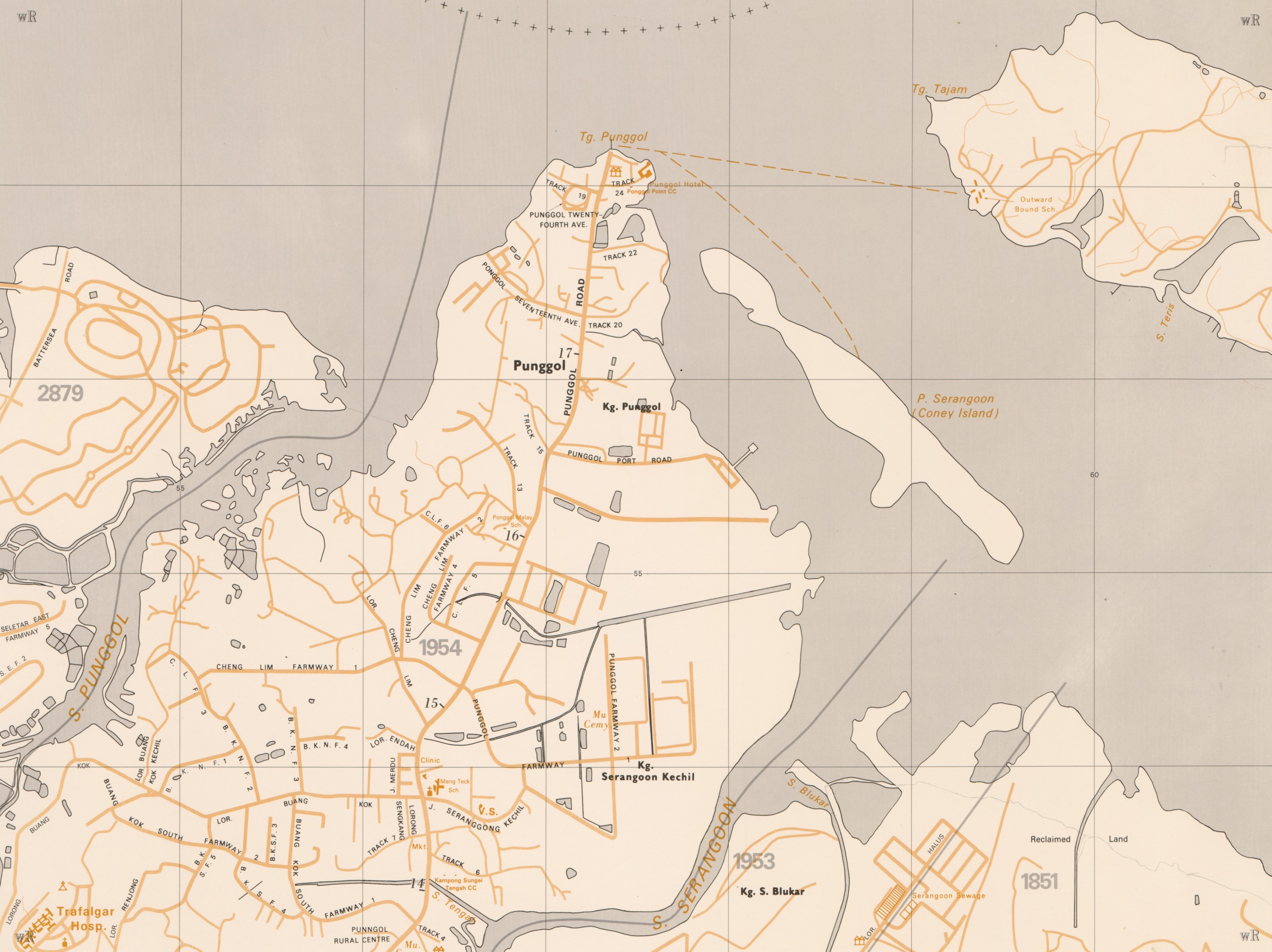
- "1985 survey map of Singapore". Singapore Land Authority.
- "Lorong Cheng Lim, 1985: General View".
- "SW3 – Kupang". SBS Transit.
- (7 November 2011). "Fisherman Unloading Sea Mussels".
- "SW4 – Thanggam". SBS Transit.
- (19 January 2005). "Jalan Kayu Shops Expected to Benefit from Opening of LRT Station".
- "Train Service Information – SW5 Fernvale". SBS Transit.
- "Getting Here". The Seletar Mall.
- Baker, Jalelah Abu. (7 November 2014). "5 Things About the Upcoming Seletar Mall and 5 Other Popular Suburban Malls".
- "SW6 – Layar". SBS Transit.
- "SW7 –Tongkang". SBS Transit.
- "SW8 – Renjong". SBS Transit.
- "LRT – Your Link to the MRT". Land Transport Authority.
- (22 May 2013). "Mitsubishi Heavy Industries and Mitsubishi Corporation Receive Order for Design, Manufacture, Installation and Commissioning of Singapore Light Rapid Transit Capacity Expansion – Vehicles and Electrical and Mechanical Systems for Sengkang and Punggol LRT Systems (C810A)". Mitsubishi Heavy Industries.
- Tan, Christopher. (24 December 2015). "2-car trains roll out on Sengkang LRT".
- Tan, Christopher. (9 September 2016). "Hairline Cracks Found on 11 Sengkang-Punggol LRT Trains".
- "Annual Report 22/23". Land Transport Authority.
- "Official Exchange Rate (LCU per US$, Period Average)". World Bank.
- (15 February 2022). "LTA Awards Contracts for New Trains and Depot Expansion for Sengkang-Punggol LRT".
- (17 February 2022). "MHIENG Receives Order for Project to Enhance Capacity of Sengkang-Punggol Light Rapid Transit System in Singapore – Strengthening the Safe and Smooth Transport Structure in the Sengkang and Punggol Districts". Mitsubishi Heavy Industries.
- (18 February 2022). "三菱重工エンジニアリング,シンガポールの新交通システム輸送力増強プロジェクトを受注".
- (9 May 2023). "8 New Two-Carriage Trains to Be Added to Sengkang-Punggol LRT Line".
- (9 May 2023). "MHI Receives Follow-up Order for 8 Two-Car Trains for Sengkang-Punggol LRT (SPLRT) – Additional 16 Cars to Boost Capacity of SPLRT Serving Sengkang and Punggol Districts". Mitsubishi Heavy Industries.
- Loi, Esther. (25 November 2024). "First 2 New Trains for Sengkang-Punggol LRT Arrive in Singapore, Will Enter Service in Q3 2025".
- "LRT: Safety Tips". SBS Transit.
- "Annex A: Location Map and Artist". Land Transport Authority.
- Lee, Nian Tjoe. (15 February 2022). "LTA Awards $596m Contracts for Trains and Depot Expansion on Sengkang-Punggol LRT System".
- (3 November 2004). "VOL.54 2003 No.2 の概要". Kyosan Electric.
- "全体システム構成図". Kyosan Electric.
- Lee, Nian Tjoe. (15 July 2024). "MRT Reliability Up in First Quarter; More Frequent Delays on LRT Lines".
- (2004). "2004 International Conference on Power System Technology, 2004. PowerCon 2004". IEEE.
- "LRT: Station Facilities". SBS Transit.
- "Facilities Provided for People with Disabilities in MRT/LRT Stations". Building and Construction Authority.
- Tan, Christopher. (21 October 2015). "Platform Barriers at All LRT Stations by 2018 to Prevent Falls".
- Kok, Yufeng. (10 May 2023). "2 Deaths, 1 Injury in Last Decade from Falls on LRT Tracks".
- "Driving Workplace Safety Forward: SBS Transit Unveils New Innovative Technologies at the Rail Safety Symposium – Annex". SBS Transit.
- Yap, Gracia. (24 February 2024). "All Sengkang-Punggol LRT Stations to Get Track Intrusion Detection System in 2024".




This article was imported from Wikipedia and is available under the Creative Commons Attribution-ShareAlike 4.0 License. Content has been adapted to SurfDoc format. Original contributors can be found on the article history page.
Ask Mako anything about Sengkang LRT line — get instant answers, deeper analysis, and related topics.
Research with MakoFree with your Surf account
Create a free account to save articles, ask Mako questions, and organize your research.
Sign up freeThis content may have been generated or modified by AI. CloudSurf Software LLC is not responsible for the accuracy, completeness, or reliability of AI-generated content. Always verify important information from primary sources.
Report