From Surf Wiki (app.surf) — the open knowledge base
Seal of the Confederate States
none

none
| Field | Value |
|---|---|
| name | Seal of the Confederate States |
| image | Seal of the Confederate States.svg |
| alt | Equestrian portrait of Washington (after the statue which surmounts his monument in the capitol square, at Richmond,) surrounded with a wreath composed of the principal agricultural products of the Confederacy, (cotton, tobacco, sugar cane, corn, wheat and rice,) and having around its margin the words: "The Confederate States of America, twenty-second February, eighteen hundred and sixty-two," with the following motto: "Deo vindice" |
| image_width | 220 |
| armiger | Confederate States of America |
| year_adopted | |
| motto | |
| use | On the national currency in 1864 |
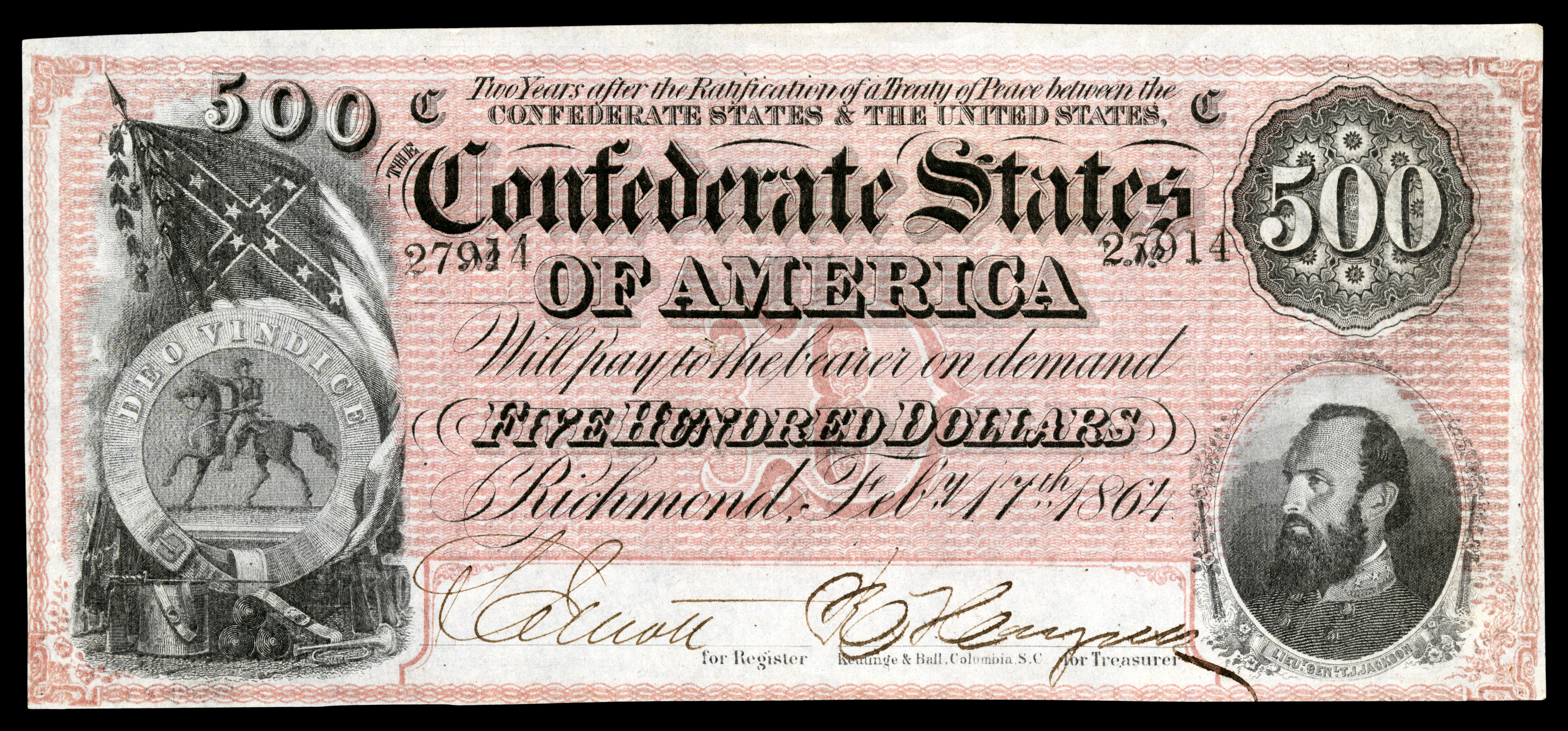
The Seal of the Confederate States was used to authenticate certain documents issued by the federal government of the Confederate States of America. The phrase is used both for the physical seal itself (which was kept by the Confederate Secretary of State), and more generally for the design impressed upon it. On May 20, 1863, C.S. Secretary of State Judah P. Benjamin instructed James Mason to arrange for its manufacture in London. The seal was first used publicly in 1864.
Design
The Seal of the Confederate States prominently features the Statue of Washington in the capitol square at Richmond. In the seal, George Washington is surrounded with a wreath made of some of the main agricultural products of the Confederacy: wheat, corn, tobacco, cotton, rice, and sugar cane. The top margin features the words 'The Confederate States of America: 22 February 1862'. This date reflects the establishment of the federal government under the new Confederate Constitution when Jefferson Davis was inaugurated as the president of the Confederate States on Washington's birthday (February 22), 1862, in the capital square at Richmond, then the Confederacy's capitol. The bottom margin contains the national motto, Deo vindice, meaning '(With) God (as) our defender/protector'. Confederate Senator Thomas Semmes, in proposing the motto, took pains to stress that both the provisional and the permanent Confederate constitution "had deviated in the most emphatic manner from the spirit that presided over the construction of the Constitution of the United States, which is silent on the subject of the Deity."
History
According to the Richmond Whig of September 25, 1862, a design that passed the Senate represented in the foreground a Confederate soldier, in position to charge bayonet; in the middle distance, a woman with a child in front of a church, both with hands uplifted in the attitude of prayer; for a background, a homestead in the plain, with mountains in the distance beneath the meridian sun; the whole surrounded by a wreath composed of the stalks of sugar-cane, the rice, the cotton and the tobacco plants, the margin inscribed with the words 'Seal of the Confederate States of America' above, and 'Our Homes and Constitutions' beneath. This seal was never used.
The final design was approved on April 30, 1863, and a set of embossing dies ordered from London engraver Joseph Wyon. The seal was first used publicly in 1864. The dies eventually reached Richmond before the end of the war. However, due to the risks of running the Union blockade, the accompanying embossing press was only shipped as far as Bermuda. The dies (crafted in silver) were thus unlikely to ever have been used in any official capacity. Both sets of artifacts initially passed through private ownership before ultimately entering museum collections. The seal is kept at Richmond's American Civil War Museum. The press is in the BNT Museum at the Globe Hotel, St. George's.
Gallery
File:Confederate Seal Electrotype.jpg|Electrotype File:ConfederateSeal.jpg|Replica
Notes
References
References
- . (1863). ["The Statutes at Large of the Confederate States of America, Passed at the Third Session of the First Congress; 1863"](https://archive.org/stream/statutesatlargeo22conf#page/166/mode/2up). *R. M. Smith, Printer to Congress*.
- Beers, Henry Putney. (1986). "The Confederacy: A Guide to the Archives of the Government of the Confederate States of America". [[National Archives and Records Administration.
- "Great Seal of the Confederacy". [[National Museum of American History]].
- (January–December 1888). "Southern Historical Society Papers".
- Preble, George Henry. (1880). "History of the flag of the United States of America, and of the naval and yacht-club signals, seals, and arms, and principal national songs of the United States, with a chronicle of the symbols, standards, banners, and flags of ancient and modern nations". A. Williams and Company.
- . (1873). ["Sigillologia. Being Some Account of the Great or Broad Seal of the Confederate States of America. A Monograph"](https://archive.org/details/sigillologiabein00pick). *Kervand & Towers*.
- . (2014). ["The Bermuda National Trust Museum at the Globe Hotel: Teacher Resource Guide"](https://www.bnt.bm/images/documents/globe_hotel.pdf). *[[Bermuda National Trust]]*.
- "Great Seal of the Confederacy".
This article was imported from Wikipedia and is available under the Creative Commons Attribution-ShareAlike 4.0 License. Content has been adapted to SurfDoc format. Original contributors can be found on the article history page.
Ask Mako anything about Seal of the Confederate States — get instant answers, deeper analysis, and related topics.
Research with MakoFree with your Surf account
Create a free account to save articles, ask Mako questions, and organize your research.
Sign up freeThis content may have been generated or modified by AI. CloudSurf Software LLC is not responsible for the accuracy, completeness, or reliability of AI-generated content. Always verify important information from primary sources.
Report