From Surf Wiki (app.surf) — the open knowledge base
Saturn IB
American rocket used in the Apollo program during the 1960s and 70s
American rocket used in the Apollo program during the 1960s and 70s
| Field | Value |
|---|---|
| image | Saturn IB launch configurations.jpg |
| caption | Three launch configurations of the Apollo Saturn IB rocket: no spacecraft (AS-203), command and service module (AS-202), and Lunar Module (Apollo 5) |
| name | Saturn IB |
| country-origin | United States |
| function | Apollo spacecraft development; |
| S-IVB stage development in support of Saturn V; | |
| Skylab crew launcher | |
| manufacturer | Chrysler (S-IB) |
| Douglas (S-IVB) | |
| height | 141.6 ft |
| without payload | |
| diameter | 21.67 ft |
| mass | 1,300,220 lb |
| without payload | |
| stages | 2 |
| location | LEO |
| altitude | 87.5 nmi |
| mass | 46,000 lb |
| status | Retired |
| sites | Cape Canaveral, LC-34 and LC-37 |
| Kennedy, LC-39B | |
| launches | 9 |
| success | 9 |
| payloads | Apollo CSM, |
| Uncrewed Apollo LM | |
| first | |
| last | |
| stageno | First |
| type | stage |
| name | S-IB |
| length | 80.17 ft |
| diameter | 21.42 ft |
| width | |
| empty | 92500 lb |
| gross | 973000 lb |
| propmass | 880500 lb |
| engines | 8 × H-1 |
| thrust | 1,600,000 lbf |
| SI | 272 isp |
| burntime | 150 seconds |
| fuel | LOX / RP-1 |
| stageno | Second |
| type | stage |
| name | S-IVB |
| length | 58.42 ft |
| diameter | 21.42 ft |
| empty | 23400 lb |
| gross | 251900 lb |
| propmass | 228500 lb |
| engines | 1 × J-2 |
| thrust | 200,000 lbf |
| SI | 420 isp |
| burntime | 480 seconds |
| fuel | LOX / LH2 |
| country-origin = United States S-IVB stage development in support of Saturn V; Skylab crew launcher Douglas (S-IVB) without payload | alt-height = | alt-diameter = without payload
Kennedy, LC-39B Uncrewed Apollo LM
The Saturn IB (also known as the uprated Saturn I) was an American launch vehicle commissioned by the National Aeronautics and Space Administration (NASA) for the Apollo program. It uprated the Saturn I by replacing the S-IV second stage (90000 lbf, 43,380,000 lb-sec total impulse), with the S-IVB (200000 lbf, 96,000,000 lb-sec total impulse). The S-IB first stage also increased the S-I baseline's thrust from 1500000 to and propellant load by 3.1%. This increased the Saturn I's low Earth orbit payload capability from 20000 to, enough for early flight tests of a half-fueled Apollo command and service module (CSM) or a fully fueled Apollo Lunar Module (LM), before the larger Saturn V needed for lunar flight was ready.
By sharing the S-IVB upper stage, the Saturn IB and Saturn V provided a common interface to the Apollo spacecraft. The only major difference was that the S-IVB on the Saturn V burned only part of its propellant to achieve Earth orbit, so it could be restarted for trans-lunar injection. The S-IVB on the Saturn IB needed all of its propellant to achieve Earth orbit.
The Saturn IB launched two uncrewed CSM suborbital flights to a height of 162 km, one uncrewed LM orbital flight, and the first crewed CSM orbital mission (first planned as Apollo 1, later flown as Apollo 7). It also launched one orbital mission, AS-203, without a payload so the S-IVB would have residual liquid hydrogen fuel. This mission supported the design of the restartable version of the S-IVB used in the Saturn V, by observing the behavior of the liquid hydrogen in weightlessness.
In 1973, the year after the Apollo lunar program ended, three Apollo CSM/Saturn IBs ferried crews to the Skylab space station. In 1975, one last Apollo/Saturn IB launched the Apollo portion of the joint US-USSR Apollo–Soyuz Test Project (ASTP). A backup Apollo CSM/Saturn IB was assembled and made ready for a Skylab rescue mission, but never flown.
The remaining Saturn IBs in NASA's inventory were scrapped after the ASTP mission, as no use could be found for them and all heavy lift needs of the US space program could be serviced by the cheaper and more versatile Titan III family and also the Space Shuttle.
History
In 1959, NASA's Silverstein Committee issued recommendations to develop the Saturn class launch vehicles, growing from the C-1. When the Apollo program was started in 1961 with the goal of landing men on the Moon, NASA chose the Saturn I for Earth orbital test missions. However, the Saturn I's payload limit of 20000 lb to 162 km would allow testing of only the command module with a smaller propulsion module attached, as the command and service module would have a dry weight of at least 26300 lb, in addition to service propulsion and reaction control fuel. In July 1962, NASA announced selection of the C-5 for the lunar landing mission, and decided to develop another launch vehicle by upgrading the Saturn I, replacing its S-IV second stage with the S-IVB, which would also be modified for use as the Saturn V third stage. The S-I first stage would also be upgraded to the S-IB by improving the thrust of its engines and removing some weight. The new Saturn IB, with a payload capability of at least 16000 kg, would replace the Saturn I for Earth orbit testing, allowing the command and service module to be flown with a partial fuel load. It would also allow launching the 32000 lb lunar excursion module separately for uncrewed and crewed Earth orbital testing, before the Saturn V was ready to be flown. It would also give early development to the third stage.
On May 12, 1966, NASA announced the vehicle would be called the "uprated Saturn I", at the same time the "lunar excursion module" was renamed the lunar module. However, the "uprated Saturn I" terminology was reverted to Saturn IB on December 2, 1967.
By the time it was developed, the Saturn IB payload capability had increased to 41000 lb. By 1973, when it was used to launch three Skylab missions, the first-stage engine had been upgraded further, raising the payload capability to 46000 lb.
Specifications
Launch vehicle
| title=Postlaunch report for mission AS-201 (Apollo spacecraft 009) - | date=May 1966 | url=https://ntrs.nasa.gov/archive/nasa/casi.ntrs.nasa.gov/19750065090_1975065090.pdf | access-date=March 18, 2011 | publisher=NASA}} | S-IB (1st stage) | S-IVB (2nd stage) | Instrument unit | Height | Diameter | Structural mass | Propellant | Propellant mass | Engines | Thrust | Burn duration | Specific impulse | Contractor |
|---|---|---|---|---|---|---|---|---|---|---|---|---|---|---|---|---|---|
| 80.17 ft | 58.42 ft | 3 ft | |||||||||||||||
| 21.42 ft | 21.67 ft | 21.67 ft | |||||||||||||||
| 92,500 lb | 23,400 lb | 4,400 lb | |||||||||||||||
| LOX / RP-1 | LOX / LH2 | ||||||||||||||||
| 880,500 lb | 228,500 lb | ||||||||||||||||
| 8 × H-1 | 1 × J-2 | ||||||||||||||||
| 1,600,000 lbf sea level | 200,000 lbf vacuum | ||||||||||||||||
| 150 seconds | 480 seconds | ||||||||||||||||
| 272 isp sea level | 420 isp vacuum | ||||||||||||||||
| Chrysler | Douglas | IBM |
Payload configurations
| Parameter | Command and service module | Apollo 5 | AS-203 | Launch Escape System mass | Apollo command and service module mass | Apollo Lunar Module mass | Spacecraft–LM adapter mass | Nose cone height | Payload height | Total space vehicle height |
|---|---|---|---|---|---|---|---|---|---|---|
| 9,200 lb | ||||||||||
| 36,400 to | ||||||||||
| 31,650 lb | ||||||||||
| 4,050 lb | 4,050 lb | |||||||||
| 8.3 ft | 27.7 ft | |||||||||
| 81.8 ft | 36.3 ft | |||||||||
| 223.4 ft | 177.9 ft | 169.4 ft |
S-IB first stage

Main article: S-IB
The S-IB stage was built by the Chrysler corporation at the Michoud Assembly Facility, New Orleans. The four outboard engines were mounted on gimbals, allowing them to be steered to control the rocket. Eight fins surrounding the base thrust structure provided aerodynamic stability and control.
Data from:
S-IVB second stage
Main article: S-IVB
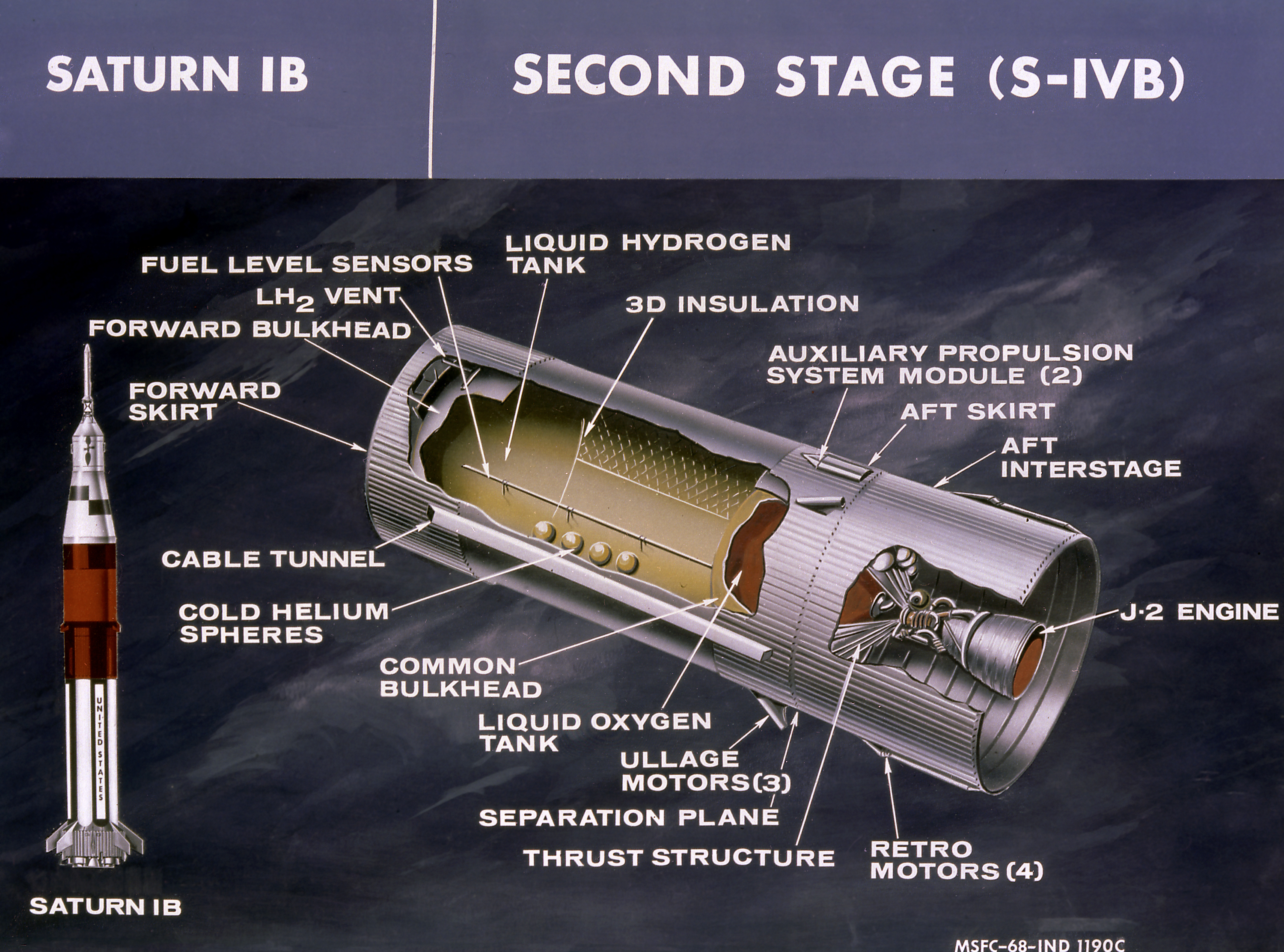
The S-IVB was built by the Douglas Aircraft Company at Huntington Beach, California. The S-IVB-200 model was similar to the S-IVB-500 third stage used on the Saturn V, with the exception of the interstage adapter, smaller auxiliary propulsion control modules, and lack of on-orbit engine restart capability. It was powered by a single Rocketdyne J-2 engine. The fuel and oxidizer tanks shared a common bulkhead, which saved about ten tons of weight and reduced vehicle length over ten feet.
Instrument unit
Main article: Saturn V instrument unit
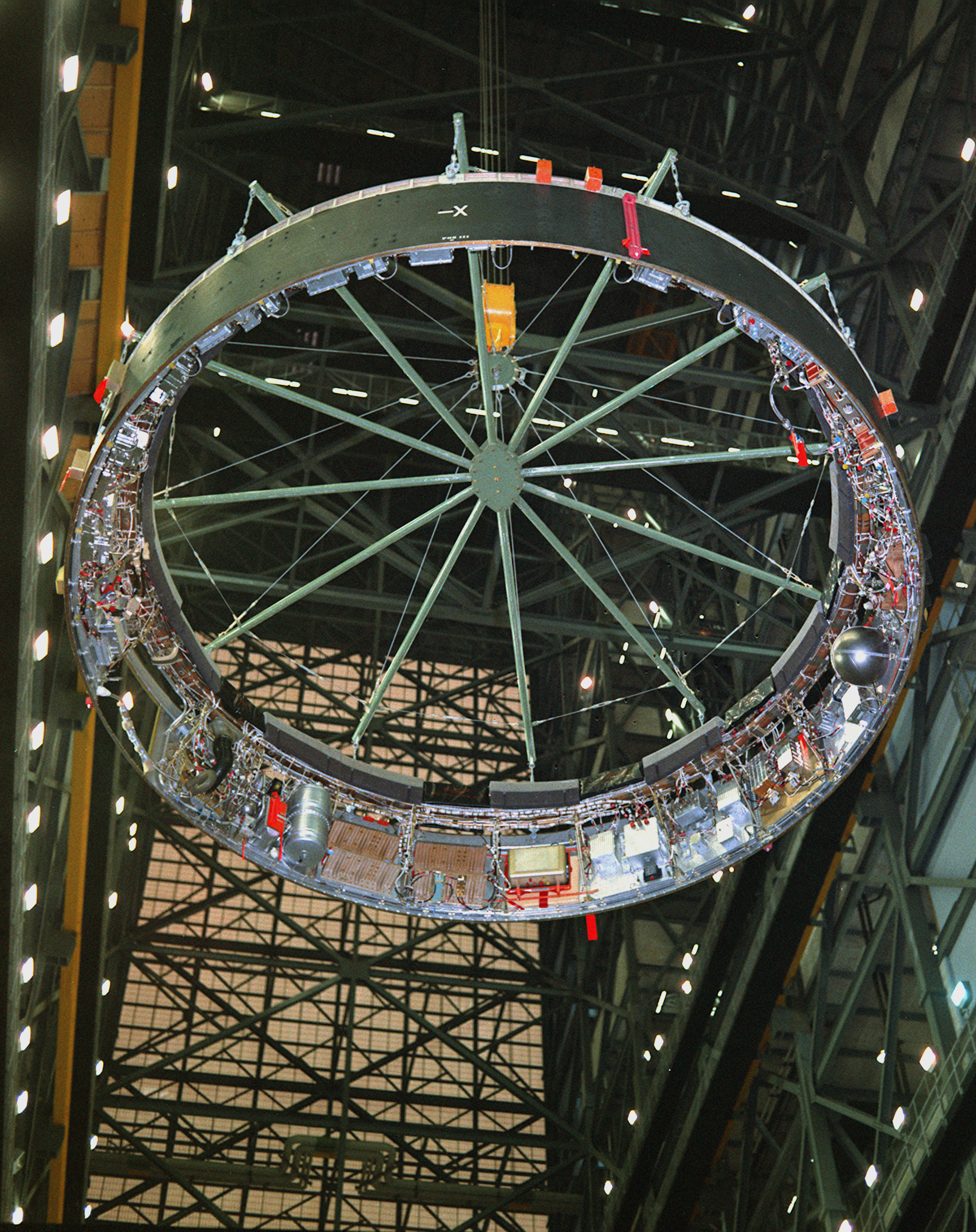
IBM built the instrument unit at the Space Systems Center in Huntsville, Alabama. Located at the top of the S-IVB stage, it consisted of a Launch Vehicle Digital Computer (LVDC), an inertial platform, accelerometers, a tracking, telemetry and command system and associated environmental controls. It controlled the entire rocket from just before liftoff until battery depletion. Like other rocket guidance systems, it maintained its state vector (position and velocity estimates) by integrating accelerometer measurements, sent firing and steering commands to the main engines and auxiliary thrusters, and fired the appropriate ordnance and solid rocket motors during staging and payload separation events.
As with other rockets, a completely independent and redundant range safety system could be invoked by ground radio command to terminate thrust and to destroy the vehicle should it malfunction and threaten people or property on the ground. In the Saturn IB and V, the range safety system was permanently disabled by ground command after safely reaching orbit. This was done to ensure that the S-IVB stage would not inadvertently rupture and create a cloud of debris in orbit that could endanger the crew of the Apollo CSM.
Launch sequence events
| title=Skylab Saturn 1B Flight Manual - | date=September 30, 1972 | url=https://ntrs.nasa.gov/archive/nasa/casi.ntrs.nasa.gov/19740021163.pdf | access-date=July 8, 2020 | publisher=NASA}} | Time (s) | Altitude (km) | Speed (m/s) |
|---|---|---|---|---|---|---|---|
| Guidance reference release | −5.0 | 0.09 | 0 | ||||
| First motion | 0.0 | 0.09 | 0 | ||||
| Mach 1 | 58.9 | 7.4 | 183 | ||||
| Maximum dynamic pressure | 73.6 | 12.4 | 328 | ||||
| Freeze tilt | 130.5 | 48.2 | 1587 | ||||
| Inboard engine cutoff | 137.6 | 54.8 | 1845 | ||||
| Outboard engine cutoff | 140.6 | 57.6 | 1903 | ||||
| S-IB / S-IVB separation | 142.0 | 59.0 | 1905 | ||||
| S-IVB ignition | 143.4 | 59.9 | 1900 | ||||
| Ullage case jettison | 154.0 | 69.7 | 1914 | ||||
| Launch escape tower jettison | 165.6 | 79.5 | 1960 | ||||
| Iterative guidance mode initiation | 171.0 | 83.7 | 1984 | ||||
| Engine mixture ratio shift | 469.5 | 164.8 | 5064 | ||||
| Guidance cutoff signal | 581.9 | 158.4 | 7419 | ||||
| Orbit insertion | 591.9 | 158.5 | 7426 |
Acceleration of the Saturn IB increased from 1.24 G at liftoff to a maximum of 4.35 G at the end of the S-IB stage burn, and increased again from 0 G to 2.85 G from stage separation to the end of the S-IVB burn.
AS-206, 207, and 208 inserted the Command and Service Module in a 150 by elliptical orbit which was co-planar with the Skylab one. The SPS engine of the Command and Service Module was used at orbit apogee to achieve a Hohmann transfer to the Skylab orbit at 431 km.
Saturn IB vehicles and launches

The first five Saturn IB launches for the Apollo program were made from LC-34 and LC-37, Cape Kennedy Air Force Station.
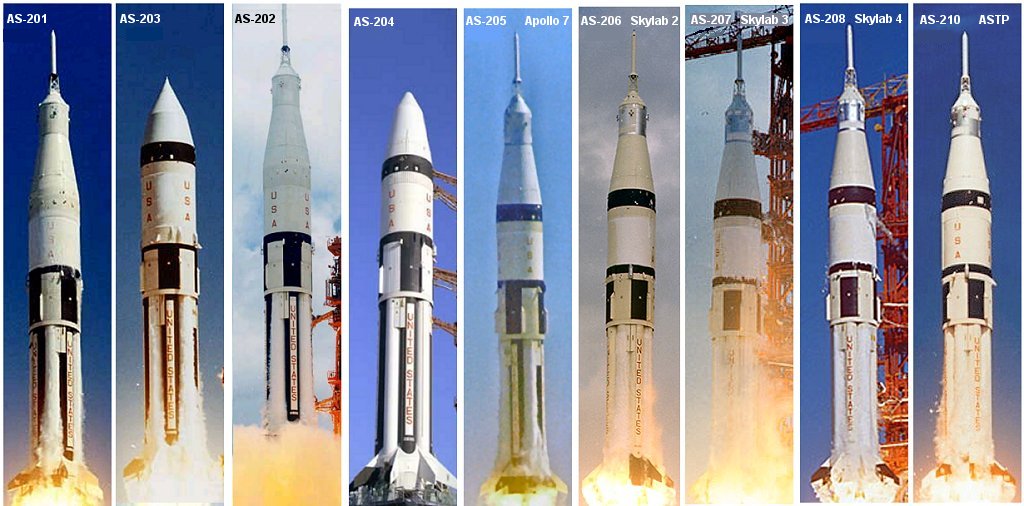
The Saturn IB was used between 1973 and 1975 for three crewed Skylab flights, and one Apollo–Soyuz Test Project flight. This final production run did not have alternating black and white S-IB stage tanks, or vertical stripes on the S-IVB aft tank skirt, which were present on the earlier vehicles. Since LC-34 and 37 were inactive by then, these launches utilized Kennedy Space Center's LC-39B. Mobile Launcher Platform No. 1 was modified, adding an elevated platform known as the "milkstool" to accommodate the height differential between the Saturn IB and the much larger Saturn V. This enabled alignment of the Launch Umbilical Tower's access arms to accommodate crew access, fueling, and ground electrical connections for the Apollo spacecraft and S-IVB upper stage. The tower's second stage access arms were modified to service the S-IB first stage.

| Serial | |||||||||
|---|---|---|---|---|---|---|---|---|---|
| number | Launch | ||||||||
| date | |||||||||
| (UTC) | Launch site | Mission | Spacecraft | ||||||
| mass (kg) | Notes | ||||||||
| SA-201 | February 26, 1966 | ||||||||
| 16:12:01 | Cape Kennedy, LC-34 | AS-201 | 20,820 | Uncrewed suborbital test of Block I CSM | |||||
| (command and service module) | |||||||||
| SA-203 | July 5, 1966 | ||||||||
| 14:53:17 | Cape Kennedy, LC-37B | AS-203 | None | Uncrewed test of unburned LH2 behavior in orbit | |||||
| to support S-IVB-500 restart design | |||||||||
| SA-202 | August 25, 1966 | ||||||||
| 17:15:32 | Cape Kennedy, LC-34 | AS-202 | 25,810 | Uncrewed suborbital test of Block I CSM | |||||
| SA-204 | Cape Kennedy, LC-34 | Apollo 1 | 20,412 | Was to be first crewed orbital test of Block I CSM. | |||||
| Cabin fire on January 27, 1967, killed astronauts and damaged CM during dress rehearsal for planned February 21, 1967 launch | |||||||||
| January 22, 1968 | |||||||||
| 22:48:08 | Cape Kennedy, LC-37B | Apollo 5 | 14,360 | Uncrewed orbital test of lunar module, used Apollo 1 launch vehicle | |||||
| SA-205 | October 11, 1968 | ||||||||
| 15:02:45 | Cape Kennedy, LC-34 | Apollo 7 | 16,520 | Crewed orbital test of Block II CSM | |||||
| SA-206 | May 25, 1973 | ||||||||
| 13:00:00 | Kennedy, LC-39B | Skylab 2 | 19,979 | Block II CSM ferried first crew to Skylab orbital workshop | |||||
| SA-207 | July 28, 1973 | ||||||||
| 11:10:50 | Kennedy, LC-39B | Skylab 3 | 20,121 | Block II CSM ferried second crew to Skylab orbital workshop | |||||
| SA-208 | Kennedy, LC-39B | AS-208 | Standby Skylab 3 rescue CSM-119; not needed | ||||||
| November 16, 1973 | |||||||||
| 14:01:23 | Kennedy, LC-39B | Skylab 4 | 20,847 | Block II CSM ferried third crew to Skylab orbital workshop | |||||
| SA-209 | Kennedy, LC-39B | AS-209 | Standby Skylab 4 and later Apollo-Soyuz rescue CSM-119. | ||||||
| Not needed, currently on display in the KSC rocket garden | |||||||||
| Skylab 5 | Planned CSM mission to lift Skylab workshop's orbit | ||||||||
| to endure until Space Shuttle ready to fly; cancelled. | |||||||||
| SA-210 | July 15, 1975 | ||||||||
| 19:50:01 | Kennedy, LC-39B | ASTP | 16,780 | Apollo CSM with special docking adapter module, | |||||
| rendezvoused with Soyuz 19. Last Saturn IB flight. | |||||||||
| SA-211 | date=14 September 2023 | title=Historic Alabama welcome center rocket dismantling begins | url=https://www.al.com/news/2023/09/historic-alabama-welcome-center-rocket-dismantling-begins.html | access-date=2023-09-20}} | |||||
| S-IVB stage rests with Skylab underwater training simulator hardware and is on display outdoors at the U.S. Space and Rocket Center in Huntsville, Alabama. | |||||||||
| SA-212 | title=Saturn IB History | url=http://www.spacelaunchreport.com/satstg2.html | url-status=usurped | archive-url=https://archive.today/20130104180922/http://www.spacelaunchreport.com/satstg2.html | archive-date=January 4, 2013 | access-date=2009-11-01}} | |||
| S-IVB stage converted to Skylab space station. | |||||||||
| SA-213 | Only first stage built. Unused and scrapped. | ||||||||
| SA-214 | Only first stage built. Unused and scrapped. |
For earlier launches of vehicles in the Saturn I series, see the list in the Saturn I article.
Saturn IB rockets on display

As of 2023 there are two locations where Saturn IB vehicles (or parts thereof) are on display:
- SA-209 is on display at the Kennedy Space Center Visitor Complex, with the Apollo Facilities Verification Vehicle. Due to severe corrosion, the first stage engines and service module were replaced with fabricated duplicates in 1993–1994.
- The SA-211 S-IVB stage was mated with the Skylab underwater training docking adapter and Apollo Telescope Mount and is on display in the Rocket Garden of the U.S. Space & Rocket Center in Huntsville, Alabama. The SA-211 first stage was on display with a mockup S-IVB stage stacked in a launch-ready condition at the Alabama Welcome Center on Interstate 65 in Ardmore, Alabama, since July 1979. The structural integrity of the display, after four decades of weathering, could not be repaired. Dismantling of the vehicle for disposal began by September 14, 2023.
Cost
In 1972, the cost of a Saturn IB including launch was .
Notes
References
References
- Wade, Mark. "Saturn IB".
- Hornung, John. (2013). "Entering the Race to the Moon: Autobiography of an Apollo Rocket Scientist". Jack Be Nimble Publishing.
- Benson, Charles D.. (1978). "Moonport: A History of Apollo Launch Facilities and Operations". NASA.
- (May 1966). "Postlaunch report for mission AS-201 (Apollo spacecraft 009) -". NASA.
- "Saturn I".
- NASA Marshall Spaceflight Center, Skylab Saturn IB Flight Manual (MSFC-MAN-206), 30 September 1972
- (September 30, 1972). "Skylab Saturn 1B Flight Manual -". NASA.
- Reynolds, David West. (2006). "Kennedy Space Center: Gateway to Space". Firefly Books Ltd..
- (14 September 2023). "Historic Alabama welcome center rocket dismantling begins".
- "Saturn IB History".
- Dooling, Dave. (May 6, 1979). "Space and Rocket Plans Summer Celebration". [[The Huntsville Times]].
- Hughes, Bayne. (April 6, 2014). "Iconic rocket due for repair". [[The Decatur Daily]].
- "SP-4221 The Space Shuttle Decision- Chapter 6: Economics and the Shuttle". NASA.
This article was imported from Wikipedia and is available under the Creative Commons Attribution-ShareAlike 4.0 License. Content has been adapted to SurfDoc format. Original contributors can be found on the article history page.
Ask Mako anything about Saturn IB — get instant answers, deeper analysis, and related topics.
Research with MakoFree with your Surf account
Create a free account to save articles, ask Mako questions, and organize your research.
Sign up freeThis content may have been generated or modified by AI. CloudSurf Software LLC is not responsible for the accuracy, completeness, or reliability of AI-generated content. Always verify important information from primary sources.
Report