From Surf Wiki (app.surf) — the open knowledge base
Satellite flare
Visual phenomenon caused by satellites

Visual phenomenon caused by satellites
- Top: a simulated animation of a typical Iridium flare
- Bottom: Both images show a flare of an Iridium satellite. Comet Holmes can be seen in the right image, slightly above the tree branch. Satellite flare, also known as satellite glint, is a satellite pass visible to the naked eye as a brief, bright "flare". It is caused by the reflection toward the Earth below of sunlight incident on satellite surfaces such as solar panels and antennas (e.g., synthetic aperture radar). Streaks from satellite flare are a form of light pollution that can negatively affect ground-based astronomy, stargazing, and indigenous people.
Many satellites flare with magnitudes bright enough to see with the unaided eye, i.e. brighter than magnitude +6.5. Smaller magnitude numbers are brighter, so negative magnitudes are brighter than positive magnitudes, i.e. the scale is reverse logarithmic .
The Iridium constellation was one of the first anthropogenic sources of near-space light pollution to draw criticism. Larger satellite constellations, like OneWeb and Starlink, have received increased criticism. Scientific and policy analyses have raised questions about which regulatory bodies hold jurisdiction over human actions that obscure starlight in ways that affect astronomy, stargazers, and indigenous communities.
Controlled satellites
The time and place of the satellite's flare can be predicted only when the satellite is controlled, and its orientation in space is known. In this case it is possible to predict the exact time of the flare, its place in the sky, the brightness and duration.
Iridium flares


The first generation of the Iridium constellation launched a total of 95 telecommunication satellites in low Earth orbit which were known to cause Iridium flares, the brightest flares of all orbiting satellites, starting in 1997. From 2017 to 2019 they were replaced with a new generation that does not produce flares, with the first generation completely deorbited by 27 December 2019.
While the first-generation Iridium satellites were still controlled, their flares could be predicted. These Iridium communication satellites had three polished door-sized antennas, 120° apart and at 40° angles with the main bus. The forward antenna faced the direction the satellite is traveling. Occasionally, an antenna reflects sunlight directly down at Earth, creating a predictable and quickly moving illuminated spot on the surface below of about 10 km diameter. To an observer this looks like a bright flash, or flare in the sky, with a duration of a few seconds.
Ranging up to −9.5 magnitude, some of the flares were so bright that they could be seen in the daytime. This flashing caused some annoyance to astronomers, as the flares occasionally disturbed observations.
As the Iridium constellation consisted of 66 working satellites, Iridium flares were visible quite often (2 to 4 times per night). Flares of brightness −5 magnitude occurred 3 to 4 times per week, and −8 magnitude were visible 3 to 5 times per month for stationary observers.
Flares could also occur from solar panels, but they were not as bright (up to −3.5 magnitude). Such flares lasted about twice as long as those from the main mission antennas (MMA), because the so-called "mirror angle" for the solar panels was twice that for the MMAs. There were also rare cases of flares from MMAs and solar panels, or two MMAs (front and either right or left) of one satellite in a single pass.
The flares were bright enough to be seen at night in big cities where light pollution usually prevents most stellar observation. When not flaring, the satellites were often visible crossing the night sky at a typical magnitude of 6, similar to a dim star.
Mega-constellations


Low-orbit satellite constellations such as Starlink are a concern for astronomers, stargazers, and indigenous communities because of light pollution.
In February 2020, the Russian Academy of Sciences said it would send a letter to the United Nations complaining that Starlink's satellites will damage "30-40% of astronomical images."
Numerous satellite operators have criticized SpaceX for attempting to overwhelm the FCC with paperwork as a means to gain approval to launch 42,000 satellites, which has raised questions about which aspects of space law pertain to light pollution from satellites.
SpaceX and Elon Musk have asserted in meetings with the National Academy of Sciences and in FCC filings that "SpaceX is committed to reducing satellite brightness to allow enjoyment of the skies and not thwart scientific discovery" and that its objectives are (1) to "make the satellites generally invisible to the naked eye within a week of launch", and (2) to "minimize Starlink's impact on astronomy by darkening satellites so they do not saturate observatory detectors." There were more than 7,800 Starlink satellites in orbit as of July 2025.
Starlink satellites can flare repeatedly in an isolated area of the sky, typically directly above the sun (below the horizon) as they transit the highest latitude of their orbits. This phenomenon is most obvious when satellites are low over the horizon, and is due to the large number of Starlink satellites that are orbiting the Earth, predominantly at ~53° orbital inclination.
The flares from Starlink have been misidentified as UFOs by airline pilots due to their unusual repetitive nature, which is visually analogous to a car's headlights at night getting brighter (then dimmer) as it rounds a turn. At cruising altitudes for commercial aircraft at night, pilots looking toward the setting or rising sun can often see the "racetrack" reflections from multiple satellites in criss-crossing orbits.
Other satellite flares
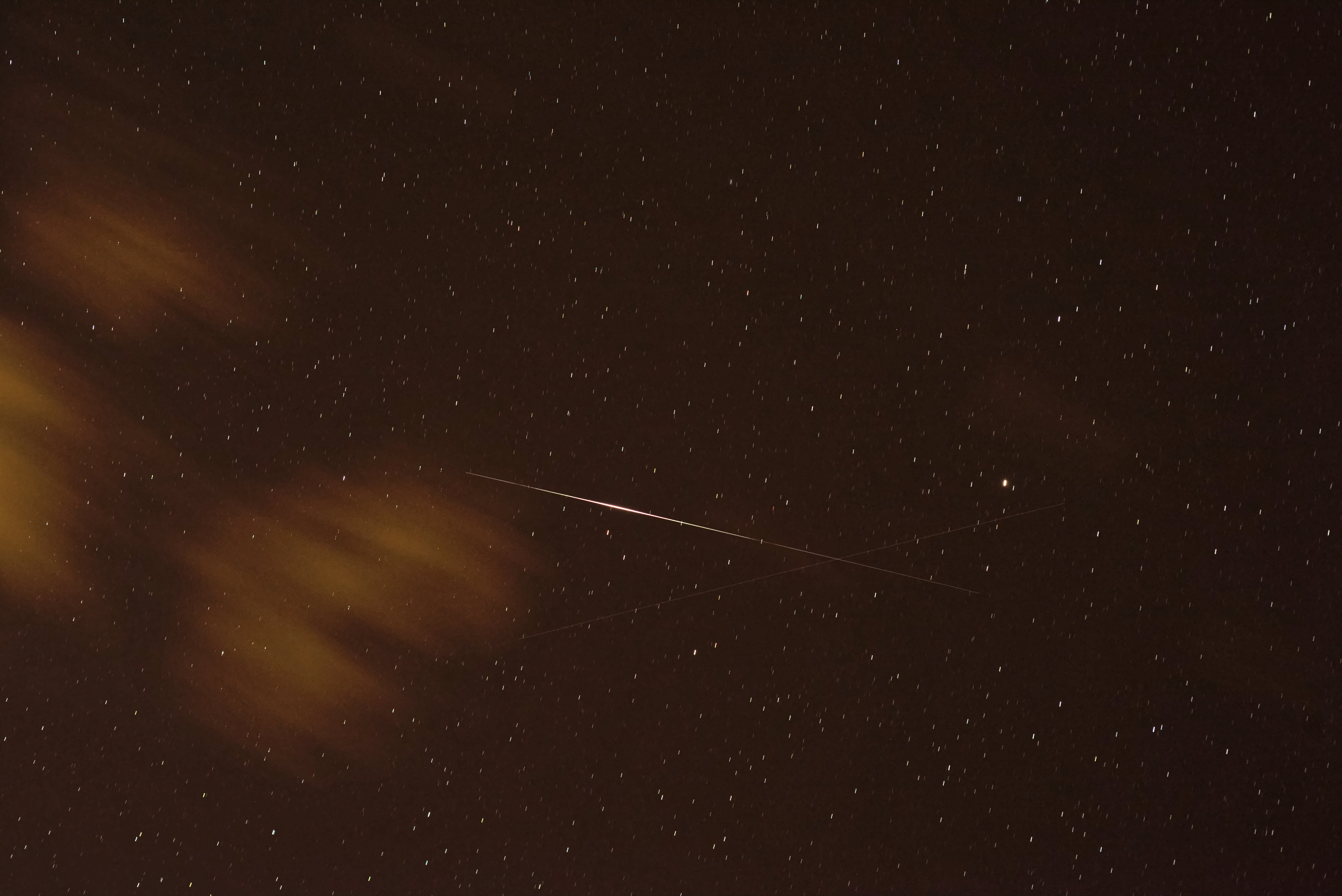
Many other controlled satellites also flare to magnitudes visible to the naked eye, i.e. larger than +6.5.
MetOp-B and C, however, can produce predictable flares up to −5 magnitude (MetOp-A is no longer controlled) . Four COSMO-SkyMed satellites can produce flares up to -3 magnitude, and lasting much longer than the Iridium flares. The Terrasar X and Tandem X also can produce predictable flares up to -3 magnitude.
The International Space Station (ISS) is known to cause bright ISS flares.

Uncontrolled satellites
When a satellite goes out of control, it becomes possible to predict only a trajectory of its pass, while it becomes virtually impossible to accurately predict any flaring. These non-operational satellites are also described as "tumbling". This category includes many rotating rocket bodies, some failed Iridium satellites, ALOS satellite (which can produce flashes up to −10 mag), etc. The most important and valuable information about tumbling satellites is the period of flashes. It can vary from 0.5 seconds (rapidly rotating objects) to a minute or more (slowly rotating objects). Other important characteristics are the amplitude of changes in brightness and period of repetition of these changes.
Observation
Main article: List of satellite pass predictors
While satellites may be seen by chance, there are websites and mobile apps which provide location-specific information as to when and where in the sky a satellite flare may be seen (for controlled satellites), or trajectory of a tumbling satellite's pass (for uncontrolled satellites) in the sky.
Reflections from satellites and other human space objects are sometimes reported as unidentified flying objects (UFOs), and are often a result of repetitive observations in an isolated area of the sky over a short time period.
References
References
- (2020-08-25). "SATCON1 Report".
- (2020-08-21). "Media advisory: Press Conference to Unveil Conclusions from Satellite Constellations 1 (SATCON1) Workshop".
- (2020-02-04). "Concerns about ground based astronomical observations: A step to Safeguard the Astronomical Sky".
- Curtis, Heber Doust. (1903). "On the Limits of Unaided Vision". [[University of California]].
- "Satellite and Flare Tracking".
- "IAU's statement on satellite constellations".
- (2019-06-14). "Light pollution from satellites will get worse. But how much?".
- (2019-05-29). "SpaceX Starlink satellite constellation astronomy light pollution".
- Bakos, Gaspar. "Light pollution from Satellites".
- Montgomery, Marc. (2020-11-18). "Astronomers vs tech giants in space".
- (2020-08-25). "SATCON1 Report".
- (2019-12-27). "Why do mega constellations matter to the Dark Sky community".
- Lawler, Samantha. (2020-11-17). "SpaceX's Starlink satellites are about to ruin stargazing for everyone".
- (2020). "The impact of satellite constellations on space as an ancestral global commons". Nature Astronomy.
- (2019-12-06). "Towards inclusive practices with indigenous knowledge". Nature Astronomy.
- "Catch the Iridium".
- Carter, Jamie. (14 November 2017). "Iridium flares to cease by end of 2018".
- Peat, Chris. (15 May 2018). "The end of Iridium flares?".
- "Iridium Flare Satellite Tracker".
- Filter, Egon. (2019-12-10). "NASA's Astronomy Picture of the Day showing Starlink Satellite Trails over Brazil". [[NASA]].
- (June 2019). "After SpaceX Starlink Launch, a Fear of Satellites That Outnumber All Visible Stars".
- (30 May 2019). "The unexpected brightness of new satellites could ruin the night sky". The Economist.
- "SpaceX's Starlink Could Change The Night Sky Forever, And Astronomers Are Not Happy".
- (2020-02-27). "RAS will complain to the UN about Elon Musk over the Starlink satellite system". RIA Novosti.
- Cole, Brendan. (2020-02-28). "Light From Elon Musk's Starlink Satellites Ruins Space Photos, Says Russian Government Agency". Newsweek.
- Tlis, Fatima. (2020-03-03). "Russian Academy of Sciences Takes Aim at Musk's SpaceX Satellites". Polygraph Info.
- Hebden, Kerry. (2019-10-18). "Companies unite to reject SpaceX satellite plans".
- (2020-04-27). "Decadal Survey on Astronomy and Astrophysics 2020 (Astro2020): Optical Interference from Satellite Constellations Meeting". National Academy of Science.
- Wiltshire, William. (2020-04-30). "Application for Fixed Satellite Service by Space Exploration Holdings, LLC SAT-MOD-20200417-00037 / SATMOD2020041700037 Space Exploration Holdings, LLC seeks to modify its Ku/Ka-band NGSO license to relocate satellites previously authorized to operate at altitudes from 1,110 km to 1,325 km down to altitudes ranging from 540 km to 570 km, and to make related changes.".
- Musk, Elon. (2020-04-27). "Starlink: NAS Decadal Panel". [[National Academy of Sciences]].
- warnerjh. (2023-04-24). "Starlink Satellites Flaring in Cassiopeia".
- (21 Oct 2022). "Pilot Shares Videos Of Strange UFO Sightings In Skies Over The US".
- (15 May 2019). "Why "Racetrack" UFOs are mostly Starlink Flares".
- "FPAS Reports - DB Query for Metop-A".
- "FPAS Reports - DB Query for Metop-B".
- Wesley. (2014-04-09). "MetOp-A satellite flare".
- (2012-03-23). "Video of Metop-A Flaring".
- "FPAS Reports - DB Query for SkyMed 2".
- (15 May 2019). "Watch International Space Station Flybys All Night Long".
- Dickinson, David. (14 May 2019). "The International Space Station Rides High Through the May Sky".
- Rao, Joe. (11 July 2008). "Spot the Space Station".
- "Spot The Station".
- (2020-12-15). "Is that a UFO?! There's probably an explanation - Human World".
This article was imported from Wikipedia and is available under the Creative Commons Attribution-ShareAlike 4.0 License. Content has been adapted to SurfDoc format. Original contributors can be found on the article history page.
Ask Mako anything about Satellite flare — get instant answers, deeper analysis, and related topics.
Research with MakoFree with your Surf account
Create a free account to save articles, ask Mako questions, and organize your research.
Sign up freeThis content may have been generated or modified by AI. CloudSurf Software LLC is not responsible for the accuracy, completeness, or reliability of AI-generated content. Always verify important information from primary sources.
Report