From Surf Wiki (app.surf) — the open knowledge base
Sardinians
People from (or residents of) Sardinia
People from (or residents of) Sardinia
| Field | Value |
|---|---|
| group | Sardinians / Sards |
| native_name | sc |
| sdn | |
| it | |
| image | Women of sardinia.jpg |
| caption | Sardinian women in traditional attire |
| popplace | Sardinia 1,661,521 |
| (Inhabitants of Sardinia inclusive of all ethnicities) | |
| pop1 | 2,250,000 (outside Sardinia) |
| ref1 | |
| langs | **Native** |
| Sardinian, Sassarese, Gallurese, Tabarchino | |
| **Primarily** | |
| Italian | |
| rels | Predominantly Roman Catholicism |
| flag_caption | Flag of Sardinia |
| related |
sdn it (Inhabitants of Sardinia inclusive of all ethnicities) Sardinian, Sassarese, Gallurese, Tabarchino Primarily Italian
Sardinians or Sards are an ethnolinguistic group of Italy indigenous to Sardinia, an island in the western Mediterranean which is administratively an autonomous region of Italy.
Etymology
Not much can be gathered from the classical literature about the origins of the Sardinian people. The ethnonym "S(a)rd" may belong to the Pre-Indo-European (or Indo-European) linguistic substratum, and whilst they might have derived from the Iberians, the accounts of the old authors differ greatly in this respect. The oldest written attestation of the ethnonym is on the Nora stone, where the word Šrdn (Shardan) bears witness to its original existence by the time the Phoenician merchants first arrived on Sardinian shores. According to Timaeus, one of Plato's dialogues, Sardinia and its people as well, the "Sardonioi" or "Sardianoi" (Σαρδονιοί or Σαρδιανοί), might have been named after "Sardò" (Σαρδώ), a legendary Lydian woman from Sardis (Σάρδεις), in the region of western Anatolia (now Turkey). Some other authors, like Pausanias and Sallust, reported instead that the Sardinians traced their descent back to a mythical ancestor, a Libyan son of Hercules or Makeris (related either to the Berber verb Imɣur "to grow", to the specific Kabyle word Maqqur "He is the greatest", or also associated with the figure of Melqart) revered as a deity going by Sardus Pater Babai ("Sardinian Father" or "Father of the Sardinians"), who gave the island its name. It has also been claimed that the ancient Nuragic Sards were associated with the Sherden (šrdn in Egyptian), one of the Sea Peoples. The ethnonym was then romanised, with regard for the singular masculine and feminine form, as sardus and sarda.
History
Prehistory

Sardinia was first settled by modern humans from continental Europe during the Upper Paleolithic and the Mesolithic; at the time Sardinia and Corsica formed a single island, the largest in the Mediterranean, separated from the Italian peninsula by a short stretch of sea. During the Neolithic, Early European Farmers settled in Sardinia. According to modern archaeogenetic investigations, the Neolithic Sardinians showed a greater affinity with the Cardial populations of Iberia and Southern France, furthermore mitochondrial haplogroups of the ancient Mesolithic inhabitants would survive in today's Sardinians.
.JPG)
In the Late Chalcolithic to the Early Bronze Age, the Bell Beaker culture from Southern France, Northeastern Spain, and then Central Europe entered the island, bringing new metallurgical techniques and ceramic styles and probably Indo-European languages. An early modest gene flow of the Western Steppe Herders has been dated to about this period (~2600 BCE).

Nuragic civilization
The Nuragic civilization arose in the Middle Bronze Age, during the Late Bonnanaro culture, which showed connections with the previous Beaker culture and the Polada culture of northern Italy. Although the Sardinians were considered to have acquired a sense of national identity, at that time, the grand tribal identities of the Nuragic Sardinians were said to be three (roughly from the South to the North): the Iolei/Ilienses, inhabiting the area from the southernmost plains to the mountainous zone of eastern Sardinia (later part of what would be called by the Romans Barbaria); the Balares, living in the North-West corner; and finally the Corsi stationed in today's Gallura and the island to which they gave the name, Corsica. Nuragic Sardinians have been connected by some scholars to the Sherden, a tribe of the so-called Sea Peoples, whose presence is registered several times in ancient Egyptian records.
The language or languages spoken in Sardinia during the Bronze Age is unknown since there are no written records of such period. According to Eduardo Blasco Ferrer, the Paleo-Sardinian language was akin to Proto-Basque and the ancient Iberian. In contrast, others believe it was related to Etruscan. Other scholars theorize that there were various linguistic areas (two or more) in Nuraghic Sardinia, possibly Pre-Indo-European and Indo-European.
Antiquity
In the 8th century BCE, Phoenicia founded colonies and ports along the southern and western coast, such as Karalis, Bithia, Sulki and Tharros; starting from the same areas, where the relations between the indigenous Sardinians and the descendants of Phoenician settlers, the Punic people, had been so far peaceful, the Carthaginians proceeded to annex the southern and western part of Sardinia in the late 6th century BC. Well into the 1st century BCE, native Sardinians were said to have preserved many cultural affinities with the Punic people of North Africa.
After the First Punic War, the whole island was conquered by the Romans in the 3rd century BC. Sardinia and Corsica were then made into a single province; however, it took the Romans more than another 150 years to manage to subdue the more belligerent Nuragic tribes of the interior, and after 184 years since the Sardinians fell under Roman sway, Cicero noted how there was still not on the island a single community which had had friendly intercourse with the Roman people. Even from the former Sardo-Carthaginian settlements, with which the Sardinian mountaineers had formed an alliance in a common struggle against the Romans, indigenous attempts emerged aimed at resisting cultural and political assimilation: inscriptions in Bithia dating to the period of Marcus Aurelius were found, and they still followed the old Punic script at a time when even in North Africa the script was neo-Punic; Punic-style magistrates called sufetes wielded local control in Nora and Tharros through the end of the first century B.C., although two sufetes existed in Bithia as late as the mid-second century CE. Overall, Sardinia was quite disliked by the Romans and, as isolated as it was kept, Romanization proceeded at a relatively slow pace.

During the Roman rule, there was a considerable immigration flow from the Italian peninsula into the island; ancient sources mention several populations of Italic origin settling down in Sardinia, like the Patulcenses Campani (from Campania), the Falisci (from southern Etruria), the Buduntini (from Apulia) and the Siculenses (from Sicily); Roman colonies were also established in Porto Torres (Turris Libisonis) and Uselis. The Italic immigrants were confronted with a difficult coexistence with the natives, who were reluctant to assimilate to the language and customs of the colonists; many aspects of the ancient Sardo-Punic culture are documented to have persisted well into Imperial times, and the mostly mountainous innerlands came to earn the name of Barbaria ("Land of the Barbarians", similar in origin to the word Barbary) as a testament of the fiercely independent spirit of the tribes who dwelled therein (in fact, they would continue to practice their indigenous prehistoric religion up until the age of Pope Gregory I). Attilio Mastino, Storia della Sardegna antica p.173}} Nevertheless, Sardinia would eventually undergo cultural Romanization, the modern Sardinian language being one of the most evident cultural developments thereof. Strabo gave a brief summary about the Mountaineer tribes, living in what would be called civitates Barbariae, Geographica V ch.2:There are four nations of mountaineers, the Parati, Sossinati, Balari, and the Aconites. These people dwell in caverns. Although they have some arable land, they neglect its cultivation, preferring rather to plunder what they find cultivated by others, whether on the island or on the continent, where they make descents, especially upon the Pisatæ. The prefects sent [into Sardinia] sometimes resist them, but at other times leave them alone, since it would cost too dear to maintain an army always on foot in an unhealthy place. Like any other subjects of the Empire, Sardinians too would be granted Roman citizenship in 212 AD with the Constitutio Antoniniana by Caracalla.
Middle Ages
After the fall of the Western Roman Empire, Sardinia was ruled in rapid succession by the Vandals, the Byzantines, the Ostrogoths and again by the Byzantines, when the island was, once again in its history, joined to North Africa as part of the Exarchate of Africa.
During the Middle Ages, the "Sardinian Nation" (Nació Sarda or Sardesca, as reported from the native and Aragonese dispatches) was juridically divided into four kingdoms, known collectively in Sardinian as Judicadu, Giudicau or simply Logu "Place"; in ); all of them, except for the Judicate of Arborea, fell under the influence of the maritime republics of Genoa and Pisa, as well as some noble families from the two cities, like the Doria family, the Della Gherardesca family, and the Malaspina family. The Dorias founded the cities of Alghero and Castelgenovese (today Castelsardo), while the Pisans founded Castel di Castro (today Cagliari) and Terranova (today Olbia); the famous count Ugolino della Gherardesca, quoted by Dante Alighieri in his Divine Comedy, favored the birth of the mining town of Villa di Chiesa (today Iglesias), which became an Italian medieval commune along with Sassari and Castel di Castro. These new cities attracted migrants from the Italian peninsula, Corsica and several regions of Sardinia.
Following the Aragonese conquest of the Sardinian territories under Pisan rule, which took place between 1323 and 1326, and then the long conflict between the Aragonese Kingdom and the Judicate of Arborea (1353–1420), the newborn Kingdom of Sardinia became one of the Associate States of the Crown of Aragon. The Aragonese repopulated the cities of Castel di Castro and Alghero predominantly with Catalans and the Algherese dialect of Catalan is still spoken by a minority in the city of Alghero.
Modern and contemporary history
In the 16th and 17th centuries, the main Sardinian cities of Cagliari (the capital of the Kingdom), Alghero and Sassari appear well placed in the trade routes of the time. The cosmopolitan composition of its people provides evidence of it: the population was not only indigenous, but also hailing from Spain, Liguria, France and the island of Corsica in particular. Especially in Sassari and across the strip of territory that goes from Anglona to Gallura, the Corsicans became the majority of the population at least since the 15th century. This migration from the neighboring island, which is likely to have led to the birth of the Tuscan-sounding Sassarese and Gallurese dialects, went on continuously until the 19th century.
The Spanish era ended in 1713, when Sardinia was ceded to the Austrian House of Habsburg, followed with another cession in 1718 to the Dukes of Savoy, who assumed the title of "Kings of Sardinia" and ruled the island from Turin, in Piedmont. During this period, Italianization policies were implemented, so as to assimilate the islanders to the then Savoyard mainland (stati di terraferma). In 1738, the Ligurian colonists escaped from Tabarka (Tunisia) were invited by Charles Emmanuel III to settle on the little islands of San Pietro and Sant'Antioco (at Carloforte and Calasetta), in the south-west area of Sardinia, bringing with them a Ligurian dialect called "Tabarchino", still widely spoken there. Then, the Piedmontese Kingdom of Sardinia annexed the whole Italian peninsula and Sicily in 1861 after the Risorgimento, becoming the Kingdom of Italy.

Since 1850, with the reorganization of the Sardinian mines, there had been a considerable migration flow from the Italian peninsula towards the Sardinian mining areas of Sulcis-Iglesiente; these Mainland miners came mostly from Lombardy, Piedmont, Tuscany and Romagna. According to an 1882 census realised by the French engineer Leon Goüine, 10,000 miners worked in the south-western Sardinian mines, one third of whom being from the Italian mainland; most of them settled in Iglesias and frazioni .
At the end of the 19th century, communities of fishermen from Sicily, Torre del Greco (Campania) and Ponza (Lazio) migrated on the east coasts of the island, in the towns of Arbatax/Tortolì, Siniscola and La Maddalena.
In 1931, only 3.2% of the island's population was estimated to be native of the Mainland. A central government policy would change this situation in the following years, which saw an immigration flow from the Italian peninsula: the Fascist regime resettled to Sardinia a considerable number of miners and peasants from a wide variety of regions like Veneto, Marche, Abruzzo and Sicily, who were encouraged to populate the new mining town of Carbonia, or agrarian villages like Mussolinia di Sardegna ("Sardinia's Mussolinia", now Arborea) and Fertilia; after World War II, Italian refugees from the Istrian–Dalmatian exodus were relocated in the Nurra region, along the north-western coastline. As a result of the city's originally diverse composition, Carbonia developed a variety of Italian with some Sardinian influences from the neighbouring areas, while the other mainland coloni ("colonists") establishing minor centres kept their dialects of Istriot, Venetian and Friulan, which are still spoken by the elderly. In the same period, a few Italian Tunisian families settled in the sparsely populated area of Castiadas, east of Cagliari.
Following the Italian economic miracle, a historic migratory movement from the inland to the coastal and urban areas of Cagliari, Sassari-Alghero-Porto Torres and Olbia, where today most Sardinians live, took place.
Demographics
Main article: Sardinia#Demographics
With a population density of 69/km2, slightly more than a third of the national average, Sardinia is the fourth least populated region in Italy. The population distribution was anomalous compared to that of other Italian regions lying on the sea. In fact, contrary to the general trend, from the late Middle Ages until the 20th century urban settlement has not taken place primarily along the coast but towards the centre of the island. Historical reasons for this include the repeated Moorish raids which made the coast unsafe, the abandonment of hundreds of settlements following the Sardinian–Aragonese war and the swampy nature of the coastal plains that were reclaimed only in the 20th century. Similarly to the Celtic clans, the Sardinians have in fact tended to retreat into the less accessible interior to keep their own independence and way of life. The situation has been recently reversed with the expansion of the industrialization and seaside tourism; today all Sardinia's major urban centres are located near the coast, while the island's interior is very sparsely populated.
It is the region of Italy with the lowest total fertility rate (1.087 births per woman), and the region with the second-lowest birth rate. However, the population in Sardinia has increased in recent years because of immigration, mainly proceeding from continental Italy and Sicily, but also from Eastern Europe (esp. Romania), Africa and Asia.
As of 2013, there were 42,159 foreign (that is, any people who have not applied for Italian citizenship) national residents, forming 2.5% of the total population.
Life expectancy and longevity

Average life expectancy is slightly over 82 years (85 for women and 79.7 for men).
Sardinia is the first discovered Blue Zone, a demographic and/or geographic area of the world where people live measurably longer lives. Sardinians share with the Ryukyuans from Okinawa (Japan) the highest rate of centenarians in the world (22 centenarians/100,000 inhabitants). The key factors of such a high concentration of centenarians are identified in the genetics of the Sardinians, lifestyle such as diet and nutrition, and the social structure.
Demographic indicators
- Birth rate: 8.3 (per 1,000 inhabitants – 2005)
- Total fertility rate: 1.07 (births per woman – 2005)
- Mortality rate: 8.7 (per 1,000 inhabitants – 2005)
- Infant mortality, males: 4.6 (per 1,000 births- 2000)
- Infant mortality, females: 3.0 (per 1,000 births – 2000)
- Marriage rate: 2.9 (per 1,000 inhabitants – 2014)
- Suicide rate, males: 20.4 (per 100,000 inhabitants)
- Suicide rate, females: 4.5 (per 100,000 inhabitants)
- Total literacy: 98.2%
- Literacy rate under 65 years old: 99.5%
Historical population
|1485 |157578 |1603 |266676 |1678 |299356 |1688 |229532 |1698 |259157 |1728 |311902 |1751 |360805 |1771 |360785 |1776 |422647 |1781 |431897 |1821 |461931 |1824 |469831 |1838 |525485 |1844 |544253 |1848 |554717 |1857 |573243 |1861 |609000 |1871 |636000 |1881 |680000 |1901 |796000 |1911 |868000 |1921 |885000 |1931 |984000 |1936 |1034000 |1951 |1276000 |1961 |1419000 |1971 |1474000 |1981 |1594000 |1991 |1648000 |2001 |1632000 |2011 |1639362
Colors= id:lightgrey value:gray(0.9) id:darkgrey value:gray(0.7) id:sfondo value:rgb(1,1,1) id:barra value:rgb(0.6,0.7,0.8)
ImageSize = width:455 height:373 PlotArea = left:50 bottom:50 top:30 right:30 DateFormat = x.y Period = from:0 till:1700 TimeAxis = orientation:vertical AlignBars = justify ScaleMajor = gridcolor:darkgrey increment:100 start:0 ScaleMinor = gridcolor:lightgrey increment:100 start:0 BackgroundColors = canvas:sfondo
BarData= bar:1861 text:1861 bar:1871 text:1871 bar:1881 text:1881 bar:1901 text:1901 bar:1911 text:1911 bar:1921 text:1921 bar:1931 text:1931 bar:1936 text:1936 bar:1951 text:1951 bar:1961 text:1961 bar:1971 text:1971 bar:1981 text:1981 bar:1991 text:1991 bar:2001 text:2001 bar:2008 text:2008
PlotData= color:barra width:20 align:left
bar:1861 from:0 till: 609.000 bar:1871 from:0 till: 636.000 bar:1881 from:0 till: 680.000 bar:1901 from:0 till: 796.000 bar:1911 from:0 till: 868.000 bar:1921 from:0 till: 885.000 bar:1931 from:0 till: 984.000 bar:1936 from:0 till: 1034.000 bar:1951 from:0 till: 1276.000 bar:1961 from:0 till: 1419.000 bar:1971 from:0 till: 1474.000 bar:1981 from:0 till: 1594.000 bar:1991 from:0 till: 1648.000 bar:2001 from:0 till: 1632.000 bar:2008 from:0 till: 1673.000 TextData= fontsize:S pos:(20,20) text:Fonte istat – Elaborazione grafica di Wikipedia
Division by gender and age
Colors= id:lightgrey value:gray(0.9) id:darkgrey value:gray(0.7) id:sfondo value:rgb(1,1,1) id:barra value:rgb(0.6,0.7,0.8) id:barra2 value:rgb(0.8,0.6,0.7)
ImageSize = width:405 height:500 PlotArea = left:50 bottom:50 top:30 right:30 DateFormat = x.y Period = from:-80 till:80 TimeAxis = orientation:horizontal AlignBars = late ScaleMajor = gridcolor:darkgrey increment:20 start:-80 ScaleMinor = gridcolor:lightgrey increment:10 start:-80 BackgroundColors = canvas:sfondo
BarData= bar:100 text:100+ bar:959 text:95–99 bar:904 text:90–94 bar:859 text:85–89 bar:804 text:80–84 bar:759 text:75–79 bar:704 text:70–74 bar:659 text:65–69 bar:604 text:60–64 bar:559 text:55–59 bar:504 text:50–54 bar:459 text:45–49 bar:404 text:40–44 bar:359 text:35–39 bar:304 text:30–34 bar:259 text:25–29 bar:204 text:20–24 bar:159 text:15–19 bar:104 text:10–14 bar:59 text:5–9 bar:04 text:0–4
PlotData= color:barra2 width:12 align:left
bar:100 from:0 till: 0.168 bar:959 from:0 till: 1.471 bar:904 from:0 till: 6.007 bar:859 from:0 till: 11.460 bar:804 from:0 till: 24.951 bar:759 from:0 till: 33.738 bar:704 from:0 till: 40.397 bar:659 from:0 till: 44.093 bar:604 from:0 till: 48.919 bar:559 from:0 till: 52.534 bar:504 from:0 till: 56.636 bar:459 from:0 till: 60.279 bar:404 from:0 till: 66.558 bar:359 from:0 till: 67.588 bar:304 from:0 till: 66.668 bar:259 from:0 till: 60.175 bar:204 from:0 till: 50.627 bar:159 from:0 till: 43.784 bar:104 from:0 till: 39.019 bar:59 from:0 till: 32.965 bar:04 from:0 till: 32.407
color:barra width:12 align:left
bar:100 from:0 till: -0.069 bar:959 from:0 till: -0.680 bar:904 from:0 till: -3.069 bar:859 from:0 till: -6.015 bar:804 from:0 till: -15.159 bar:759 from:0 till: -24.059 bar:704 from:0 till: -32.837 bar:659 from:0 till: -38.642 bar:604 from:0 till: -44.946 bar:559 from:0 till: -51.726 bar:504 from:0 till: -56.135 bar:459 from:0 till: -59.627 bar:404 from:0 till: -65.613 bar:359 from:0 till: -68.125 bar:304 from:0 till: -68.727 bar:259 from:0 till: -62.627 bar:204 from:0 till: -53.570 bar:159 from:0 till: -46.228 bar:104 from:0 till: -41.205 bar:59 from:0 till: -35.979 bar:04 from:0 till: -34.494
TextData= fontsize:S pos:(20,20) text:Fonte ISTAT 2005 – Elaborazione grafica di Wikipedia
Total population by age
Colors= id:lightgrey value:gray(0.9) id:darkgrey value:gray(0.7) id:sfondo value:rgb(1,1,1) id:barra value:rgb(0.6,0.7,0.8)
ImageSize = width:415 height:500 PlotArea = left:50 bottom:50 top:30 right:30 DateFormat = x.y Period = from:0 till:150 TimeAxis = orientation:horizontal AlignBars = late ScaleMajor = gridcolor:darkgrey increment:10 start:0 ScaleMinor = gridcolor:lightgrey increment:10 start:0 BackgroundColors = canvas:sfondo
BarData= bar:100 text:100+ bar:959 text:95–99 bar:904 text:90–94 bar:859 text:85–89 bar:804 text:80–84 bar:759 text:75–79 bar:704 text:70–74 bar:659 text:65–69 bar:604 text:60–64 bar:559 text:55–59 bar:504 text:50–54 bar:459 text:45–49 bar:404 text:40–44 bar:359 text:35–39 bar:304 text:30–34 bar:259 text:25–29 bar:204 text:20–24 bar:159 text:15–19 bar:104 text:10–14 bar:59 text:5–9 bar:04 text:0–4
PlotData= color:barra width:12 align:left
bar:100 from:0 till: 0.237 bar:959 from:0 till: 2.151 bar:904 from:0 till: 9.076 bar:859 from:0 till: 17.475 bar:804 from:0 till: 40.141 bar:759 from:0 till: 57.797 bar:704 from:0 till: 73.234 bar:659 from:0 till: 82.735 bar:604 from:0 till: 93.865 bar:559 from:0 till: 104.260 bar:504 from:0 till: 112.771 bar:459 from:0 till: 119.906 bar:404 from:0 till: 132.171 bar:359 from:0 till: 135.713 bar:304 from:0 till: 135.395 bar:259 from:0 till: 122.847 bar:204 from:0 till: 104.197 bar:159 from:0 till: 90.012 bar:104 from:0 till: 80.224 bar:59 from:0 till: 68.944 bar:04 from:0 till: 66.901
TextData= fontsize:S pos:(20,20) text:Fonte ISTAT 2005 – Elaborazione grafica di Wikipedia
Geographical distribution
Most Sardinians are native to the island but a sizable number of people have settled outside Sardinia: it had been estimated that, between 1955 and 1971, 308,000 Sardinians emigrated to the Italian mainland. Sizable Sardinian communities are located in Piedmont, Liguria, Lombardy, Tuscany and Latium.
Sardinians and their descendants are also numerous in Germany, France, Belgium, Switzerland and the USA (part of the Italian-American community). Almost all the Sardinians migrating to the Americas settled down in the Southern part of the continent, especially in Argentina (between 1900 and 1913 about 12,000 Sardinians lived in Buenos Aires and neighbourhoods) and Uruguay (in Montevideo in the 1870s lived 12,500 Sardinians). Between 1876 and 1903, 92% of the Sardinians that moved towards the Americas settled in Brazil. Between 1876 and 1925 34,190 Sardinians migrated to Africa, in particular towards the then French Algeria and Tunisia. Small communities with Sardinians ancestors, about 5000 people, are also found in Brazil (mostly in the cities of Belo Horizonte, Rio de Janeiro and São Paulo), the UK, and Australia.
The Region of Sardinia keeps a register of overseas Sardinians who have managed to set up, in the Italian mainland and the rest of the world, a number of cultural associations: these are meant to provide the people of Sardinian descent, or those with an interest on Sardinian culture, an opportunity to enjoy a wide range of activities. As of 2012, there are 145 clubs registered on it.
| **Total** | 93,497 |
|---|
Unlike the rest of Italian emigration, where migrants were mainly males, between 1953 and 1974 an equal number of females and males emigrated from Sardinia to the Italian mainland.
Surnames and given names
Main article: Sardinian surnames
Fewer than a hundred Sardinian surnames are needed to group together as much as a third of the whole Sardinian population. The most common Sardinian surnames, like Sanna (fang), Piras (pears), Pinna (feather, pen) and Melis (honey), derive from the Sardinian language and developed among the Judicates in the Middle Ages as a result of being registered in documents like the condaghes for administrative purposes; most of them derive either from Sardinian place names (e.g. Fonnesu "from Fonni", Busincu "from Bosa" etc.), from animal names (e.g. Porcu "pig", Piga "magpie", Cadeddu "puppy" etc.) or from a person's occupation, nickname (e.g. Pittau "Sebastian"), distinctive trait (e.g. Mannu "big"), and filiation (last names ending in -eddu which could stand for "son of", e.g. Corbeddu "son/daughter of Corbu"); a number of them have undergone Italianization over the most recent centuries (e.g. Pintori, Scano, Zanfarino, Spano, etc.). Some local surnames also derive from terms of the Paleo-Sardinian substrate. The largest percentage of last names originating from outside the island is from Southern Corsica (like Cossu, Cossiga, Alivesi and Achenza, originally from the towns of Olivese and Quenza respectively), followed by Italian (especially Piedmontese but also Campanian, Sicilian and Ligurian, originating from the days of the Savoyard rule and the assimilation policy: some of them have been "Sardinianized", like Accardu, Calzinu, Gambinu, Raggiu, etc.) and Spanish (especially Catalan) surnames.
| 20 | Fadda |
|---|
The Sardinian personal names (like Baínzu or Gavine "Gavin", Bachis "Bachisius", Bobore "Salvator", Iroxi "George", Chìrigu "Cyricus", Gonare "Gonarius", Elianora "Eleanor", Boele "Raphael", Sidore "Isidore", Billía "William", Tiadora "Theodora", Itria, etc.) are historically attested and were common among the islanders up until the contemporary era, when they switched in full measure to the Italian names.
Self-identification
Population surveys have been carried out, on repeated occasions, to provide information about the Sardinians' identity, as well as their conciliation with the institutional layers of political governance. The most detailed survey, conducted by the University of Cagliari and Edinburgh, made use of a Moreno Question which gave the following results: (1) just Sardinian, 26%; (2) more Sardinian than Italian, 37%; (3) equally Sardinian and Italian, 31%; (4) more Italian than Sardinian, 5%; (5) only Italian and not Sardinian, 1%. A 2017 poll by the Ixè Institute reported that 51% of the Sardinians questioned identified themselves as Sardinian (as opposed to an Italian average of 15% who identified by their region of origin) rather than Italian (19%), European (11%), and/or citizen of the world (19%).
Culture
Languages
Main article: Sardinian language, Sassarese language, Gallurese language, Italianization#Sardinia
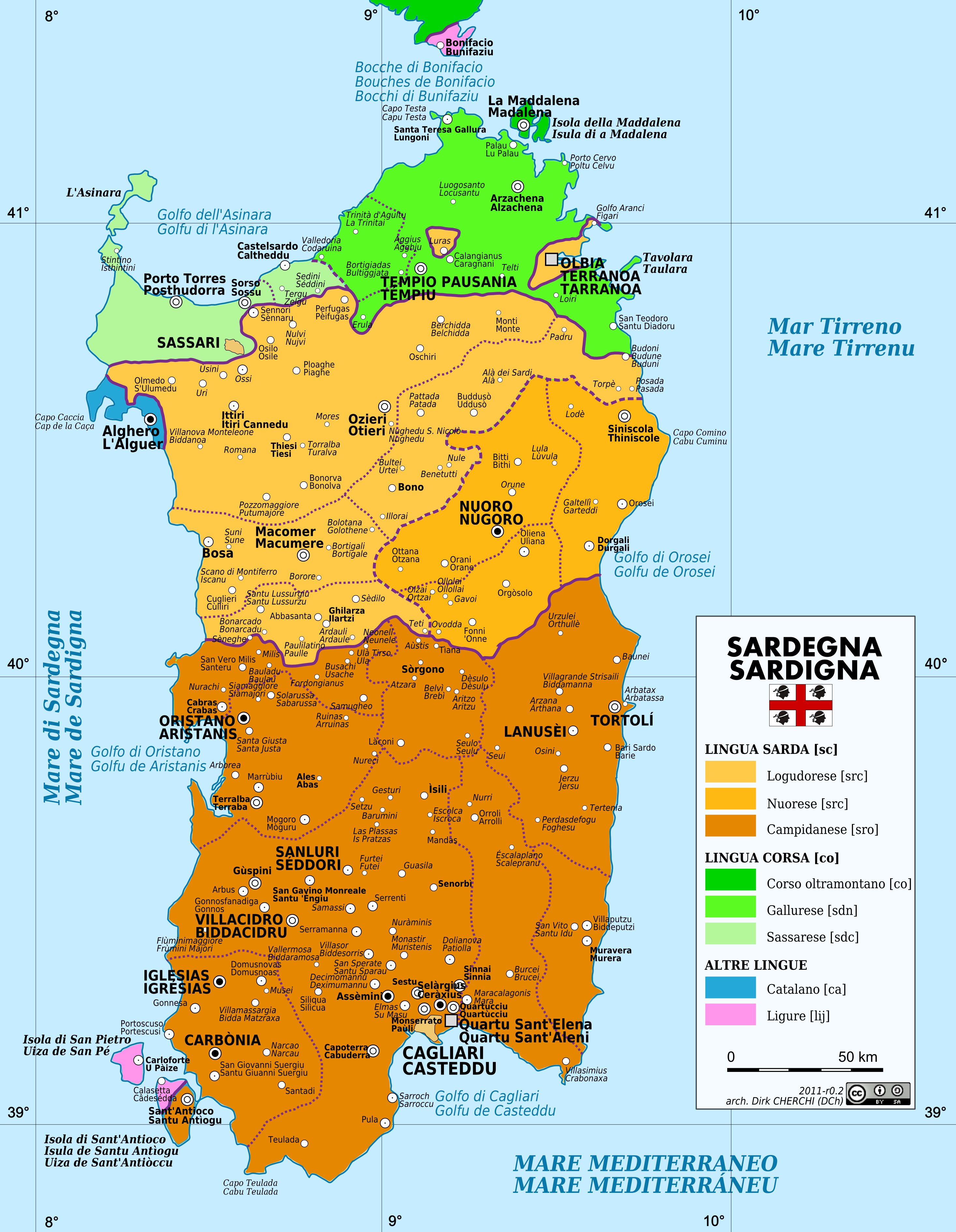
Italian (italiano) was first introduced to Sardinia by the House of Savoy in July 1760 and is the most commonly spoken language nowadays, albeit in a regional variety, as a result of policies fostering language shift and assimilation that facilitated Italianization.
On the other hand, Sardinian (sardu) has been the native language of the indigenous Sards ever since Latin supplanted the Pre-Indo-European Paleo-Sardinian, a language supposedly related to Basque with some Berber influence and of which remnants can be still be found in vocabulary and local toponyms. The historical loss of the islanders' political autonomy has kept the language at a stage of dialectal fragmentation, reflecting the coexistence of the various other languages (namely Catalan, Spanish, and finally Italian) imposing themselves in a position of political and thereby social prestige. Because of a movement, described by some authors as a "linguistic and cultural revival" that gained traction in the postwar period, the Sardinians' cultural heritage was recognized in 1997 and 1999, which makes them the largest ethnolinguistic minority group in Italy, with around a million Sardinians still able to speak the language to some degree. However, because of a rigid model of Italian education system that has strongly promoted Italian to the detriment of Sardinian, the language has been in decline over the past century, since the people effectively retaining Sardinian have gradually become a minority in their own island (in fact, most Sardinians are linguistically Italianized nowadays, and it has been estimated that only 10-13 percent of the young native population have some active and passive competence in the language). Therefore, Sardinian is facing challenges analogous to other definitely endangered minority languages across Europe, and its two main Logudorese and Campidanese varieties, as defined by their standard orthographies, have been designated as such by UNESCO.
The other languages spoken in Sardinia, all also endangered but with much fewer speakers than Sardinian in absolute numbers, developed after the arrival of certain communities from outside the island, namely Corsicans, Catalans and Italians from Genoa and Pisa, settling in specific regions of Sardinia over the recent centuries; because of these dynamics, Sardinia's society has been characterized by situational plurilingualism since the late Middle Ages. These languages include Sassarese (sassaresu) and Gallurese (gadduresu), which are of remote Corso-Tuscan origin but often socially associated with Sardinian, Algherese Catalan (alguerés), and Ligurian Tabarchino (tabarchin).
Flag
Main article: Flag of Sardinia
The so-called flag of the Four Moors is the historical and official flag of Sardinia. The flag is composed of the St George's Cross and four Moor's heads wearing a white bandana in each quarter. Its origins are basically shrouded in mystery, but it is presumed it originated in Aragon to symbolize the defeat of the Moorish invaders in the battle of Alcoraz.
Sardinia's Day
Main article: Sa die de sa Sardigna
Sa die de sa Sardigna ("Sardinia's Day" in English) is a holiday celebrated each 28 April to commemorate the revolt occurring from 1794 to 1796 against the feudal privileges, and the execution or expulsion of the Savoyard officials (including the then Piedmontese viceroy, Carlo Balbiano) from Sardinia on 28 April 1794. The revolt was spurred by the King's refusal to grant the island the autonomy the locals demanded in exchange for defeating the French. The holiday has been formally recognised by the Sardinian Council since 14 September 1993. Some public events are annually held to commemorate the episode, while the schools are closed.
Religion

The vast majority of the Sardinians are baptized as Roman Catholic, however church attendance is one of the lowest in Italy (21.9%). Our Lady of Bonaria is the Patroness Saint of Sardinia.
In popular traditions, beliefs and rites of pre-Christian origin, which have evolved symbiotically with Christianity, have survived until the contemporary era, for example the day of Su mortu mortu or "the dead dead" (2 November, All Souls' Day), the Sardinian equivalent to Halloween, when children go from house to house asking for small donations to feed the deceased (traditionally seasonal fruits, dried fruit, sweets, bread).
Traditional clothes
Colourful and of various and original forms, the Sardinian traditional clothes are an ancient symbol of belonging to specific collective identities, as well as one of the most genuine ethnic expressions of the Mediterranean folklore. Although the basic model is homogeneous and common throughout the island, each town or village has its own traditional clothing which differentiates it from the others. The Sardinians' traditional garments, as well as their jewellery, have been defined as an object of study in ethnography since the late 19th century, at a time in which they first started to be slowly displaced in favour of the "Continental fashion" in the various contexts of everyday life, and their primary function has since switched to become a marker of ethnic identity.
In the past, the clothes diversified themselves even within the communities, performing a specific function of communication as it made it immediately clear the marital status and the role of each member in the social area. Until the mid-20th century the traditional costume represented the everyday clothing in most of Sardinia, but even today in various parts of the island it is possible to meet elderly people dressed in costume. Herbert Kubly, writing for The Atlantic in 1955, said that «for Sardinians, traditional costumes are daily dress and not a holiday or touristic get-up. In the arid brown autumn landscape the population blossoms like flowers on the desert».
The materials used for their packaging are among the most varied, ranging from the typical Sardinian woollen fabric (orbace) to silk and from linen to leather. The various components of the feminine apparel are: the headgear (mucadore), the shirt (camisa), the bodice (palas, cossu), the jacket (coritu, gipone), the skirt (unnedda, sauciu), the apron (farda, antalena, defentale). Those of the male are: the headdress (berrita), the shirt (bentone or camisa), the jacket (gipone), the trousers (cartzones or bragas), the skirt (ragas or bragotis), the overcoat (gabbanu and colletu), and finally the piece of clothing most associated with the Sardinians, the mastruca, a sheep or goatskin leather jacket without sleeves: "Sardi pelliti" and "mastrucati latrones". "[Sardinian] thieves with rough wool cloaks" were names by which Cicero and other authors mentioned the Sardinians.
Cuisine
Main article: Sardinian cuisine
Music
Main article: Sardinian music
Genetics
Main article: Genetic history of Sardinia, Genetic history of Europe
Sardinians, while being part of the European gene pool, are well-known outliers in the European genetic landscape (together with the Basques, the Chuvash, the Sami, the Finns and the Icelanders). Studies analyzing the DNA of both ancient and modern individuals from the island confirm that the current population is mainly (50% or more) derived from the prehistoric settlers (mostly Early Neolithic Farmers and to a lesser degree Western Hunter-Gatherers with few Bronze Age individuals showing evidences of Western Steppe Herder ancestry
Several studies have been carried out on the genetics of the Sardinian population to investigate some pathologies to which the Sardinians seem to be predisposed in a unique way, likely linked due to founder effects and genetic drift of this island population, like diabetes mellitus type 1, beta thalassemia and favism, multiple sclerosis and coeliac disease. Some other genetic peculiarities have been noted, like the high frequency of rare uniparental haplotypes, extensive linkage disequilibrium of autosomal markers, high levels of homozygosity, the lowest frequency of RH-negative genes in the Mediterranean, the highest frequency in the world of the MNSM* gene, the highest frequency of HLAB18* together with some typical North African alleles, and the highest frequency of the thalassemia variant β39.
Notable Sardinians
Main article: List of Sardinians
References
- .
Notes
References
References
- (5 July 2019). "EMIGRAZIONE SARDA, STORIE DI VITE NEL MONDO | InfoSardinya - sardegna info eventi advertising communication itinerari promotion guide".
- [http://www.demo.istat.it/bilmens2014gen/ Statistiche demografiche ISTAT]
- "Sardinia {{!}} Encyclopedia.com".
- "SARD {{!}} Meaning & Definition for UK English {{!}} Lexico.com".
- «Sardi: indigeni, qui in Sardinia nati sunt.» ("Sardinians: the indigenous people who are born on the island of Sardinia.") Robert Estienne, 1583, ''Dictionarium, seu Latinae linguae Thesaurus, Robert Estienne'', Q-Z, v.III
- (1980). "Ethnic culture, language and poetry in Sardinia, part one. Scripta Mediterranea. Bulletin of the Society for Mediterranean Studies".
- Kurt Braunmüller, Gisella Ferraresi. (2003). "Aspects of multilingualism in European language history". University of Hamburg. John Benjamins Publishing Company.
- Danver, Steven L. ''Native Peoples of the World: An Encyclopedia of Groups, Cultures and Contemporary Issues'', 2012, pp.370-371
- Lang, Peter; Petricioli, Marta. ''L'Europe Méditerranéenne'', pp.201-254
- [[Jeffrey Cole. Cole, Jeffrey]]. ''Ethnic Groups of Europe: An Encyclopedia'', pp.321-325
- <<Sull'origine del popolo sardo le fonti classiche non riescono a darci che poche e scarse notizie, la cui interpretazione non è affatto facile.>> Sanna, Natale (1986). ''Il cammino dei Sardi: storia, economia, letteratura ed arte di Sardegna'', I, Ed.Sardegna, Cagliari, p.19
- (2022). "Unveiling the Enigmatic Origins of Sardinian Toponyms". Languages.
- I.E.S. Edwards, C.J. Gadd, N.G.L. Hammond, E.Sollberger (edited by). 1970. ''The Cambridge Ancient History'', Volume II, Part 2, Cambridge University Press, p.369
- ''Platonis dialogi, scholia in Timaeum'' (edit. C. F. Hermann, Lipsia 1877), 25 B, pag. 368
- Pittau, Massimo (1981). ''La Lingua dei Sardi Nuragici e degli Etruschi'', Sassari, p. 57
- Sanna, Emanuele (2009). ''Nella preistoria le origini dei sardi'', CUEC, Cagliari, p.76
- "Sardus, ut inquit Pausanias, filius fuit Maceridis, qui apud Aegyptios et Libyes, Libyes Hercules dicebatur, et Delphos aliquando petiit." [[Giovanni Francesco Fara. Fara, Francesco Giovanni]] (1580). ''De Rebus Sardois'', ''Libri quatuor'', 1835 - 1580, Turin, p.106
- [[Edward Lipiński (orientalist). Lipiński, Edward]] (1995). ''Dieux et déesses de l'univers phénicien et punique'', Peeters Publishers, p. 368
- Attilio Mastino. (2015). "L'iscrizione latina del restauro del tempio del Sardus Pater ad Antas e la problematica istituzionale".
- [[Francesco Cesare Casula. Casula, Francesco Cèsare]] (2017). ''La storia di Sardegna, I, Evo Antico Sardo : Dalla Sardegna Medio-Nuragica (100 a.C. c.) alla Sardegna Bizantina (900 d.C. c.)'', p.92
- Bartoloni, Piero (2009). ''I Fenici e i Cartaginesi in Sardegna'', C. Delfino, Sassari, p.130
- Sallust, ''Historiae'', II, fr.4
- Pausanias, Ελλάδοσ περιήγησισ, X, 17
- [[Silius Italicus]], ''Punica'', XII, 360
- [[Gaius Julius Solinus]], ''Collectanea rerum memorabilium'', IV, 1
- [[Isidore of Seville]], XIV, ''[[Etymologiae]]'', ''Thapsumque iacentem'', 39
- "I monumenti dell'Egitto che hanno di già sparsa tanta luce sulla storia dell'antico oriente, sarebbero quelli i quali, secondo un'opinione recentemente emessa da più di un dotto, farebbero anche il più antico ricordo dei Sardi." Pais, Ettore (1881). ''Sardegna prima del dominio romano: studio storico archeologico'', Coi tipi del Salviucci, Roma, p.261
- "Sardi - Enciclopedia".
- Mulas, Francesca. (3 February 2017). "ARCHIVIO. Nuovo studio dell'archeologo Ugas: "È certo, i nuragici erano gli Shardana"".
- "''Shardana, sardi nuragici: erano lo stesso popolo?'', Interview with Giovanni Ugas (in Italian)".
- (25 January 2019). "La certezza degli accademici egiziani: "Gli shardana erano i nuragici sardi"". SardiniaPost.
- "I primi abitanti della Sardegna".
- "IL DNA DEI SARDI SVELA L'ORIGINE GENETICA DI UN POPOLO ANTICHISSIMO".
- (4 July 2017). "Tempio-Altare di monte d'Accoddi". SardegnaTurismo.
- Manlio Brigaglia – Storia della Sardegna, pg. 48-49-50
- Giovanni Ugas – L'alba dei Nuraghi, pg.22-23-24
- Manjusha Chintalapati, Nick Patterson, Priya Moorjani (2022) The spatiotemporal patterns of major human admixture events during the European Holocene eLife 11:e77625 https://doi.org/10.7554/eLife.77625
- Attilio Mastino. (2005). "Storia della Sardegna antica". Edizioni Il Maestrale.
- (2022). "Technological insights on the Early-Middle Bronze Age pottery of Monte Meana cave (Sardinia, Italy)". Heliyon.
- Lilliu, Giovanni; Alberto Moravetti (edited by). ''Cultura & culture : storia e problemi della Sardegna negli scritti giornalistici di Giovanni Lilliu'', v.1, 1995, Delfino, Sassari, p.18-19
- "Iliensi - Enciclopedia".
- "Iliensi - Enciclopedia".
- "Balari - Enciclopedia".
- Giovanni Ugas – L'alba dei Nuraghi, p. 241
- "SardiniaPoint.it – Interview with Giovanni Ugas, archaeologist and professor of the University of Cagliari".
- Giovanni Ugas - L'Alba dei Nuraghi pg.241,254 - Cagliari, 2005
- [[Francesco Cesare Casula. Casula, Francesco Cèsare]] (2017). ''La storia di Sardegna, I, Evo Antico Sardo : Dalla Sardegna Medio-Nuragica (100 a.C. c.) alla Sardegna Bizantina (900 d.C. c.)'', p.110, 137-151
- (2018). "Ancient mitogenomes of Phoenicians from Sardinia and Lebanon: A story of settlement, integration, and female mobility". PLOS ONE.
- [https://core.ac.uk/download/pdf/11691083.pdf Manlio Brigaglia, Attilio Mastino, Gian Giacomo Ortu (edited by). ''Storia della Sardegna, dalle Origini al Settecento''], p. 41
- [[Francesco Cesare Casula. Casula, Francesco Cèsare]] (2017). ''La storia di Sardegna, I, Evo Antico Sardo : Dalla Sardegna Medio-Nuragica (100 a.C. c.) alla Sardegna Bizantina (900 d.C. c.)'', p.184
- Emmanuel Anati (ed. by). ''I sardi : la Sardegna dal paleolitico all'eta romana'', Editrice Mediterranea, Cagliari, p.21
- [44] ''Neque ego, cum de vitiis gentis loquor, neminem excipio; sed a me est de universo genere dicendum, in quo fortasse aliqui suis moribus et humanitate stirpis ipsius et gentis vitia vicerunt. Magnam quidem esse partem sine fide, sine societate et coniunctione nominis nostri res ipsa declarat. Quae est enim praeter Sardiniam provincia quae nullam habeat amicam populo Romano ac liberam civitatem?'' . [http://www.thelatinlibrary.com/cicero/scauro.shtml Cicero, Pro Scauro]
- [[Francesco Cesare Casula. Casula, Francesco Cèsare]] (2017). ''La storia di Sardegna, I, Evo Antico Sardo : Dalla Sardegna Medio-Nuragica (100 a.C. c.) alla Sardegna Bizantina (900 d.C. c.)'', p.186
- Gennaro Pesce. "La vita quotidiana durante il periodo punico, in La società in Sardegna nei secoli".
- (2018). "Insularity and identity in the Roman Mediterranean". Oxbow Books.
- A. Mastino, ''Storia della Sardegna antica'', p.173
- [https://core.ac.uk/download/pdf/11691083.pdf Manlio Brigaglia, Attilio Mastino, Gian Giacomo Ortu (edited by). ''Storia della Sardegna, dalle Origini al Settecento''], p. 42
- [https://core.ac.uk/download/pdf/11691083.pdf Manlio Brigaglia, Attilio Mastino, Gian Giacomo Ortu (edited by). ''Storia della Sardegna, dalle Origini al Settecento''], pp. 41, 43-45
- Contini & Tuttle, 1982: 171; Blasco Ferrer, 1989: 14.
- Story of Language, Mario Pei, 1949
- Romance Languages: A Historical Introduction, Cambridge University Press
- [https://core.ac.uk/download/pdf/11691083.pdf Manlio Brigaglia, Attilio Mastino, Gian Giacomo Ortu (edited by). ''Storia della Sardegna, dalle Origini al Settecento''], p. 44
- Attilio Mastino. (2005). "Storia della Sardegna antica". Edizioni Il Maestrale.
- [[Francesco Cesare Casula. Casula, Francesco Cèsare]] (2017). ''La storia di Sardegna, I, Evo Antico Sardo : Dalla Sardegna Medio-Nuragica (100 a.C. c.) alla Sardegna Bizantina (900 d.C. c.)'', pp. 255-269
- [[Francesco Cesare Casula]] – La Storia di Sardegna, pg.141
- [[Francesco Cesare Casula. Casula, Francesco Cèsare]] (1982). ''Profilo storico della Sardegna catalano-aragonese'', Edizioni della Torre, Cagliari, pp.8-10; Casula, Francesco Cèsare (1985). ''La Sardenya catalano-aragonesa : perfil historic'', Dalmau, Barcelona, p.14
- Cèsare, Francesco Cèsare (1985). ''La Sardenya catalano-aragonesa : perfil historic'', Dalmau, Barcelona, p.19
- [[Francesco Cesare Casula. Casula, Francesco Cèsare]] (1990). ''La Sardegna aragonese'', 6.2 ''La nazione sarda'', Sassari, Chiarella
- Mauro Maxia, I corsi in Sardegna, 2006, Edizioni della Torre, ISBN 8873434126
- Marco Tangheroni, La città dell'argento. Iglesias dalle origini alla fine del Medioevo, Napoli 1985, Liguori editore, ISBN 9788820713669
- Manlio Brigaglia – Storia della Sardegna, pg.158
- "World Directory of Minorities and Indigenous Peoples - Italy: Sardinians".
- Stranieri nella Cagliari del XVI e XVII secolo da "Los Otros: genti, culture e religioni diverse nella Sardegna spagnola", Cagliari, 23 aprile 2004.
- Antonio Budruni, Da vila a ciutat: aspetti di vita sociale in Alghero, nei secoli XVI e XVII
- Cardia, Amos (2006). '' S'italianu in Sardìnnia candu, cumenti e poita d'ant impostu: 1720-1848; poderi e lìngua in Sardìnnia in edadi spanniola '', Iskra, Ghilarza, p. 92
- ''Dizionario geografico storico-statistico-commerciale degli Stati di S. M. il Re di Sardegna: 3, Volumes 1-28'', Presso G. Maspero librajo, 1836, year 1738
- Stefano Musso, Tra fabbrica e società: mondi operai nell'Italia del Novecento, Volume 33, p.316
- "Quando i bergamaschi occuparono le case".
- "Il progresso sociale della Sardegna e lo sfruttamento industriale delle miniere – Sardegnaminiere.it".
- [http://www2.regione.veneto.it/videoinf/periodic/precedenti/99/1/celebrazioni.htm Veneti nel Mondo (Venetians in the World) – Anno III – numero 1 – Gennaio 1999] {{in lang. it
- "E al ritorno conquistarono le terre abbandonate".
- Georgina Ashworth. (1977). "World Minorities". Quartermaine House.
- [[Istituto Nazionale di Statistica. ISTAT]] [http://demo.istat.it/altridati/indicatori/2005/Tab_4.pdf Numero medio di figli per donna per regione 2002–2005]
- "Solo 1,1 figli per madre la Sardegna ultima in Italia".
- [[Istituto Nazionale di Statistica. ISTAT]] [http://demo.istat.it/altridati/indicatori/2005/Tab_1.pdf Tassi generici di natalità, mortalità e nuzialità per regione 2002–2005]
- "Bilancio demografico popolazione straniera".
- "ISTAT - Indicatori demografici anno 2015, p.6".
- "Sardinia, Italy".
- "Okinawa, Japan".
- "Does Sardinia hold the secret of long life - mystery | Advertisement feature | guardian.co.uk".
- (Jul 2007). "Different antioxidant profiles in Italian centenarians: the Sardinian peculiarity". Eur J Clin Nutr.
- Pinker, Susan. (20 March 2015). "Susan Pinker: why face-to-face contact matters in our digital age". The Guardian.
- [[National Institute of Statistics (Italy). ISTAT]] [http://demo.istat.it/altridati/indicatori/2005/Tab_1.pdf Tassi generici di natalità, mortalità e nuzialità per regione 2002–2005]
- [[National Institute of Statistics (Italy). ISTAT]] [http://demo.istat.it/altridati/indicatori/2005/Tab_4.pdf Numero medio di figli per donna per regione 2002–2005]
- [[Ministero della Salute]] [http://www.ministerosalute.it/imgs/C_17_bacheca_32_listaelencodocumenti_elenco1_listadocumenti_documento0_listafile_file0_linkfile.pdf Speranza di vita e mortalità] {{webarchive. link. (20 October 2009)
- (15 March 2016). "Matrimoni | Il processo di secolarizzazione in Sardegna".
- (21 September 2017). "Isola prima in Italia per suicidi - Notizie - Ansa.it".
- [https://www.sardegnadies.it/sardegna-il-paradiso-dei-suicidi/ Sardegna, il paradiso dei suicidi, Sardegna Dìes]
- "La Sardegna prima in Italia nella classifica dei suicidi".
- "Analfabetismo Italia – Censimento 2001".
- "Sardegna Statistiche - Home page".
- (15 December 2024). "A.S.E.I. – Archivio Storico dell'Emigrazione Italiana".
- [http://www.scuolebolotana.it/CD%20AMBASSADORES/emigraz_sarda_900.htm L'emigrazione sarda tra la fine dell' 800 e i primi del 900]
- http://lipari.istat.it/digibib/Annuari/TO00176482Annuario_statistico_emigrazione_italiana_1876_1925.pdf Commissariato generale dell'emigrazione (a cura di), Annuario statistico della emigrazione italiana dal 1876 al 1925
- "Il messagero sardo – Una piccola ma attiva colonia di sardi vive nello stato di Bahia".
- "Assessoradu de su traballu, formatzione professionale, cooperatzione e seguràntzia sotziale".
- "Museo Nazionale Emigrazione Italiana – 25-03-2012".
- "Cognomi sardi - Cognomi Diffusi in Sardegna".
- (18 November 2018). "''Le origini dei cognomi sardi, il primo Sanna aveva i canini affilati come zanne'', Mauro Maxia".
- (9 December 2018). "''Cognomi sardi. Piras, secondo nell'isola: le origini in villaggi dell'Ozierese e del Sulcis'', Mauro Maxia".
- (16 December 2018). "''I segreti dei cognomi. Cinquemila famiglie Pinna: tutto iniziò con la piuma e la penna di uno scrivano'', Mauro Maxia".
- (30 December 2018). "''Il cognome: Melis, dolce come il miele. La prima apparizione risale al 1200 nel Regno di Arborea'', Mauro Maxia".
- "I Sanna battono i Piras: è loro il cognome più diffuso in Sardegna. Ecco la classifica".
- (20 March 2016). "Cognomi | I più diffusi in Sardegna per territorio".
- Manconi, Lorenzo (1987). ''Dizionario dei cognomi sardi'', Edizioni della Torre, p.15
- "''Rivista italiana di onomastica'', Mauro Maxia, ''Cognomi sardi medioevali formati da toponimi''".
- (14 April 2019). "All'origine di Piga c'è la gazza non la lentiggine". La Nuova Sardegna.
- Manconi, Lorenzo (1987). ''Dizionario dei cognomi sardi'', Edizioni della Torre, p.16
- Pittau, Massimo, 2014. ''I cognomi della Sardegna: Significato e origine di 8.000 cognomi indigeni e forestieri'', Ipazia Books
- Manconi, Lorenzo (1987). ''Dizionario dei cognomi sardi'', Edizioni della Torre, p.12
- "Le origini dei cognomi sardi, dai colori agli animali".
- Maxia, Mauro (2002). ''Dizionario dei cognomi sardo-corsi. Frequenze, fonti, etimologia'', Condaghes, {{ISBN. 978-88-7356-005-0
- (20 January 2019). "Cognomi sardi, Cossu: breve, antico e con un'infinità di complicazioni". La Nuova Sardegna.
- (17 March 2019). "I segreti dei cognomi sardi: Cossiga è glorioso e raro. Ma l'accento andrebbe sulla o". La Nuova Sardegna.
- (27 October 2018). "I segreti dei cognomi sardi: Achenza, viaggio dalla Corsica al Nord Sardegna". La Nuova Sardegna.
- Manconi, Lorenzo (1987). ''Dizionario dei cognomi sardi'', Edizioni della Torre, p.13
- Bonamore, Daniele (2004). ''Lingue minoritarie, lingue nazionali, lingue ufficiali nella Legge 482/1999'', Franco Angeli, Milano, pp.62-63
- Ruggiu, Ilenia. (1 August 2014). "The Scottish Referendum: The View from Italy and Sardinia". Scottish Affairs.
- (2013). "Identità e Autonomia in Sardegna e Scozia". Maggioli Editore.
- [http://www.unionesarda.it/articolo/cronaca/2015/09/30/sardi_i_pi_identitari-68-437201.html L'esempio della Catalogna, i sardi sono più «identitari»] - [[L'Unione Sarda]]; [http://www.fondazionesardinia.eu/ita/?p=10875 Sardi, i più «identitari»], di Giuseppe Meloni; L'Unione Sarda, Fondazione Sardinia, 30.09.2015
- ''La Sardegna: lo stato delle cose fra "percepito" e ossatura reale'', Istituto Ixè, Fondazione di Sardegna; Vissuto - identità, table n.44
- (2017-12-07). "L'Isola ha paura del futuro Fiducia solo sul turismo - Regione".
- Bolognesi, Roberto. (1998). "The Phonology of Campidanian Sardinian: A Unitary Account of a Self-Organizing Structure". Holland Academic Graphics.
- Cardia, Amos (2006). ''S'italianu in Sardìnnia candu, cumenti e poita d'ant impostu: 1720-1848; poderi e lìngua in Sardìnnia in edadi spanniola'', Iskra, Ghilarza, pp. 88, 91
- ''Settecento sardo e cultura europea: Lumi, società, istituzioni nella crisi dell'Antico Regime''; Antonello Mattone, Piero Sanna; FrancoAngeli Storia; pp.18
- Salvi, Sergio (1974). ''Le lingue tagliate'', Rizzoli, pg.181
- "Limba Sarda 2.0S'italianu in Sardigna? Impostu a òbligu de lege cun Boginu – Limba Sarda 2.0". Limba Sarda 2.0.
- "La limba proibita nella Sardegna del '700 da Ritorneremo, una storia tramandata oralmente".
- «come conseguenza dell'italianizzazione dell'isola – a partire dalla seconda metà del XVIII secolo ma con un'accelerazione dal secondo dopoguerra – si sono verificati i casi in cui, per un lungo periodo e in alcune fasce della popolazione, si è interrotta la trasmissione transgenerazionale delle varietà locali. [...] Potremmo aggiungere che in condizioni socioeconomiche di svantaggio l'atteggiamento linguistico dei parlanti si è posto in maniera negativa nei confronti della propria lingua, la quale veniva associata ad un'immagine negativa e di ostacolo per la promozione sociale. [...] Un gran numero di parlanti, per marcare la distanza dal gruppo sociale di appartenenza, ha piano piano abbandonato la propria lingua per servirsi della lingua dominante e identificarsi in un gruppo sociale differente e più prestigioso.» Gargiulo, Marco (2013). ''La politica e la storia linguistica della Sardegna raccontata dai parlanti'', in ''Lingue e diritti. Lingua come fattore di integrazione politica e sociale, Minoranze storiche e nuove minoranze'', Atti a cura di Paolo Caretti e Andrea Cardone, Accademia della Crusca, Firenze, pp. 132-133
- Georgina Ashworth. (1977). "World Minorities". Quartermaine House.
- ''Sardu'', in Ditzionàriu in línia de sa limba e de sa cultura sarda, Regione Autonoma de Sardigna
- Floris, Giovanni (1998). ''L'uomo in Sardegna : aspetti di antropobiologia ed ecologia umana'', Sestu, Zonza, ''Distribuzione delle frequenze fenotipiche del sistema AB0 in diversi gruppi linguistici'', p.206
- Danver, Steven. ''Native peoples of the world - An Encyclopedia of Groups, Cultures, and Contemporary Issues''
- Eduardo Blasco Ferrer, ed. 2010. ''Paleosardo: Le radici linguistiche della Sardegna neolitica'' (Paleosardo: The Linguistic Roots of Neolithic Sardinian). De Gruyter Mouton
- Mele, Antonio. ''Termini prelatini della lingua sarda tuttora vivi nell'uso''. Edizioni Ilienses, Olzai
- Martin Maiden, John Charles Smith, Adam Ledgeway (edited by). ''The Cambridge History of the Romance Languages'': Volume II, Contexts, Cambridge University Press, 2013, p.167
- Giannetta Murru Corriga (edited by), 1977. ''Etnia, lingua, cultura : un dibattito aperto in Sardegna'', EDES, ''Tradizione, identità e cultura sarde nella scuola'', Giovanni Lilliu, pp.128-131
- Raffaele Simone. (2009). "''Lingue'' in ''Il Libro dell'Anno''". Treccani.
- ''<<Nel 1948 la Sardegna diventa, anche per le sue peculiarità linguistiche, Regione Autonoma a statuto speciale. Tuttavia a livello politico, ufficiale, non cambia molto per la minoranza linguistica sarda, che, con circa 1,2 milioni di parlanti, è la più numerosa tra tutte le comunità alloglotte esistenti sul territorio italiano...>>''. De Concini, Wolftraud (2003). ''Gli altri d'Italia : minoranze linguistiche allo specchio'', Pergine Valsugana : Comune, p.196.
- Bonamore, Daniele (2004). ''Lingue minoritarie, lingue nazionali, lingue ufficiali nella Legge 482/1999'', Franco Angeli, Milano, pp.96-98
- [http://www.minoranze-linguistiche-scuola.it/sardo/ Lingue di minoranza e scuola: Sardo]
- "Legislazione sulle altre minoranze linguistiche, Sardegna Cultura".
- [https://www.degruyter.com/view/product/180542 ''Manuale di linguistica sarda'' (Manual of Sardinian linguistics)], 2017, Ed. by Eduardo Blasco Ferrer, Peter Koch, Daniela Marzo. Manuals of Romance Linguistics, De Gruyter Mouton, pp.208
- Minahan, James. (2000). "One Europe, Many Nations: A Historical Dictionary of European National Groups". [[Greenwood Publishing Group]].
- Cited in Lilliu, Giovanni; Alberto Moravetti (edited by). ''Cultura & culture : storia e problemi della Sardegna negli scritti giornalistici di Giovanni Lilliu'', v.2, 1995, Delfino, Sassari, p.445
- Daniele Petrosino. (2008). "Identity and Hybridism in Sardinia and Sicily, in Petricioli, Marta (edited by). L'Europe Méditerranéenne". Peter Lang.
- La Nuova Sardegna, 04/11/10, Per salvare i segni dell'identità – di Paolo Coretti
- Corongiu, Giuseppe. (2010). "La politica linguistica per la lingua sarda, in Maccani, Lucia; Viola, Marco. Il valore delle minoranze. La leva ordinamentale per la promozione delle comunità di lingua minoritaria". Provincia Autonoma di Trento.
- ''Sardinia'', Lonely Planet, Damien Simonis, pg. 44
- "UNESCO Interactive Atlas of the World's Languages in Danger".
- Rebecca Posner, John N. Green. (1993). "Bilingualism and Linguistic Conflict in Romance". De Gruyter Mouton.
- Floris, Giovanni (1998). ''L'uomo in Sardegna : aspetti di antropobiologia ed ecologia umana'', Sestu, Zonza, ''Distribuzione delle frequenze fenotipiche del sistema AB0 in diversi gruppi linguistici'', p.207
- <<[Sardinians] speak a peculiar language, Sardinian, and use it to write both in poetry and prose, especially in Logudoro where it has been kept purer, and more elegant and rich. And, since many Spaniards, both Aragonese and Catalan, and Italians immigrated to Sardinia, and keep doing so in order to trade, Spanish, Catalan and Italian are also spoken; so, a single people is able to hold a conversation in all these languages. However, those from Cagliari and Alghero usually speak their masters' language, Catalan, whilst the other people retain the genuine language of the Sardinians.>> Original text: <<[Sardi] Loquuntur lingua propria sardoa, tum ritmice, tum soluta oratione, praesertim in Capite Logudorii, ubi purior copiosior, et splendidior est. Et quia Hispani plures Aragonenses et Cathalani et Itali migrarunt in eam, et commerciorum caussa quotidie adventant, loquuntur etiam lingua hispanica et cathalana et italica; hisque omnibus linguis concionatur in uno eodemque populo. Caralitani tamen et Algharenses utuntur suorum maiorum lingua cathalana; alii vero genuinam retinent Sardorum linguam.>> [[Giovanni Francesco Fara. Fara, Francesco Giovanni]] (1580). ''De Rebus Sardois, De natura et moribus Sardorum'' ("On the Sardinian things, On the Nature and Customs of the Sardinians"), 1835 - 1580, Turin, p. 51
- "Sardinian, Sassarese | Ethnologue Free".
- "Sardinian, Gallurese | Ethnologue Free".
- B. Fois, ''The crest of the four Moors, brief history of the Sardinian emblem'', Carlo Delfino, Sassari 1990
- Onnis, Omar (2015). ''La Sardegna e i sardi nel tempo'', Arkadia, Cagliari, pp.150-151
- Alberto Loni e Giuliano Carta. Sa die de sa Sardigna - Storia di una giornata gloriosa. Sassari, Isola editrice, 2003.
- Massimo Pistis, Rivoluzionari in sottana. Ales sotto il vescovado di mons. Michele Aymerich, Roma, Albatros Il Filo, 2009.
- Adriano Bomboi, L'indipendentismo sardo. Le ragioni, la storia, i protagonisti, Cagliari, Condaghes, 2014.
- "Sa die de sa Sardigna, Sardegna Cultura".
- (20 March 2016). "Religious observances, Aspects of daily life, Regions and type of municipality". ISTAT.
- (24 October 2022). "Halloween? No grazie: "Su mortu mortu"".
- Arata, Giulio Ulisse (1983). ''Arte sarda'', C. Delfino, Sassari, p.11
- Arata, Giulio Ulisse (1983). ''Arte sarda'', C. Delfino, Sassari, p.27
- Mario Atzori (ed. by), 2000, ''Gli ornamenti preziosi dei sardi'', Sassari, C. Delfino, p.31
- ''Costumi: storia, linguaggio e prospettive del vestire in Sardegna'' (2003). Ilisso, Nuoro, p.53
- (4 February 2020). "I maestri dell'arte sarda, Filippo Figari: la civiltà di un popolo barbaro".
- ''Costumi: storia, linguaggio e prospettive del vestire in Sardegna'' (2003). Ilisso, Nuoro, p.20
- "Olim Sardi vestiebantur caprarum pellibus, veterum Graecorum more, ut inquit Alexander Sardus lib. 1, cap. 9 de Moribus Gentium. Nam et Hercules, a quo originem duxerunt, pelle etiam vestiebatur. Illis tamen utebantur hyeme, pilis introrsum conversis; aestate vero, aversis, ut inquit Nymphodorus, quem refert Volaterramus, eamque tunicam sardonicam vocat Caelius, lib. 16, cap. 1 o, et Sardorum mastrucam appellat Cicero et Divus Hieronymus lib. Adversus Luciferianos. Unde Sardi Mastrucati sunt dicti a Cicerone, et Pelidi a Sabellico, post Livium lib. 23 et 29, qui, alibi refert, anno ante Christum 3757, fuisse a Sardis Romano exercitui data duodecim millia tunicarum, et mille et ducentae togae." [[Giovanni Francesco Fara. Fara, Francesco Giovanni]] (1580). ''De Rebus Sardois'', ''Libri quatuor'', 1835 - 1580, Turin, p.51
- (2017). "Mitogenome Diversity in Sardinians: A Genetic Window onto an Island's Past". Mol Biol Evol.
- Gabriella Grimaldi. (14 February 2017). "Il dna dei sardi è unico in Europa, è lo stesso dei loro avi nuragici". La Nuova Sardegna.
- Luigi Luca Cavalli-Sforza, Paolo Menozzi, Alberto Piazza - ''The History and Geography of Human Genes'', 1994, Princeton University Press, pp.272
- ), plus some contribution of the historical colonizers, with the highest [[Neolithic]] and [[Mesolithic]] ancestry being found in the mountainous region of [[Ogliastra]].Marcus et al.,''Population history from the Neolithic to present on the Mediterranean island of Sardinia: An ancient DNA perspective'', 2019
- (2020). "Ancient DNA from Sardinia reveals 6,000 years of genetic history, Science Daily".
- "Genetica, malattie e caratteri dei sardi - Sardegna Ricerche".
- (20 April 2013). "I dialoghi della scienza di Sardegna Ricerche: "I sardi hanno caratteristiche genetiche uniche"".
- [https://bolognamedicina.it/en/session/the-sardinians-dna-a-key-to-explaining-human-illness/ The sardinians' dna, a key to explain human illness]
- "Diabetes Mellitus (DM) - Endocrine and Metabolic Disorders".
- Floris, Giovanni (1998). ''L'uomo in Sardegna : aspetti di antropobiologia ed ecologia umana'', Sestu, Zonza, ''Sull'evoluzione dei Sardi dalla Preistoria ad oggi'', p.13
- (1996). "Epidemiology of multiple sclerosis in Northwestern Sardinia: further evidence for higher frequency in Sardinians compared to other Italians". Neuroepidemiology.
- (2002). "Multiple sclerosis complexity in selected populations: the challenge of Sardinia, insular Italy". Eur J Neurol.
- (2017). "Mitogenome diversity in Sardinians: A genetic window onto an island's past". Mol. Biol. Evol..
- (2015). "Small island, big genetic discoveries". Nat. Genet..
- (1994). "The History and Geography of Human Genes". Princeton University Press.
- F. J. Chabas (1872), ''Étude sur l'antiquité historique d'après les sources égyptiennes et les monuments réputés préhistoriques'', impr. de J. Dejussieu (Chalon-sur-Saône), p.191-192, 314
- "Francesco Cucca: "Caratteri immutati da diecimila anni, ecco perché la Sardegna è speciale"[di Elena Dusi] | Sardegna Soprattutto".
- "Sardinia". Online Etymology Dictionary.
- "Eupedia".
- Herbert Kubly. (1955). "Sardinia".
- (2020). "Genetic history from the Middle Neolithic to present on the Mediterranean island of Sardinia". Nature.
- (February 24, 2020). "Genetic history from the Middle Neolithic to present on the Mediterranean island of Sardinia". [[Nature Research]].
- Attilio Mastino. "Natione Sardus: una mens, unus color, una vox, una natio". Rivista Internazionale di Scienze Giuridiche e Tradizioni Romane.
- Mauro Maxia, Studi Sardo-Corsi, Dialettologia e storia della lingua fra le due isole
- James Noel Adams. (9 January 2003). "Bilingualism and the Latin Language". Cambridge University Press.
- (17 October 2018). "Genomic history of the Sardinian population". Nature Genetics.
- E. De Rougè (1867), ''Révue Archéologique, XVI'', p.35 ff.
- Serra, Marcello (1978). ''Enciclopedia della Sardegna : con un saggio introduttivo intitolato Alla scoperta dell'isola'', Pisa, Giardini editori e stampatori, p.29: "Origine e carattere dei Sardi"
- (February 24, 2020). "The spread of steppe and Iranian-related Ancestry in the islands of the Western Mediterranean". Nature Ecology and Evolution.
- Roberto Almagia. (1936). "Sardegna, in Enciclopedia Italiana". Treccani.
- "Sardi in ''Dizionario di Storia'' (2011)". Treccani.
- Ugas, Giovanni (2017). ''Shardana e Sardegna : i popoli del mare, gli alleati del Nordafrica e la fine dei grandi regni (15.-12. secolo a.C.)'', Edizioni della Torre, Cagliari, pp.398-408
This article was imported from Wikipedia and is available under the Creative Commons Attribution-ShareAlike 4.0 License. Content has been adapted to SurfDoc format. Original contributors can be found on the article history page.
Ask Mako anything about Sardinians — get instant answers, deeper analysis, and related topics.
Research with MakoFree with your Surf account
Create a free account to save articles, ask Mako questions, and organize your research.
Sign up freeThis content may have been generated or modified by AI. CloudSurf Software LLC is not responsible for the accuracy, completeness, or reliability of AI-generated content. Always verify important information from primary sources.
Report